
In the modern manufacturing landscape, sand casting services are pivotal for producing complex and large-scale metal components across industries such as automotive, aerospace, and heavy machinery. However, traditional sand casting methods often face challenges like long production cycles, high trial costs, and difficulties in quality control, especially for medium-to-large castings with intricate geometries. To address these issues, I propose and implement an integrated CAD/CAE/CAM approach that revolutionizes sand casting services by enhancing design accuracy, simulating processes, and automating manufacturing. This methodology leverages computer-aided design (CAD) for 3D modeling, computer-aided engineering (CAE) for numerical simulation of casting processes, and computer-aided manufacturing (CAM) for precision tooling production, all unified to streamline workflows and reduce costs. In this article, I will detail how this integration transforms sand casting services, using generalized examples and emphasizing key aspects through formulas and tables to provide a comprehensive guide.
The foundation of improved sand casting services lies in CAD technology, which enables the creation of detailed 3D models from 2D part drawings. In my experience, using software like CATIA V5, I can construct accurate representations of castings, including components such as templates and core boxes. For instance, a typical large ductile iron casting—with dimensions like 1854 mm × 1037 mm × 822 mm and a mass of 2780 kg—requires precise modeling to account for wall thickness variations ranging from 22 mm to 103 mm. This CAD phase is crucial for sand casting services, as it allows for virtual prototyping and design validation before physical production. The process involves generating solid models of the casting, sand cores, and core boxes, which can be visualized and modified digitally. By integrating CAD into sand casting services, I reduce errors in pattern-making and ensure that complex geometries, such as curved surfaces and internal cavities, are accurately captured. This step not only shortens design time but also facilitates better communication between design and manufacturing teams, a key advantage in offering competitive sand casting services.
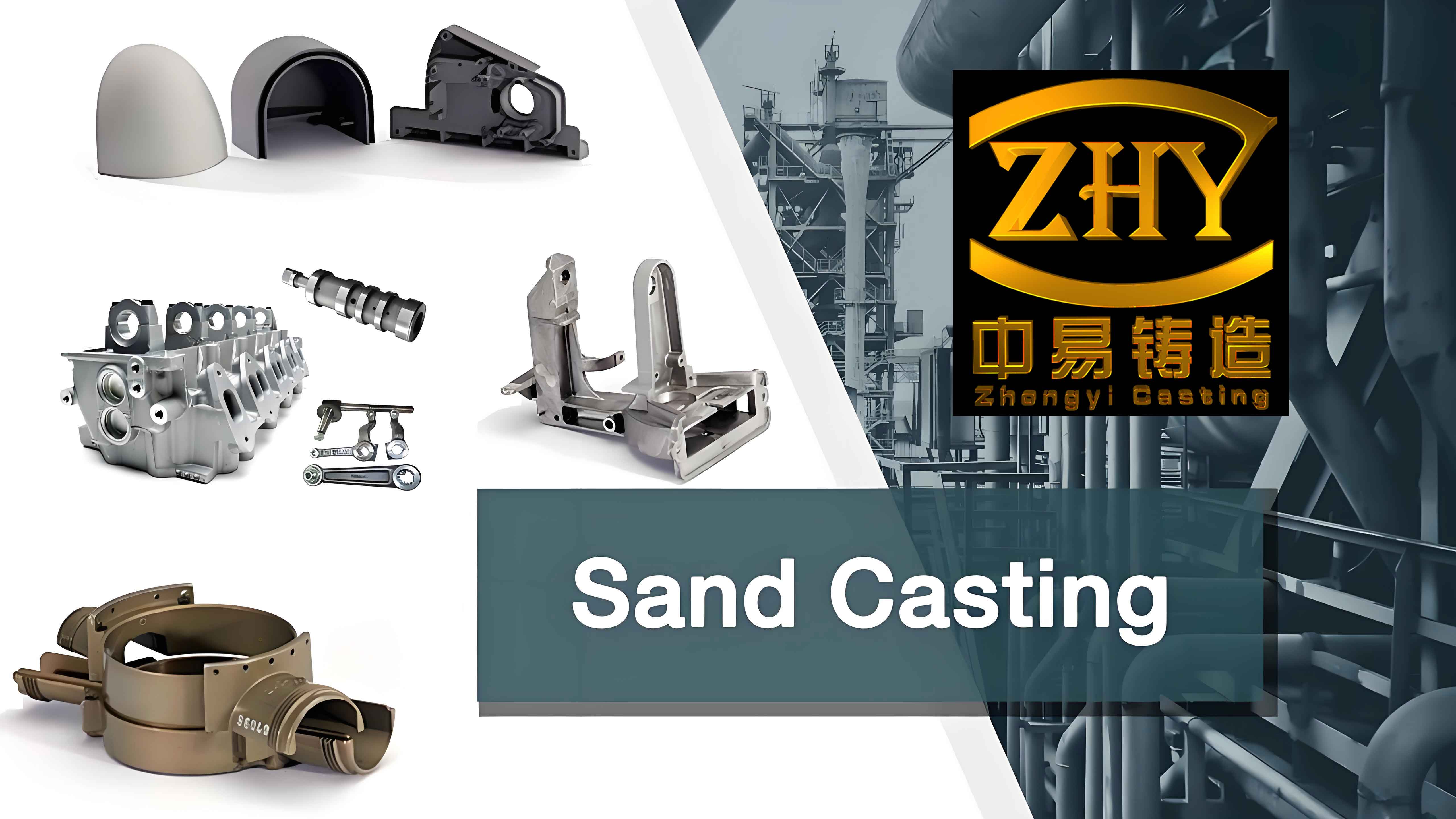
Following CAD modeling, CAE simulation plays a vital role in optimizing sand casting services by predicting potential defects and refining工艺 parameters. I employ software such as Experto-ViewCast to simulate the mold filling and solidification processes, which are critical for ensuring high-quality castings. For sand casting services, numerical simulation helps analyze factors like shrinkage porosity, hot tears, and cold shuts, enabling proactive adjustments. The simulation involves setting up initial conditions, such as material properties and boundary conditions. For example, in ductile iron castings, the interfacial heat transfer coefficient between the casting and sand core is typically set to 800 W/(m²·K), while between the casting and sand mold, it is 600 W/(m²·K). The governing equations for fluid flow and heat transfer during mold filling and solidification are based on fundamental principles, which can be summarized using formulas. The continuity equation for incompressible flow during mold filling is:
$$\nabla \cdot \mathbf{v} = 0$$
where $\mathbf{v}$ is the fluid velocity vector. The momentum equation, considering viscosity and gravity, is:
$$\rho \left( \frac{\partial \mathbf{v}}{\partial t} + \mathbf{v} \cdot \nabla \mathbf{v} \right) = -\nabla p + \mu \nabla^2 \mathbf{v} + \rho \mathbf{g}$$
where $\rho$ is density, $p$ is pressure, $\mu$ is dynamic viscosity, and $\mathbf{g}$ is gravitational acceleration. For solidification, the energy equation is:
$$\rho c_p \frac{\partial T}{\partial t} = \nabla \cdot (k \nabla T) + \dot{Q}$$
where $c_p$ is specific heat, $T$ is temperature, $k$ is thermal conductivity, and $\dot{Q}$ is the latent heat release rate due to phase change. In sand casting services, these equations are solved numerically to predict temperature distributions and defect formation. I often use a shrinkage-expansion dynamic superposition (DEMC) method to analyze shrinkage defects in ductile iron, which accounts for liquid contraction, graphite expansion, and mold wall movement. Through simulation, I can optimize浇注系统 designs, such as incorporating filters to reduce turbulence and improve metal quality. For instance, comparing two gating system designs—one without a filter and one with a ceramic foam filter—reveals significant differences in filling velocity and defect rates. The average filling velocity should be controlled below a critical value, often around 0.5 m/s, to prevent mold erosion and inclusion entrapment. In sand casting services, such CAE insights directly guide工艺 design, reducing trial-and-error and enhancing yield rates.
To further illustrate the parameters involved in CAE for sand casting services, I summarize key material properties and process settings in Table 1. This table provides typical values for ductile iron castings, which are common in sand casting services for applications like engine blocks and structural components.
| Parameter | Symbol | Typical Value | Unit |
|---|---|---|---|
| Density of Ductile Iron | $\rho$ | 7100 | kg/m³ |
| Specific Heat | $c_p$ | 460 | J/(kg·K) |
| Thermal Conductivity | $k$ | 40 | W/(m·K) |
| Liquidus Temperature | $T_l$ | 1370 | °C |
| Solidus Temperature | $T_s$ | 1150 | °C |
| Interfacial Heat Transfer (Casting-Core) | $h_{core}$ | 800 | W/(m²·K) |
| Interfacial Heat Transfer (Casting-Mold) | $h_{mold}$ | 600 | W/(m²·K) |
| Pouring Temperature | $T_{pour}$ | 1400 | °C |
| Filling Velocity Limit | $v_{crit}$ | 0.5 | m/s |
In addition to simulation, CAM integration is essential for producing precise tooling in sand casting services. After optimizing the design through CAE, I use CAM software to generate数控 (NC) codes for machining patterns, core boxes, and other模具 components. For example, complex core boxes with multiple cavities require meticulous programming to ensure accuracy and efficiency. The CAM process involves several steps: importing the CAD model, selecting tool paths, setting cutting parameters, and simulating the machining operation to avoid collisions and errors. Key parameters in milling for sand casting services include feed rate and spindle speed, which depend on the workpiece material and tool geometry. The feed rate $F$ (in mm/min) can be calculated as:
$$F = n \cdot z \cdot f_z$$
where $n$ is spindle speed in rpm, $z$ is the number of teeth on the cutter, and $f_z$ is feed per tooth in mm. For铸铁 materials like HT200 (commonly used for core boxes in sand casting services), typical $f_z$ values are provided in Table 2, which guides the selection of cutting conditions to achieve optimal surface finish and tool life.
| Workpiece Material | Feed per Tooth $f_z$ (mm/tooth) for Cylindrical Milling | Feed per Tooth $f_z$ (mm/tooth) for Face Milling | Recommended Cutting Speed $v_c$ (m/min) for HSS Tools |
|---|---|---|---|
| Cast Iron (HT200) | 0.2 | 0.2 | 24-36 |
| Ductile Iron | 0.15 | 0.18 | 20-30 |
| Steel | 0.1 | 0.12 | 30-40 |
The spindle speed $N$ (in rpm) is derived from the cutting speed $v_c$ (in m/min) and tool diameter $D$ (in mm):
$$N = \frac{1000 \cdot v_c}{\pi \cdot D}$$
By applying these formulas, I can optimize machining parameters for sand casting services, reducing production time and improving模具 quality. The CAM simulation also allows for virtual verification of tool paths, minimizing material waste and ensuring that the final components meet design specifications. This automation is a cornerstone of modern sand casting services, enabling rapid prototyping and mass production with consistent精度.
To delve deeper into the benefits of integrated CAD/CAE/CAM for sand casting services, I explore how each phase contributes to overall efficiency. In the CAD phase, 3D modeling facilitates the creation of digital twins for castings, which can be used for assembly checks and interference detection. For sand casting services, this means that potential issues, such as mismatched core prints or inadequate draft angles, are identified early, reducing rework. Moreover, CAD models serve as the basis for finite element analysis (FEA) in CAE, where structural integrity and thermal stresses are evaluated. In sand casting services, FEA helps predict distortion and residual stresses, allowing for design modifications like rib additions or wall thickness adjustments to enhance performance. The coupling between CAD and CAE is seamless, with data transferred via standard formats like STL or STEP, ensuring that simulations reflect the actual geometry.
In the CAE phase, advanced modeling techniques are employed for sand casting services to simulate multiphase flows, including air entrapment and slag formation. The volume of fluid (VOF) method is often used to track the free surface during mold filling, governed by the equation:
$$\frac{\partial \alpha}{\partial t} + \nabla \cdot (\alpha \mathbf{v}) = 0$$
where $\alpha$ is the volume fraction of the fluid. This allows for precise prediction of filling patterns and potential defects like cold shuts. For solidification, microstructural models can be integrated to predict grain size and mechanical properties, which are critical for high-performance sand casting services. I frequently use criteria functions to identify shrinkage porosity, such as the Niyama criterion, which relates temperature gradient $G$ and cooling rate $\dot{T}$ to defect formation:
$$N_y = \frac{G}{\sqrt{\dot{T}}}$$
A lower Niyama value indicates a higher risk of shrinkage, guiding the placement of risers and chills in sand casting services. By iterating between CAD and CAE, I optimize the工艺 layout, such as determining the optimal number and size of risers. For example, in a large ductile iron casting, simulations might show that a single top riser is sufficient to compensate for liquid shrinkage, provided that the feeding path is open. This iterative process significantly reduces the need for physical prototypes, cutting costs and time in sand casting services.
The CAM phase extends these benefits to manufacturing, where数控 machining of patterns and core boxes is automated. In sand casting services, this is particularly valuable for complex cores that require intricate geometries. I use CAM software to generate tool paths for multi-axis milling machines, which can produce cores with undercuts and curved surfaces. The machining time and tool wear are optimized through algorithms that balance speed and precision. For instance, adaptive clearing strategies can be applied to reduce cutting forces and extend tool life, which is economical for high-volume sand casting services. Additionally, post-processing of NC codes ensures compatibility with specific machine controllers, facilitating seamless integration into production lines. The entire CAM workflow is summarized in Table 3, highlighting key steps and their impact on sand casting services.
| CAM Step | Description | Impact on Sand Casting Services |
|---|---|---|
| Model Import | Import 3D CAD model (e.g., from CATIA) into CAM software. | Ensures accuracy and reduces data translation errors. |
| Tool Selection | Choose appropriate cutters based on material and geometry. | Optimizes machining efficiency and surface quality. |
| Path Generation | Generate tool paths for roughing, finishing, and drilling. | Minimizes material waste and reduces machining time. |
| Simulation | Simulate machining to detect collisions and verify paths. | Prevents tool damage and ensures part integrity. |
| NC Code Output | Export G-code or other NC formats for machine control. | Enables automated production with high repeatability. |
Beyond technical aspects, the integration of CAD/CAE/CAM fosters innovation in sand casting services by enabling customization and rapid response to market demands. For example, in the automotive industry, sand casting services are used to produce engine blocks and transmission cases, where weight reduction and durability are paramount. Through CAD, I can design lightweight structures with optimized wall thickness, and via CAE, validate their performance under thermal and mechanical loads. CAM then ensures that the corresponding tooling is produced with precision, supporting just-in-time manufacturing. This holistic approach reduces lead times from months to weeks, as evidenced in practical applications where sand casting services have adopted this methodology. Moreover, sustainability benefits arise from reduced material waste and energy consumption, as simulations minimize trial casts and machining optimizes raw material usage.
To quantify the advantages, I often analyze key performance indicators (KPIs) for sand casting services before and after implementing CAD/CAE/CAM integration. Common KPIs include production cycle time, defect rate, and cost per unit. For instance, a comparative study might show that traditional sand casting services experience a defect rate of 5-10%, whereas integrated approaches can lower it to 1-2%. The reduction in cycle time is also significant, with examples indicating a decrease from 120 days to 60 days for complex castings. These improvements are driven by the seamless flow of digital data, which eliminates bottlenecks in design and manufacturing. In sand casting services, this translates to higher customer satisfaction and competitive pricing, as overhead costs are minimized through virtual validation and automation.
Looking forward, the evolution of sand casting services will likely involve deeper integration with technologies like additive manufacturing (3D printing) and artificial intelligence (AI). For instance, 3D-printed sand molds and cores are becoming popular, and CAD/CAE/CAM systems can be adapted to design and simulate these additive processes. AI algorithms can further optimize工艺 parameters by learning from simulation data, predicting defects with higher accuracy. In my work, I explore these trends to enhance sand casting services, such as using generative design in CAD to create organic shapes that reduce weight while maintaining strength. CAE simulations can then test these designs under real-world conditions, and CAM can generate paths for hybrid manufacturing systems. This forward-thinking approach ensures that sand casting services remain at the forefront of industrial production.
In conclusion, the integrated CAD/CAE/CAM methodology represents a paradigm shift for sand casting services, offering a comprehensive solution to longstanding challenges. By leveraging CAD for precise 3D modeling, CAE for predictive simulation, and CAM for automated manufacturing, I can deliver high-quality castings with shorter lead times and lower costs. The use of formulas and tables in this article underscores the technical rigor involved, from fluid dynamics equations for mold filling to optimization formulas for machining. As sand casting services continue to evolve, this integration will be key to meeting the demands for complexity, efficiency, and sustainability. Through continuous innovation and application of these digital tools, sand casting services can achieve new levels of performance and reliability in the global manufacturing arena.