
The evolution of manufacturing is increasingly defined by the integration of digital design and additive processes. Among these, 3D printing, or Additive Manufacturing (AM), has emerged as a transformative force, particularly for producing prototypes, tooling, and even end-use parts. Its principle of constructing objects layer-by-layer from a digital model offers unparalleled freedom in geometry. This capability is especially beneficial for foundries specializing in sand casting products, where the complexity of a part often dictates the cost and lead time of the necessary tooling—the pattern. Traditional patternmaking, often from wood or metal, involves subtractive machining, which is time-consuming, material-wasteful, and economically challenging for low-volume or complex geometries. This article explores a practical methodology wherein Fused Deposition Modeling (FDM) 3D printing is employed to create foundry patterns directly, thereby streamlining the production of intricate sand casting products.
The Synergy of FDM and Sand Casting
Sand casting is a versatile and ancient manufacturing process for creating metal components. Its fundamental steps involve creating a negative impression of the desired part within compacted sand (the mold), typically using a physical pattern. For sand casting products with complex features like undercuts, thin walls, or organic surfaces, pattern fabrication becomes the critical path. FDM 3D printing addresses this bottleneck head-on. As an additive process, it builds the pattern by extruding and depositing thermoplastic filaments, such as PLA (Polylactic Acid) or ABS (Acrylonitrile Butadiene Styrene), layer by layer. The complexity of the part’s geometry has minimal impact on the printing process, making it ideal for the one-off or small-batch production of patterns for sand casting products. The comparative advantages can be summarized by the following relation, where the traditional manufacturing cost \( C_t \) is often dominated by fixed setup costs, while the 3D printing cost \( C_a \) is more linearly related to material volume:
$$ C_t = C_{setup} + C_{material\_waste} + C_{machining} \cdot t $$
$$ C_a = C_{material\_used} \cdot V + C_{machine} \cdot t_{print} $$
For a single pattern, \( C_{setup} \) (including fixture design and CNC programming) and \( C_{material\_waste} \) can make \( C_t \) prohibitively high, whereas \( C_a \) remains predictable and often lower.
Case Study: Impeller Pattern Design and Process
To demonstrate this integration, we consider the development of a blower impeller—a classic example of a complex sand casting product. The component features multiple curved blades with varying thickness, requiring a draft angle for mold release.
The workflow began with creating a precise 3D digital model using CAD software. Critical casting parameters were integrated directly into this model. For an aluminum alloy like ZL301, a linear shrinkage allowance of 1.3% was applied uniformly. A draft angle of 2° was added to all blade surfaces to facilitate pattern removal from the sand mold without tearing the cavity. The parting line was strategically placed at the largest cross-section on the impeller’s backplate, enabling a simple two-part cope and drag mold. A top-gating system was designed, as expressed by the following fluid dynamics consideration for thin-walled castings, where \( v \) is the flow velocity, \( \mu \) is the dynamic viscosity, \( \rho \) is the density, and \( \Delta P \) is the pressure head:
$$ \Delta P = \frac{1}{2} \rho v^2 + \rho g h + \mu \frac{\partial^2 v}{\partial y^2} $$
The top gate utilizes the full gravitational head (\( \rho g h \)) to ensure rapid and complete filling of the thin blade sections, minimizing defects like cold shuts or misruns common in such sand casting products.
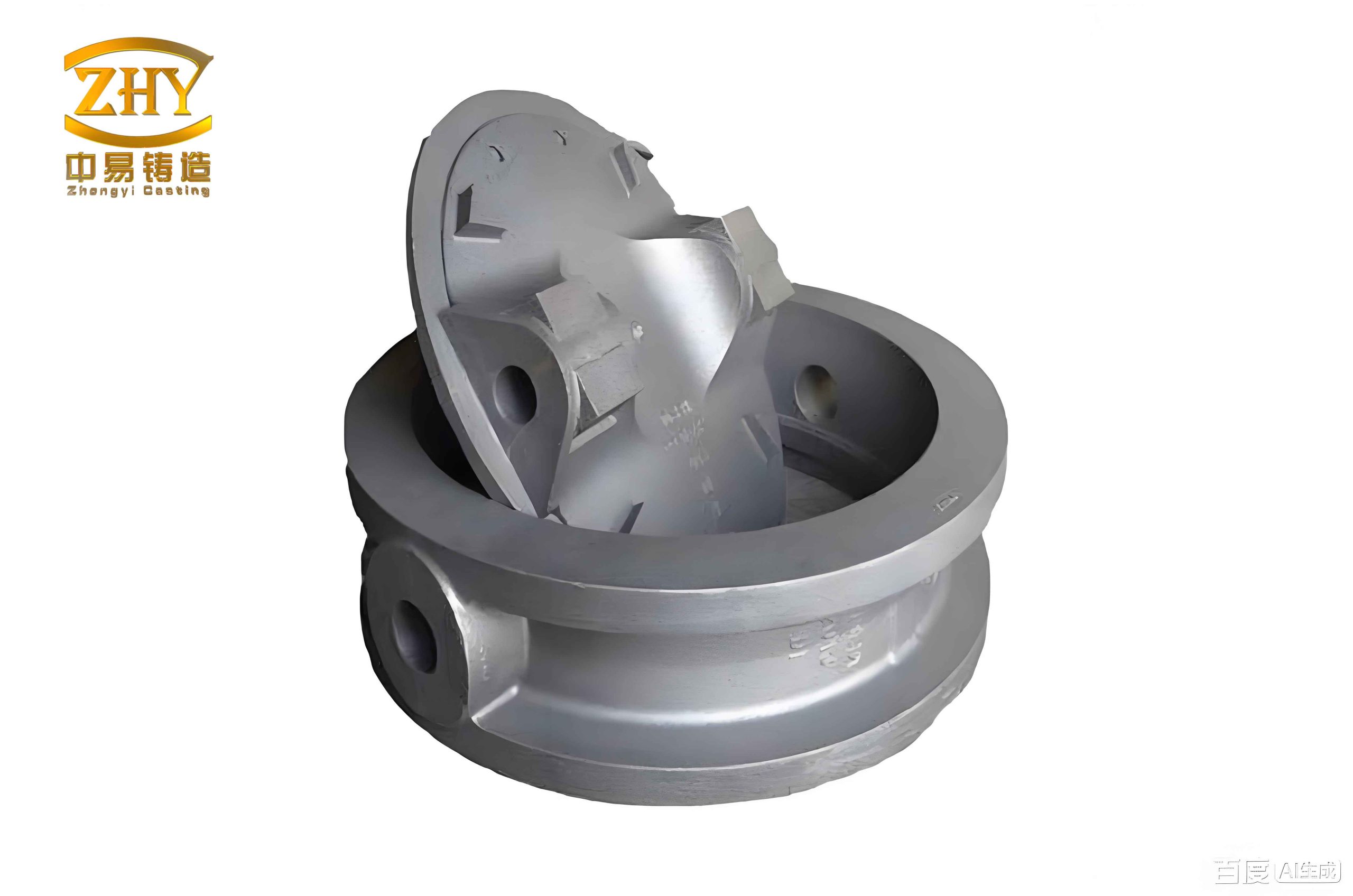
Rapid Prototyping of the Pattern via FDM
The finalized 3D model was exported in STL format and processed in slicing software (e.g., Cura) to generate machine instructions (G-code). Key printing parameters significantly influence the pattern’s surface quality, strength, and build time—critical factors for its performance as a tool for sand casting products. Two distinct printing strategies were formulated and analyzed:
| Parameter | Strategy A (Optimized for Speed) | Strategy B (Optimized for Surface Finish) |
|---|---|---|
| Layer Height (\( h_l \)) | 0.2 mm | 0.1 mm |
| Wall Thickness (\( t_w \)) | 0.8 mm | 0.8 mm |
| Print Speed (\( v_p \)) | 50 mm/s | 40 mm/s |
| Nozzle Temperature (\( T_n \)) | 210 °C | 210 °C |
| Support Structure | Everywhere | Everywhere |
| Build Plate Adhesion | Raft | Brim |
| Print Time (\( t_{total} \)) | 3 hours 58 minutes | 6 hours 59 minutes |
| Material Used (\( m \)) | 36 g | 32 g |
The primary trade-off is governed by the relationship between layer height and surface roughness (\( R_a \)), and the linear relationship between layer height and build time for a given volume \( V \):
$$ t_{total} \approx \frac{V}{v_p \cdot A_{extrusion} \cdot h_l} $$
$$ R_a \propto h_l $$
Strategy A, with a larger layer height, completed the build in nearly half the time of Strategy B. While the surface finish on the intricate blade profiles was comparable, the finish on larger, flat surfaces (like the impeller backplate) was noticeably smoother with Strategy B’s finer 0.1 mm layers. For functional patterns used in sand casting, where the final metal surface of the sand casting products is later machined or where roughness is non-critical, Strategy A presents a more efficient solution. The printed PLA pattern demonstrated excellent dimensional stability, sufficient hardness to resist sand abrasion, and no susceptibility to moisture—a common failure mode for wooden patterns.
Mold Making and Casting Validation
The 3D printed pattern was successfully employed in standard green sand molding practice. The pattern was placed in the drag, rammed with sand, and the cope was created. After venting and making the runner and gate cuts, the mold was ready for pouring. The aluminum alloy ZL301 was melted and poured at approximately 755°C. Its casting suitability is quantified by key parameters, as shown in the table below, which are essential for predicting the quality of the resulting sand casting products:
| Property | Symbol / Metric | Value for ZL301 | Implication for Casting |
|---|---|---|---|
| Linear Shrinkage | \( \alpha_l \) | 1.30 – 1.35 % | Determines final part dimensions after pattern allowance. |
| Fluidity Length (700°C) | \( L_f \) | 325 mm | Indicates ability to fill thin sections and complex molds. |
| Hot Tearing Resistance | Ring Test Width | 22.5 mm | Higher value suggests lower susceptibility to cracking during solidification. |
After casting, cooling, and shakeout, the impeller was extracted. Visual and dimensional inspection confirmed that the cast component met all specified requirements. The geometry of the thin blades was fully formed, validating the effectiveness of both the pattern design and the top-gating system. This successful cast impeller stands as a direct testament to the viability of using FDM-printed patterns for functional sand casting products.
Comprehensive Economic and Technical Analysis
The advantages of this hybrid approach become starkly evident when quantified against traditional wood pattern fabrication. The following analysis compares key performance indicators (KPIs) for producing a single impeller pattern, a common scenario for prototypes or specialized sand casting products.
| KPI | Traditional Wooden Pattern | FDM 3D Printed Pattern (PLA) | Relative Improvement |
|---|---|---|---|
| Material Utilization (\( \eta_m \)) | ~46% (High waste from machining) | ~98% (Only support waste) | $$ \frac{\eta_{m,FDM}}{\eta_{m,Wood}} \approx 2.13 $$ |
| Total Lead Time (\( T \)) | ~32 hours (CAD, CAM, Fixturing, Machining) | ~5 hours (CAD + Print Time) | $$ \frac{T_{Wood}}{T_{FDM}} \approx 6.4 $$ |
| Estimated Cost (\( C \)) | ~$240 (Material + Fixture + Machining Labor) | ~$8 (Material + Machine Time) | $$ \frac{C_{Wood}}{C_{FDM}} \approx 30 $$ |
| Pattern Durability | Susceptible to wear, moisture warping, and cracking. | High hardness, moisture-resistant, good dimensional stability. | Significantly extended service life for multiple mold cycles. |
| Geometric Freedom | Limited by tool access and machining feasibility. | Nearly unrestricted; complexity is free. | Enables previously un-moldable designs for sand casting products. |
The cost relationship clearly demonstrates the disruptive potential for small batches. The traditional cost function is dominated by high fixed costs \( C_{fixed} \) (setup, programming, fixturing), while the additive cost is almost purely variable, scaling with material volume \( V \) and a constant machine utility rate \( r \):
$$ C_{wood} = C_{fixed} + k \cdot V $$
$$ C_{FDM} = (c_{material} + r) \cdot V $$
For \( n = 1 \) pattern, \( C_{fixed} \) makes \( C_{wood} \) disproportionately large. This economic model powerfully advocates for the adoption of 3D printed patterns in jobbing foundries and for research and development of new sand casting products.
Future Trajectory and Conclusions
The integration of FDM 3D printing for pattern making represents a significant leap forward for the sand casting industry, particularly in the realm of low-volume and high-complexity sand casting products. This study concretely demonstrates that:
1. Digital Workflow Efficiency: The path from digital model to physical cast part is drastically shortened, eliminating multiple manual and CNC machining steps.
2. Economic Viability: For prototype and small-batch production, the cost savings are substantial, often exceeding an order of magnitude.
3. Performance Superiority: Printed polymer patterns outperform traditional wood in durability, consistency, and moisture resistance, leading to more reliable mold production.
4. Design Empowerment: Engineers are liberated from traditional manufacturing constraints, enabling more optimized, lightweight, and efficient designs for sand casting products.
The logical progression of this technology points toward direct sand mold printing using binder jetting (3DP) processes, which would eliminate the physical pattern altogether. However, the FDM-pattern method remains a highly accessible, low-capital-entry solution for existing foundries to modernize their operations. As 3D printer reliability increases and advanced composite filaments (e.g., fiber-reinforced) become more affordable, the strength and temperature resistance of printed patterns will further improve, solidifying this hybrid approach as a standard practice for producing advanced, complex, and cost-effective sand casting products.