
In my research into lost foam casting (LFC), a pivotal area of focus has always been the formulation of the coating applied to the expandable polystyrene (EPS) foam pattern. The quality of the final casting—its surface finish, dimensional accuracy, and freedom from defects—is profoundly dependent on the properties of this coating. The coating must fulfill a complex set of requirements: it must provide high strength at room temperature to protect the delicate foam pattern during handling and sand compaction, yet it must exhibit high permeability at the elevated temperatures of metal pouring to allow for the rapid escape of pyrolysis gases. Furthermore, it should sinter adequately but also be readily removable from the casting surface after cooling. Among the various components of a coating formulation—refractory aggregates, suspension agents, and additives—the binder system plays arguably the most critical role in balancing these often-conflicting demands.
This study was undertaken to systematically evaluate the influence of different binder types and combinations on the key performance metrics of a water-based coating designed for iron castings in lost foam casting. The objective was to identify an optimal binder system that offers superior comprehensive properties, ensuring both process reliability and high-quality castings. I approached this by first establishing a baseline refractory composition and then conducting comparative tests on coatings formulated with single and composite binders.
1. Experimental Methodology and Material Selection
The foundation of any LFC coating is its refractory aggregate. For ferrous applications, particularly iron, acidic aggregates are preferred due to their high refractoriness and chemical stability against molten metal. In this work, I selected a blend of zircon flour (ZrSiO4) and silica flour (SiO2). Zircon flour offers exceptional thermal stability and resistance to metal penetration, while silica flour is a cost-effective component that contributes to the overall structural integrity of the coating. Preliminary trials were conducted to determine an effective ratio, balancing performance and cost.
The binder systems under investigation were:
- Polyvinyl Alcohol (PVA): An organic binder known for providing good green strength and flexibility.
- Starch: A natural organic polymer that enhances room-temperature strength and burns out cleanly at high temperatures, potentially aiding permeability.
- Sodium Silicate (Water Glass): An inorganic binder that imparts high strength both at room temperature and after sintering.
- Composite Binders: Combinations of starch and sodium silicate, aiming to synergize the benefits of organic (good burnout, room-temp strength) and inorganic (high-temperature integrity) binders.
To maintain homogeneity and prevent settling, a mixed suspension system of sodium bentonite and carboxymethyl cellulose (CMC) was used. Various additives were incorporated to fine-tune the coating’s properties:
- Defoamer (n-Butanol): To eliminate air bubbles introduced during mixing.
- Wetting Agent (Sodium dodecyl benzene sulfonate): To improve the coating’s ability to spread over and wet the hydrophobic EPS surface.
- Ferric Oxide (Fe2O3): Acts as a sintering aid, lowering the sintering temperature of the aggregate blend.
- Talc & Graphite: Talc further promotes sintering and improves peel-off characteristics, while graphite enhances lubricity and the surface finish of the casting.
- Preservative (Formaldehyde): To prevent biological degradation of the organic components.
The performance of the developed coatings was assessed using a suite of standard and relevant tests for lost foam casting applications:
- Suspension Stability: Measured as the volume percentage of sediment in a 100 mL graduated cylinder after 48 hours of quiescent settling. A higher value indicates better suspension.
- Density ($\rho$): Calculated using a simple volumetric method: $$\rho = \frac{M – M_0}{V}$$ where $M$ is the mass of the cylinder with coating, $M_0$ is the mass of the empty cylinder, and $V$ is the volume of coating.
- Viscosity: Assessed using a standard flow cup (e.g., Ford cup), recording the efflux time for a specific volume.
- Permeability: A critical parameter measured using a dedicated permeability tester (e.g., STZ type). The test determines the volume of air passing through a standardized dried coating sample under a defined pressure.
- Application Properties:
- Drip/Flowability: The mass of coating dripping off a vertically held, coated glass slide in one minute. Lower values indicate better anti-sag properties.
- Applicability/Adhesion: Evaluated by weighing an EPS pattern before and after dipping to determine the mass of coating adhered. $$m_{\text{coating}} = m_{\text{pattern+coating}} – m_{\text{pattern}}$$
- Mechanical Strength:
- Room-Temperature Bending/Tensile Strength: Measured on dried coating strips using a universal testing machine or a similar fixture.
- Low-Temperature (50°C) Crack Resistance: Coated glass plates were dried at 50°C for 6 hours and visually inspected for crack formation (network, stripes, or none).
2. Results, Analysis, and Discussion
2.1 Determination of Baseline Refractory Composition
Before investigating binders, I needed to establish an effective refractory base. Six preliminary formulations (P1-P6) with varying ratios of zircon flour to silica flour were prepared and tested. A constant amount of a provisional binder (2% PVA) and other additives was used in all mixes. The key results are summarized below.
| Sample ID | Zircon Flour (%) | Silica Flour (%) | Density (g/cm³) | Adhesion (g) | Flowability (g/min) | Permeability | Suspension (%) | RT Strength (MPa) | 50°C Crack Resistance |
|---|---|---|---|---|---|---|---|---|---|
| P1 | 85 | 15 | 1.21 | 4.62 | 2.68 | 16.7 | 93 | 2.6 | Striped cracks |
| P2 | 75 | 25 | 1.23 | 4.76 | 2.76 | 15.8 | 94 | 2.8 | No cracks |
| P3 | 65 | 35 | 1.24 | 4.96 | 2.98 | 15.1 | 95 | 3.1 | No cracks |
| P4 | 55 | 45 | 1.22 | 4.90 | 2.92 | 14.5 | 93.5 | 3.2 | No cracks |
| P5 | 45 | 55 | 1.20 | 4.82 | 2.85 | 13.9 | 93 | 3.2 | Fine cracks |
| P6 | 35 | 65 | 1.13 | 4.72 | 2.80 | 14.3 | 92.2 | 3.3 | Network cracks |
Analysis of Table 1 reveals important trends. Samples P2, P3, and P4 exhibited excellent low-temperature crack resistance. Sample P3 showed the best combination of adhesion, flowability, density, and suspension stability. While room-temperature strength generally increased with higher silica flour content, permeability showed a corresponding decrease. Considering the need for a balanced profile—good permeability, adequate strength, and crack-free drying—a composition of approximately 70% zircon flour and 30% silica flour (close to P3) was selected as the optimal refractory base for all subsequent binder experiments in this lost foam casting study.
2.2 Influence of Binder Type and Content on Coating Properties
With the refractory base fixed, I proceeded to the core of my investigation: evaluating single binders (starch, sodium silicate, PVA) and composite binders (starch + sodium silicate) across a range of concentrations (0.5% to 3.0%). The performance data for key properties are presented and discussed below.
2.2.1 Drip/Flowability
Flowability affects how evenly a coating can be applied without running or sagging. The data is consolidated in the following summary.
| Binder Content (%) | Starch | Sodium Silicate | PVA | Starch (2%) + Na₂SiO₃ (Var.) | Na₂SiO₃ (2%) + Starch (Var.) |
|---|---|---|---|---|---|
| 0.5 | 2.68 | 2.72 | 2.65 | 2.58 | 2.55 |
| 1.0 | 2.65 | 2.70 | 2.62 | 2.56 | 2.52 |
| 1.5 | 2.60 | 2.66 | 2.58 | 2.51 | 2.48 |
| 2.0 | 2.55 | 2.61 | 2.53 | 2.45 | 2.42 |
| 2.5 | 2.52 | 2.58 | 2.50 | 2.48 | 2.46 |
| 3.0 | 2.54 | 2.60 | 2.52 | 2.52 | 2.50 |
The composite binder system with 2% sodium silicate and a variable amount of starch consistently yielded the lowest drip mass, indicating superior anti-sag properties. Generally, flowability improved (drip mass decreased) with increasing binder content up to a point (~2.0%), after which it stabilized or slightly worsened, likely due to increased viscosity.
2.2.2 Coating Adhesion/Applicability
This property indicates how well the coating adheres to the EPS pattern, influencing final coating thickness and uniformity.
| Binder Content (%) | Starch | Sodium Silicate | PVA | Starch (2%) + Na₂SiO₃ (Var.) | Na₂SiO₃ (2%) + Starch (Var.) |
|---|---|---|---|---|---|
| 0.5 | 4.42 | 4.38 | 4.45 | 4.65 | 4.68 |
| 1.0 | 4.55 | 4.50 | 4.58 | 4.78 | 4.82 |
| 1.5 | 4.68 | 4.62 | 4.70 | 4.85 | 4.90 |
| 2.0 | 4.80 | 4.75 | 4.83 | 4.92 | 4.96 |
| 2.5 | 4.78 | 4.73 | 4.80 | 4.88 | 4.91 |
| 3.0 | 4.75 | 4.70 | 4.77 | 4.85 | 4.88 |
Adhesion increased with binder content up to approximately 2.0% for all systems. The composite binder, particularly the variant with 2% sodium silicate and variable starch, achieved the highest adhesion mass (~4.96 g at 2% starch). This superior adhesion also translated to a more uniform coating thickness, with measurements showing a thicker layer on horizontal surfaces (e.g., ~0.55 mm) compared to vertical surfaces (~0.42 mm), which is typical and acceptable in lost foam casting dip-coating processes.
2.2.3 Room-Temperature Permeability
While high-temperature permeability is crucial, room-temperature permeability gives an indication of the pore structure in the dried coating.
| Binder Content (%) | Starch | Sodium Silicate | PVA | Starch (2%) + Na₂SiO₃ (Var.) | Na₂SiO₃ (2%) + Starch (Var.) |
|---|---|---|---|---|---|
| 0.5 | 15.7 | 15.2 | 15.9 | 15.0 | 14.8 |
| 1.0 | 15.3 | 14.8 | 15.5 | 14.6 | 14.4 |
| 1.5 | 14.9 | 14.4 | 15.1 | 14.2 | 14.0 |
| 2.0 | 14.5 | 14.0 | 14.7 | 13.8 | 13.6 |
| 2.5 | 14.2 | 13.7 | 14.4 | 13.5 | 13.4 |
| 3.0 | 14.0 | 13.5 | 14.2 | 13.3 | 13.2 |
A clear inverse relationship is observed: permeability decreases as binder content increases for all systems. This is expected, as more binder fills the inter-particle voids between refractory grains. PVA-based coatings maintained the highest permeability across the range, closely followed by starch. The composite binders resulted in the lowest permeability values, suggesting a denser, more consolidated structure. In lost foam casting, a balance must be struck; sufficient binder is needed for strength, but not so much as to severely impede gas escape during pouring.
2.2.4 Room-Temperature Tensile Strength
This is a critical property for withstanding the stresses of pattern handling, transportation, and sand vibration.
| Binder Content (%) | Starch | Sodium Silicate | PVA | Starch (2%) + Na₂SiO₃ (Var.) | Na₂SiO₃ (2%) + Starch (Var.) |
|---|---|---|---|---|---|
| 0.5 | 2.3 | 2.5 | 2.2 | 2.7 | 2.8 |
| 1.0 | 2.6 | 2.8 | 2.5 | 3.0 | 3.2 |
| 1.5 | 2.9 | 3.1 | 2.8 | 3.3 | 3.5 |
| 2.0 | 3.1 | 3.3 | 3.0 | 3.5 | 3.7 |
| 2.5 | 3.2 | 3.4 | 3.1 | 3.6 | 3.8 |
| 3.0 | 3.2 | 3.5 | 3.1 | 3.6 | 3.8 |
Strength increased monotonically with binder content, beginning to plateau around 2.0-2.5%. The composite binder system, especially the combination of 2% sodium silicate with starch, delivered the highest tensile strength (~3.7-3.8 MPa). This synergistic effect is significant: the sodium silicate creates a strong, rigid inorganic network, while the starch acts as an organic binder and potential filler, improving cohesion and bridging between particles. This high green strength is paramount for successful lost foam casting, as it prevents pattern distortion or coating damage during the crucial sand-filling and compaction stages.
2.2.5 Low-Temperature (50°C) Crack Resistance
Rapid or uneven drying can induce stresses leading to cracks, which are catastrophic for the lost foam casting process as they provide direct paths for metal penetration. Visual observation showed that coatings with single binders, especially at lower concentrations, often exhibited stripe-like or fine cracks. In contrast, the composite binder formulations, particularly those centered around the 2% sodium silicate and 2% starch combination, consistently produced crack-free surfaces after drying at 50°C. This indicates excellent stress distribution and drying behavior, preventing the formation of defects that would compromise the coating’s barrier function.
2.3 Phase Analysis via X-ray Diffraction (XRD)
To understand the chemical and structural changes in the coating, I performed XRD analysis on samples in two states: after drying (green state) and after exposure to molten iron (post-casting).
The XRD pattern of the dried coating confirmed the presence of the primary refractory phases: zircon (ZrSiO4) and silica (SiO2), along with additives like graphite and Fe2O3.
The post-casting XRD revealed notable transformations:
- Formation of New Iron Oxides: The Fe2O3 peak diminished, and new peaks corresponding to mixed iron oxides (e.g., Fe3O4) appeared. This supports the proposed mechanism where Fe2O3 decomposes at high temperature, releasing oxygen that can oxidize the iron casting surface, potentially forming a weak interface that aids in coating peel-off. $$ \text{Fe}_2\text{O}_3 \xrightarrow{\Delta} 2\text{FeO} + \frac{1}{2}\text{O}_2 $$
- Interaction of Silica: The intensity of the crystalline SiO2 peak was reduced. This suggests partial dissolution or reaction of silica at the metal-coating interface, which is common in ferrous lost foam casting and can contribute to the sintering of the coating layer.
- Stability of Zircon: Zircon phases remained largely stable, underlining their role as a high-performance refractory backbone.
These changes confirm that the coating is not inert but undergoes designed interactions at high temperature, which are essential for its performance in the lost foam casting process.
3. Production Validation and Final Coating Formulation
Based on the comprehensive experimental data, the optimal binder system was conclusively identified as a composite of 2% starch and 2% sodium silicate. This combination excelled in providing high green strength, excellent adhesion, good anti-sag properties, and crack-free drying, while maintaining acceptable permeability. A full coating formulation for iron lost foam casting was thus finalized, as shown in the table below.
| Component | Function | Content (%) |
|---|---|---|
| Zircon Flour | Primary Refractory | 70 |
| Silica Flour | Secondary Refractory / Cost Adjuster | 30 |
| Graphite | Lubricity / Surface Finish | 5 |
| Talc | Sintering Aid / Peel-off Promoter | 10 |
| Starch | Organic Binder (Green Strength) | 2 |
| Sodium Silicate | Inorganic Binder (High-Temp Strength) | 2 |
| CMC | Suspension Agent / Thickener | 1 |
| Sodium Bentonite | Suspension Agent / Thixotropy | 1.5 |
| Fe2O3 | Sintering Aid / Oxidation Promoter | 1 |
| Other Additives (Wetter, Defoamer, Preservative) | Process Aids | q.s. |
| Water | Carrier | To desired density (~1.23 g/cm³) |
This optimized coating was prepared in bulk and tested under actual production conditions at a foundry specializing in lost foam casting. The coating was applied to complex EPS patterns via dipping, followed by brushing to ensure uniformity. The coated patterns were then dried in a controlled oven at 50-60°C until a uniform, crack-free coating with a thickness of over 1 mm was achieved.
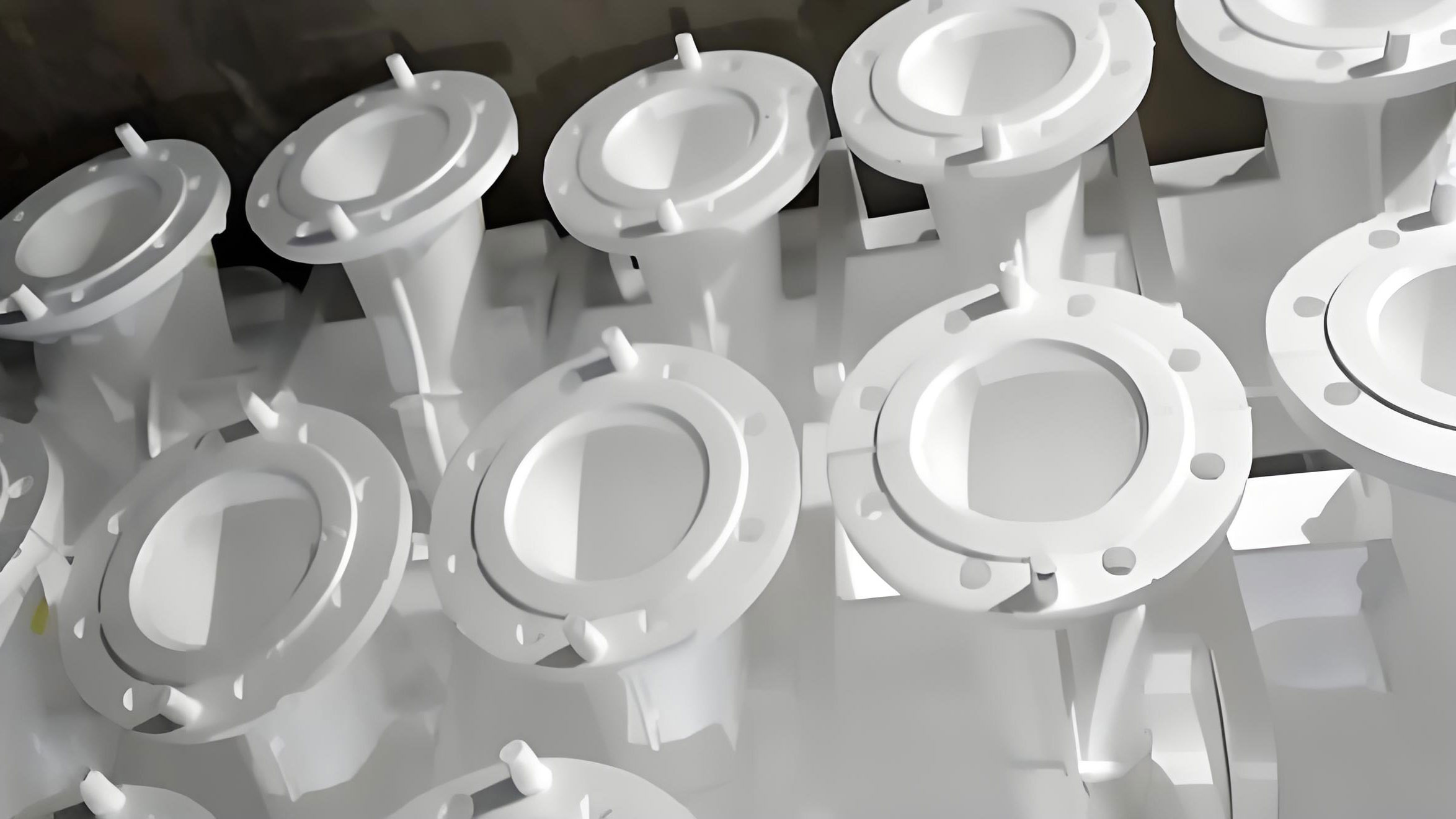
The molds were prepared using unbonded sand, and molten iron was poured. The process was observed to be stable, with no visible smoke or flame flare-ups indicating controlled gas evolution. Upon cooling and shakeout, the castings were inspected.
The results were highly satisfactory. The castings exhibited excellent surface finish, were free from common defects such as penetration, rough surfaces, or blows associated with poor gas evacuation. A significant portion of the coating shell detached spontaneously from the casting surface, and the remainder was easily removed by light mechanical action, such as tumbling or wire brushing. This validated the coating’s designed performance in a real-world lost foam casting environment.
4. Conclusions
Through this detailed investigation into lost foam casting coatings, I have reached several definitive conclusions:
- Refractory Base Optimization: A blend of 70% zircon flour and 30% silica flour forms an effective and balanced refractory base for iron lost foam casting coatings, providing a good compromise between high-temperature performance, strength, and cost.
- Superiority of Composite Binders: The performance of a coating in lost foam casting is highly sensitive to the binder system. While single binders can fulfill specific roles, a composite binder system combining organic and inorganic components delivers a far more balanced property profile. Specifically, the combination of 2% starch and 2% sodium silicate proved to be optimal.
- Mechanism of Performance: This composite binder works synergistically. The starch provides robust green strength and burns out during metal pouring, creating micro-channels that enhance high-temperature permeability. The sodium silicate delivers essential strength both at room temperature and, more importantly, after sintering at high temperature, ensuring the coating maintains its integrity against the hydrodynamic pressure of the molten metal. This combination also promotes excellent drying characteristics, preventing crack formation.
- Successful Production Validation: The coating formulated with the optimized composition performed flawlessly in an actual lost foam casting production setting. It produced iron castings with smooth surfaces, no defects related to the coating, and exhibited excellent collapsibility/peel-off behavior. This confirms the practical viability and effectiveness of the developed coating for industrial lost foam casting applications.
In summary, the strategic use of a starch-sodium silicate composite binder is a highly effective approach to engineering high-performance coatings for lost foam casting, successfully addressing the multifaceted challenges of this innovative casting process.