
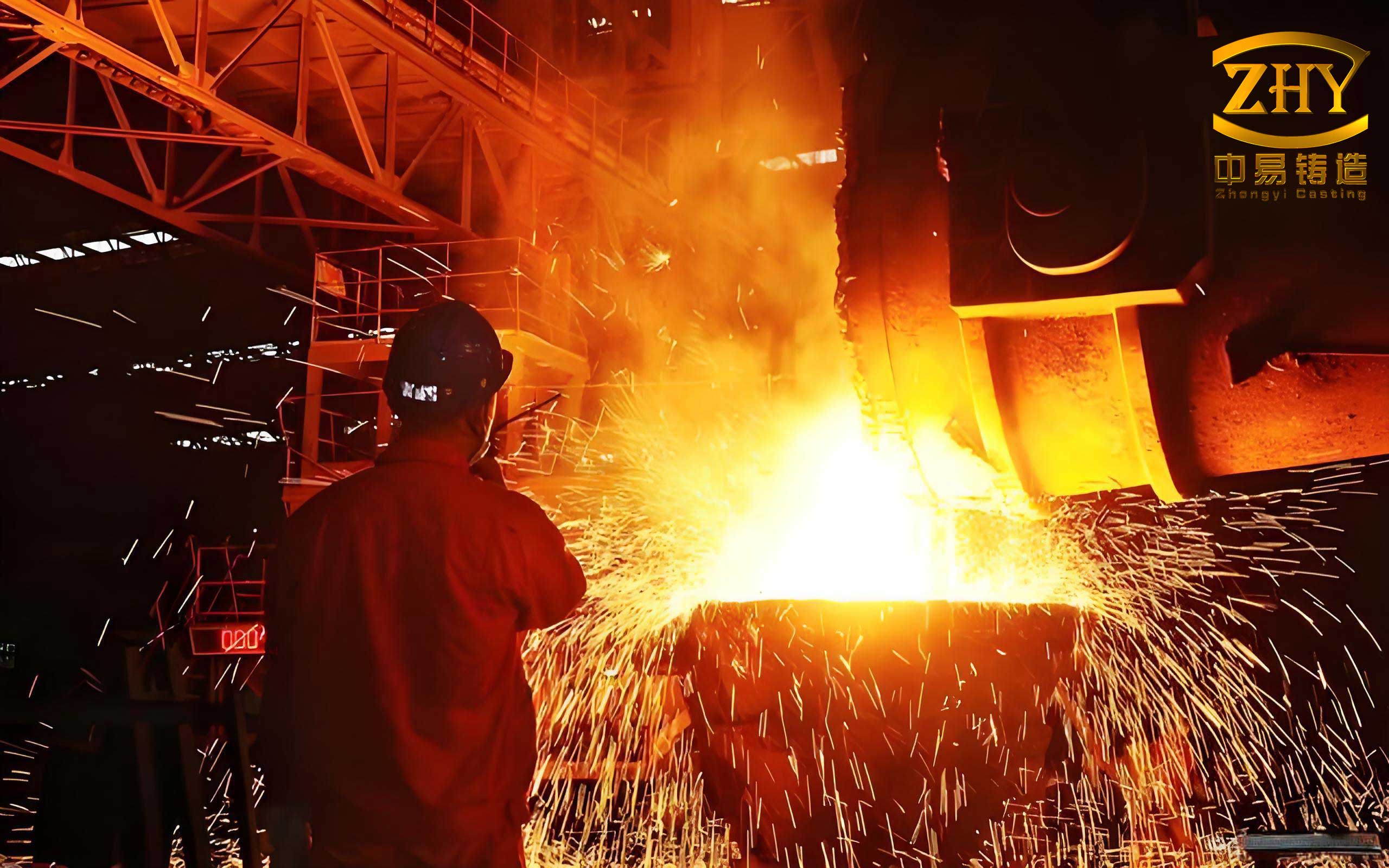
The manufacturing of casting parts, particularly those of large scale, serves as a cornerstone for heavy industry and national defense, reflecting a nation’s industrial capability. As critical sectors such as aerospace, energy, and high-speed rail demand increasingly massive and complex components, the ability to produce high-quality, defect-free large casting parts has become paramount. Traditional trial-and-error methods are prohibitively costly and time-consuming for such components. Consequently, the integration of advanced casting processes with sophisticated computer-aided engineering (CAE) simulation has emerged as the definitive pathway to ensure reliability, optimize production, and drive innovation in the foundry industry. This article reviews the application progress of key casting processes for large components and delves into the latest advancements in numerical simulation technologies that are revolutionizing how we design, predict, and control the quality of these essential casting parts.
Evolution of Casting Processes for Large Components
The selection and design of an appropriate casting process are fundamental to the success of manufacturing large casting parts. While sand casting remains a versatile and cost-effective backbone, several specialized processes have been developed to meet specific requirements for precision, material, or production volume.
Sand Casting: This remains the most prevalent method for large, thick-walled casting parts due to its flexibility and low cost for single or small batches. Recent advancements focus on material science, such as developing specialized binders and sands for challenging alloys like titanium, enabling the production of complex pump bodies and structural components that meet stringent aerospace standards.
Investment (Lost-Wax) Casting: Essential for producing complex, high-precision casting parts with excellent surface finish. The technology is critical for aerospace turbine blades and intricate medical implants. Research is intensely focused on controlling dimensional accuracy in large, complex molds, developing high-stability ceramic shell systems, and innovating techniques for core removal and heat treatment to mitigate distortion.
Die Casting and Low-Pressure Die Casting: High-pressure die casting is renowned for high-volume production of thin-walled, high-integrity casting parts, predominantly in aluminum and magnesium for the automotive sector. Low-pressure variants offer better control over filling and solidification, reducing turbulence and gas entrapment, making them suitable for larger, structural components like automotive wheels or gearbox housings. Differential pressure casting, a further refinement, applies counter-pressure to the mold, allowing for even finer control of filling speed and final part density.
Lost Foam Casting: This process uses a foam pattern that vaporizes upon metal entry, enabling the creation of highly complex geometries without cores or parting lines. It is particularly advantageous for engine blocks and other intricate shapes. Key research areas include developing foam materials with controlled degradation, optimizing coating permeability for different alloys, and integrating process variants like vacuum-assisted or vibration-aided casting to eliminate defects and refine microstructure.
Centrifugal Casting: Ideal for manufacturing rotationally symmetric casting parts like pipes, cylinders, and rings. The centrifugal force ensures a dense, clean microstructure as impurities segregate towards the inner surface. It is extensively used for duplex stainless steel pipes, large bearing rings, and other components where structural integrity and homogeneity are critical.
The choice among these processes involves a critical trade-off between cost, production rate, geometric complexity, and the required metallurgical quality of the final casting parts. A comparative summary is provided in Table 1.
| Process | Key Advantages | Typical Applications for Large Parts | Primary Challenges |
|---|---|---|---|
| Sand Casting | Low cost for large parts, high flexibility, wide material suitability. | Machine tool beds, engine blocks, pump housings, large valves. | Lower dimensional accuracy, potential for sand-related defects, slower production. |
| Investment Casting | Excellent surface finish, high dimensional accuracy, complex geometries. | Turbine blades, aerospace structural components, complex impellers. | High cost, lengthy process, size limitations for very large parts, ceramic core technology. |
| High-Pressure Die Casting | High production rate, excellent surface finish, thin walls. | Automotive transmission cases, structural components. | High tooling cost, limited to non-ferrous alloys, porosity from entrapped gas. |
| Low-Pressure Die Casting | Better metal quality than HPDC, good dimensional accuracy, reduced turbulence. | Automotive wheels, large aluminum housings. | Slower cycle time than HPDC, higher equipment cost. |
| Lost Foam Casting | High design freedom, no cores needed, good accuracy. | Engine cylinder heads, complex machinery housings. | Pattern density/strength control, coating development, gas evolution management. |
| Centrifugal Casting | Dense microstructure, high purity, good mechanical properties. | Pipes, large bearing rings, cylinder liners. | Limited to axi-symmetric shapes, potential for chemical segregation. |
The Paradigm Shift: Numerical Simulation in Casting
The development of casting process simulation, or Casting CAE, represents one of the most significant technological leaps in foundry engineering. It allows engineers to virtually prototype the entire process—filling, solidification, and cooling—predicting defects before any metal is poured. This capability is indispensable for large casting parts, where the financial risk of failure is immense.
The theoretical foundation lies in solving the governing equations of fluid flow, heat transfer, and stress. The core thermal analysis is based on the Fourier heat conduction equation, often modified to account for the latent heat released during phase change:
$$ \rho c_p \frac{\partial T}{\partial t} = \nabla \cdot (k \nabla T) + \dot{Q}_{latent} $$
where $\rho$ is density, $c_p$ is specific heat, $T$ is temperature, $t$ is time, $k$ is thermal conductivity, and $\dot{Q}_{latent}$ is the latent heat source term.
For fluid flow during mold filling, the Navier-Stokes equations are solved, typically coupled with a Volume-of-Fluid (VOF) method to track the metal-air interface:
$$ \frac{\partial \vec{v}}{\partial t} + (\vec{v} \cdot \nabla) \vec{v} = -\frac{1}{\rho} \nabla p + \nu \nabla^2 \vec{v} + \vec{g} $$
$$ \nabla \cdot \vec{v} = 0 $$
where $\vec{v}$ is the velocity vector, $p$ is pressure, $\nu$ is kinematic viscosity, and $\vec{g}$ is gravity.
A pivotal achievement in defect prediction was the development of criteria functions, such as the widely used Niyama criterion for predicting shrinkage porosity in steel and aluminum casting parts:
$$ G / \sqrt{R} \leq C_{Niyama} $$
where $G$ is the temperature gradient, $R$ is the cooling rate at the end of solidification, and $C_{Niyama}$ is a material-dependent constant. Regions where this inequality holds are predicted to be prone to microporosity.
Advances in Simulation Capabilities: From Macroscopic to Microscopic
Modern simulation software has evolved from basic thermal analysis to sophisticated multi-physics platforms. The progression can be categorized into several key areas of advancement.
1. Thermal and Fluid Flow Simulation: This is the core of Casting CAE. By solving the coupled thermal and flow equations, engineers can visualize the filling sequence, identify cold shuts or mistruns, map temperature gradients, and locate last-to-freeze zones (hot spots) that lead to macro-shrinkage. For a large gearbox housing, simulation might reveal that a top-gating system causes excessive turbulence and air entrapment, leading to its redesign into a bottom-filling system that promotes quiescent, sequential filling and solidification. The accurate prediction of shrinkage cavity location allows for the strategic placement of risers and chills, optimizing yield and ensuring soundness in the final casting parts.
2. Stress and Distortion Simulation: As the casting part cools from solidus temperature to room temperature, thermal stresses develop due to non-uniform cooling and geometric constraints. These stresses can cause hot tearing during solidification, residual stresses in the final product, or outright distortion (warpage). Thermo-mechanical simulation incorporates the temperature-dependent elastic-plastic properties of the material to calculate stress evolution. This is crucial for large, intricate casting parts like turbine casings or machine frames, where distortion can lead to assembly issues and residual stresses can negatively impact fatigue life. Simulation guides the design of molding sand properties, the use of yield sleeves, and the planning of heat treatment cycles to mitigate these problems.
3. Microstructure and Properties Prediction: This frontier links process parameters directly to the metallurgical quality of casting parts. Simulation at this level predicts grain size, morphology (columnar vs. equiaxed), phase distribution, and micro-segregation. Techniques like the Cellular Automaton (CA) or Phase Field (PF) method are often coupled with macroscopic thermal calculations. For instance, in the production of a large ductile iron roller, simulation can predict the nodule count and the risk of carbide formation based on cooling rates, enabling adjustments to inoculation practice or mold design. This micro-scale predictive capability is vital for achieving desired properties like strength, toughness, and corrosion resistance in high-performance casting parts.
4. Multi-Physics and Coupled Phenomena: The most advanced simulations integrate multiple physical phenomena. Examples include:
- Magneto-Hydrodynamics (MHD): Simulating the effect of electromagnetic stirring or field on molten metal flow and solidification structure in continuous casting or large ingots.
- Macrosegregation Modeling: Predicting the non-uniform distribution of alloying elements at the scale of the entire casting part, which is critical for large ingots where solute-rich liquid flow during solidification can create harmful centerline segregation.
- Microporosity Formation: Coupling hydrogen/nitrogen diffusion, shrinkage, and pore nucleation models to predict the size and distribution of micro-pores.
The landscape of commercial software enabling these analyses is rich, as summarized in Table 2.
| Software | Origin | Core Numerical Method | Key Strengths & Typical Applications |
|---|---|---|---|
| ProCAST | USA | Finite Element Method (FEM) | Comprehensive multi-physics (thermal, flow, stress, microstructure). Widely used for investment, sand, and die casting of high-value aerospace and automotive casting parts. |
| MAGMASOFT | Germany | Finite Difference Method (FDM) / FEM | Robust process optimization and defect prediction with extensive material databases. Dominant in high-volume casting like automotive and heavy machinery casting parts. |
| FLOW-3D CAST | USA | Finite Volume Method (FVM) with TruVOF | Superior free surface flow modeling. Excellent for simulating high-pressure die casting, tilt pouring, and complex filling patterns where free surface dynamics are critical. |
| NOVACAST | Sweden | FDM / FEM | User-friendly interface with strong solidification and defect analysis. Popular in jobbing foundries and for educational purposes. |
| Huazhu CAE | China | FDM | Cost-effective solution with good capabilities for thermal and shrinkage analysis of sand castings. Widely adopted in Chinese foundries. |
| AnyCasting | South Korea | FVM | Fast solver with good visualization. Gaining traction in various casting sectors for filling and solidification analysis. |
Future Directions: Intelligent and Sustainable Casting
The future of manufacturing large casting parts is inextricably linked with digitalization and sustainability. Several converging trends are shaping the next generation of foundry technology.
1. Digital Twins and Industry 4.0: The concept of a “digital twin” – a dynamic, real-time virtual model of the physical casting process – is becoming a reality. By feeding sensor data from the actual furnace, mold, and cooling line into the simulation model, the digital twin continuously validates and updates itself. This allows for predictive quality control, real-time process adjustment, and predictive maintenance. Artificial Intelligence (AI) and Machine Learning (ML) algorithms are being deployed to mine historical simulation and production data, discovering non-intuitive correlations between process parameters and defects, thereby automating and optimizing process design for new casting parts.
2. Additive Manufacturing (AM) Integration: AM, or 3D printing, is no longer just for prototypes. Binder jetting and sand printing technologies are used to produce complex sand molds and cores directly from digital models, eliminating the need for traditional pattern equipment. This is transformative for large, one-off, or highly complex casting parts, enabling previously impossible geometries and drastic reductions in lead time. Furthermore, simulation is crucial for optimizing the design of these printed molds, such as tailoring sand permeability in specific regions.
3. Advanced and Sustainable Materials: Development continues for new generations of high-strength, lightweight, or high-temperature alloys (e.g., new aluminum-scandium alloys, advanced high-manganese steels, intermetallics). Simulation is essential for adapting existing processes or developing new ones for these challenging materials. Concurrently, the drive for sustainability promotes simulation-based optimization to reduce energy consumption (e.g., optimizing pouring temperature), minimize material waste (e.g., minimizing riser size through accurate feeding distance prediction), and facilitate recycling of sand and metal.
4. High-Fidelity Multi-Scale Modeling: The ultimate goal is a fully integrated simulation that seamlessly connects the macroscopic process (filling, cooling) with the microscopic evolution (grain growth, phase transformation) and the final performance (mechanical properties, fatigue life). Advances in computational power and multi-scale algorithms are steadily making this holistic virtual prototyping a feasible tool for designing next-generation casting parts with guaranteed performance.
Conclusion
The journey of manufacturing large casting parts has evolved from an artisanal craft to a highly sophisticated engineering discipline. The synergy between innovative casting processes and powerful numerical simulation has been the key driver of this transformation. Simulation acts as a virtual crucible, allowing for the exploration of countless design and process variations without the cost and waste associated with physical trials. From predicting shrinkage in a massive valve body to optimizing the grain structure of a turbine blade, casting CAE has become indispensable. As we move forward, the integration of digital twins, artificial intelligence, additive manufacturing, and advanced multi-physics modeling promises to usher in an era of “right-first-time” manufacturing for even the most massive and critical casting parts, ensuring they meet the ever-growing demands of modern industry with unprecedented efficiency and sustainability.