
In my experience with modern manufacturing, lost foam casting has emerged as a pivotal technique for producing complex components like gearbox shell castings. This process, which gained widespread adoption in the late 20th century, involves creating a foam pattern that vaporizes upon contact with molten metal, leaving behind a precise casting. Over the years, I have worked extensively on optimizing this method for gearbox shell castings, which are critical in automotive transmissions due to their intricate geometries and high durability requirements. The success of shell castings hinges on meticulous control over every step, from pattern design to pouring and cooling. In this article, I will delve into the intricacies of lost foam casting for shell castings, focusing on gating system design, process parameters, common defects, and mitigation strategies, all while incorporating tables and formulas to summarize key points. Throughout, I will emphasize the importance of precision in producing high-quality shell castings.
The foundation of effective lost foam casting for shell castings lies in the gating system design. Unlike traditional casting methods, lost foam casting offers unparalleled freedom in placing gates, but this also introduces challenges. Initially, I explored various gating configurations, including stepped and bottom-gating systems. Stepped gating involves introducing molten metal through both bottom and top gates, which can lead to cold shuts and wrinkle defects at the junctions, especially in complex shell castings. Based on my trials, I found that bottom-gating is more suitable for gearbox shell castings. This system connects two ingates to the bottom of the casting, reducing pouring time and minimizing turbulence compared to a single ingate. To quantify this, the pouring time \( t_p \) can be estimated using the formula:
$$ t_p = \frac{V}{Q} $$
where \( V \) is the volume of the shell casting and \( Q \) is the flow rate. With two ingates, \( Q \) is effectively doubled, reducing \( t_p \) and enhancing metal flow stability. Additionally, I position the ingates to direct metal streams toward the casting’s end, where a riser collects slag. This approach has significantly improved the yield of shell castings. The table below summarizes the comparison between stepped and bottom-gating systems for shell castings:
| Gating System | Advantages | Disadvantages | Suitability for Shell Castings |
|---|---|---|---|
| Stepped Gating | Uniform filling; reduces thermal gradients | Risk of cold shuts and wrinkles; complex design | Low – prone to defects in intricate geometries |
| Bottom-Gating | Faster pouring; reduced turbulence; simpler layout | Potential for slag entrapment if risers are inadequate | High – ideal for complex shell castings with deep sections |
Beyond gating, other process parameters are crucial for achieving defect-free shell castings. I use silica sand with a fineness of 200-270 mesh and a silicon content \( \omega(Si) \geq 96\% \pm 1\% \), which ensures proper refractoriness and permeability. For coatings, I mix a water-based coating powder in a 1:10 ratio, applying it manually in two layers. The coated patterns are dried in a controlled environment at \( 50 \pm 5^\circ \text{C} \) for 15-20 hours. Drying time \( t_d \) can be modeled using a diffusion equation:
$$ \frac{\partial C}{\partial t} = D \nabla^2 C $$
where \( C \) is moisture concentration and \( D \) is the diffusion coefficient. Proper drying prevents coating cracks that could lead to defects in shell castings. After drying, I employ a rain-sand filling method in a \( 1200 \, \text{mm} \times 1000 \, \text{mm} \times 900 \, \text{mm} \) flask, accommodating multiple shell castings per batch. Compaction is achieved using a three-dimensional vibration table with an amplitude of 0.5-1.0 mm and frequency of 40-80 Hz. The vibration intensity \( I_v \) can be expressed as:
$$ I_v = A \cdot f $$
where \( A \) is amplitude and \( f \) is frequency. Optimal compaction ensures uniform sand density around the foam patterns, critical for dimensional accuracy in shell castings. For melting, I use a 3-ton medium-frequency furnace to melt scrap steel and pig iron, reaching a tapping temperature of \( 1520^\circ \text{C} \). Pouring is done with a 0.5-ton ladle, maintaining metal temperature between \( 1420^\circ \text{C} \) and \( 1480^\circ \text{C} \). To avoid anti-pouring phenomena, I employ a intermittent pouring technique—fast initially to fill the gate, then slow to stabilize flow—which minimizes gas evolution and improves the integrity of shell castings.
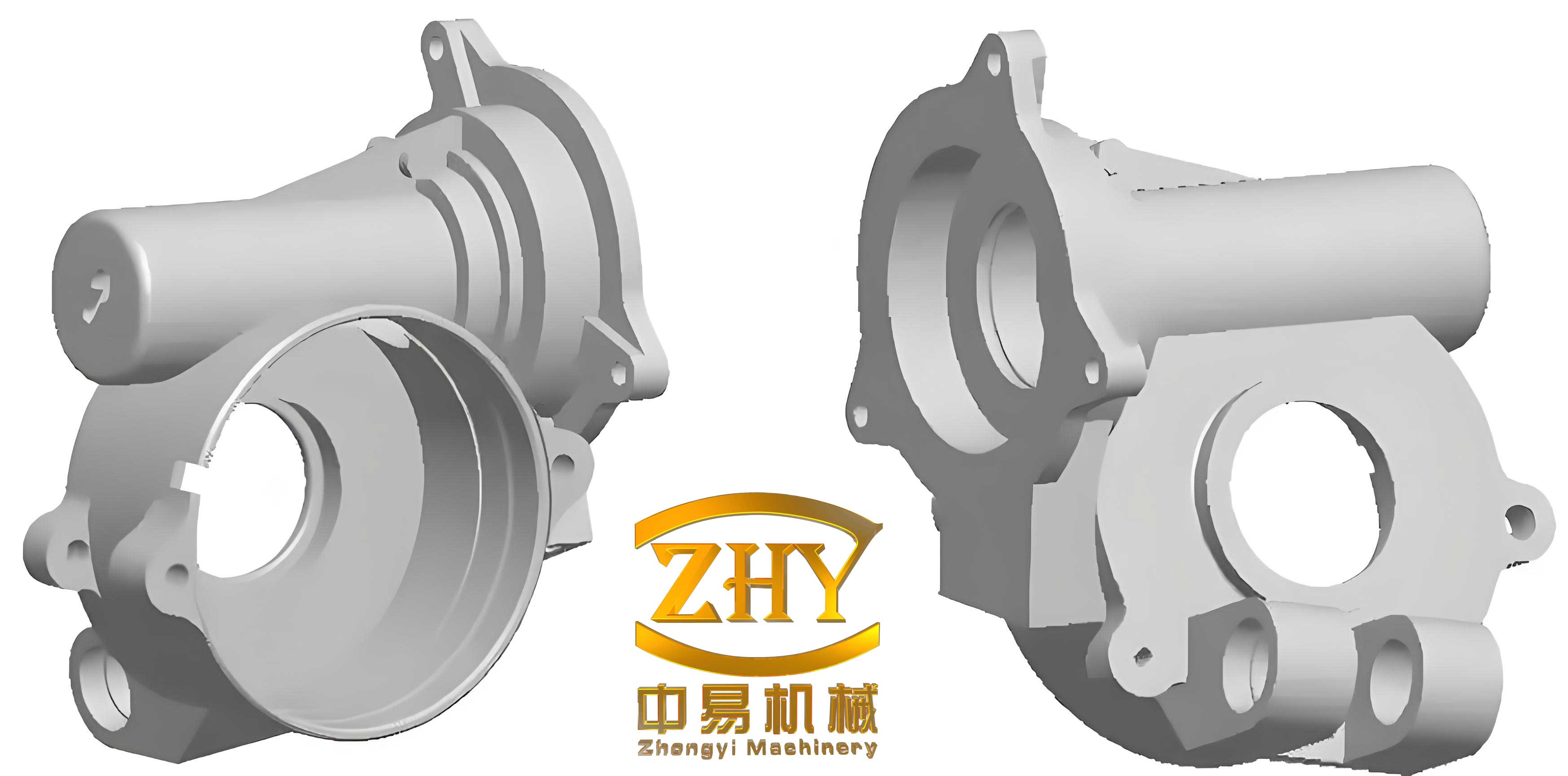
Defect prevention is paramount in producing high-quality gearbox shell castings. The primary defects I have encountered are deformation, carbon defects, and sand sticking, each with unique causes and solutions. Deformation occurs due to the low strength of foam patterns during handling, coating, and molding. For shell castings with large, complex geometries, I have tested several reinforcement methods. Initially, I tried external steel frames bonded to the pattern, but these were difficult to remove and often fused with the casting. Next, I experimented with foam strips attached to weak areas, but this increased metal consumption and cleaning effort. Ultimately, I found that bonding bamboo strips to critical sections—such as the bottom of the pattern—provided adequate support without interfering with the casting process. The number of strips \( N_s \) depends on the pattern’s geometry and can be estimated as:
$$ N_s = k \cdot \frac{A_p}{A_s} $$
where \( A_p \) is the pattern surface area, \( A_s \) is the strip coverage area, and \( k \) is a safety factor (typically 1.2-1.5). This method has effectively minimized deformation in shell castings.
Carbon defects manifest as black inclusions on the top and sides of shell castings, resulting from incomplete vaporization of foam residues. When metal front velocity \( v_m \) exceeds the gas evacuation rate \( v_g \), sticky pyrolysis products accumulate, forming carbonaceous deposits. The relationship can be described by:
$$ v_m > v_g = \frac{G}{\rho_g \cdot A_g} $$
where \( G \) is the gas generation rate, \( \rho_g \) is gas density, and \( A_g \) is the venting area. To mitigate this in shell castings, I focus on four factors: pattern material, pouring parameters, ingate placement, and raw material composition. For patterns, I select expanded polystyrene (EPS) with additives like methyl violet to reduce carbon content \( \omega(C) \) and control gas generation. During pouring, I optimize speed and temperature to balance heat loss and gas removal, often using the empirical formula for pouring time \( t_p \) in lost foam casting:
$$ t_p = C \cdot \frac{M}{\Delta T} $$
where \( M \) is the casting mass, \( \Delta T \) is the temperature drop, and \( C \) is a material constant. For ingates, bottom-gating with risers at the top, as mentioned earlier, facilitates slag collection and reduces carbon defects in shell castings. Additionally, I adjust charge materials to lower overall carbon content, as summarized in the table below for typical shell castings:
| Factor | Influence on Carbon Defects | Optimal Range for Shell Castings | Mitigation Strategy |
|---|---|---|---|
| Pattern Material \( \omega(C) \) | Higher carbon increases gas generation and defect risk | \( \omega(C) < 2\% \) in EPS | Use low-carbon EPS with additives |
| Pouring Temperature | Too low leads to cold shuts; too high increases pyrolysis | \( 1420^\circ \text{C} – 1480^\circ \text{C} \) | Maintain narrow range; monitor with thermocouples |
| Pouring Speed | Fast pouring traps gases; slow pouring causes misruns | \( 0.5 – 1.0 \, \text{kg/s per ingate} \) | Use intermittent pouring; calibrate ladle tilt |
| Raw Material Composition | High carbon in charge elevates defect propensity | \( \omega(C)_{\text{total}} < 3.5\% \) in iron | Blend scrap steel with low-carbon pig iron |
Sand sticking, another common issue in shell castings, occurs in dead corners and hot spots due to coating failure or insufficient sand compaction. The causes are multifaceted: coating cracks, inadequate vibration, short drying times, low vacuum pressure, improper gating, high pouring temperatures, low coating strength, and operational errors. To address this, I apply a layer of self-setting resin sand inside the dried pattern, concentrating on死角 and corners. The thickness \( t_r \) of this resin sand layer can be calculated based on the thermal gradient:
$$ t_r = \frac{\alpha \cdot \Delta T}{q} $$
where \( \alpha \) is thermal diffusivity, \( \Delta T \) is the temperature difference, and \( q \) is the heat flux. This reinforcement prevents metal penetration and ensures easy shakeout for shell castings. Moreover, I ensure proper vibration parameters and vacuum levels—typically maintaining a negative pressure of \( -0.04 \, \text{MPa} \) to \( -0.06 \, \text{MPa} \) during pouring—to enhance sand stability. The table below outlines key parameters for preventing sand sticking in shell castings:
| Parameter | Role in Sand Sticking | Recommended Value for Shell Castings | Control Method |
|---|---|---|---|
| Coating Thickness | Thin coatings crack; thick coatings impede gas escape | \( 0.5 – 1.0 \, \text{mm} \) per layer | Apply uniformly; measure with thickness gauge |
| Vibration Time | Insufficient time leaves voids; excessive time damages patterns | \( 30 – 60 \, \text{s} \) per axis | Use automated timers on vibration table |
| Drying Time \( t_d \) | Short drying causes moisture-related defects | \( 15 – 20 \, \text{h} \) at \( 50^\circ \text{C} \) | Monitor humidity levels in drying oven |
| Vacuum Pressure \( P_v \) | Low pressure reduces sand compactness and gas extraction | \( -0.05 \, \text{MPa} \pm 0.01 \, \text{MPa} \) | Adjust vacuum pump settings continuously |
| Pouring Temperature \( T_p \) | High temperature overheats sand and coating | \( \leq 1480^\circ \text{C} \) for iron shell castings | Preheat ladle; use infrared pyrometry |
In refining the lost foam process for gearbox shell castings, I have also incorporated advanced modeling techniques. For instance, computational fluid dynamics (CFD) simulations help predict metal flow and temperature distribution. The Navier-Stokes equations govern the flow:
$$ \rho \left( \frac{\partial \mathbf{v}}{\partial t} + \mathbf{v} \cdot \nabla \mathbf{v} \right) = -\nabla p + \mu \nabla^2 \mathbf{v} + \mathbf{f} $$
where \( \rho \) is density, \( \mathbf{v} \) is velocity, \( p \) is pressure, \( \mu \) is viscosity, and \( \mathbf{f} \) represents body forces. By simulating different gating designs, I can optimize the process for shell castings before physical trials, reducing waste and improving yield. Additionally, heat transfer analysis during solidification is critical. The Fourier heat conduction equation:
$$ \frac{\partial T}{\partial t} = \alpha \nabla^2 T $$
where \( T \) is temperature and \( \alpha \) is thermal diffusivity, aids in predicting shrinkage and porosity in shell castings. I use these models to adjust riser sizes and cooling rates, ensuring sound castings.
Furthermore, quality control measures are integral to producing reliable shell castings. I implement non-destructive testing (NDT) methods like ultrasonic inspection to detect internal defects. The wave velocity \( c \) in the casting material relates to defect size \( d \) through:
$$ d = \frac{c \cdot \Delta t}{2} $$
where \( \Delta t \) is the time delay in wave reflection. Regular metallographic analysis also verifies microstructure, ensuring that shell castings meet mechanical specifications such as tensile strength \( \sigma_t \) and hardness \( H \). For iron-based shell castings, I aim for a pearlitic matrix with graphite dispersion, achieved by controlling cooling rate \( \dot{T} \):
$$ \dot{T} = \frac{T_p – T_s}{t_s} $$
where \( T_s \) is solidus temperature and \( t_s \) is solidification time. These parameters are fine-tuned based on the specific requirements of gearbox shell castings.
In conclusion, the production of high-quality gearbox shell castings via lost foam casting is a multifaceted endeavor that demands careful attention to gating design, process parameters, and defect mitigation. Through my experience, I have found that bottom-gating systems, combined with optimized coating, vibration, and pouring practices, significantly enhance the integrity of shell castings. Defects like deformation, carbon inclusions, and sand sticking can be effectively controlled through strategic reinforcements, material selection, and process adjustments. The use of mathematical models and tables, as illustrated throughout this article, provides a systematic approach to refining the process. As the automotive industry evolves, continued innovation in lost foam casting will be essential for meeting the growing demands for precision and durability in shell castings. By sharing these insights, I hope to contribute to the advancement of manufacturing techniques for complex components like gearbox shell castings.