
In my experience with advanced manufacturing processes, lost foam casting stands out as a highly efficient method for producing complex and large-scale steel components. This technique involves creating a foam pattern that is embedded in sand and then replaced by molten metal, resulting in precise and high-integrity castings. The lost foam casting process is particularly advantageous for applications requiring intricate geometries and minimal post-processing, such as in structural nodes for large buildings or industrial machinery. Over the years, I have observed that lost foam casting reduces machining costs and improves material utilization, making it a preferred choice in many engineering projects.
The fundamental principle of lost foam casting revolves around the use of expandable polystyrene (EPS) or similar foam materials to form patterns. These patterns are crafted using computer-aided design (CAD) and computer numerical control (CNC) machining to ensure dimensional accuracy. During the lost foam casting process, the foam pattern is coated with a refractory material to create a barrier against the sand mold. This coating is crucial as it prevents metal penetration and ensures a smooth surface finish. In my work, I have found that the quality of the coating directly impacts the final casting, with factors like viscosity and drying time playing key roles. The lost foam casting method allows for the integration of multiple parts into a single pattern, reducing assembly requirements and enhancing structural integrity.
One of the critical aspects of lost foam casting is the control of chemical composition in the molten metal. For low-alloy steels commonly used in lost foam casting, elements such as carbon, silicon, manganese, molybdenum, and vanadium must be carefully balanced to achieve desired mechanical properties. Based on my analysis, the carbon equivalent (CE) can be calculated using the formula: $$ CE = C + \frac{Mn}{6} + \frac{Mo + V}{5} $$ where C, Mn, Mo, and V represent the weight percentages of carbon, manganese, molybdenum, and vanadium, respectively. This equation helps in predicting weldability and hardness in lost foam casting applications. I often refer to tables like the one below to summarize typical compositional ranges for low-alloy steels in lost foam casting:
| Element | Typical Range (%) | Influence on Properties |
|---|---|---|
| C | 0.08–0.12 | Affects strength and weldability; lower values reduce cracking risk in lost foam casting. |
| Si | 0.35–0.60 | Improves fluidity and deoxidation; excessive Si can embrittle the casting. |
| Mn | 1.20–1.80 | Enhances hardenability and strength; balances sulfur effects in lost foam casting. |
| Mo | 0.20–0.40 | Increases high-temperature strength and reduces temper embrittlement. |
| V | 0.05–0.10 | Refines grain structure and improves toughness through precipitation hardening. |
In lost foam casting, the melting and pouring stages require precise temperature control to avoid defects like gas porosity or shrinkage. I typically use medium-frequency induction furnaces for melting, as they provide uniform heating and allow for efficient alloy addition. The pouring temperature in lost foam casting is maintained between 1560°C and 1620°C, depending on the section thickness and complexity of the pattern. During pouring, the foam pattern vaporizes, and the metal fills the cavity. The rate of vaporization can be modeled using the equation: $$ \frac{dm}{dt} = k \cdot A \cdot (T_m – T_v) $$ where dm/dt is the mass loss rate, k is a constant, A is the surface area, T_m is the metal temperature, and T_v is the vaporization temperature of the foam. This relationship highlights the importance of thermal management in lost foam casting to ensure complete pattern removal and sound castings.
After pouring, the casting undergoes solidification and cooling in the sand mold. In lost foam casting, the cooling rate must be controlled to prevent residual stresses and distortion. I often employ simulation software to predict solidification patterns, using equations like the Fourier heat conduction law: $$ \frac{\partial T}{\partial t} = \alpha \nabla^2 T $$ where T is temperature, t is time, and α is the thermal diffusivity. This helps in optimizing the gating and riser design for lost foam casting, minimizing shrinkage defects. Once cooled, the castings are removed from the mold and subjected to cleaning processes, such as shot blasting, to remove residual sand and coating materials. The lost foam casting process typically results in a surface finish that requires less machining compared to traditional sand casting.
Heat treatment is a vital post-processing step in lost foam casting to achieve the desired mechanical properties. For low-alloy steels, quenching and tempering are commonly used. In my practice, I follow a specific heat treatment cycle: the casting is heated to 900–950°C for austenitization, held for several hours based on thickness, and then quenched in a polymer-based solution to form martensite. The quenching process in lost foam casting can be described by the cooling curve equation: $$ T(t) = T_0 \cdot e^{-bt} $$ where T(t) is the temperature at time t, T_0 is the initial temperature, and b is a cooling constant. After quenching, tempering is performed at 640–660°C to transform the microstructure into tempered sorbite, which balances strength and toughness. The table below summarizes typical mechanical properties achieved through this heat treatment in lost foam casting:
| Property | Value Range | Test Standard |
|---|---|---|
| Yield Strength | 380–550 MPa | ASTM E8 |
| Tensile Strength | 500–650 MPa | ASTM E8 |
| Elongation | 18–25% | ASTM E8 |
| Impact Energy | 60–120 J | ASTM E23 |
Quality control in lost foam casting involves non-destructive testing (NDT) methods such as radiography, ultrasonic testing, and magnetic particle inspection. I have implemented these techniques to detect internal and surface defects, ensuring compliance with international standards. For instance, ultrasonic testing in lost foam casting uses the reflection of sound waves to identify discontinuities, governed by the equation: $$ A = A_0 e^{-\alpha x} $$ where A is the amplitude, A_0 is the initial amplitude, α is the attenuation coefficient, and x is the distance traveled. This allows for the assessment of integrity in thick-section castings produced via lost foam casting. Additionally, dimensional checks using coordinate measuring machines (CMM) are essential to verify tolerances, often within CT8 to CT13 grades as per ISO standards.
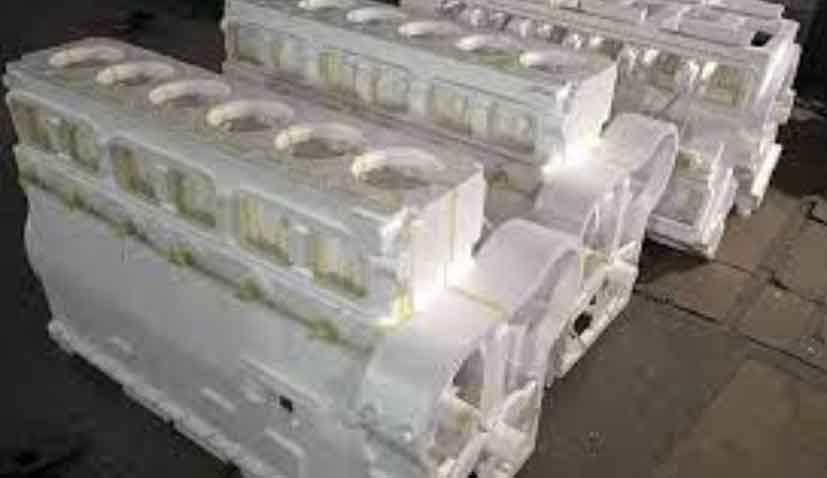
The application of lost foam casting extends to various industries, including automotive, aerospace, and construction. In my projects, I have utilized lost foam casting for producing large structural nodes, where weight reduction and high load-bearing capacity are critical. The flexibility of lost foam casting allows for the integration of internal channels and complex shapes that are difficult to achieve with other methods. For example, in architectural structures, lost foam casting enables the creation of nodes with optimized stress distribution, calculated using finite element analysis (FEA) and equations like: $$ \sigma = \frac{F}{A} $$ where σ is stress, F is force, and A is cross-sectional area. This ensures that castings meet performance requirements under dynamic loads.
Despite its advantages, lost foam casting presents challenges such as pattern distortion and gas evolution during pouring. To address these, I have developed strategies like using high-density foam and optimized coating formulations. The economic benefits of lost foam casting are significant, as it reduces material waste and labor costs. In summary, lost foam casting is a versatile and efficient process that continues to evolve with advancements in materials and simulation technologies. Through continuous improvement and adherence to quality standards, lost foam casting remains a cornerstone in modern manufacturing for producing high-performance components.
In conclusion, my involvement with lost foam casting has demonstrated its superiority in handling large and intricate steel castings. The process integrates seamlessly with digital tools for pattern design and process optimization, ensuring repeatability and precision. As industries demand lighter and stronger components, lost foam casting will play an increasingly vital role. I am confident that ongoing research into foam materials and metal-mold interactions will further enhance the capabilities of lost foam casting, making it indispensable for future engineering applications.