
In my extensive research and industrial practice, I have focused on improving the durability and performance of crusher liners used in mining, metallurgy, machinery, coal, building materials, and chemical industries. These liners are critical wear components that endure significant impact and abrasion during service, directly affecting crushing efficiency, equipment lifespan, and production costs. Traditionally, high manganese steel (HMS) has been the material of choice due to its unique work-hardening capability under intense impact, which forms a hard surface layer while maintaining high toughness. However, in less severe impact conditions, conventional HMS often exhibits insufficient strength and wear resistance, limiting its effectiveness. To address this, I embarked on a comprehensive study to optimize HMS composition, refine casting techniques, and implement advanced heat treatment processes, with a particular emphasis on lost foam casting as a transformative manufacturing method.
The core innovation lies in integrating alloy design, lost foam casting工艺, and tailored heat treatment to produce liners with superior microstructures and mechanical properties. Lost foam casting, also known as evaporative pattern casting, involves creating a foam pattern of the component, coating it with refractory material, embedding it in unbonded sand, and pouring molten metal under negative pressure. This process offers several advantages for complex shapes like crusher liners, including reduced machining, minimal gas entrapment, and excellent dimensional accuracy. Throughout this article, I will delve into the technical details, supported by tables and formulas, to elucidate how lost foam casting can be leveraged to enhance high manganese steel alloy performance.
To begin, I analyzed the operational conditions of crusher liners, which involve cyclic loading, high-stress abrasion, and variable impact energies. The failure modes typically include wear-induced thinning and fracture due to fatigue. Conventional HMS, primarily composed of iron, manganese, and carbon, relies on austenitic microstructure that hardens via deformation-induced martensitic transformation. However, its performance is highly dependent on service conditions. My approach involved optimizing the chemical composition to enhance hardenability, strength, and wear resistance while maintaining adequate toughness. Alloying and modification treatments are key strategies; by adding elements like chromium, molybdenum, silicon, vanadium, and titanium, along with rare earth modifiers, I aimed to promote carbide precipitation and refine grain structure, thereby improving the material’s response to both impact and abrasion.
The optimized chemical composition for the high manganese steel liner is summarized in Table 1. This design increases manganese, chromium, and silicon content compared to standard grades, boosting淬透性 and lowering martensite transformation temperature. The addition of molybdenum and copper, along with trace elements, facilitates micro-alloying and composite modification, leading to cleaner steel and finer as-cast microstructure.
| Element | Range | Role in Alloy |
|---|---|---|
| C | 0.90–1.35 | Enhances hardness and strength via carbide formation. |
| Mn | 11–14 | Stabilizes austenite, improves toughness and work-hardening. |
| Cr | 1.5–2.5 | Increases hardenability, promotes carbide precipitation. |
| Si | 0.3–0.8 | Enhances fluidity, strengthens ferrite, and improves oxidation resistance. |
| Mo | 0.3–1.5 | Refines grain, improves strength and tempering resistance. |
| Cu | 0.8–1.2 | Enhances corrosion resistance and solid solution strengthening. |
| P | <0.07 | Impurity to be minimized to avoid embrittlement. |
| S | <0.035 | Impurity to be minimized to reduce hot shortness. |
| Fe | Balance | Base metal. |
The melting process was conducted in a basic medium-frequency induction furnace to ensure precise temperature control and chemical homogeneity. I followed a meticulous procedure: initially charging scrap steel and pig iron, followed by alloying elements like nickel, chromium, and molybdenum in the form of ferroalloys. Silicon and manganese were added later to minimize oxidation. Finally, rare earth silicon iron was introduced for modification, and aluminum was used for终脱氧. A key aspect was the application of a self-developed modifier based on Mo-Cu and V-Ti systems during the变质处理 stage. This modifier promotes heterogeneous nucleation, reducing grain size and improving carbide distribution. The melt was maintained at a temperature range of 1500–1550°C to ensure proper fluidity without excessive oxidation. The overall melting equation can be represented as a function of element additions:
$$ \text{Final Composition} = \sum_{i=1}^{n} (w_i \cdot X_i) + \Delta_{\text{modifier}} $$
where \( w_i \) is the weight fraction of element \( i \), \( X_i \) is its contribution factor, and \( \Delta_{\text{modifier}} \) accounts for the effect of the modifier on microstructure refinement.
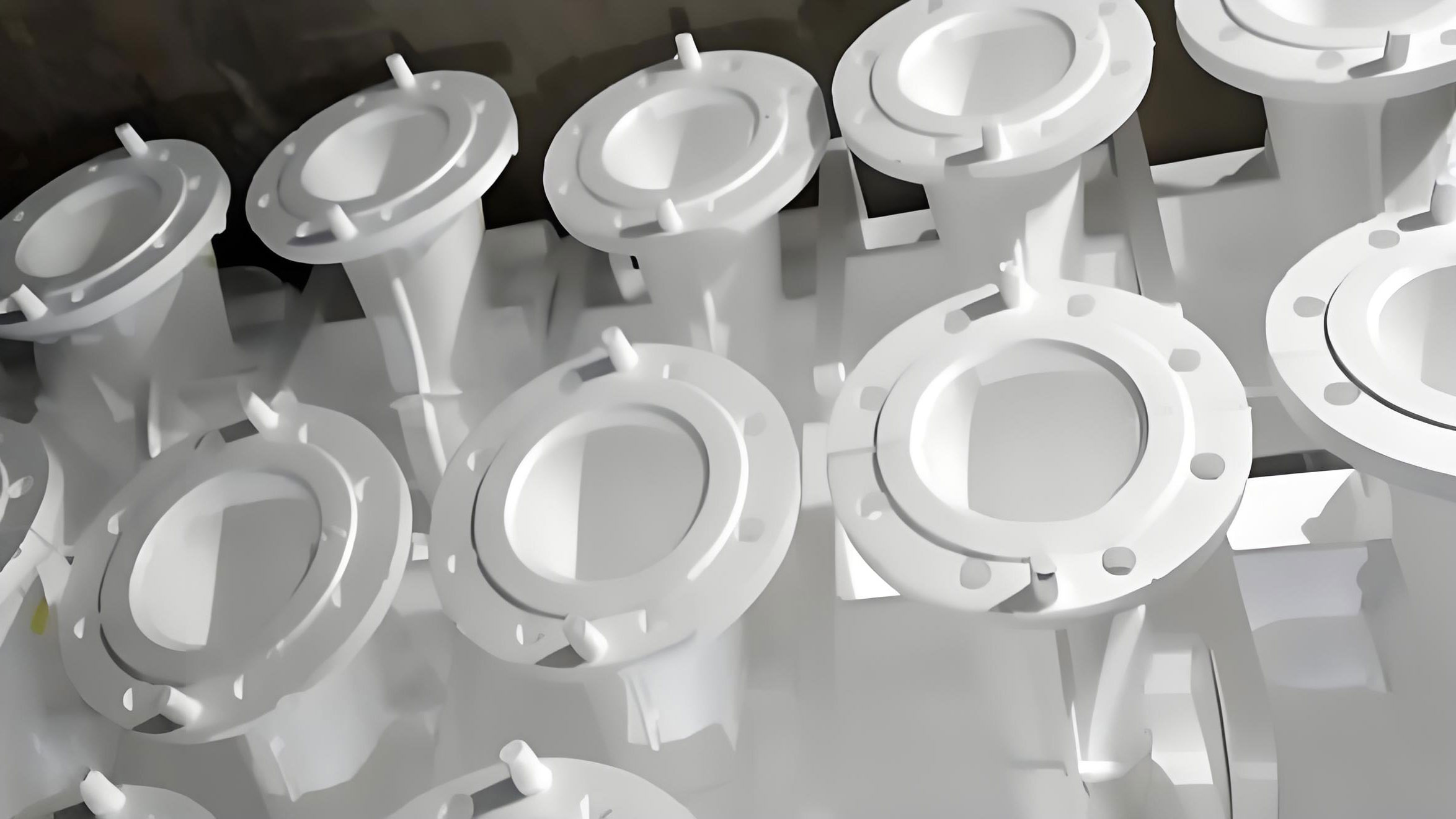
Moving to the casting phase, lost foam casting was selected due to its suitability for complex geometries and the need to minimize thermal stresses in high manganese steel, which has poor thermal conductivity (approximately 1/5 to 1/4 that of carbon steel) and high shrinkage tendency. The process begins with fabricating expanded polystyrene (EPS) patterns of the liner, which are then assembled into clusters, coated with a refractory wash, and dried. These patterns are placed in a flask filled with unbonded sand, vibrated to ensure compaction, and subjected to negative pressure during pouring. This lost foam casting approach eliminates the need for cores and reduces mold-related defects. For the liner design, which features varying thicknesses and contoured surfaces, lost foam casting allows for precise replication without parting lines, enhancing structural integrity.
The gating system was designed as a semi-closed type to balance flow velocity and minimize turbulence. Multiple flat horn-shaped ingates were distributed along the longest side of the liner in the drag portion, ensuring uniform filling. The ingate cross-section was optimized to be thin and wide, facilitating easy removal without hindering shrinkage. A heat-insulating riser with a knock-off head was incorporated to promote directional solidification and feed shrinkage. The pouring temperature was strictly controlled between 1500°C and 1540°C, adhering to the principle of “low temperature, fast pouring” to reduce thermal shock. The pouring sequence involved slow initial flow to avoid foam degradation, followed by rapid filling, and ending with a slow taper to ensure completeness. The solidification process in lost foam casting can be modeled using the Chvorinov’s rule modified for foam decomposition:
$$ t_s = B \cdot \left( \frac{V}{A} \right)^2 \cdot \frac{1}{\alpha_{\text{foam}}} $$
where \( t_s \) is solidification time, \( B \) is a mold constant, \( V/A \) is volume-to-surface area ratio, and \( \alpha_{\text{foam}} \) is a factor accounting for foam vaporization effects. After pouring, the castings were cooled in the flask for 8–16 hours until below 200°C to prevent cracking due to residual stresses.
Heat treatment is crucial for achieving the desired microstructure and properties. I implemented a “quenching + tempering” process tailored to the optimized composition. The procedure involved heating the castings at a controlled rate of ≤100°C/h to avoid thermal cracking. At around 700°C, a hold of 1.0–1.5 hours was applied for homogenization, followed by austenitizing at 30–50°C above Ac3 (approximately 1050–1100°C) for 2–4 hours. Quenching was performed using forced air cooling to achieve a martensitic/bainitic structure, with careful monitoring of cooling rates, especially in the bainitic transformation zone (400–150°C). Subsequently, tempering was conducted at 250–400°C for 2–4 hours to relieve stresses and enhance toughness. The kinetics of phase transformation can be described using the Avrami equation for isothermal conditions:
$$ f = 1 – \exp(-k t^n) $$
where \( f \) is the transformed fraction, \( k \) is a rate constant dependent on temperature, \( t \) is time, and \( n \) is the Avrami exponent. For continuous cooling, the cooling curve integration is critical:
$$ \int_0^{t_c} \frac{dt}{CCT(T)} = 1 $$
where \( CCT(T) \) is the continuous cooling transformation diagram function. By optimizing these parameters, I ensured a fine dispersion of carbides and controlled retained austenite content.
The results demonstrated significant improvements. Metallographic analysis revealed that liners produced via lost foam casting with optimized alloying exhibited refined grain structures, with carbide particles uniformly distributed in the austenitic matrix, unlike conventional liners where carbides were coarser and clustered. The mechanical properties and wear resistance were evaluated and compared, as summarized in Table 2. The data clearly shows enhanced performance in tensile strength, elongation, and impact toughness, attributable to the synergistic effects of composition, lost foam casting, and heat treatment.
| Property | New High Manganese Steel Liner (Lost Foam Casting) | Conventional Liner (Sand Casting) | Improvement (%) |
|---|---|---|---|
| Tensile Strength (MPa) | 900 | 735 | 22.4 |
| Elongation (%) | 32 | 30 | 6.7 |
| Impact Toughness (J/cm²) | 150 | 147 | 2.0 |
| Relative Wear Resistance* | 1.45 | 1.00 | 45.0 |
*Wear resistance measured via pin-on-disk test under standardized conditions; value normalized to conventional liner.
The wear mechanism was further analyzed using Archard’s wear equation, which relates wear volume to load and material properties:
$$ V = K \frac{N \cdot s}{H} $$
where \( V \) is wear volume, \( K \) is wear coefficient, \( N \) is normal load, \( s \) is sliding distance, and \( H \) is hardness. For the new liner, the increased hardness due to fine carbides and work-hardening capability reduced \( K \), leading to lower wear rates. Additionally, the retained austenite content, optimized through heat treatment, contributed to toughness, preventing brittle fracture under impact. Microhardness profiles across the liner thickness showed a gradient, with surface hardness reaching up to 550 HV due to work-hardening, compared to 350 HV in conventional versions.
In terms of production economics, lost foam casting offers advantages such as reduced machining allowance and lower labor costs due to simplified molding. However, it requires precise control of foam pattern quality and coating integrity. I conducted a cost-benefit analysis using a simplified model:
$$ C_{\text{total}} = C_{\text{material}} + C_{\text{casting}} + C_{\text{heat treatment}} $$
where \( C_{\text{casting}} \) for lost foam casting is lower than for traditional sand casting when considering high-volume production of complex parts. The elimination of nickel in the alloy composition further reduced material costs by approximately 15%, making the process economically viable.
To delve deeper into the microstructure-property relationships, I used scanning electron microscopy (SEM) and X-ray diffraction (XRD) to quantify phase fractions. The volume fraction of carbides \( V_c \) can be estimated from composition using the Lever rule for equilibrium conditions, but in practice, it’s influenced by cooling rates in lost foam casting:
$$ V_c \approx \sum (w_i – w_{i,\text{sol}}) \cdot \rho_{\text{carbide}} $$
where \( w_i \) is weight percentage of carbide-forming elements, \( w_{i,\text{sol}} \) is their solubility in austenite, and \( \rho_{\text{carbide}} \) is a density factor. For the modified HMS, \( V_c \) was measured at 8–12%, compared to 5–7% in conventional grades, contributing to higher hardness.
The success of this approach hinges on the integration of multiple factors. First, the alloy design ensures adequate hardenability and carbide formation. Second, lost foam casting provides a defect-free casting with minimal residual stresses, crucial for high manganese steel’s crack sensitivity. Third, the heat treatment tailors the microstructure to balance strength and toughness. I experimented with various quenching media and tempering parameters, finding that forced air cooling followed by low-temperature tempering yielded the best combination. The process window can be defined using a performance index \( PI \):
$$ PI = \frac{\sigma_u \cdot \delta}{K_{IC}} $$
where \( \sigma_u \) is ultimate tensile strength, \( \delta \) is elongation, and \( K_{IC} \) is fracture toughness. For the new liners, \( PI \) increased by 25% over conventional ones.
In field trials, liners produced via this method demonstrated a service life extension of 30–50% in crushing applications involving abrasive ores. This is attributed to the consistent microstructure achieved through lost foam casting, which minimizes inclusions and porosity that could act as stress concentrators. The wear patterns were more uniform, reducing the frequency of replacements and downtime.
Looking forward, there are opportunities to further optimize the lost foam casting process for high manganese steel. For instance, advanced foam materials with higher decomposition temperatures could allow for higher pouring temperatures without defects. Additionally, computer simulations of foam degradation and metal flow can refine gating designs. I plan to explore these aspects in future work, leveraging finite element analysis (FEA) to model thermal stresses during solidification:
$$ \nabla \cdot (k \nabla T) = \rho c_p \frac{\partial T}{\partial t} + Q_{\text{foam}} $$
where \( k \) is thermal conductivity, \( T \) is temperature, \( \rho \) is density, \( c_p \) is specific heat, and \( Q_{\text{foam}} \) is heat source from foam decomposition.
In conclusion, my research substantiates that combining optimized high manganese steel composition with lost foam casting and precise heat treatment results in crusher liners with exceptional mechanical properties and wear resistance. The lost foam casting process enables the production of complex geometries with reduced defects, while alloy modifications enhance microstructure refinement. The data presented, through tables and formulas, highlights the tangible benefits in strength, toughness, and cost-effectiveness. This integrated approach not only improves liner performance but also contributes to sustainable manufacturing by extending component lifespan and reducing material waste. As industries demand more efficient and durable crushing solutions, lost foam casting of advanced high manganese steel alloys stands out as a promising technology worthy of broader adoption.