
The production of wear-resistant components like mill liners presents a unique set of challenges in the realm of high manganese steel casting. Traditional sand casting methods for this material are often hampered by its significant solidification shrinkage and the subsequent need for large feeding risers. These risers are not only inefficient, consuming a substantial amount of metal and reducing yield, but their removal is particularly problematic for high manganese steel. Due to its austenitic structure and work-hardening characteristics, thermal cutting methods like oxy-fuel cutting are impractical before heat treatment, necessitating expensive and time-consuming machining or grinding. My exploration and practical implementation of a riserless lost foam casting process directly addresses these longstanding inefficiencies, offering a robust, economical solution for manufacturing specific geometries of high manganese steel liners.
This methodology hinges on a deep understanding of both the material’s behavior and the lost foam process’s capabilities. The core principle involves forgoing traditional feeding mechanisms by carefully controlling thermal conditions to promote simultaneous solidification across the entire casting, thereby minimizing shrinkage porosity in locations deemed non-critical for the final application. The success of this approach is not merely theoretical; it has been validated through extensive production trials and over two years of successful field service in demanding mineral processing applications.
Operational Context and Justification for Riserless Design
The liners in question are subjected to a harsh environment of impact and abrasive gouging within rotary grinding mills. Ore is lifted by the rotation of the mill and cascades down, repeatedly impacting the liner surface. This service condition is classified as low-stress, high-impact gouging abrasion. The primary failure mode is gradual thickness reduction through wear, not catastrophic fracture from high tensile or fatigue loads. This distinction is crucial for the riserless approach.
In a conventionally fed casting, directional solidification is encouraged, channeling shrinkage to the riser. In a uniformly thick plate cast without a riser, the last region to solidify is typically at its thermal center, which can lead to a centralized shrinkage zone or axial porosity. The critical engineering judgment here is that this inherent centerline condition does not compromise the liner’s functional integrity. As wear progresses uniformly from the working surface, the component is replaced long before the wear depth approaches this internal zone. Therefore, accepting a controlled, predictable internal discontinuity is a rational trade-off for eliminating the substantial costs and handling difficulties associated with risers. This makes certain high manganese steel casting geometries ideal candidates for this process.
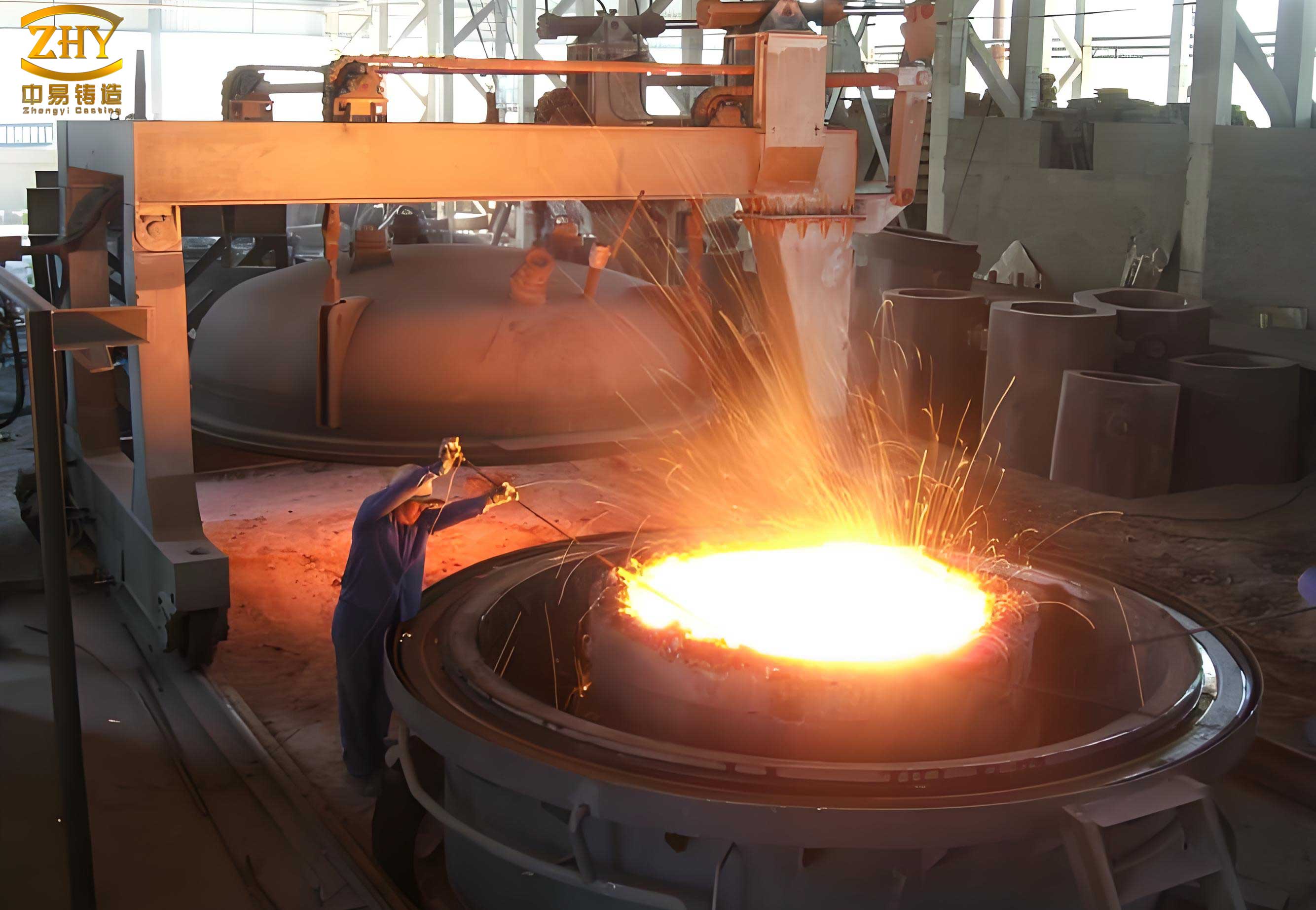
Metallurgical and Process Fundamentals of High Manganese Steel Casting
To appreciate the innovation, one must first understand the material’s constraints. High manganese steel (typically ASTM A128 Grade B2/B3 or similar, with 11-14% Mn, 1.0-1.4% C) possesses exceptional toughness and work-hardening capacity, but its foundry characteristics are demanding.
- High Solidification Shrinkage: The volumetric shrinkage during the liquid-to-solid transformation is significant, typically ranging from 6.0% to 8.5%. This is the primary driver for large risers in conventional methods.
$$ \epsilon_{sh} = \frac{V_l – V_s}{V_l} \approx 0.065 \text{ to } 0.085 $$
where $\epsilon_{sh}$ is the linear shrinkage strain, $V_l$ is the liquid volume, and $V_s$ is the solid volume at the solidus temperature. - Low Thermal Conductivity: Austenitic manganese steel has poor thermal conductivity, around 12-15 W/m·K at room temperature and lower at elevated temperatures. This inhibits rapid heat extraction, promotes hot spots, and increases the risk of columnar grain growth and micro-segregation of carbides if cooling is too slow.
- Excellent Fluidity: Despite its high melting point (~1340°C liquidus), the alloy exhibits remarkable fluidity, allowing for successful pouring at temperatures only slightly above its melting point. This characteristic is key to the riserless strategy, as it enables lower pouring temperatures to reduce total liquid contraction.
- Solidification Morphology: The goal is to achieve a fully austenitic, carbide-free matrix after solution heat treatment (water quenching). This requires avoiding the formation of stable, brittle grain boundary carbides during cooling. The lost foam process, with its insulating ceramic coating and dry sand mold, creates a relatively slow, uniform cooling environment that can be beneficial if managed correctly.
The lost foam process itself contributes essential features. The expandable polystyrene (EPS) pattern vaporizes upon metal entry, and the resulting gap is filled by unbonded sand under vacuum. This creates a near-isothermal condition at the metal-mold interface initially, promoting simultaneous nucleation. The vacuum applied to the sand mold (typically -0.04 to -0.06 MPa gauge pressure) serves multiple purposes: it removes pattern decomposition gases swiftly, draws liquid metal into intricate details, and consolidates the sand, allowing the use of a completely closed, riserless gating system.
Comparative Process Analysis: Traditional vs. Lost Foam Riserless
| Parameter | Traditional Sand Casting (with Risers) | Lost Foam Riserless Casting |
|---|---|---|
| Pattern/Mold | Wood/metal pattern, bonded sand mold. | EPS foam pattern, unbonded dry sand mold under vacuum. |
| Feeding System | Complex gating with multiple large risers (often 40-50% of casting weight). | Simplified gating, no risers. Yield improvement >20%. |
| Solidification Mode | Directional, towards risers. | Simultaneous, across casting volume. |
| Shrinkage Accommodation | Concentrated in risers. | Dispersed as micro-porosity at thermal centers. |
| Post-Casting Operation | Riser removal required (difficult for as-cast high manganese steel). | No riser removal. Only gating system knockout is needed. |
| Dimensional Accuracy | Good, but affected by mold assembly. | Excellent, no mold parting lines or core shifts. |
| Internal Soundness | Generally sound in fed areas. | Sound except at predictable, non-critical thermal centers. |
Detailed Production Protocol for Riserless High Manganese Steel Casting
1. EPS Pattern Fabrication and Requirements
The foundation of quality in lost foam casting is the pattern. For high manganese steel casting, the demands are stringent.
- Density & Strength: The EPS bead pre-expansion and molding must be controlled to achieve a finished pattern density greater than 18 kg/m³. This ensures adequate strength to resist handling distortion and the pressure of coating application, while also minimizing the gaseous products during decomposition.
- Dimensional Compensation: The pattern dimensions must incorporate not only the standard solidification shrinkage of the metal (~2.5% for high manganese steel) but also the unique expansion and contraction behaviors of the foam and coating system during processing. An empirical shrinkage rule, often a hybrid value, is developed through trial.
- Drying: Patterns must be thoroughly dried after molding to remove any residual pentane or moisture, which are significant sources of gas defects. This involves controlled atmospheric drying for a period of 24-48 hours.
2. Refractory Coating Formulation and Application
The coating is a critical semi-permeable barrier. Its functions are to: provide a refractory surface against metal erosion, allow the escape of pyrolysis gases, and impart strength to the fragile pattern assembly. For high manganese steel, a basic coating is preferred to minimize metal-mold reaction.
| Component | Function | Typical Composition (wt.%) |
|---|---|---|
| Fused Magnesia Powder | Primary refractory aggregate. High refractoriness, basic pH. | 60-70% |
| Lithium-based Bentonite | Suspension agent, green strength. | 2-4% |
| Water-soluble Phenolic Resin | Binder for dry strength and permeability. | 2-3% |
| Polyvinyl Acetate (PVA) Emulsion | Binder for pattern adhesion and wet strength. | 1-2% |
| Carboxymethyl Cellulose (CMC) | Thickening and water retention agent. | 0.1-0.3% |
| Sodium Hexametaphosphate | Dispersant, reduces slurry viscosity. | 0.1-0.2% |
| Water | Carrier medium. | Balance |
The coating slurry is applied via dipping. A minimum dry coating thickness of 2.0 mm is essential for the thermal mass and strength required in high manganese steel casting. This typically necessitates two dip coats.
- First Coat: Applied, then dried for a minimum of 6 hours in a well-ventilated oven at 40-50°C.
- Second Coat: Applied after the first is completely dry, then dried for a minimum of 8 hours. The pattern must be bone-dry (moisture content <0.5%) before molding to prevent steam explosions or blow defects.
3. Molding and Vacuum System
The coated patterns are assembled into clusters using hot-melt glue, attached to a central downgate/runner system. This cluster is then placed in a flask equipped with a vacuum connection. The flask dimensions must allow for a minimum of 100 mm of sand between any pattern and the flask wall.
- Sand: Dry, unbonded silica sand (AFS GFN 50-60) is used. It must be clean, cool, and free from fines to ensure high permeability.
- Filling and Compaction: Sand is rained in around the cluster. Vibration is applied intermittently during filling to achieve uniform and high-density sand compaction, crucial for mold stability and dimensional accuracy. The process follows a layering principle: fill 300 mm, vibrate, then repeat. Continuous vibration while pouring sand is avoided as it leads to segregation.
- Vacuum Level: A vacuum of -0.045 to -0.05 MPa (gauge) is established in the sand mass prior to pouring and maintained throughout pouring and solidification. This negative pressure:
- Removes foam pyrolysis products rapidly.
- Draws the metal through the gating system fully.
- Provides the mechanical strength to the unbonded sand mold, preventing wall movement or collapse.
4. Melting, Pouring, and Temperature Control
Precise thermal management is the cornerstone of the riserless high manganese steel casting process.
- Melting: A basic-lined electric arc furnace is standard. The target chemistry conforms to standard specifications (e.g., C: 1.0-1.2%, Mn: 11.5-13.0%, Si: 0.4-0.7%, P <0.06%, S <0.03%). A final deoxidation with aluminum (0.02-0.04%) is common to control gas content.
- Pouring Temperature: This is the most critical parameter. The principle is “low temperature pouring.” While the alloy melts around 1340°C, the target pouring range is deliberately lowered to 1420-1430°C (as measured by immersion thermocouple in the ladle). This minimizes:
- Total Liquid Contraction: The lower superheat reduces the temperature drop from pouring to start of solidification, thereby reducing the volume deficit from liquid contraction.
$$ \Delta V_{liq} \propto \beta_l \cdot \Delta T_{superheat} $$
where $\Delta V_{liq}$ is the liquid contraction volume, $\beta_l$ is the coefficient of thermal expansion of the liquid, and $\Delta T_{superheat}$ is the degree of superheat. - Pattern Gas Generation: Less thermal energy reduces the rate and total volume of foam decomposition.
- Metal-Mold Reaction: Lessens the thermal attack on the coating.
- Total Liquid Contraction: The lower superheat reduces the temperature drop from pouring to start of solidification, thereby reducing the volume deficit from liquid contraction.
- Pouring Practice: Metal is tapped into a pre-heated ladle and allowed to “teem” or calm for 5-7 minutes to allow inclusions to float. Pouring must be swift and uninterrupted to maintain the thermal gradient necessary for simultaneous filling. The pouring cup must remain full to prevent vortexing and air aspiration.
5. Heat Treatment (Water Quenching – Solution Annealing)
To dissolve the precipitated carbides and achieve the required toughness, a precise water quench is non-negotiable. After shakeout and cleaning, the castings undergo the following cycle:
| Stage | Parameter | Rationale |
|---|---|---|
| Heating | Rate: ≤100°C/hour to ~600°C. | Avoids thermal stress cracking in the brittle as-cast structure with grain boundary carbides. |
| Soak & Heating to Solution Temp | Hold at 600°C for 1-2 hrs, then heat to 1050-1080°C. | Equalizes temperature, allows carbides to begin dissolving. |
| Solutionizing (Austenitizing) | Hold at 1050-1080°C for 3-4 hours (depends on section thickness). | Fully dissolves carbides into the austenitic matrix. Temperature must be high enough for solution but below grain growth temperature. |
| Quenching | Rapid transfer to agitated water tank. Quench water temperature <35°C. Quench time: ~40 min for heavy sections. | Rapid cooling “freezes” the carbon in solution, preventing carbide reprecipitation and obtaining a fully austenitic, ductile microstructure. The large water-to-casting mass ratio (>10:1) prevents significant water temperature rise. |
The resulting microstructure is a single-phase austenite with a hardness of approximately 200 HB. The famed work-hardening capability is described empirically by relationships such as:
$$ H_v = H_0 + k \cdot \varepsilon^n $$
where $H_v$ is the hardness after deformation, $H_0$ is the initial hardness, $k$ is a material constant, $\varepsilon$ is the true strain, and $n$ is the work-hardening exponent (high for Hadfield steel).
Advantages, Economic Impact, and Quality Control
The transition to a riserless lost foam process for these high manganese steel castings yields profound benefits:
- Material Yield and Cost Savings: Eliminating risers increases the casting yield from typically 50-60% to over 80%. This direct reduction in melt tonnage per finished part translates to lower costs for alloying elements (especially manganese), energy, and consumables.
- Elimination of Riser Removal Cost: The most labor-intensive and hazardous post-casting operation is removed. This saves on machining time, tool wear, grinding consumables, and associated labor.
- Improved Working Conditions: Removing the need for heavy riser cutting reduces noise, dust, and physical strain on operators.
- Enhanced Dimensional Consistency: The lost foam process produces castings with excellent surface finish and dimensional repeatability, reducing subsequent machining allowances.
Quality Verification: The integrity of riserless castings is confirmed through:
- Dimensional inspection against CAD models.
- Surface examination for defects.
- Sectioning of sample castings to confirm the location and morphology of the central porosity zone, ensuring it is within the predicted, non-critical region.
- Mechanical testing (impact toughness, hardness) to confirm proper heat treatment.
- Final validation through extended field trials, which have consistently shown service life equivalent or superior to conventionally cast liners.
Conclusion and Broader Implications
The successful implementation of a riserless lost foam casting process for high manganese steel mill liners demonstrates a powerful synergy between material science, component function, and advanced foundry technology. It moves beyond the conventional paradigm that all shrinkage must be physically fed. Instead, it embraces a holistic engineering approach where the casting process is designed in concert with the component’s service life and failure modes.
This methodology represents a significant optimization within the field of high manganese steel casting. It proves that for components with uniform sections and wear-based failure mechanisms, the costly overhead of risers and their removal can be entirely circumvented. The key lies in precise control over every step: dense, dry patterns; a robust, permeable coating; meticulous sand compaction; critically low pouring temperatures; and a controlled vacuum environment. The result is not just a cost-effective component, but a demonstration of intelligent manufacturing where understanding and leveraging process physics leads to superior economic and operational outcomes. This principle has broad applicability and encourages re-evaluation of traditional feeding rules for other cast alloy systems and component geometries.