
The production of large-scale motor housings presents a significant challenge in foundry operations, demanding high dimensional accuracy, internal soundness, and excellent surface finish. Among modern casting techniques, the lost foam casting process has emerged as a superior alternative to conventional sand casting for such complex, thin-walled components. This green casting method, often hailed as a pivotal 21st-century manufacturing technology, minimizes structural constraints, reduces machining allowances, and offers substantial environmental benefits by eliminating binders and core-making processes. In this detailed account, I will share my first-hand experience and systematic approach in mastering the lost foam casting process for a large 400-type motor housing, focusing on critical aspects from pattern making to pouring.
The component in question is a cylinder-shaped housing for an electric motor, cast in HT200 gray iron. Its specifications are demanding: a main body diameter of approximately 780 mm, a height of 1260 mm, and a nominal wall thickness of only 22 mm. The internal geometry is complex, featuring circumferential cooling fins at both ends and four axially oriented internal ventilation channels running along the midsection. The most critical areas are the fin tips, where the wall thickness tapers to a mere 6 mm. Achieving complete fill in these sections without defects like cold shuts or misruns is the primary challenge of the lost foam casting process for this part.
1. Foundry Process Design and Gating System Optimization
The initial and most crucial step was designing an effective gating system. For large, thin-walled castings in the lost foam casting process, the manner in which molten metal replaces the vaporizing foam pattern directly dictates the final quality. Two fundamentally different approaches were experimentally investigated: a bottom-gating system and a top-gating system.
Process Scheme One (Bottom Gating): This design aimed for tranquil filling. The sprue was positioned at the center of the housing base, feeding into a star-shaped runner system located at the bottom of the internal cavity. The hypothesis was that metal would rise slowly and uniformly, minimizing turbulence and air entrapment. However, practical trials revealed significant drawbacks. With six ingates, severe sand erosion (wash) occurred on the cavity wall opposite the gates. Increasing the number of ingates to eight did not solve the core issue; severe cold shuts persisted in the upper cooling fins, and sand burning/penetration remained a problem. The metal front lost heat and momentum as it traveled the full 1260 mm height, failing to properly fill the intricate fin details at the top.
Process Scheme Two (Top Gating – “Shower Gate”): This scheme reversed the fill direction. Multiple ingates were placed directly at the top of the pattern, allowing metal to enter from the highest point. The initial trial with 12 ingates showed improvement but some cold shuts remained. The solution was found by increasing the number of ingates to 16, arranged evenly around the circumference, and coupling this with a carefully controlled, slightly elevated pouring temperature. This configuration proved optimal. The top-gating lost foam casting process offers distinct advantages for this geometry:
- Thermal Advantage: The hottest metal is delivered directly to the most distant and geometrically complex features (the top fins), maintaining sufficient fluidity for complete replication.
- Directional Solidification: Solidification progresses naturally from the bottom (farthest from the gate and coolest) towards the top ingates, promoting effective feeding and reducing shrinkage porosity.
- Reduced Foam Degradation Products: The metal flows downward, pushing the liquid and gaseous polystyrene decomposition products ahead of the advancing front and out through the coating into the sand. This minimizes the chance of carbonaceous defects (slag spots, lustrous carbon) being trapped within the casting wall.
The final, validated lost foam casting process layout is therefore a top-poured, multi-ingate system where the horizontal runner is the largest cross-sectional element, acting as a flow distributor and slag trap.
| Scheme | Ingate Configuration | Observed Defects | Root Cause Analysis | Verdict |
|---|---|---|---|---|
| Bottom Gating | 6-8 radial ingates at base | Sand erosion, severe cold shuts on upper fins, burn-on. | Excessive velocity at base causing wash; metal temperature drop over long vertical fill path. | Rejected |
| Top Gating | 12-16 ingates at pattern top | With 12 gates: partial cold shuts. With 16 gates & optimized temp: sound casting. | 16 gates ensure even, rapid fill of entire perimeter; hot metal reaches critical areas first. | Selected |
2. Expandable Polystyrene (EPS) Pattern: Manufacturing and Dimensional Control
The heart of the lost foam casting process is the expendable pattern. For a part of this size and required precision, a one-piece, integrally molded pattern is essential. A segmented or glued pattern introduces weakness at joints and risks dimensional inaccuracies and veining defects. Therefore, a large, complex foam molding die was designed and built.
2.1 Mold Design for Integral Patterns
The die was a monumental piece of tooling, measuring approximately 2000 x 2000 x 1700 mm, with a total required opening height of 2900 mm. Its structure comprised:
- A one-piece outer jacket (cavity).
- A top plate.
- A complex bottom core assembly with multiple retractable internal segments to form the internal fins and channels.
- Side sliders for external features.
This design allowed for the production of a monolithic EPS pattern with a final size of 1260 x 870 x 910 mm and a wall thickness of 12-14 mm, ensuring high strength and rigidity to resist handling and coating stresses.
2.2 Critical Factor: EPS Shrinkage and its Management
Pattern dimensional stability is paramount. Unlike typical small castings using 16-17 g/L EPS beads (shrinkage ~0.4-0.5%), large patterns require denser foam for strength. We used beads with a pre-expanded density of 25-27 g/L. However, higher density and the massive volume of the pattern significantly alter the shrinkage dynamics. The foam must be properly fused in the mold and then undergo controlled drying (aging) to achieve dimensional stability before coating.
Our established cycle was: manual bead filling from the top, steam curing, followed by a controlled drying at 45-55°C for 48 hours, and finally a critical room-temperature aging period of 7-10 days. The shrinkage was meticulously measured on critical dimensions. The data revealed a consistent, predictable shrinkage much lower than that of lighter foams.
| Sample # | Dimension Post-Molding (mm) | Dimension After Aging (mm) | Calculated Linear Shrinkage (%) |
|---|---|---|---|
| 1 | 1276.8 | 1275.2 | 0.125 |
| 2 | 1276.7 | 1275.2 | 0.117 |
| 3 | 1276.6 | 1274.6 | 0.157 |
| 4 | 1276.5 | 1274.3 | 0.172 |
| 5 | 1276.5 | 1274.3 | 0.172 |
| 6 | 1276.8 | 1274.9 | 0.149 |
| Average | 1276.65 | 1274.75 | 0.149 |
This low, consistent shrinkage of approximately 0.15% is a key process parameter. It must be accurately compensated for in the tooling design to achieve the final casting dimensions. The shrinkage behavior can be modeled as a function of bead density, molding pressure, and thermal history during drying:
$$ \alpha_{EPS} = k_1 \cdot \rho^{-n} + k_2 \cdot \int_{t_0}^{t_f} T(t) \, dt $$
where $\alpha_{EPS}$ is the total linear shrinkage, $\rho$ is the pre-expanded bead density, $T(t)$ is the temperature profile over time during drying/aging, and $k_1$, $k_2$, $n$ are material-specific constants.
3. The Protective Barrier: Coating Technology in Lost Foam Casting
The refractory coating is the unsung hero of the lost foam casting process. It performs multiple critical functions: providing a barrier between the metal and sand, allowing gases from foam decomposition to escape, and maintaining the pattern’s shape under the pressure of unbonded sand. For the motor housing, the coating requirements are exceptionally high: excellent wetting and adhesion to the large EPS surface, high green and dry strength to prevent rounding or distortion, and superior high-temperature permeability.
We developed and employed a proprietary water-based coating with a multi-component formulation designed to meet these challenges:
| Component | Weight % | Primary Function | Secondary Benefit |
|---|---|---|---|
| Alumina (Calcined Bauxite) | 40-50% | Primary refractory filler, provides high-temperature stability. | Low thermal expansion minimizes cracking. |
| Quartz Flour (SiO₂) | 10-15% | Secondary refractory, provides structural skeleton. | Contributes to coating strength. |
| Flake Graphite | 15-25% | Enhances peel-off property, improves metal finish. | Increases thermal conductivity of coating layer. |
| Bentonite Clay | 5-10% | Green and dry bond strength, suspension agent. | Prevents sagging on vertical surfaces. |
| Polyvinyl Alcohol (PVA) | 3-10% | Organic binder, enhances tensile strength and toughness. | Improves crack resistance during drying. |
| Carboxymethyl Cellulose (CMC) | 1-5% | Rheology modifier, controls viscosity and thixotropy. | Ensures uniform coating thickness. |
| Mica | 1-3% | Permeability enhancer, creates micro-cracks for gas venting. | Improves high-temperature permeability critical for large patterns. |
The coating slurry was applied via dipping, ensuring complete coverage, especially within the intricate fin passages. Drainage time and slurry viscosity were tightly controlled to achieve a target dried coating thickness of 0.8-1.2 mm. The coated patterns were then dried thoroughly in a temperature- and humidity-controlled chamber until a moisture content of less than 0.5% was achieved. These “investment-like” coated patterns, now called “green molds,” were stored in the drying room until immediately before molding to prevent moisture pick-up, which is catastrophic in the lost foam casting process.
4. Molding, Compaction, and the Anti-Distortion Strategy
For the lost foam casting process, molding refers to placing the coated pattern into a flask and surrounding it with dry, unbonded sand, which is then compacted (tamped) to form a rigid mold. The primary risks for a large cylindrical housing are distortion (“roundness loss”) and insufficient compaction around deep internal fins, leading to wall movement or sand collapse during pouring.
4.1 Sand Fill and Vibration Compaction
We used cylindrical flasks suitable for stacking multiple patterns. The process sequence was critical:
- A base layer of dry silica sand (approx. 300 mm thick) was placed, leveled, and pre-compacted.
- The dried green mold was carefully positioned on this sand bed.
- Sand filling proceeded concurrently inside and outside the cylindrical pattern to maintain uniform lateral pressure and prevent distortion. Sand was added in stages with intermittent vibration.
- A three-dimensional vibration table was used with parameters finely tuned for this specific pattern geometry and sand type.
The vibration parameters are crucial for achieving high and uniform bulk density without damaging the fragile pattern. Excessive or improperly directed vibration can cause pattern deformation or coating damage.
| Parameter | Value / Description | Objective |
|---|---|---|
| Frequency | 30-35 Hz | Optimal for achieving sand flowability and packing around complex features. |
| Amplitude | 0.5-0.8 mm | Sufficient energy for compaction without causing violent pattern movement. |
| Vibration Time (per stage) | 10-15 seconds | Allows sand to settle to maximum density without segregation. |
| Sand Fill Method | Concurrent internal/external filling in layers | Maintains hydrostatic pressure balance to prevent pattern distortion. |
| Final Sand Level | To the top of the pouring cup | Ensures adequate pressure head over the entire pattern. |
4.2 Composite Anti-Distortion Measures
To guarantee cylindrical integrity, a multi-pronged approach was implemented, which I term the “Composite Anti-Distortion Strategy” for the lost foam casting process:
- Integral Pattern Strength: The one-piece, dense EPS pattern provided inherent stiffness.
- High-Strength Coating: The formulated coating acted as a rigid ceramic shell after drying.
- Balanced Sand Filling: The simultaneous internal/external fill technique prevented unbalanced pressures.
- Optimized Vibration: Precise control of vibration parameters ensured uniform sand support without distorting forces.
This combination effectively solved the historical challenge of roundness loss in large cylindrical lost foam castings.
5. The Climax: Pouring, Solidification, and Process Outcomes
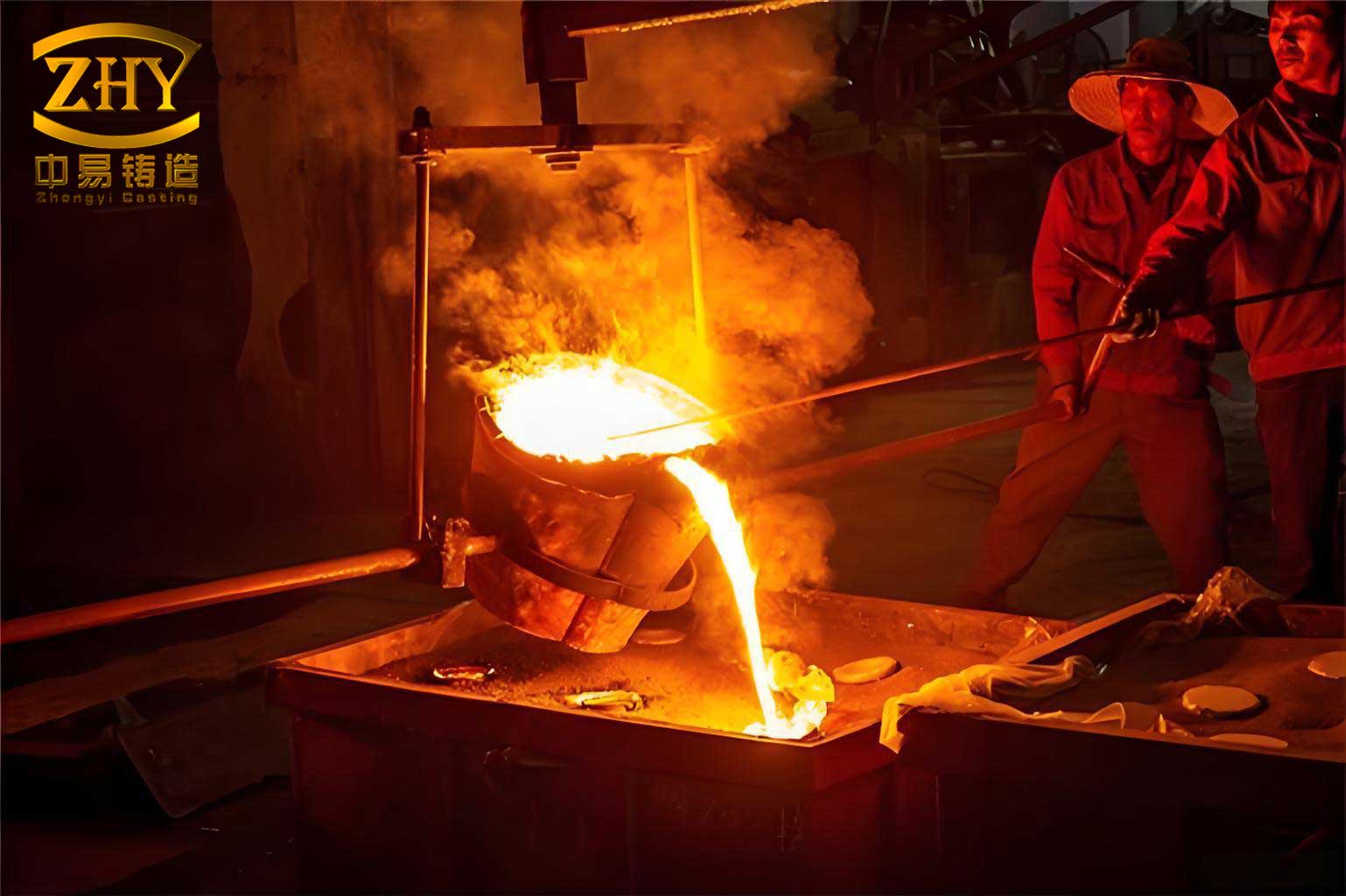
With the mold prepared, the final act of the lost foam casting process—pouring—commences. This phase is a rapid, complex interplay of heat transfer, fluid flow, and mass transfer (gas evolution).
5.1 Pouring Parameters
The established parameters for the 400-type housing were:
- Metal Grade: HT200 Gray Iron.
- Pouring Temperature: 1470°C (measured in the ladle). This is deliberately higher than for equivalent sand castings to compensate for the endothermic decomposition of the EPS pattern. The heat balance must account for the energy required to pyrolyze the foam: $$ Q_{total} = Q_{heating\ metal} + Q_{foam\ decomposition} + Q_{mold\ heating} + Q_{losses} $$
- Pouring Speed: Fast and non-interrupted. A quick pour is essential to maintain a strong thermal gradient and push decomposition products ahead of the metal front.
- Vacuum Assistance: A moderate vacuum level (approximately 0.04-0.05 MPa) was applied to the sand mold through the flask’s bottom grid. This serves two key purposes: it strengthens the unbonded sand mold, further preventing wall movement, and more importantly, it rapidly extracts gaseous foam pyrolysis products through the permeable coating, minimizing the chance of gas porosity or carbon defects in the casting.
5.2 Process Outcome and Quality Assessment
The implementation of the optimized lost foam casting process as described yielded excellent results:
- Dimensional Accuracy: The castings maintained roundness within a 1.5 mm tolerance on the major diameter, with all critical mounting and sealing surfaces requiring minimal machining.
- Surface Finish: The as-cast surface was smooth,清晰地 reproducing the foam pattern’s texture, including the sharp edges of the cooling fins. The coating peeled off cleanly.
- Internal Soundness: Radiographic and ultrasonic inspection confirmed the absence of shrinkage porosity in the heavy sections and no gas holes related to foam decomposition. The thin fin tips were completely formed.
- Productivity: The process eliminated core-making, core-setting, and mold assembly operations, streamlining production. The use of dry, reusable sand eliminated waste sand generation from binders.
6. Conclusion and Broader Implications
The successful production of large motor housings via the lost foam casting process is a testament to the method’s capability for complex, high-quality components. This experience underscores several universal principles for scaling up the lost foam casting process:
- Integral Pattern is Paramount: For critical dimensions and structural integrity, a one-piece molded pattern is non-negotiable for large castings.
- Shrinkage is Density & Process Dependent: The linear shrinkage of EPS is not a fixed value. It must be empirically determined for the specific bead density, molding, and aging cycle used, and this data must drive tooling design.
- Gating Defines Quality: For tall, thin-walled cylindrical parts, a top-gated, multi-ingate “shower” system often outperforms bottom gating by delivering hot metal to critical areas first and promoting favorable temperature gradients.
- Coating is a Functional Engineering Layer: Its composition must be tailored for strength, permeability, and stability. It is a key component in preventing distortion.
- Process Control is Holistic: Success in lost foam casting process comes from the meticulous integration and control of all steps—from bead pre-expansion and pattern aging to coating drying, sand compaction, and pouring parameters. Each stage influences the final outcome.
The lost foam casting process, as demonstrated, provides a robust, environmentally conscious, and technically superior route for manufacturing complex industrial components like large motor housings. The knowledge gained from this project, particularly in managing pattern shrinkage, preventing distortion, and optimizing filling dynamics, forms a valuable framework for applying the lost foam casting process to other large-scale and geometrically challenging castings.