
In modern manufacturing, circular parts are extensively utilized across sectors such as construction, automotive, and petrochemical industries due to their structural efficiency and load-bearing capabilities. These components often demand superior comprehensive mechanical properties and high densification to endure operational stresses. However, the casting of thin-walled circular parts, particularly medium-sized ones with large diameters and minimal wall thicknesses, presents significant challenges. Common defects like misruns, cold shuts, shrinkage porosity, and cavities frequently arise during conventional casting processes, primarily due to rapid heat dissipation and poor fluidity of molten metal. To address these issues, lost foam casting has emerged as a promising technique, offering advantages such as simplified production steps, reduced machining needs, and environmental friendliness. This study focuses on optimizing the lost foam casting process for a medium thin-walled circular part through numerical simulation and practical experimentation, aiming to enhance casting quality and productivity.
The lost foam casting process involves using a foam pattern that vaporizes upon contact with molten metal, leaving a precise cavity for casting. This method is especially beneficial for complex geometries and thin-walled structures, as it minimizes turbulence and allows for intricate designs. Previous research has demonstrated its efficacy in producing thin-walled components. For instance, studies on large-diameter thin-walled ductile iron water meter shells and flywheel housings have shown that lost foam casting can achieve high qualification rates by optimizing gating systems and process parameters. Similarly, numerical simulations using software like ProCAST have been instrumental in predicting defects and refining designs for parts such as furnace grates and pressure plates. Building on these foundations, this work investigates a step gating system and cluster casting approach for a circular part, leveraging simulation to guide production and ensure defect-free outcomes.
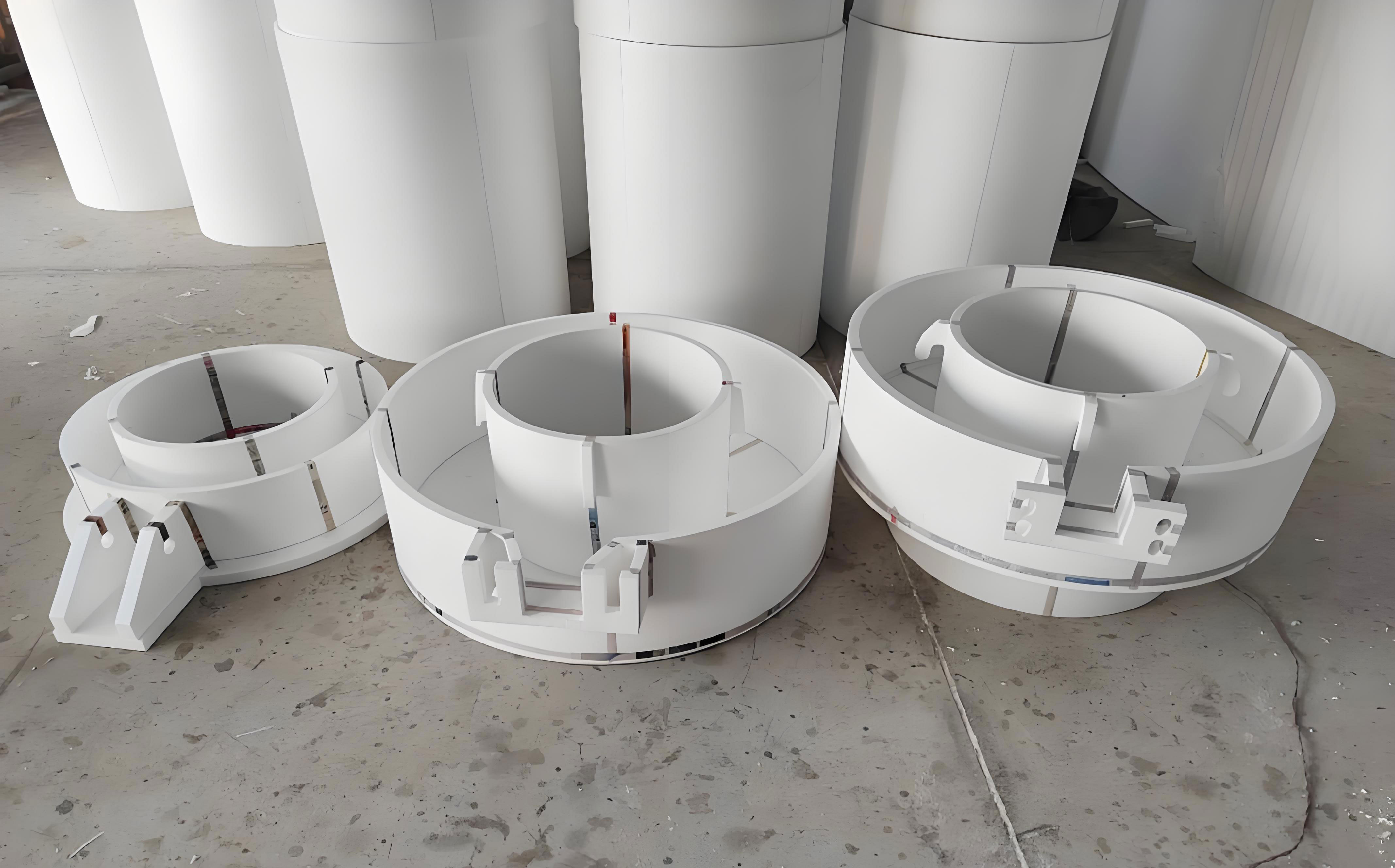
The circular part under consideration has an outer diameter of 435 mm, an inner diameter of 311 mm, with a maximum wall thickness of 19 mm and edge thickness of 10 mm, classifying it as a medium thin-walled component. Its three-dimensional model reveals a large radius-to-thickness ratio, which exacerbates cooling rates and metal flow issues during casting. In lost foam casting, the foam pattern is coated with a refractory layer and embedded in unbonded sand, where molten metal replaces the pattern. The rapid vaporization of foam can lead to gas evolution and cooling effects, necessitating careful control of pouring parameters. To mitigate defects, we designed a step gating system that facilitates simultaneous filling of multiple patterns in a cluster arrangement. This design not only improves pouring efficiency but also provides thermal compensation to maintain metal fluidity. Each pattern is equipped with two ingates, one dark riser, and one open riser to aid feeding and reduce shrinkage risks.
For numerical analysis, we employed ProCAST software to simulate the filling and solidification processes in lost foam casting. The finite element model comprised the foam pattern, coating layer, and virtual sandbox, with mesh counts of 197,343 surface elements and 421,558 volume elements. The casting material was QT500-7 ductile iron, with liquidus and solidus temperatures of 1,209.0°C and 1,127.4°C, respectively. Pouring temperature was set at 1,430 ± 10°C, with a pouring time of 30 seconds. Gating cross-sections measured 20 mm × 14 mm, and risers were sized at φ35 mm × 125 mm. The coating thickness was 2 mm, using a permeable form setting, while the sand was zircon sand (bead sand) with properties summarized in Table 1. Interfacial heat transfer coefficients between metal-coating and coating-sand were set at 500 W/(m²·K) to account for thermal interactions in lost foam casting.
| Sand Type | Mesh Size | Bulk Density (g/cm³) | Tensile Strength (MPa) | Permeability | Gas Evolution (g/cm³) |
|---|---|---|---|---|---|
| Zircon Sand | 70/140 | 2.00 | 1.8 | High | 10.28 |
The simulation of temperature fields during lost foam casting revealed a smooth filling process. At 2.05 seconds, molten metal entered the sprue for each pattern via the runner. By 5.66 seconds, metal flowed from bottom ingates into the cavity without turbulence, minimizing gas entrapment and slag defects. As filling progressed, top ingates activated at 26.73 seconds, providing thermal compensation and enhancing fluidity. Complete filling was achieved at 34.00 seconds, with no misruns observed. The cooling curve showed rapid temperature drops at inner and outer circles due to coating chill, reaching below liquidus quickly. Solidification analysis indicated that the outer layers solidified first, forming a rigid shell, while the core remained molten longer. The solid fraction evolution, governed by the Scheil equation, can be expressed as:
$$ f_s = 1 – \left( \frac{T_L – T}{T_L – T_S} \right)^{\frac{1}{k-1}} $$
where \( f_s \) is the solid fraction, \( T \) is the temperature, \( T_L \) is the liquidus temperature, \( T_S \) is the solidus temperature, and \( k \) is the partition coefficient. In lost foam casting, the cooling rate \( \frac{dT}{dt} \) is influenced by heat transfer through the coating and sand, described by Fourier’s law:
$$ q = -k \nabla T $$
with \( q \) as heat flux and \( k \) as thermal conductivity. The overall heat transfer coefficient \( h \) in lost foam casting integrates multiple layers, affecting solidification morphology.
To assess internal solidification, cross-sectional views were analyzed. At 112.60 seconds, the gating system and open risers fully solidified, ceasing feeding. However, the thin-walled design and graphite expansion in ductile iron compensated for shrinkage. The Niyama criterion, often used to predict shrinkage porosity, is given by:
$$ N_y = \frac{G}{\sqrt{\dot{T}}} $$
where \( G \) is the temperature gradient and \( \dot{T} \) is the cooling rate. In this simulation, \( N_y \) values remained above critical thresholds, indicating low shrinkage risk. Defect prediction results confirmed no cold shuts, misruns, or shrinkage porosity, attributed to the step gating design in lost foam casting. Stress analysis showed von Mises stresses below 231.2 MPa at ingate connections, with part stresses under 173.4 MPa, well under the yield strength of 320 MPa for QT500-7. Deformation analysis revealed maximum displacements of 0.63 mm in risers, but part distortion was minimal (under 0.29 mm), within machining allowances of 2 mm. Radial and axial deformations were negligible, ensuring dimensional accuracy.
| Parameter | Value | Description |
|---|---|---|
| Material | QT500-7 | Ductile iron grade |
| Liquidus Temperature | 1,209.0°C | Phase change start |
| Solidus Temperature | 1,127.4°C | Phase change end |
| Pouring Temperature | 1,430 ± 10°C | Metal temperature at pour |
| Pouring Time | 30 s | Duration of filling |
| Coating Thickness | 2 mm | Refractory layer |
| Sand Type | Zircon Sand | Bead sand for mold |
| Interfacial Heat Transfer | 500 W/(m²·K) | Metal-coating-sand interface |
For experimental validation, we conducted trial production using the optimized lost foam casting process. The foam patterns were made from STMMA (styrene-methyl methacrylate) copolymer, pre-expanded to a density of 18-20 g/L using a DH-450 intermittent pre-expansion machine. Steam pressure was controlled at 0.14-0.18 MPa, expansion chamber pressure at 0.03-0.06 MPa, and temperature at 100 ± 10°C for 30-70 seconds. After fluidized bed drying at 30 ± 5°C, beads were aged for over 24 hours before molding and assembly. Patterns were coated with a water-based refractory coating, dipped twice to achieve 1-2 mm thickness, and dried at 50°C with humidity below 10% for 72 hours. In lost foam casting, cluster arrangement of five patterns was employed, fixed with wooden strips to prevent distortion. Zircon sand of 2 ± 1 mm粒度 was used, with sandbox vacuum set at 0.06 MPa. Pouring was performed at 1,430 ± 10°C for 30 seconds, followed by 3-4 minutes of pressure holding.
The as-cast parts were cleaned and machined, revealing no defects such as shrinkage, slag inclusions, or cold shuts. Dimensional inspection confirmed roundness and flatness within tolerances, validating the simulation predictions. The success of this lost foam casting process underscores the importance of gating design and cluster casting for thin-walled components. The step gating system ensured rapid, uniform filling, while risers and graphite expansion mitigated shrinkage. Moreover, the use of zircon sand enhanced permeability and heat dissipation, critical in lost foam casting for thin walls. Compared to traditional sand casting, lost foam casting reduced scrap rates and improved surface finish, aligning with green manufacturing goals.
Further analysis of thermal dynamics in lost foam casting can be modeled using the energy equation:
$$ \rho C_p \frac{\partial T}{\partial t} = \nabla \cdot (k \nabla T) + Q_{latent} $$
where \( \rho \) is density, \( C_p \) is specific heat, and \( Q_{latent} \) is latent heat release during solidification. For ductile iron, the latent heat \( L \) affects cooling curves, and its incorporation improves simulation accuracy. In our study, the solidification time \( t_s \) for the thin wall can be estimated by:
$$ t_s = \frac{\rho L V}{h A (T_{pour} – T_{sand})} $$
with \( V \) as volume and \( A \) as surface area. The short \( t_s \) in lost foam casting necessitates fast pouring to avoid premature freezing.
| Casting Method | Misrun/Cold Shut Rate (%) | Shrinkage Porosity Rate (%) | Surface Quality | Production Efficiency |
|---|---|---|---|---|
| Lost Foam Casting | < 1 | < 0.5 | Excellent | High (cluster casting) |
| Traditional Sand Casting | 5-10 | 3-8 | Good | Moderate |
The economic and environmental benefits of lost foam casting are notable. By enabling cluster casting, pattern yield increases, reducing material waste and energy consumption per part. The foam patterns are lightweight and recyclable, minimizing environmental impact. Additionally, the precision of lost foam casting reduces machining allowances, saving time and resources. For medium thin-walled circular parts, this process offers a viable solution for mass production with consistent quality. Future work could explore alternative coatings or sand types to further enhance performance in lost foam casting.
In conclusion, this study demonstrates the efficacy of lost foam casting for producing medium thin-walled circular parts. Through numerical simulation and experimental trials, we optimized a step gating system and cluster arrangement that eliminated common defects like cold shuts and shrinkage porosity. The simulation results, validated by production, showed that temperature fields and solidification patterns in lost foam casting can be effectively controlled to ensure part integrity. The process not only achieves high dimensional accuracy but also improves production efficiency, making it a robust method for thin-walled component manufacturing. As industries demand lighter and stronger parts, lost foam casting will continue to play a pivotal role in advancing casting technology.