
Lost foam casting (LFC), also known as expendable pattern casting or full mold casting, is a transformative method that utilizes foam patterns to create precise metal components. This article explores its working principles, process flows, and the pivotal role of refractory coatings while analyzing its advantages and limitations.
1. Working Principles of Lost Foam Casting
In LFC, foam patterns (polystyrene or wax) replicating the final part geometry are assembled into clusters, coated with refractory material, and embedded in dry quartz sand under vibration. The mold is then subjected to vacuum-assisted pouring, where molten metal replaces the vaporized foam, forming the desired casting. Key equations governing foam decomposition include:
$$
\frac{dm}{dt} = -k \cdot m \cdot e^{-\frac{E_a}{RT}}
$$
where \( m \) is foam mass, \( k \) the reaction rate constant, \( E_a \) activation energy, \( R \) gas constant, and \( T \) temperature. This endothermic process ensures minimal residue and dimensional accuracy.
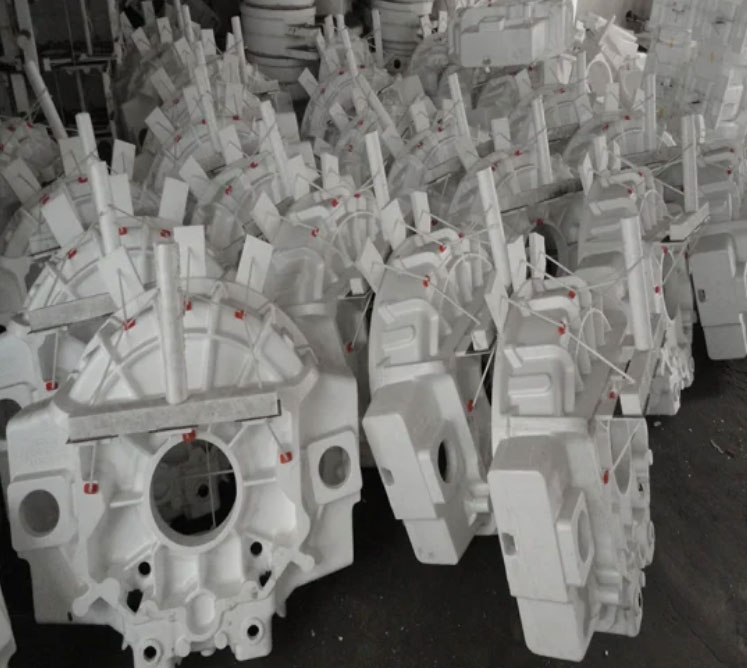
2. Process Flow: White Zone vs. Black Zone
| White Zone Processes | Black Zone Processes |
|---|---|
|
|
3. Refractory Coatings: Composition and Functions
Critical to lost foam casting success, coatings must balance gas permeability, thermal resistance, and mechanical stability. A typical formulation includes:
| Component | Weight (%) | Function |
|---|---|---|
| Zircon flour | 45–60 | High refractoriness |
| Bentonite | 3–5 | Suspension agent |
| Latex binder | 8–12 | Green strength |
| Graphite | 5–10 | Anti-sticking |
| Water | 25–35 | Carrier |
Coating permeability (\( K \)) is calculated via Darcy’s law:
$$
K = \frac{Q \cdot \mu \cdot L}{A \cdot \Delta P}
$$
where \( Q \) = gas flow rate, \( \mu \) = gas viscosity, \( L \) = coating thickness, \( A \) = area, and \( \Delta P \) = pressure gradient.
4. Advantages and Challenges
Advantages:
- Dimensional accuracy: Machining allowance reduced to 1.5–2 mm
- Cost efficiency: 40–50% lower machining vs. sand casting
- Design flexibility: No draft angles or parting lines
Defects & Solutions:
| Defect | Root Cause | Mitigation |
|---|---|---|
| Cold shuts | Insufficient pouring temp | \( T_{pour} \geq T_{liquidus} + 100^\circ C \) |
| Sand erosion | Low coating thickness | Coating ≥ 1.2 mm |
| Carbon defects | Incomplete foam pyrolysis | Vacuum > -0.05 MPa |
5. Industrial Applications and Trends
Since H.F. Shroyer’s 1958 patent, lost foam casting has been adopted for engine blocks, pump housings, and complex geometries. Recent innovations include:
- 3D-printed foam patterns for rapid prototyping
- Hybrid vacuum-pressure systems improving fill rates
- AI-driven sand compaction control
With reduced emissions (\( CO_2 \) output ≤ 0.8 kg/kg casting) and 95% sand reclamation rates, LFC aligns with circular manufacturing principles. As global markets expand, ongoing R&D in bead materials and coating nanotechnology will further enhance its competitiveness against conventional casting methods.