
The lost foam casting process, derived from full-mold casting technology, has evolved significantly since the development of China’s first production line by the Chinese Academy of Sciences in 1981. This method utilizes expandable polystyrene (EPS) or resin patterns to create complex metal components through vaporization and replacement with molten metal. Below, we explore its technical characteristics, production workflows, and critical engineering design principles.
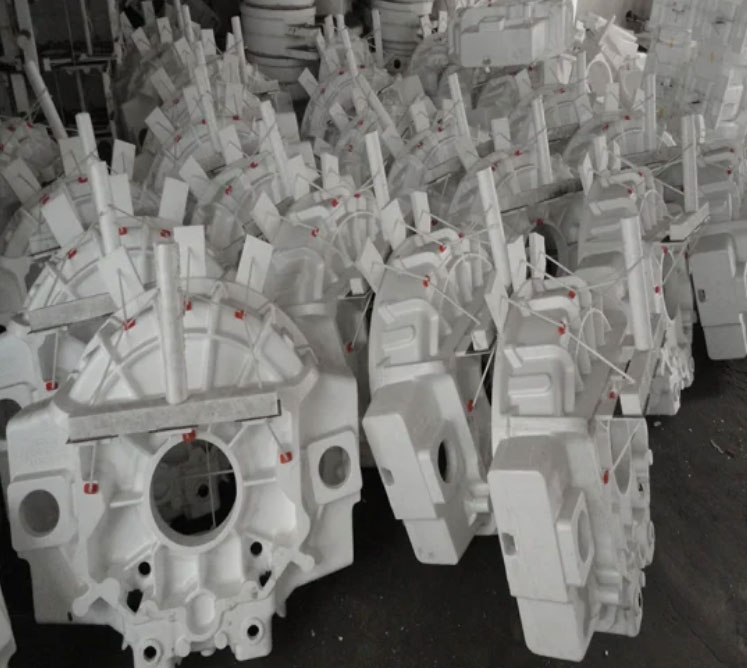
1. Key Features of Lost Foam Casting
Compared to conventional sand casting, lost foam casting demonstrates distinct advantages:
| Parameter | Lost Foam Casting | Sand Casting |
|---|---|---|
| Pattern Complexity | High (no draft angles) | Moderate |
| Core Requirements | None | Mandatory for complex geometries |
| Surface Finish (Ra) | 12.5–25 μm | 25–50 μm |
| Sand Reclamation Rate | >90% | 60–80% |
| Energy Consumption | Reduced by 15% | Baseline |
The process flow comprises three zones:
$$ \text{White Zone} \rightarrow \text{Gray Zone} \rightarrow \text{Black Zone} $$
- White Zone: Pattern fabrication (pre-expansion, aging, coating)
- Gray Zone: Cluster assembly and drying
- Black Zone: Mold filling, pouring, and cooling
2. Material Selection and Thermal Dynamics
Foam materials determine process compatibility:
| Material | Applications | Decomposition Temp. (°C) |
|---|---|---|
| EPS | Non-ferrous, gray iron | 160–200 |
| STMMA | Low-carbon steel | 220–280 |
| EPMMA | Stainless steel | 300–400 |
The gasification process follows Arrhenius kinetics:
$$ k = A \cdot e^{-\frac{E_a}{RT}} $$
Where \( k \) = decomposition rate, \( E_a \) = activation energy, and \( T \) = absolute temperature.
3. Plant Design Optimization
Modern lost foam casting facilities prioritize fire safety and spatial efficiency:
| Zone | Fire Hazard Class | Key Requirements |
|---|---|---|
| Pattern Storage | Class A | ≤5% of total area |
| White Zone | Class C | Automatic sprinklers |
| Black Zone | Class D | Standard ventilation |
Multi-level pattern workshops enhance land utilization:
$$ \text{Floor Area Efficiency} = \frac{\sum \text{Equipment Footprints}}{\text{Total Building Area}} \times 100\% $$
4. Process Parameter Optimization
Critical parameters for dimensional stability:
| Factor | Range | Impact |
|---|---|---|
| Vacuum Pressure | 0.04–0.06 MPa | Reduces gas defects |
| Vibration Frequency | 50–60 Hz | Improves sand compaction |
| Pouring Temp. | ΔT + 50°C | Prevents misruns |
The sand cooling requirement can be modeled as:
$$ Q = \dot{m} \cdot c_p \cdot \Delta T $$
Where \( \dot{m} \) = sand flow rate, \( c_p \) = specific heat (≈800 J/kg·K).
5. Economic and Environmental Benefits
Lost foam casting demonstrates superior sustainability metrics:
| Metric | Value | Regulatory Standard |
|---|---|---|
| VOC Emissions | <0.5 mg/m³ | GB 16297-1996 |
| Energy Intensity | 280 kWh/t | ISO 50001 |
| Water Reuse | 95% | ISO 14046 |
The cost reduction potential follows:
$$ C_{\text{savings}} = C_{\text{machining}} \cdot (1 – \frac{t_{\text{LFC}}}{t_{\text{sand}}}) $$
6. Future Development Trends
Emerging innovations in lost foam casting include:
- AI-driven pattern optimization algorithms
- Hybrid additive manufacturing for complex runners
- Real-time thermal monitoring via IR spectroscopy
Through continuous improvement in pattern materials, automated sand handling, and energy recovery systems, lost foam casting remains at the forefront of sustainable metal forming technologies.