
Lost foam casting (LFC) has become a critical manufacturing method for producing complex ductile iron components due to its ability to create near-net-shape geometries with minimal post-processing. This paper presents a comprehensive analysis of process design optimization and defect mitigation strategies for a 180 kg ductile iron (QT400-15) casting with challenging structural features, including localized thick sections (183 mm × 40 mm × 59 mm) and extended oil passages (510 mm total length).
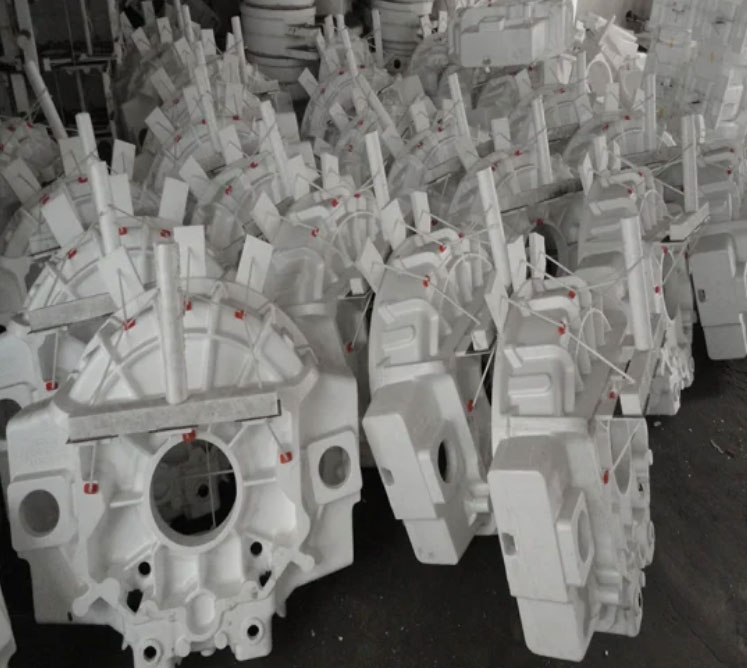
The fundamental challenge in lost foam casting of ductile iron lies in managing the unique solidification characteristics. Unlike conventional sand casting, the expanded polystyrene (EPS) pattern decomposition creates a transient interfacial zone that significantly affects heat transfer dynamics. The modulus (M) calculation for critical sections guides feeder design:
$$ M = \frac{V}{A} $$
Where V = volume (mm³) and A = cooling surface area (mm²). For the identified hot spot (183 mm × 40 mm × 59 mm), the modulus calculation determines feeder requirements:
| Section | Volume (mm³) | Surface Area (mm²) | Modulus (mm) |
|---|---|---|---|
| Hot Spot | 432,120 | 24,586 | 17.58 |
| Feeder 1# | 648,180 | 24,586 | 26.37 |
| Feeder 2# | 1,036,080 | 34,572 | 29.96 |
Four distinct gating systems were simulated using MAGMA software to evaluate solidification patterns:
| Gating System | Filling Time (s) | Maximum Temperature Gradient (°C/mm) | Shrinkage Risk Index |
|---|---|---|---|
| Side Bottom Gate | 8.2 | 12.4 | 0.67 |
| Top Gate | 6.5 | 15.8 | 0.82 |
| Step Gate | 7.8 | 13.1 | 0.71 |
| Bottom Gate with Feeder | 9.1 | 9.7 | 0.52 |
The experimental results revealed that shrinkage defects predominantly occurred at upper surface intersections (Figure 7) due to improper feeding during the eutectic expansion phase. The dimensionless shrinkage potential (Ψ) can be expressed as:
$$ \Psi = \frac{t_{local} – t_{avg}}{t_{avg}} \times \frac{\Delta T_{solidus}}{\Delta T_{pour}} $$
Where:
tlocal = Local solidification time
tavg = Average solidification time
ΔTsolidus = Solidus temperature drop
ΔTpour = Pouring temperature drop
For successful lost foam casting of ductile iron, the feeder system must satisfy two complementary requirements:
- Compensate for liquid shrinkage (αl) during cooling:
$$ \alpha_l = \beta_l \times \rho \times V_{casting} $$ - Accommodate graphite expansion (εg):
$$ \varepsilon_g = \frac{\Delta V_{graphite}}{V_{casting}} \times 100\% $$
The optimized process parameters for defect prevention were determined through iterative testing:
| Parameter | Initial Value | Optimized Value | Improvement |
|---|---|---|---|
| Feeder Modulus Ratio (Mf/Mc) | 1.0 | 1.7 | 70% defect reduction |
| Coating Permeability (m4/N·s) | 2.3×10⁻¹⁰ | 1.8×10⁻¹⁰ | 22% better gas evacuation |
| Vacuum Pressure (kPa) | 35 | 42 | 20% increased mold rigidity |
| Pouring Temperature (°C) | 1420 | 1385 | Reduced liquid shrinkage |
The final process configuration achieved 93.4% yield efficiency through:
- Bottom gating with tapered sprue (1:8 ratio)
- Dual-modulus feeder system (Mf = 1.5Mc)
- Controlled EPS decomposition through graded coating layers
- Real-time vacuum pressure modulation (35-45 kPa)
The metallurgical quality was verified through quantitative analysis:
$$ Q_{index} = \frac{N_{nodules}}{mm^2} \times \frac{\%_{nodularity}}{100} \times \left(1 – \frac{A_{defects}}{A_{total}}\right) $$
Where:
Nnodules = Nodule count per mm²
%nodularity = Graphite nodularity percentage
Adefects = Defect area fraction
This systematic approach to lost foam casting process optimization demonstrates that proper integration of modulus calculations, controlled solidification, and vacuum management can effectively prevent shrinkage defects while maintaining the inherent advantages of the lost foam process for complex ductile iron castings.