
In my extensive experience with advanced foundry techniques, the lost foam casting process stands out as a transformative method for producing complex near-net-shape components with minimal waste. This article delves into the comprehensive application of the lost foam casting process to manufacture a gray iron flywheel housing, a critical automotive part. I will systematically explore every stage, from initial design to final inspection, emphasizing key parameters and lessons learned through practical implementation. The lost foam casting process, characterized by its use of foam patterns and dry sand molds under vacuum, offers significant advantages in precision and environmental sustainability, which I aim to highlight throughout this discussion.
The lost foam casting process begins with a thorough analysis of the target component. For the gray iron flywheel housing, which typically serves in engine assemblies, the design features a large planar surface with uniform wall thicknesses ranging from 4 to 6 mm. Such geometry poses challenges in conventional sand casting, such as risks of misruns and cold shuts, but the lost foam casting process mitigates these by allowing vertical orientation and controlled metal flow. In my practice, I prioritize simulating the filling and solidification dynamics using computational tools, though here I focus on empirical insights. The part weighs approximately 20 kg and is specified to HT200 grade, requiring a tensile strength above 200 MPa and a microstructure of pearlite and ferrite with uniformly distributed graphite.
Designing the foam pattern is foundational to the lost foam casting process. I employ a vertically parted mold for EPS pattern production, as illustrated in the accompanying figure. The mold includes features like feed guns, cavities, and cooling channels to ensure consistent foam expansion. Critical dimensions are maintained to account for shrinkage during casting, typically applying a scaling factor of 2.0–2.5% for gray iron. Below is a table summarizing key mold design parameters:
| Parameter | Value | Description |
|---|---|---|
| Mold Type | Vertical Parting | Enables easy pattern ejection |
| Cavity Material | Aluminum Alloy | Good thermal conductivity for steam heating |
| Shrinkage Allowance | 2.2% | Compensates for metal contraction |
| Vent Holes Diameter | 0.5–1.0 mm | Facilitates steam escape during foaming |
The gating system design is pivotal in the lost foam casting process to ensure smooth metal flow and minimize defects. I adopt a top-pouring system with a stepped configuration, positioning ingates at the top flange of the housing to promote directional solidification. The gating ratio is set as \( F_{\text{inner}} : F_{\text{runner}} : F_{\text{sprue}} = 1.0 : 1.2 : 1.4 \), where \( F \) denotes cross-sectional area. To calculate the total ingate area, I use the hydraulic formula adapted from sand casting principles:
$$ \sum F_{\text{inner}} = \frac{G}{0.31 \mu t \sqrt{H_p}} $$
Here, \( G \) is the total mass of metal (80 kg for four pieces per mold), \( \mu \) is the flow loss coefficient (taken as 0.8 for lost foam), \( t \) is the pouring time (estimated at 12 seconds based on empirical data), and \( H_p \) is the effective pressure head (20 cm). Substituting values:
$$ \sum F_{\text{inner}} = \frac{80}{0.31 \times 0.8 \times 12 \times \sqrt{20}} \approx 13.6 \, \text{cm}^2 $$
Thus, each of the four ingates has an area of 3.4 cm², with a length of 25 mm to reduce heat loss. I use circular ceramic tubes of 35 mm diameter for sprues, enhancing flow stability. The gating system layout minimizes turbulence, which is crucial in the lost foam casting process to prevent pattern degradation and gas entrapment.
Foam pattern production is a multi-step sequence in the lost foam casting process. I select expandable polystyrene (EPS) beads, type CL600A with a pentane content of 5–6%, due to their low gas evolution and cost-effectiveness. Pre-expansion involves steam heating at 110°C under 0.2 MPa pressure to achieve a bead density of 22.6 g/L, as per the equation:
$$ \rho_{\text{final}} = \rho_{\text{initial}} \times \left( \frac{V_{\text{initial}}}{V_{\text{final}}} \right) $$
where \( \rho \) is density and \( V \) is volume. After pre-expansion, beads are conditioned in a fluidized bed for over 12 hours to stabilize moisture content below 0.5%. Molding then proceeds with steam at 0.3–0.5 MPa and cooling water at 20–30°C to form patterns with precise dimensions. The cycle times are optimized to 120 seconds per pattern, ensuring efficiency. Below, a table outlines key foam parameters:
| Process Stage | Temperature (°C) | Pressure (MPa) | Time (s) |
|---|---|---|---|
| Pre-expansion | 110 | 0.2 | 60 |
| Bead Conditioning | 25–30 | Ambient | >43200 |
| Molding | 110 | 0.3–0.5 | 120 |
| Drying | 50–60 | Ambient | 7200–14400 |
Pattern assembly and coating are critical in the lost foam casting process to ensure dimensional integrity. I manually bond foam sections using cold-set adhesives, maintaining a glue thickness of 0.1–0.3 mm at joints to prevent metal penetration. The assembled pattern is then dipped into a refractory coating, EP9511 paste diluted to a Baume degree of 85. Coating thickness is controlled to 0.5–1.0 mm via empirical checks, as described by the relationship:
$$ \delta = k \sqrt{\frac{\eta t}{\rho g}} $$
where \( \delta \) is coating thickness, \( \eta \) is viscosity, \( t \) is dipping time, \( \rho \) is density, and \( k \) is a constant. After dipping, patterns are dried at 50–60°C for 2–4 hours to remove moisture, which is vital to reduce gas defects during pouring.
Molding involves placing coated patterns in a flask filled with unbonded silica sand of AFS 30–40 fineness. I use a rain sand-filling method to evenly distribute sand around patterns, followed by compaction on a three-dimensional vibrating table. Vibration parameters are set at 50–60 Hz frequency, 0.5–1.0 mm amplitude, and acceleration of 1–2 g for 40–60 seconds to achieve optimal sand density without pattern distortion. Vacuum is applied at 0.04–0.055 MPa during and after pouring to evacuate decomposition gases. The sand temperature is kept below 50°C to prevent foam warping, as per the heat transfer equation:
$$ Q = h A (T_{\text{sand}} – T_{\text{pattern}}) $$
where \( Q \) is heat flux, \( h \) is convective coefficient, and \( A \) is surface area.
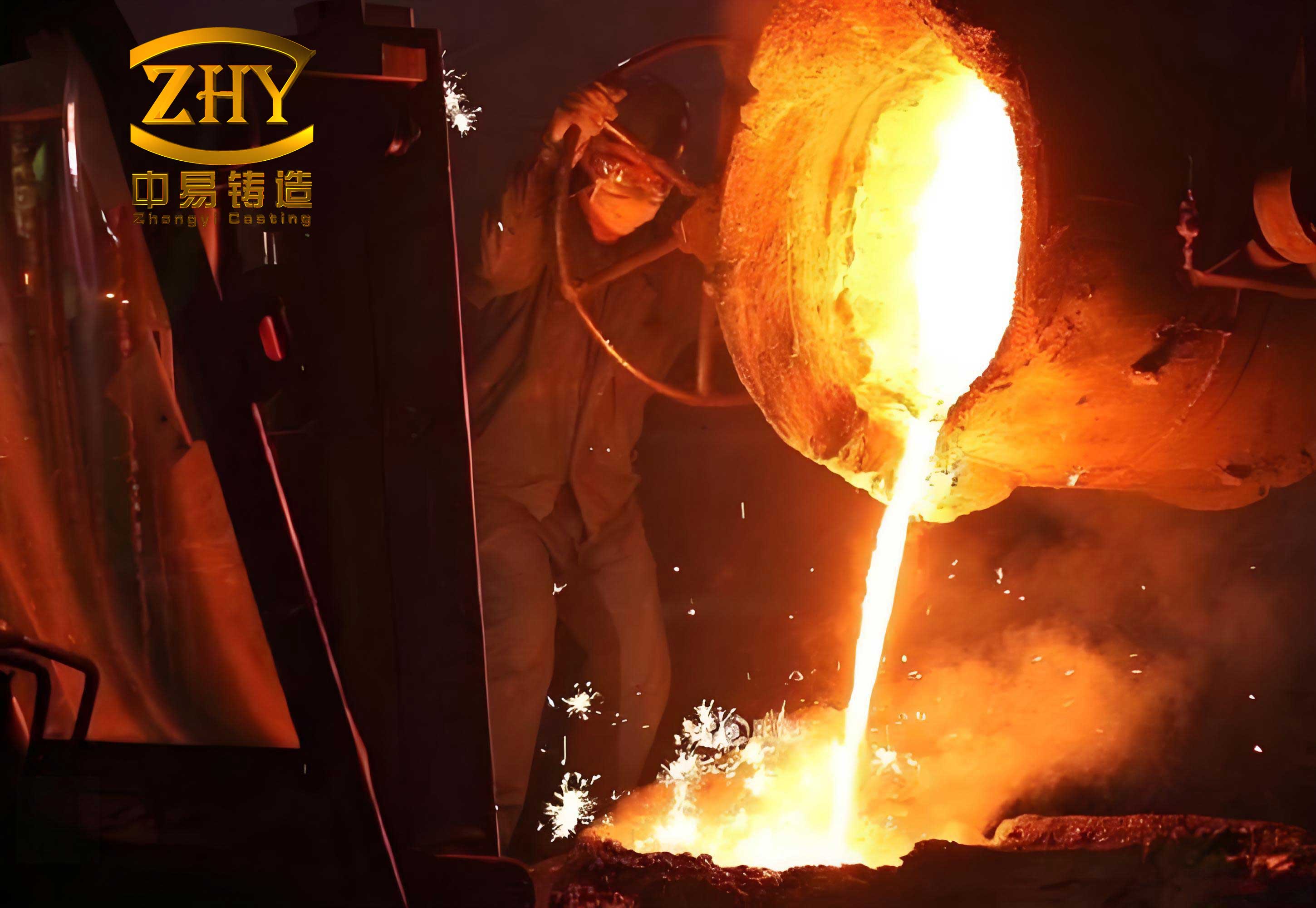
Melting and pouring are executed with precision in the lost foam casting process. I use a medium-frequency induction furnace of 2.5-ton capacity to melt gray iron charges. Chemistry is adjusted to target ranges: 3.2–3.6% C, 2.0–2.4% Si, 0.8–1.0% Mn, with P and S below 0.05%. Inoculation is done with 0.1–0.3% FeSi alloy at 1400°C to promote graphite nucleation. The pouring temperature is maintained at 1470–1480°C, calculated based on the superheat requirement:
$$ T_{\text{pour}} = T_{\text{liquidus}} + \Delta T_{\text{superheat}} $$
where \( T_{\text{liquidus}} \) for HT200 is approximately 1380°C, and \( \Delta T_{\text{superheat}} \) is 90–100°C to ensure fluidity. Pouring is completed within 12 seconds under continuous vacuum, and the gating ratio ensures minimal turbulence. After solidification, castings are shaken out and cleaned using abrasive methods to remove residual coating and gates.
Quality verification is integral to the lost foam casting process. I conduct chemical analysis via optical emission spectroscopy and tensile tests on separately cast samples. The results from multiple batches show consistency, as tabulated below:
| Sample ID | C (%) | Si (%) | Mn (%) | P (%) | S (%) | Tensile Strength (MPa) |
|---|---|---|---|---|---|---|
| 1 | 3.52 | 2.19 | 0.96 | 0.042 | 0.022 | 200 |
| 2 | 3.40 | 2.34 | 0.88 | 0.042 | 0.032 | 225 |
| 3 | 3.32 | 2.27 | 0.99 | 0.034 | 0.016 | 225 |
Metallographic examination reveals a matrix of pearlite and ferrite with type A graphite distribution, indicating effective inoculation and cooling control. The graphite morphology can be quantified using the aspect ratio formula:
$$ \text{Aspect Ratio} = \frac{L}{W} $$
where \( L \) is length and \( W \) is width of graphite flakes, typically ranging from 10 to 20 for optimal properties. These outcomes validate the robustness of the lost foam casting process for achieving desired mechanical and microstructural characteristics.
Throughout this exploration, I have emphasized the iterative refinement inherent in the lost foam casting process. Parameters such as gating design, foam density, coating thickness, and pouring conditions are interlinked; for instance, I derive a comprehensive model for defect prediction:
$$ \text{Defect Index} = \alpha \cdot \left( \frac{G}{\mu t} \right) + \beta \cdot (T_{\text{pour}} – T_{\text{min}}) + \gamma \cdot \Delta P $$
where \( \alpha, \beta, \gamma \) are empirical coefficients, and \( \Delta P \) is vacuum pressure. This holistic approach underscores the versatility of the lost foam casting process for mass-producing high-integrity castings like flywheel housings. Future advancements may integrate real-time monitoring and adaptive control, further enhancing the lost foam casting process’s efficiency and repeatability. In conclusion, the lost foam casting process, when meticulously applied, delivers superior quality with economic and environmental benefits, solidifying its role in modern foundry practice.