
As the project lead for this foundry expansion, I was entrusted with designing a modern casting facility that embodies the ethos of green manufacturing. Our objective was to establish a production line capable of manufacturing high-quality diesel engine castings—specifically cylinder blocks, cylinder heads, and transmission housings—while minimizing environmental impact, reducing energy consumption, and creating a worker-friendly environment. After extensive evaluation of various casting methodologies, we determined that the lost foam casting process was the most suitable choice. This decision was driven by its alignment with circular economy principles, its potential for clean production, and its technical suitability for the complex geometries of our target components. Throughout this design endeavor, the lost foam casting process served as our foundational technology, guiding every decision from equipment selection to facility layout.
The production mandate for the new workshop was clearly defined. We needed to meet an annual output target, which is summarized in the table below. This production纲领 formed the basis for all subsequent capacity calculations and equipment sizing.
| Product Name | Specifications (mm) | Unit Weight (kg) | Annual Production Volume (pieces) | Total Gross Weight (tons) |
|---|---|---|---|---|
| Single-Cylinder Engine Block | 500 x 300 x 200 | 50 | 80,000 | 4,000 |
| Cylinder Head | 500 x 350 x 300 | 40 | 28,000 | 1,120 |
| Transmission Housing | 600 x 250 x 200 | 25 | 2,000 | 50 |
| Total | 110,000 | 5,170 |
To translate this into operational requirements, we established a work schedule of 250 days per year. The annual operating time for general equipment was set at 1,970 hours, while for the core melting equipment, we used a base of 1,930 hours to account for maintenance. Worker hours were based on 1,750 hours annually. The total required molten metal capacity was a critical first calculation. Considering a yield rate of approximately 75% (accounting for gating systems, scrap, and melting loss), the annual molten iron demand is calculated as:
$$ Q_{metal} = \frac{P}{\eta} = \frac{5170 \text{ tons}}{0.75} \approx 6893 \text{ tons} $$
Applying an imbalance factor (k) of 1.1 to account for production peaks, the required melting capacity becomes:
$$ C_{melt} = \frac{Q_{metal} \times k}{T_{operating}} = \frac{6893 \times 1.1}{1930} \approx 3.93 \text{ tons per hour} $$
This calculation confirmed that a melting system with a capacity of around 4 tons per hour would be necessary.
The selection of the core casting process was paramount. We conducted a comparative analysis of several mainstream processes for engine castings: multi-piston squeeze molding, high-pressure static pressure lines (green sand), and the lost foam casting process. Multi-piston molding, while lower in initial investment, often results in lower mold compactness and a more polluted production environment due to binding agents, contradicting our green goals. Static pressure lines offer high efficiency and quality but require massive investment, high厂房 standards, and are economically justifiable only at very high volumes, which our adjusted production纲领 did not support. In contrast, the lost foam casting process presented compelling advantages: significantly lower capital expenditure (30-40% less than comparable clay sand processes), reduced energy consumption (10-20% less), and a 30-50% reduction in required footprint. Most importantly, it eliminates the need for cores and complex mold parting, making it ideal for intricate shapes like engine blocks and housings. Its use of unbonded dry sand aligns perfectly with the concept of green casting, minimizing waste and pollution. Therefore, the lost foam casting process was unequivocally chosen as the technological cornerstone of this project.
The lost foam casting process is a transformative method. It involves creating a foam pattern cluster that is an exact replica of the final part, coating it with a refractory slurry, embedding it in dry, unbonded sand under vibration, and then pouring molten metal under a partial vacuum. The heat of the metal vaporizes the foam pattern, allowing the metal to take its precise shape. The fundamental process flow can be visualized as follows:
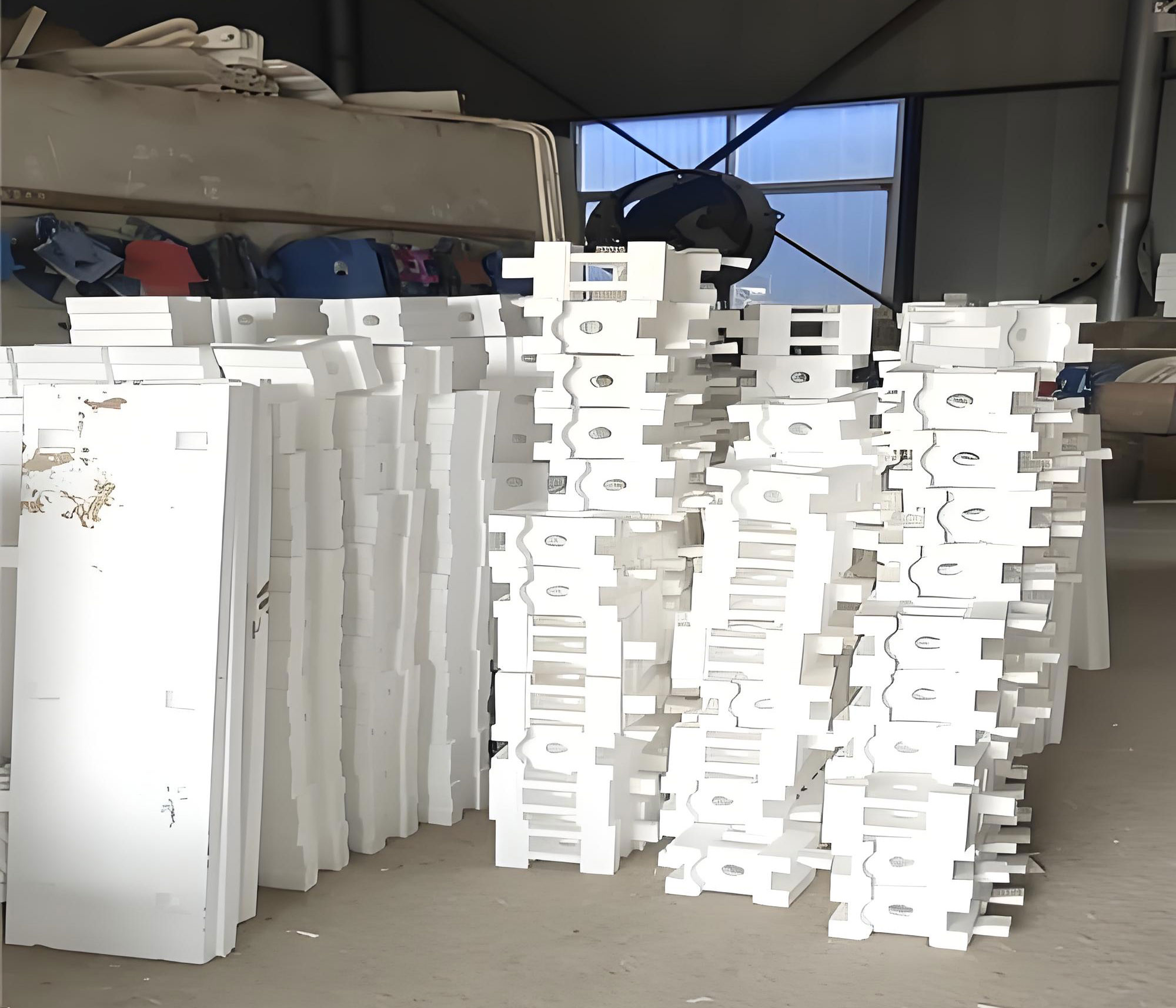
This image encapsulates the essence of the lost foam casting process, from pattern creation to casting. The流程 typically includes: raw EPS bead pre-expansion and aging; pattern molding using steam; pattern drying and aging; assembly of patterns and gating systems; application and drying of refractory coatings (often multiple layers); mold filling with sand and vibration compaction; vacuum-assisted pouring and cooling; and finally, shakeout and casting extraction. Each step in the lost foam casting process must be meticulously controlled to ensure dimensional accuracy and surface quality of the final castings.
Based on the production requirements and the characteristics of the lost foam casting process, we proceeded with detailed equipment selection for each department.
Melting Department Equipment
To meet the calculated demand of ~4 t/h, we selected two sets of 2-ton medium-frequency induction furnaces, each set configured as a “one-drag-two” system (one power supply unit serving two furnace bodies). This allows one body to melt while the other holds or pours, ensuring continuous metal supply to the automated pouring line. Each furnace body is paired with an automatic charging and batching car. The total installed melting capacity is 4 tons, comfortably exceeding our requirement. The specific power was chosen to be 1650 kW per set to ensure rapid melting and energy efficiency. The annual molten iron production capacity can be verified with the formula:
$$ A_{capacity} = N_{units} \times C_{unit} \times U_{time} \times U_{rate} $$
Where:
$N_{units}$ = Number of furnace sets (2),
$C_{unit}$ = Capacity per set (2 tons),
$U_{time}$ = Annual operating hours (1930 h),
$U_{rate}$ = Utilization rate (estimated at 0.85 for melting and holding cycles).
Thus, $$ A_{capacity} = 2 \times 2 \times 1930 \times 0.85 \approx 6562 \text{ tons} $$
This, coupled with the ability to run two melts per cycle, ensures robust coverage of the 6893-ton demand. Auxiliary equipment includes a double-girder overhead crane with an electromagnetic chuck for automated material handling, a dedicated spectrographic and thermal analysis lab for rapid chemistry control, and an advanced dust collection system with spark arrestors for each furnace.
Pattern Making (White Area) Equipment
The white area is dedicated to creating the expendable foam patterns. The process parameters were defined based on the largest and most complex parts. The pattern making sequence involves: pre-expansion of EPS beads to a controlled density; aging of beads to stabilize; steam-chest molding to form patterns; pattern drying at 30-40°C for 20-24 hours; further aging; assembly and gluing of patterns to gating systems; dipping or spraying of refractory coatings; and coating drying at 50±5°C. Multiple coating layers are applied, with total drying time exceeding 50 hours. The equipment selection was based on the required pattern throughput. Given the part mix and box loading strategy, we sized the pattern production area to support the molding line. A key calculation involves the number of patterns per molding box. Based on part dimensions, we standardized on a sandbox size of 1200 mm (L) x 1200 mm (W) x 1100 mm (H). The loading is summarized below:
| Product | Patterns per Box | Daily Box Requirement (based on 88 boxes/day for full capacity) | Annual Pattern Quantity |
|---|---|---|---|
| Engine Block | 6 | 56 boxes | 336 patterns/day |
| Cylinder Head | 4 | 30 boxes | 120 patterns/day |
| Transmission Housing | 4 | 2 boxes | 8 patterns/day |
This totals approximately 464 patterns per working day, guiding the capacity of pre-expanders, molding machines, and the footprint of drying and aging areas. The entire white area operation is designed to feed the molding line with fully processed, coated, and dried pattern clusters, a critical supply chain within the lost foam casting process.
Molding, Pouring & Cooling (Black Area) Equipment
The heart of the lost foam casting process is the black area, where sand molding, metal pouring, and in-mold cooling occur. We designed for a molding line with a cycle rate of 13 to 20 boxes per hour, providing flexibility. The line automates key steps: placing the sandbox on a 3D vibration table; adding and compacting a base layer of sand; positioning the coated pattern cluster; filling with sand and performing multi-axis vibration compaction; leveling the sand surface; sealing the box with a plastic film and connecting to the vacuum system; and moving the box to the pouring station. After pouring, boxes travel through a cooling tunnel for a minimum of 90 minutes before shakeout. The selection of a high-performance 3D vibration table is crucial, as it ensures uniform and adequate sand compaction around complex patterns, directly impacting casting quality. We specified tables with an excitation force of at least 80 kN and a load capacity of 5 tons. The sand consumption rate dictates the sand plant capacity. For a maximum rate of 20 boxes/hour, the volume of sand per box is:
$$ V_{sand} = L \times W \times H_{fill} \times \phi $$
Where L=1.2m, W=1.2m, $H_{fill}$ is the effective fill height (~1.0m), and $\phi$ is the packing density factor (~0.95). Using a sand bulk density ($\rho_{sand}$) of approximately 1.6 t/m³, the sand consumption is:
$$ Q_{sand} = R_{boxes} \times V_{sand} \times \rho_{sand} = 20 \times (1.2 \times 1.2 \times 1.0 \times 0.95) \times 1.6 \approx 43.8 \text{ tons per hour} $$
Therefore, we specified a sand treatment line with a nominal capacity of 40 t/h, with provisions for future expansion. The sand plant employs a tower design: shaken-out sand is conveyed to a magnetic separator, a rotary screen, and then to a fluidized-bed cooler to reduce sand temperature before storage and reuse. The closed-loop sand system is a key environmental benefit of the lost foam casting process, as it eliminates the need for binders and associated waste.
Sand System Calculations and Design
The sand system is critical for maintaining consistent mold quality in the lost foam casting process. Its design revolves around heat balance and sand degradation. The heat input to the sand comes from the poured castings. An approximate heat load can be estimated. Assuming an average casting weight per box of 150 kg (based on part mix), a pouring temperature of 1400°C, a sand discharge temperature of 80°C, and a specific heat of cast iron (~0.5 kJ/kg·°C), the heat transferred to the sand per box is:
$$ E_{heat/box} = m_{casting} \times c_{iron} \times (T_{pour} – T_{ambient}) \times f $$
Where $f$ is the fraction of heat absorbed by the sand (≈0.7). For 20 boxes/hour:
$$ E_{heat/hr} = 20 \times 150 \times 0.5 \times (1400-25) \times 0.7 \approx 1.44 \times 10^6 \text{ kJ/hr} $$
This heat must be removed by the sand cooler to maintain sand temperature below 50°C, ideally. The cooler capacity is selected based on this load, the specific heat of silica sand (~0.8 kJ/kg·°C), and the required temperature drop. The sand flow rate $Q_{sand}$ (in kg/hr) and temperature drop $\Delta T$ required dictate the cooling power:
$$ P_{cooling} = Q_{sand} \times c_{sand} \times \Delta T $$
For $Q_{sand}=40,000$ kg/hr, $c_{sand}=0.8$ kJ/kg·°C, and $\Delta T = 60°C$ (from 110°C to 50°C), $$ P_{cooling} = 40,000 \times 0.8 \times 60 = 1.92 \times 10^6 \text{ kJ/hr} $$
This matches the estimated heat input, validating the 40 t/h system size.
Cleaning and Finishing Department
After cooling, boxes enter an automatic shakeout station. Castings are removed, and the sand is returned to the processing loop. The castings then undergo a cleaning sequence: removal of gating systems via sawing or breaking; preliminary grinding of obvious fins and flash; shot blasting in a continuous through-feed roller conveyor type shot blast machine; inspection; and finally, dipping in a water-based anti-corrosion primer followed by drying in a convection oven. This integrated cleaning and coating line ensures castings are finished and protected for storage or shipment. The design of this area emphasizes dust control at grinding stations and vapor extraction from the paint drying oven.
Overall Workshop Layout
The facility was designed as a single large hall, approximately 153 meters long and 96 meters wide, divided into bays. The layout was meticulously planned to optimize material flow and operational efficiency around the lost foam casting process. The core principle was a “黑区-centered” linear flow. The melting zone is situated at the western end of the hall, adjacent to the raw material (metal charge) storage. Molten metal flows eastward into the central black area, which houses the molding, pouring, and cooling line, as well as the sand treatment tower. Immediately to the east of the black area is the white area—pattern making, coating, and drying. This proximity minimizes the travel distance for delicate pattern clusters. Further east is the cleaning and finishing department. Finally, the finished castings are stored in a designated area near the logistics exit on the south side. This layout creates a smooth, unidirectional flow: patterns move west to the molding line; metal moves east to the molding line; and finished castings move east to south for dispatch. Support functions like compressed air stations, vacuum pump rooms, transformer substations, and dust collector enclosures are located in ancillary rooms along the north wall or on dedicated platforms. The entire layout minimizes cross-traffic and handling, reducing energy use and improving safety—a holistic application of green design principles facilitated by the lost foam casting process.
The following table summarizes the major equipment selected for the workshop, illustrating the scale of the implementation of the lost foam casting process:
| Department | Equipment | Key Specifications | Quantity | Purpose in Lost Foam Process |
|---|---|---|---|---|
| Melting | Medium Frequency Furnace | 2-ton capacity, 1650 kW | 2 sets (4 bodies) | Provide precise, continuous molten iron for pouring. |
| Automatic Charge Car | 2-ton capacity | 4 | Automate feedstock handling for efficiency and consistency. | |
| Pattern Making | EPS Molding Machine | Steam-chest type, suitable for part size | Multiple | Produce precise foam patterns, the first critical element. |
| Coating & Drying | Coating Dip Tank / Spray Booth | Agitated slurry system | 1 set | Apply refractory coating to patterns for mold surface. |
| Drying Ovens | Temperature controlled, 50±5°C | Multiple zones | Dry coatings thoroughly to prevent casting defects. | |
| Molding & Pouring | 3D Vibration Table | 80 kN激振力, 5-ton load | Integrated into line | Compact dry sand around patterns uniformly. |
| Automatic Molding Line | 13-20 boxes/hour, 1200x1200x1100mm box | 1 line (1预留) | Automate sand filling, compaction, and box handling. | |
| Vacuum System | Pumps and manifold | 1 set | Create negative pressure for mold stability and foam removal. | |
| Sand Treatment | Complete Sand Plant | 40 t/h capacity, with cooling & screening | 1 line (1预留) | Clean, cool, and recycle dry silica sand. |
| Cleaning | Through-feed Shot Blast + Dip Line | Roller conveyor, integrated dip & dry | 1 line | Clean castings and apply protective coating. |
Environmental and Green Manufacturing Integration
A paramount objective was to realize a “green casting” facility. The lost foam casting process inherently supports this goal, and our design amplified it. Key environmental measures include: 1) **Dust Collection:** High-efficiency baghouse dust collectors are installed at every major dust generation point—melting furnace charging/tapping, shakeout, sand handling transfers, and grinding stations. The captured dust is safely disposed of. 2) **Sand Reclamation:** The 100% reuse of dry, binder-free sand in the lost foam casting process eliminates the massive solid waste stream associated with resin-bonded sand systems. 3) **Emissions Control:** The pyrolysis products from the vaporizing foam are contained within the sand mold and drawn into the vacuum system, which is typically routed through a thermal or catalytic oxidizer before release, minimizing atmospheric emissions. 4) **Energy Efficiency:** Medium-frequency furnaces offer high electrical efficiency. The sand cooling system recovers heat which can be repurposed for space heating in winter or pattern drying areas. 5) **Water Management:** The furnace cooling systems are closed-loop circuits with cooling towers, eliminating wastewater discharge. The use of a water-based primer in finishing also reduces VOC emissions compared to solvent-based paints. The formula for evaluating the environmental footprint reduction can be conceptualized as a reduction factor $R$ for waste:
$$ R_{waste} = 1 – \frac{W_{LFC}}{W_{traditional}} $$
For sand waste, $W_{LFC}$ approaches zero, while $W_{traditional}$ is significant, making $R_{waste}$ close to 1, or 100% reduction in this stream. This holistic integration of environmental controls ensures the workshop operates as a clean, modern facility, truly embodying the sustainable potential of the lost foam casting process.
Conclusion
Designing this diesel engine casting workshop around the lost foam casting process has been a comprehensive exercise in applying green engineering principles to heavy industry. From the initial production analysis and process selection through to detailed equipment specification and plant layout, every decision was made to optimize for efficiency, quality, and minimal environmental impact. The lost foam casting process proved to be the enabling technology, offering a unique combination of technical suitability for complex parts, economic advantages at our production volume, and a fundamentally cleaner operational profile compared to traditional sand casting methods. The resulting design features a highly automated flow, centered on a robust black area生产线, supported by efficient melting and pattern-making operations, and finished with an integrated cleaning process. By incorporating state-of-the-art pollution control equipment and emphasizing resource circulation—particularly the complete recycling of molding sand—the workshop stands as a model for sustainable manufacturing. It demonstrates that through careful planning and the adoption of advanced processes like lost foam casting, it is entirely possible to build a foundry that is not only productive and competitive but also responsible and aligned with the global imperative for green industry. The success of this project underscores the viability of the lost foam casting process as a cornerstone for the future of casting, especially in sectors demanding high-integrity components with complex geometries.