
The foundry industry, particularly for machine tool manufacturing, is undergoing a significant transformation driven by the need for higher precision, better surface quality, and more environmentally sustainable production methods. Traditional sand casting processes, while effective, often face challenges related to cost, environmental impact from binders, and labor intensity. In recent years, to secure a supply of high-quality castings and enhance competitiveness, many machine tool manufacturers have invested in new, modern foundry facilities. These investments focus on upgrading workshops, adopting advanced equipment, optimizing production processes, implementing new technologies and materials, and embracing modern management philosophies to produce high-value, premium-quality castings. A critical decision in such projects is the selection of the core casting process. Based on an analysis of product characteristics and extensive technical and economic evaluation, the lost foam casting process has emerged as a highly suitable solution for producing large, complex machine tool components like beds and headstocks. This article details the comprehensive design approach for a new, large-scale foundry workshop dedicated to the lost foam casting process, covering design principles, layout, process flow, key equipment selection, and supporting infrastructure.
Project Overview and Foundry Characteristics
The primary objective of this greenfield foundry project is to establish a dedicated production facility for key machine tool castings. The workshop is designed to produce bed components up to 1 meter in size and headstock castings. The annual production capacity is set at 30,000 tons of finished castings, with a detailed breakdown as follows:
| Product | Annual Output (Tons) | Key Challenge Addressed |
|---|---|---|
| Bed Castings | 13,000 | Low automation, high labor costs, insufficient production capacity. |
| Headstock Castings | 17,000 |
The total building area spans 17,000 m². The main production building consists of three 24-meter wide bays and one longitudinal bay of the same span. A separate cleaning building comprises two 18-meter wide longitudinal bays. To optimize logistics, expandable polystyrene (EPS) patterns are supplied from a dedicated pattern-making shop via an overhead conveyor system, facilitating easy retrieval and production preparation. Rough machining of the castings is handled by a separate machining workshop, with transportation between facilities managed by electric flat cars.
Foundry Design Principles
The entire workshop design was governed by a set of core principles to ensure technical excellence, economic viability, and sustainable operation:
- Adoption of Advanced Process Technology: The design must embody technological progress, selecting processes that offer superior quality, efficiency, and environmental performance. This principle led to the definitive choice of the lost foam casting process.
- Strategic Equipment Selection: For new key equipment, priority is given to domestically manufactured, advanced, and energy-efficient models, provided they meet all technical and productivity requirements. This supports the domestic equipment industry and helps control capital investment.
- Integrated Design Approach: Process layout, civil engineering, and utility systems (power, water, air) are designed in a coordinated manner. The goal is to meet all process needs while minimizing both initial construction costs and long-term operational expenses for the building and utilities.
- Commitment to Environmental, Health, and Safety Standards: The design strictly adheres to all national and local regulations concerning environmental protection, labor safety, and industrial hygiene. Social responsibility and worker well-being are considered equally important as economic returns.
Core Process Technology: Selection and Justification
Why Lost Foam Casting?
Large and medium-sized machine tool castings have traditionally been produced using furan resin sand molding. While this process offers good dimensional accuracy and surface finish, and allows for sand reclamation, it presents significant drawbacks: high raw material costs, emissions of fumes and odors from organic binders, and complex sand reclamation systems. After thorough investigation, research, and trial production, the lost foam casting process was selected for this project.
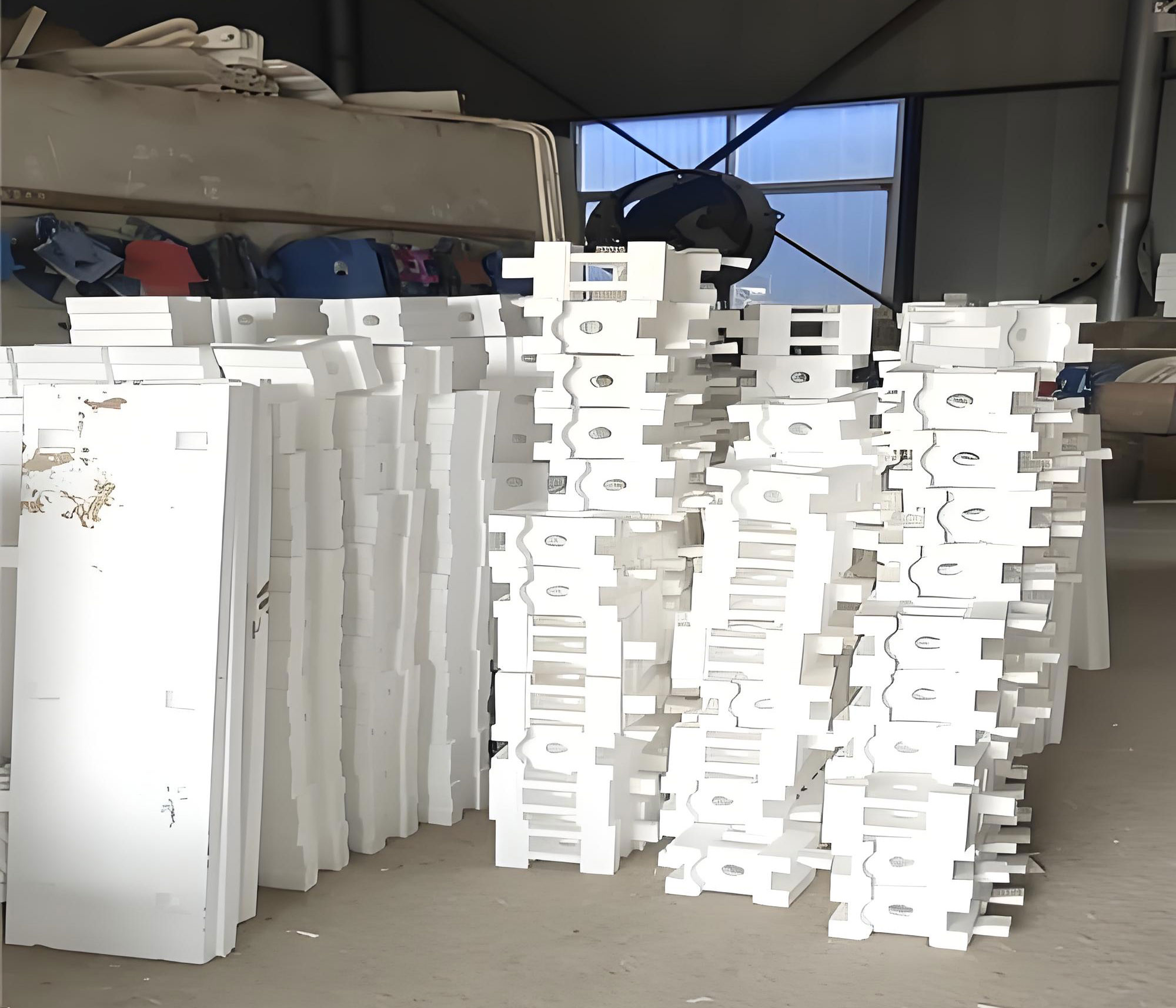
The lost foam casting process is a precision, near-net-shape casting technology recognized as a major advancement in foundry practice and hailed as a “green casting” technology for the 21st century. After decades of development, it has matured into a robust and scalable process integral to modern foundries. Its advantages are particularly compelling for the specified product range:
- Excellent Dimensional Accuracy and Surface Finish: The process yields castings with minimal draft angles, tight tolerances, and very smooth surfaces, significantly reducing subsequent machining and finishing work.
- Design Flexibility and Simplified Core Making: Complex internal geometries are formed by the EPS pattern itself, eliminating the need for separate sand cores. This simplifies mold assembly, improves accuracy, and reduces costs.
- Environmental and Economic Benefits: The process uses unbonded, free-flowing sand, which is nearly 100% dry and recyclable. There are no chemical binders, leading to a drastic reduction in air emissions and solid waste (spent sand). The sand system is simpler and less expensive to operate than chemically-bonded sand systems.
- Reduced Overall Energy Consumption: The combined effect of high yield, minimal sand preparation energy, and reduced machining leads to a lower total energy cost per ton of finished casting.
The fundamental chemical reaction during the metal pour in the lost foam casting process involves the thermal degradation of the polystyrene pattern. This can be simplified for analysis as the decomposition of styrene monomer:
$$ C_8H_8 (solid) + n O_2 \xrightarrow{\Delta} (gaseous \ products: CO, CO_2, H_2, H_2O, \ etc.) $$
Controlling this reaction through pattern coating, sand compaction, and vacuum level is key to achieving defect-free castings.
Workshop Layout and Material Flow
The foundry is designed as a multi-bay, unified building. The process layout follows the principle of logical production flow and minimal material travel distance. Key functional areas—melting, production lines, sand handling, and cleaning—are clearly zoned. Material handling within and between bays utilizes overhead cranes, electric flat cars, forklifts, and conveyor systems to maximize production flexibility and equipment utilization.
The layout features two independent, fully automated lost foam casting production lines: one dedicated to bed castings and another to headstock castings. While the lines share a similar configuration (comprising stations for molding, pattern placement, pouring, cooling, and sand processing), their specific dimensions and cycle times are tailored to the size, weight, and required cooling period of their respective products. The melting area is centrally located to efficiently feed both lines. After shakeout on the line, castings are transferred via overhead conveyor to the dedicated cleaning bay for further processing.
Detailed Process Description and Equipment Sizing
1. Production Line Specifications and Cycle Calculation
Each lost foam casting line is designed for two-shift operation. The required production capacity is calculated based on the annual output, yield rate, and operating hours. The key design parameter is the number of molds (flasks) required per hour.
For the Bed Casting Line:
Sand Flask Size: 2,700 mm (L) × 900 mm (W) × 950 mm (H).
Average Casting Weight per Flask: 0.418 tons (one casting per flask).
Annual Requirement for Good Castings: 13,000 tons.
Yield Rate (Good Castings / Total Poured Metal): Assumed at 80%. Accounting for scrap (3%) and molding losses (2%), the total metal poured must be higher.
First, calculate the total number of good flasks needed per year:
$$ N_{good} = \frac{Annual\ Output}{Avg.\ Weight/Flock} = \frac{13,000\ t}{0.418\ t/flask} \approx 31,100\ flasks $$
Considering a plant operating basis of 3,700 hours/year and an imbalance factor (K) of 1.05, the required line capacity is:
$$ R_{bed} = \frac{N_{good} \times K}{Hours} = \frac{31,100 \times 1.05}{3,700} \approx 8.8\ \frac{flasks}{hour} $$
A designed capacity of 12 flasks/hour provides a comfortable buffer and meets production demand.
For the Headstock Casting Line:
Sand Flask Size: 1,850 mm (L) × 1,150 mm (W) × 1,100 mm (H).
Average Casting Weight per Flask: 0.57 tons (two castings per flask).
Annual Requirement for Good Castings: 17,000 tons.
Number of good flasks needed:
$$ N_{good} = \frac{17,000\ t}{0.57\ t/flask} \approx 29,825\ flasks $$
Required capacity:
$$ R_{headstock} = \frac{29,825 \times 1.05}{3,700} \approx 8.5\ \frac{flasks}{hour} $$
Similarly, a designed capacity of 12 flasks/hour is selected.
2. Metal Melting System Calculation
Given the product requirements for high-quality iron and local energy considerations, medium-frequency coreless induction furnaces are selected for melting, superheating, and composition adjustment. Charge materials (pig iron, steel scrap, returns) are accurately weighed using computerized electromagnetic scales and charged via a charging bucket.
The total annual metal requirement is calculated from the product mix and yield. A metal balance is established:
| Item | Percentage of Total Metal Charge (%) | Annual Weight (Tons) |
|---|---|---|
| Good Castings | 77.0 | 30,000 |
| Gating & Risers | 15.0 | ~5,850 |
| Scrap Castings | 3.0 | ~1,170 |
| Other Losses (e.g., oxidation) | 3.0 | ~1,170 |
| Total Liquid Metal Required | 98.0 | ~38,190 |
| Melt Loss (Oxidation, etc.) | 2.0 | ~780 |
| Total Solid Charge Required | 100.0 | ~38,970 |
For simplified sizing, we use a rounded figure of 37,500 tons of solid charge. The required average melting rate is:
$$ q_m = \frac{Total\ Charge \times K}{Operating\ Hours} = \frac{37,500\ t \times 1.1}{3,700\ h} \approx 11.1\ t/h $$
To meet this demand with flexibility for maintenance and peak pouring, the design selects two sets of 6-ton capacity “one-power-supply-two-furnace” medium-frequency induction furnaces. This configuration allows one furnace to melt while the other holds or pours, ensuring a continuous supply of liquid metal to the lost foam casting lines.
3. Sand System Calculation
In the lost foam casting process, dry, unbonded silica sand is used. After shakeout, the hot sand must be cooled, screened to remove debris, and returned to storage hoppers for reuse. The sand circulation rate is high, determined by the sand-to-metal ratio (S/M).
For the Bed Casting Line: S/M Ratio = 7:1.
The required sand system capacity is calculated based on the annual metal poured for beds, including scrap and losses.
$$ Q_{sand,\ bed} = \frac{M_{bed,\ poured} \times (S/M) \times K}{Hours} $$
Where \( M_{bed,\ poured} = 13,000 t / 0.80 = 16,250 t \). Including scrap and loss factors (1.02 * 1.03 ≈ 1.05):
$$ Q_{sand,\ bed} = \frac{16,250 \times 7 \times 1.1}{3,700} \approx 33.8\ t/h $$
For the Headstock Casting Line: S/M Ratio = 5.5:1.
\( M_{headstock,\ poured} = 17,000 t / 0.80 = 21,250 t \).
$$ Q_{sand,\ headstock} = \frac{21,250 \times 5.5 \times 1.1}{3,700} \approx 34.8\ t/h $$
Therefore, each lost foam casting line is equipped with a dedicated sand handling and cooling system rated at 40 t/h, ensuring sufficient capacity for smooth operation.
4. Quality Control and Auxiliary Systems
To ensure consistent melt chemistry, a direct-reading optical emission spectrometer is installed for fast, accurate analysis of carbon, silicon, manganese, sulfur, phosphorus, and alloying elements. The sand system for each line includes vibratory screens, magnetic separators, and efficient sand coolers (typically fluidized-bed or drum-type) to maintain sand temperature below 50°C, which is critical for pattern stability and casting quality in the lost foam casting process. A centralized vacuum system serves the molding stations on both lines to ensure proper compaction of dry sand around the fragile EPS patterns.
Civil Engineering and Building Design
The structural design of the main workshop employs a clear-span portal steel frame structure with welded solid-web steel columns at a 6-meter bay spacing, providing a large, unobstructed floor space essential for flexible layout of the lost foam casting lines and material handling. Ancillary buildings (offices, labs) use reinforced concrete frame construction.
The roof and wall cladding utilize high-performance composite panels. The roof panel consists of a 0.6mm thick Alu-Zinc coated outer sheet, a 120mm thick layer of centrifugal glass wool insulation with a protective facing, and a 0.45mm thick Alu-Zinc coated inner sheet. The specified minimum coating weight (≥165 g/m²) and high yield strength (≥345 MPa outer, ≥550 MPa inner) ensure long-term durability and resistance to the foundry environment. Walls below 1.2m are constructed from solid masonry with exterior tile cladding for impact resistance, while walls above are finished with insulated composite panels.
Environmental Protection and Industrial Safety
The design incorporates comprehensive measures to protect the environment and ensure worker safety, aligning with the “green” nature of the lost foam casting process.
1. Dust and Fume Control
- Shakeout Areas: Enclosed or semi-enclosed hoods with local exhaust ventilation (LEV) capture dust during flask dumping.
- Sand Handling: All transfer points, screens, and coolers are equipped with LEV, connected to high-efficiency baghouse dust collectors.
- Cleaning Operations: Grinding, cutting, and welding stations feature downdraft tables or side-draft hoods. Each shot blasting machine incorporates an integral cyclone and bag-type dust collector.
- General Ventilation: High-volume, low-speed (HVLS) fans or roof-mounted ventilators provide general dilution ventilation to remove residual heat and fumes from pouring zones and other areas.
2. Water Management
The process is designed for minimal water consumption and zero wastewater discharge. Cooling water for furnaces, sand coolers, and vacuum pumps is circulated in closed-loop systems with cooling towers, requiring only periodic makeup for evaporation losses.
3. Safety and Noise Control
- Layout Safety: Clear, marked pedestrian aisles and adequate safety spacing around all equipment are provided. Platforms, pits, and floor openings are guarded with standard railings, ladders, or covers.
- Machine Guarding: Rotating equipment, conveyors, and press mechanisms are fitted with appropriate guards and interlocked safety devices. Pouring areas have protective screens.
- Noise Reduction: Low-noise equipment is prioritized. Enclosures, acoustic barriers, and vibration isolators are used on high-noise sources like shakeouts and air compressors. The goal is to maintain workplace noise levels below 85 dB(A).
Conclusion and Outlook
The design of this large-scale foundry centers on the strategic implementation of the lost foam casting process for machine tool components. This technology selection addresses the core needs for high dimensional accuracy, excellent surface finish, production flexibility, and environmental sustainability. The detailed layout ensures an efficient material flow, while the rigorous sizing of melting, molding, and sand systems guarantees the designed production capacity. The integration of modern pollution control and safety measures creates a responsible production facility.
The lost foam casting process, with its near-total sand reusability (exceeding 95%), elimination of binder-related emissions, and reduction in post-casting machining, significantly lowers the environmental footprint and total energy cost per ton of casting compared to traditional bonded sand methods. Data from pilot production runs confirms that the castings meet all quality specifications for machine tool applications. Upon full production, this modern lost foam casting workshop is projected to deliver substantial economic benefits through reduced operating costs and high-value output, while simultaneously achieving exemplary environmental and social performance, truly embodying the principles of advanced, green manufacturing.