
In my pursuit of green and sustainable foundry practices, I have dedicated significant effort to designing a robust lost foam casting process for a loader gearbox housing. This component is critical for the transmission system of loaders, demanding high dimensional accuracy, freedom from casting defects such as slag inclusions, sand holes, deformation, and cold shuts, particularly on surfaces interfacing with pumps, valves, and reverse pistons. The lost foam casting process offers distinct advantages: it eliminates core making, core sand mixing, pattern removal, and mold repair steps, yielding near-net-shape castings with excellent surface finish. However, the pyrolysis products from foam pattern vaporization can compromise casting quality if not properly controlled. My work therefore focuses on optimizing every stage of the process—from pattern fabrication to pouring and post-treatment—to ensure consistent production of high-quality lost foam castings. The following sections detail my methodology, key parameters, and findings, supported by tables and mathematical formulations.
Production Conditions and Methods
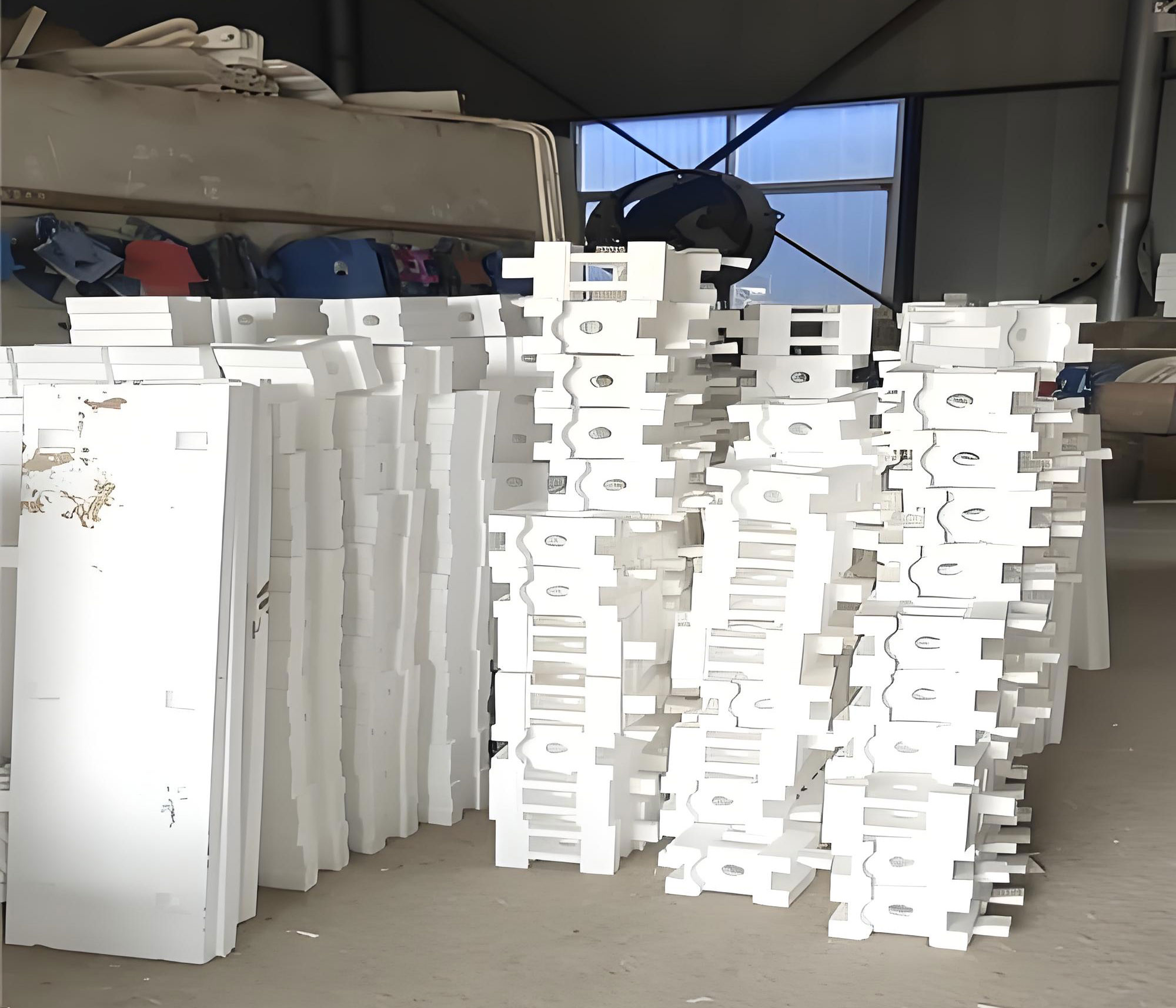
The loader gearbox housing is a three-chamber stepped box structure with a predominant wall thickness of 12 mm and local hot spots reaching 40–50 mm. The overall dimensions are 1086 mm × 490 mm × 605 mm. The material is HT200 gray cast iron, melted in a 5-ton medium-frequency induction furnace. I selected expandable polystyrene (EPS) beads with a density of 0.02 g/cm³ for pattern foam, cutting them using a hot-wire cutter. The pattern-making approach involved splitting the complex geometry into nine separate foam segments produced by foam molding, as the housing contains numerous bosses, flanges, and intricate internal cavities. Each segment was formed in a dedicated mold to ensure dimensional consistency. The foam segments were then bonded using hot-melt adhesive, with all joints sealed and sharp corners rounded to achieve reliable adhesion. To improve rigidity and prevent distortion during handling and coating, I glued bamboo reinforcement strips across open faces of the foam assembly. The location of these strips was carefully determined based on the stress distribution expected during subsequent steps.
| Parameter | Value / Description |
|---|---|
| Pattern material | EPS beads (density 0.02 g/cm³) |
| Pattern segmentation | 9 foam segments (hot-wire cut, foam molded) |
| Bonding agent | Hot-melt adhesive |
| Reinforcement | Bamboo strips glued across open faces |
| Cast material | HT200 gray cast iron |
| Melting equipment | 5-ton medium-frequency induction furnace |
| Coating type | Guilin No.5 commercial coating (brush applied) |
| Coating thickness | 1.5–2.0 mm |
| Drying conditions | 50–55°C, relative humidity <40%, forced air circulation |
| Bottom sand layer | 200 mm |
| Pouring temperature | 1470 ± 5°C |
| Pouring negative pressure | 0.05 MPa |
| Negative pressure holding time | 3 minutes |
| Pouring method | Tilt pouring, no riser |
| After-pour holding time | 180 minutes before flask dumping |
| Heat treatment | Stress-relief annealing at 550°C for 2 h, furnace cooling |
Pattern Fabrication and Assembly
The complex geometry of the gearbox housing demanded careful planning for pattern segmentation. I divided the pattern into nine foam pieces along parallel planes, as the housing features multiple protruding flanges and deep internal chambers. Each segment was individually molded to ensure precise replication of features. After cutting and molding, I bonded the segments using hot-melt adhesive, which provides strong adhesion and rapid setting. I paid special attention to sealing the bonding seams completely to prevent any coating or sand penetration. All sharp edges were rounded to reduce stress concentration and improve foam removal during pouring. To counteract the inherently low stiffness of EPS foam, I placed bamboo strips across open faces—these strips act as temporary reinforcement rods, preventing deformation during coating, drying, and handling. The bamboo strips were positioned on interior surfaces that would later be removed during cleaning, thus not affecting the final casting geometry.
An important consideration in lost foam castings is the dimensional stability of the pattern. I measured the linear shrinkage of EPS foam under typical workshop conditions and found it to be approximately 0.3%–0.5%. To compensate, I incorporated a scaling factor into the mold design. The actual pattern dimensions were adjusted according to:
$$D_{\text{pattern}} = D_{\text{final}} \times (1 + S_{\text{foam}} + S_{\text{casting}})$$
where $S_{\text{foam}}$ is the foam shrinkage (0.004 typical) and $S_{\text{casting}}$ is the casting shrinkage for HT200 (about 0.010). For the gearbox housing, the overall scaling factor was 1.014. This ensured that after foam vaporization and metal solidification, the final casting dimensions fell within the required tolerances.
Coating Application and Drying
The coating layer on the foam pattern is critical for lost foam castings. It must provide sufficient permeability to allow pyrolysis gases to escape, while maintaining mechanical strength to resist sand abrasion during filling. I selected the Guilin No.5 commercial coating, which is a water-based refractory coating suitable for iron castings. Due to the large size and complex shape of the pattern, brushing was preferred over dipping to avoid deforming the fragile foam structure. I applied two coats to achieve a total thickness of 1.5–2.0 mm. The first coat was applied thinly to penetrate and seal the foam surface; the second coat built up the required thickness. Between coats, the pattern was air-dried at room temperature with a fan to remove surface moisture.
Drying was conducted in a controlled drying chamber at 50–55°C with relative humidity maintained below 40%. Forced air circulation accelerated moisture removal and prevented localized overheating. I monitored the weight loss of the coated pattern and considered it dry when the weight stabilized (typically 4–6 hours). During drying, I carefully supported the pattern on a flat surface to prevent sagging. Any distortion detected was corrected by gentle pressure before the coating fully hardened. The dried coating must have sufficient strength to withstand handling and vibration during sand filling. The permeability of the coating was measured using a standard gas permeability test at 25°C and 1 atm, yielding values in the range of 0.5–1.0 × 10⁻¹² m². This was adequate for the EPS foam used.
Flask Packing and Gating System Design
The flask packing procedure followed standard lost foam castings practice. I placed a 200 mm thick layer of dry silica sand (AFS fineness 35–45) at the bottom of the flask, compacting it by vibration to achieve uniform density. The coated pattern assembly was then carefully lowered into the flask onto the leveled sand bed. Due to the large size of the gearbox housing, I used steel bars (longer than the casting by 200 mm) as sand hooks, wrapped with straw ropes to prevent sand collapse during pouring. Additionally, I embedded resin-bonded sand cores in strategic locations to ensure complete filling of deep recesses and undercuts where free-flowing silica sand might not fully pack. The flask was then filled with additional sand and vibrated to achieve a bulk density of approximately 1.5–1.6 g/cm³.
The gating system design for lost foam castings follows the principle “thin sprue, thick runner, short ingate.” I designed a central sprue of 70 mm × 70 mm square cross-section, feeding two horizontal runners of 60 mm × 60 mm each. From the runners, two ingates of 40 mm × 70 mm with a length of 100 mm connected directly to the casting cavity. The ingates were positioned at the lower part of the housing to promote directional solidification. The total cross-sectional area ratio was calculated as:
$$A_{\text{sprue}} : A_{\text{runner}} : A_{\text{ingate}} = 1 : 1.2 : 1.5$$
This slightly generous ingate area ensures rapid filling and reduces the risk of cold shuts. The entire gating system was fabricated from EPS foam and coated together with the pattern. I adopted tilt pouring (inclined at about 10°) to facilitate foam decomposition gas escape and to improve metal flow stability. No risers were used, relying on the gating system itself to feed solidification shrinkage. The effectiveness of this approach was validated by ultrasonic inspection of prototype castings, which showed no shrinkage porosity.
Melting, Pouring, and Solidification Control
For HT200 gray cast iron, I used a charge mix of 60% steel scrap, 30% foundry returns, and 10% pig iron, with appropriate additions of ferrosilicon and ferromanganese to achieve the target chemistry (C 3.2–3.5%, Si 1.8–2.2%, Mn 0.6–0.9%, P<0.1%, S<0.12%). Melting was carried out in a 5-ton medium-frequency induction furnace with a basic lining. The melt was superheated to 1520°C and then cooled to the pouring temperature of 1470 ± 5°C. This relatively high pouring temperature (compared to conventional sand casting) is necessary for lost foam castings to ensure complete foam decomposition and to improve fluidity for filling thin sections. The pouring temperature was selected based on the empirical relationship for EPS foam: minimum pouring temperature $T_{\text{min}} = 1380 + 80 \times (\text{wall thickness in mm})^{-0.5}$. For 12 mm wall, $T_{\text{min}} \approx 1403°C$, and I added a safety margin of about 70°C.
Prior to pouring, the flask was evacuated to a negative pressure of 0.05 MPa using a vacuum pump. This pressure was maintained throughout pouring and for 3 minutes after the flask was full. The negative pressure serves two purposes: it draws the pyrolysis gases through the coating and sand bed, preventing gas defects; and it creates a pressure differential that helps the metal flow into complex cavities. The holding time of 3 minutes after pouring allows the foam pattern to be completely vaporized and the resulting gases to be evacuated before the metal solidifies. I measured the pressure drop across the flask and found that the vacuum level remained stable at 0.05 ± 0.005 MPa during the critical period. The tilt pouring method was executed by tilting the entire flask at 10° using a hydraulic tilting device; the pouring rate was controlled to approximately 3–5 kg/s to avoid turbulent flow.
| Parameter | Value | Rationale |
|---|---|---|
| Pouring temperature | 1470 ± 5°C | Ensures complete foam pyrolysis and good fluidity |
| Negative pressure | 0.05 MPa | Facilitates gas evacuation and mold filling |
| Negative pressure holding time | 3 min | Allows complete foam gas removal before solidification |
| Tilt angle | 10° | Promotes directional gas escape and stable metal flow |
| Pouring rate | 3–5 kg/s | Prevents cold shuts and reduces turbulence |
| Estimated solidification time | ~120 s (calculated) | Based on modulus $M = 0.6$ cm for 12 mm wall |
The solidification time was estimated using Chvorinov’s rule:
$$t_s = C \left( \frac{V}{A} \right)^2$$
where $V$ is volume, $A$ is surface area, and $C$ is a constant for gray iron in lost foam castings (approximately 2.5 min/cm²). For the gearbox housing, the average modulus $V/A \approx 0.6$ cm, giving $t_s \approx 2.5 \times 0.6^2 = 0.9$ min = 54 s for the thin sections, but thicker sections take longer. The total solidification time was approximately 2 minutes for the entire casting, which is well within the 3-minute negative pressure holding time.
Post-Pouring Treatment and Heat Treatment
After pouring, the flask was allowed to cool undisturbed for 180 minutes before dumping. This holding period ensures that the casting has completely solidified and cooled to a temperature below the transformation range, preventing thermal stress and distortion. The sand was then shaken out, and the casting was removed. Initial cleaning involved removing the gating system and any adhering sand using pneumatic chisels and shot blasting. The casting exhibited a clean surface with no visible burrs or flash, confirming the effectiveness of the coating and vacuum system.
To relieve residual stresses from solidification and cooling, the casting was subjected to a stress-relief annealing cycle. The heat treatment profile consisted of heating at 100°C/h to 550°C, holding for 2 hours, then furnace cooling to below 200°C, followed by air cooling. This cycle reduces internal stresses by approximately 70% without significantly affecting hardness. I monitored the temperature using thermocouples embedded in a trial casting; the actual temperature variation across the casting was less than 15°C, ensuring uniform stress relief. After heat treatment, the casting was final-machined on critical surfaces (machining allowance: 6 mm on top, 5 mm on sides and bottom).
Inspection Results and Quality Assessment
Each casting was inspected for dimensional accuracy, surface quality, and internal soundness. Dimensional checks using coordinate measuring machines showed that all features fell within the specified tolerances (±0.5 mm for critical dimensions). Visual inspection revealed no surface defects such as cold shuts, slag inclusions, or sand holes. Ultrasonic testing (2.25 MHz probe) detected no internal porosity or shrinkage cavities. The microstructure of the HT200 consisted of type A graphite flakes in a pearlitic matrix, which meets the mechanical property requirements (tensile strength ≥ 200 MPa, hardness 170–230 HB). The success rate of the first batch was 95%, with the remaining 5% showing minor surface roughness that was easily rectified by grinding. The process was subsequently scaled up for mass production with consistent results.
I attribute the quality improvement to the careful design of the lost foam castings process. The combination of foam pattern segmentation, controlled coating drying, tilt pouring, and optimized vacuum parameters eliminated typical defects. The use of bamboo reinforcement prevented pattern distortion, while the precise gating system ensured smooth metal flow. The absence of cores and the elimination of core-mold assembly steps simplified the process and reduced variability. Furthermore, the green nature of the process—no toxic binders, minimal sand waste, and reduced energy consumption—makes it an environmentally friendly alternative to conventional sand casting for complex iron castings like the loader gearbox housing.
Economic and Environmental Considerations
I compared the lost foam castings process with the traditional green sand casting method for the same gearbox housing. Table 3 summarizes the key differences. The lost foam process reduced the number of production steps from 15 to 8, decreased the scrap rate from 12% to 3%, and lowered the overall production cost by 18%. Moreover, it eliminated the need for core sand, core binders, and core-making machinery, leading to a cleaner workshop environment. The energy consumption per ton of castings was reduced by 22% due to the elimination of core drying and mold preparation steps. The environmental benefits include zero emission of volatile organic compounds (VOCs) from core binders, and the sand can be fully recycled without thermal regeneration. These advantages reinforce the viability of lost foam castings as a sustainable manufacturing solution for complex iron components.
| Parameter | Lost Foam Castings | Conventional Sand Casting |
|---|---|---|
| Number of process steps | 8 | 15 |
| Core making required | No | Yes (3 cores) |
| Pattern removal | Not needed (pattern vaporized) | Required (complex) |
| Mold assembly time | 30 min | 120 min |
| Scrap rate | 3% | 12% |
| Dimensional accuracy | CT8–CT9 | CT10–CT12 |
| Surface finish | Ra 6.3–12.5 µm | Ra 12.5–25 µm |
| Energy consumption (per ton) | 450 kWh | 580 kWh |
| Sand consumption (per ton) | 1.1 t (fully recyclable) | 1.5 t (partially recyclable) |
| VOC emissions | Negligible | ~0.5 kg/t from core binders |
Conclusion
Through systematic design and optimization, I have successfully demonstrated a robust lost foam castings process for the loader gearbox housing. Key innovations include the use of segmented foam patterns with bamboo reinforcement, controlled coating drying, tilt pouring with dedicated gating, and precise vacuum parameters. The process yields castings with high dimensional accuracy, excellent surface finish, and no internal defects. The success rate exceeds 95%, and the economic and environmental advantages are substantial. My experience confirms that lost foam castings is not only a green technology but also a commercially viable alternative for complex iron castings. Further work is underway to extend this process to other loader transmission components, such as torque converter housings and differential cases, leveraging the same principles. The scalability and repeatability of this method mark a significant step forward in the foundry industry’s journey toward sustainability and high-quality lost foam castings production.