
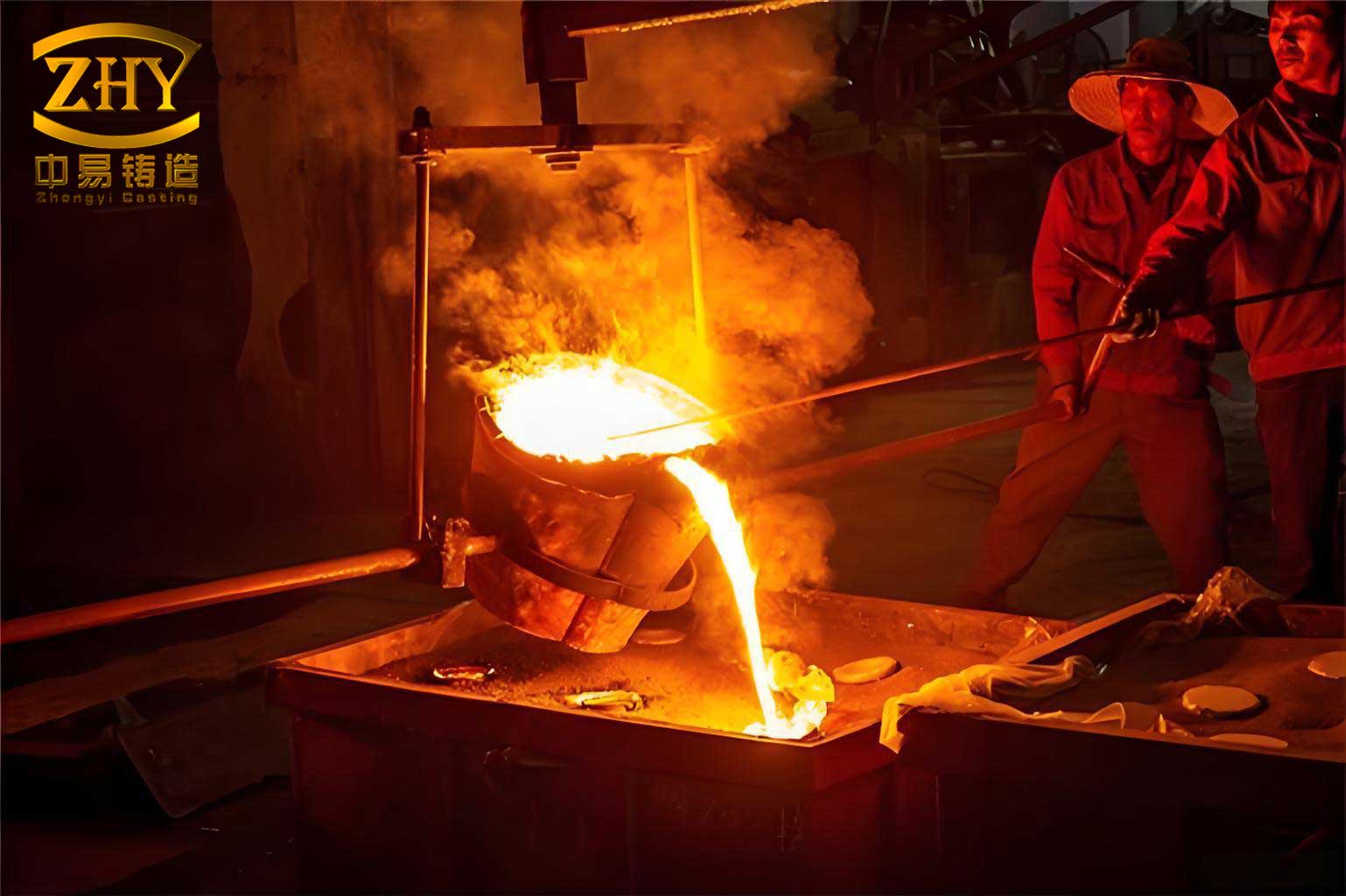
In my years of experience within the foundry and pump manufacturing industry, the quest for producing high-integrity, complex components has consistently led to the exploration and refinement of advanced casting techniques. Among these, the lost foam casting process stands out as a particularly transformative method for intricate parts. The focus of this detailed analysis is the specialized domain of designing lost foam molds for large slurry pump impellers. These impellers are the very heart of slurry pumps, critical equipment deployed in demanding sectors like mining, power generation, and metallurgy to handle abrasive and corrosive solid-laden fluids. Their performance, efficiency, and service life are directly dictated by the quality of the cast impeller. Traditional casting methods often struggle with the geometric complexity and internal soundness requirements of these components. This is where the lost foam casting process offers a compelling advantage, enabling the precise replication of complex shapes like twisted blades and internal flow passages, leading to superior dimensional accuracy and surface finish. The core principle involves creating a foam pattern (or “white model”) of the desired impeller, coating it with a refractory material, embedding it in unbonded sand, and then pouring molten metal. The metal vaporizes the foam, taking its exact shape, and solidifies into the final casting. This article delves into a comprehensive, first-person perspective on the key technologies, structural innovations, and technical challenges inherent in the mold design for these substantial and critical components.
To design an effective mold, one must first intimately understand the component it will produce. A large slurry pump impeller is a sophisticated piece of engineering. Structurally, it comprises a central hub for shaft connection, a series of vanes (typically 5 or 6), and a front and back shroud. The vanes are not simple flat plates; they are three-dimensionally twisted to efficiently impart energy to the slurry. Both shrouds often feature auxiliary “pump-out” or “back” vanes to manage pressure and seal wear. For a large impeller, diameters can exceed 1000 mm, with significant mass. The functional importance of each part is paramount: the hub must withstand high torsional stresses; the vane geometry dictates hydraulic efficiency and wear patterns; the shrouds contain the flow and define the internal passageways. Any casting defect—be it a surface imperfection on a vane, a mis-sized flow passage, or internal porosity—can drastically reduce pump performance and longevity. Therefore, the primary goal of the mold design for the foam pattern is to guarantee the flawless geometric and volumetric integrity of this pattern, as any flaw in the foam will be faithfully transferred to the final metal casting.
The design of a lost foam mold is governed by several critical, interdependent elements. Unlike conventional pattern equipment, these molds are used to produce the expendable foam patterns and must withstand a unique set of operational conditions—cyclic heating from steam, cooling, and mechanical actuation.
| Design Element | Key Considerations & Rationale | Typical Choice for Large Impellers |
|---|---|---|
| Mold Material | Must have excellent thermal conductivity for rapid heating/cooling cycles, good corrosion resistance to steam/water, sufficient strength to withstand foaming pressure, dimensional stability, and good machinability. | Aluminum Alloy (e.g., ZL104 series). It offers low density, superb thermal conductivity, excellent machinability for complex shapes, and adequate strength, making it ideal for reducing cycle times and manufacturing complexity. |
| Parting Line Determination | Critical for pattern demolding, mold machining, and assembly. Must avoid undercuts, ensure part strength, and facilitate easy removal of the fragile foam pattern. | A plane through the center of the outlet passage, perpendicular to the impeller axis. This is superior to the traditional shroud-vane fillet parting line for large impellers, as it drastically reduces the mass of complex side cores (“active blocks”). |
| Shrinkage Allowance | The mold cavity must account for the cumulative shrinkage of the foam pattern during cooling and the metal casting during solidification. | The total mold shrinkage rate is the sum of the foam shrinkage and the alloy shrinkage. The allowance is applied uniformly to the master model data used to machine the mold: $$ S_{total} = S_{foam} + S_{metal} $$ where $S_{total}$ is the scaling factor for the mold, $S_{foam}$ is the polystyrene foam contraction, and $S_{metal}$ is the contraction of the specific cast alloy (e.g., high-chromium white iron). |
| Venting System Design | Essential for allowing steam to penetrate the cavity, fuse the foam beads, and evacuate air and condensate. Poor venting leads to incomplete fusion, surface defects, and poor pattern density. | Preference for numerous, strategically placed sintered metal or plastic vent plugs over drilled holes. Vents are distributed more densely in thick sections to ensure proper heating and fusion, and more sparsely in thin areas to prevent overheating and shrinkage. The closed end contacts the pattern cavity. |
The most pivotal and challenging aspect of the design revolves around the parting line and the resulting mold structure. For a large impeller with twisted vanes, the geometry inherently creates severe undercuts relative to any simple mold opening direction. The traditional solution of parting at the back shroud and using large, heavy active blocks for each vane becomes physically impractical for an impeller over 500 mm in diameter. The mass of these blocks makes demolding hazardous; the fragile foam vane cannot withstand the force required to pull such a heavy metal block from it, leading to guaranteed pattern damage. My adopted solution is the strategic re-location of the parting plane. By splitting the pattern horizontally through the center of the outlet volute, the complex vane geometry is divided between an upper and a lower foam pattern half. This fundamentally changes the demolding mechanics and allows for a more elegant and manageable active block design.
Based on this central parting plane, two separate but coordinated molds are designed: one for the upper pattern half and one for the lower.
Upper Pattern Half Mold Structure: This assembly consists of a core upper mold plate, a lower mold plate, and the critical active block system for the vanes. The vane-shaped cavities are created not by the main plates directly, but by separate “vane reaction modules” that are assembled into the lower plate. Each module itself is split. It contains a primary reaction module body (machined separately for vent plug installation) and a smaller, lightweight, curved first active block. This active block is designed to form the undercut portion of the vane on the upper pattern half. Crucially, its contact face with the module body is a simple vertical plane, aligned with the impeller’s back shroud, making for a precise and easy-to-machine sealing interface. The block itself is hollowed out to minimize its weight. During demolding, the entire foam upper half, with these light active blocks still embedded in its vanes, is ejected. The blocks are then manually removed from the foam and returned to the mold for the next cycle. The low mass is key to preventing foam damage.
Lower Pattern Half Mold Structure: This mold mirrors the concept but is configured for the lower half of the pattern. It comprises upper and lower plates and its own set of second active blocks housed within corresponding vane reaction modules in the upper plate. These blocks form the complementary undercuts on the lower pattern half. The contact face of these blocks is a vertical plane aligned with the front shroud. Similar lightweight, hollowed construction is employed. The lower mold plate features precisely machined slots or豁口 to accommodate and locate these active blocks while maintaining uniform wall thickness for consistent steam heating.
| Feature | Traditional Shroud Parting Line | Proposed Central Flow Passage Parting Line |
|---|---|---|
| Demolding Force | Extremely high due to massive, full-vane active blocks. | Moderate; force is applied to lighter, partial-vane active blocks. |
| Pattern Damage Risk | Very High. Foam vanes are likely to tear or distort. | Low. Lightweight blocks reduce stress on foam during ejection. |
| Active Block Complexity | High (complex 3D shape, large mass). | Reduced (simpler interface plane, hollow design). |
| Mold Machining | Challenging for large, deep cavities. | Simplified into smaller, more manageable modules. |
| Operator Handling | Difficult and potentially unsafe. | Ergonomic and manageable. |
The lost foam casting process places unique demands on the mold, and its design is fraught with specific technical hurdles that require innovative solutions.
Precise Replication of Complex Geometry: Accurately machining the contoured surfaces of the vane passages and hub into the aluminum mold is paramount. This relies heavily on high-fidelity 3D CAD data and precision CNC machining. However, challenges like tool wear during long machining operations of aluminum and error stack-up can affect the final cavity dimensions. My approach involves implementing a rigorous tool management protocol, using high-performance cutting tools, and employing on-machine probing for in-process verification. The final mold geometry is often a compensated version of the nominal part geometry, accounting for the dual shrinkage factors as defined earlier: $$ Cavity_{mold} = Geometry_{part} \times (1 + S_{total}) $$ This calculation is applied to the entire digital model before toolpath generation.
Active Block Design and Demolding Dynamics: This is the core innovation and challenge. The design must ensure that the active block:
- Precisely forms the required undercut geometry.
- Seals perfectly against its reaction module to prevent foam leakage (“flashing”).
- Is lightweight enough for safe demolding.
- Has reliable guiding and locating features to ensure repeatable positioning cycle after cycle.
The hollowed design with a vertical sealing face addresses points 1, 2, and 3. For point 4, incorporating tapered guide pins and matching bushings into the block and module is essential. The demolding sequence must be carefully choreographed, often involving a slight delay or a specific mold opening sequence to allow the foam pattern to contract away from the main cavity walls before the active blocks are mechanically or manually disengaged.
Thermal Management and Distortion Control: The cyclic thermal shock from steam is a significant issue. While aluminum’s high thermal conductivity is beneficial, it also leads to rapid expansion and contraction. Over time, this can cause permanent distortion, misalignment, or even cracking at stress concentrators. My design strategy incorporates several mitigations:
- Uniform Wall Thickness: Designing mold plates and modules with consistent wall thickness promotes even heating and cooling, reducing thermal stresses.
- Strategic Ribbing: Adding reinforcing ribs in non-cavity areas increases stiffness without compromising thermal response.
- Material Selection: Using a heat-treated aluminum alloy like ZL104 provides a better balance of strength and thermal stability.
- Preventive Maintenance: Regular inspection and measurement of critical mold dimensions are necessary to catch distortion early.
The heat flux during the steaming phase can be conceptually considered, though complex to calculate precisely. Ensuring efficient venting also contributes to thermal management by allowing steam to reach all cavity areas uniformly.
Optimization of the Venting System: The placement, size, and number of vent plugs are more art than science, heavily informed by experience. An under-vented thick section will result in poorly fused, crumbly foam with low strength. An over-vented thin section can lead to excessive steam heat, causing the foam to shrink and distort. I use a heuristic approach based on section thickness:
- Map the pattern’s wall thickness from the 3D model.
- Define vent plug density zones (e.g., High, Medium, Low).
- Place vents primarily in areas facing the sand (not in areas where two foam surfaces will be glued later).
- Prototype and test, then adjust. A well-vented mold is crucial for a dimensionally stable and robust foam pattern, which is the first critical step in a successful lost foam casting process.
Looking forward, the evolution of lost foam casting process模具 design for such large components is tied to broader technological trends. The integration of additive manufacturing (3D printing) for producing conformal cooling channels within mold plates could revolutionize thermal management, further reducing cycle times and distortion. The direct 3D printing of sand molds for the foam patterns themselves is also an area of exploration for prototyping or very low-volume production. Furthermore, the incorporation of IoT sensors into molds to monitor temperature and pressure in real-time during the foaming cycle will enable data-driven process optimization and predictive maintenance. The pursuit of even more wear-resistant and thermally stable aluminum alloys or composite materials for mold construction continues. As digital twin technology matures, we can foresee simulating the entire foam expansion, steam fusion, and pattern cooling process within the virtual mold to predict and eliminate defects before any metal is cut. The lost foam casting process, empowered by these advanced design and manufacturing tools, is poised to become even more reliable and efficient, solidifying its role as a key enabler for producing the next generation of high-performance, large-scale industrial components like slurry pump impellers.