
In the realm of foundry engineering, the production of intricate sand casting parts often presents formidable challenges, particularly when dealing with components that demand high dimensional accuracy and smooth surface finishes. Through my extensive experience in sand casting processes, I have encountered numerous complex parts, such as enclosed aluminum alloy impellers with multiple twisted blades, where traditional methods fall short. The integration of lost pattern technology into sand casting has revolutionized the approach to manufacturing such sand casting parts, enabling unprecedented precision and efficiency. This article delves into my first-hand application of fusible alloy lost patterns for overall core-making in sand casting, highlighting the methodologies, analytical insights, and practical outcomes that have transformed the production of demanding sand casting parts.
The core of this innovation lies in addressing the limitations of conventional sand casting for parts with intricate internal cavities. Sand casting parts, like the impeller in question, typically feature non-machined surfaces and narrow flow channels, making core assembly a critical bottleneck. In my practice, I have observed that combined cores often introduce cumulative errors, leading to dimensional inaccuracies and increased scrap rates. To overcome this, I adopted a lost pattern technique, where the pattern itself is made from a low-melting-point alloy and melted out during core baking, facilitating the creation of a monolithic core. This approach ensures that the core retains its exact shape, thereby enhancing the fidelity of the final sand casting parts. The significance of this method extends beyond impellers to various other sand casting parts requiring complex internal geometries, offering a scalable solution for high-precision applications.
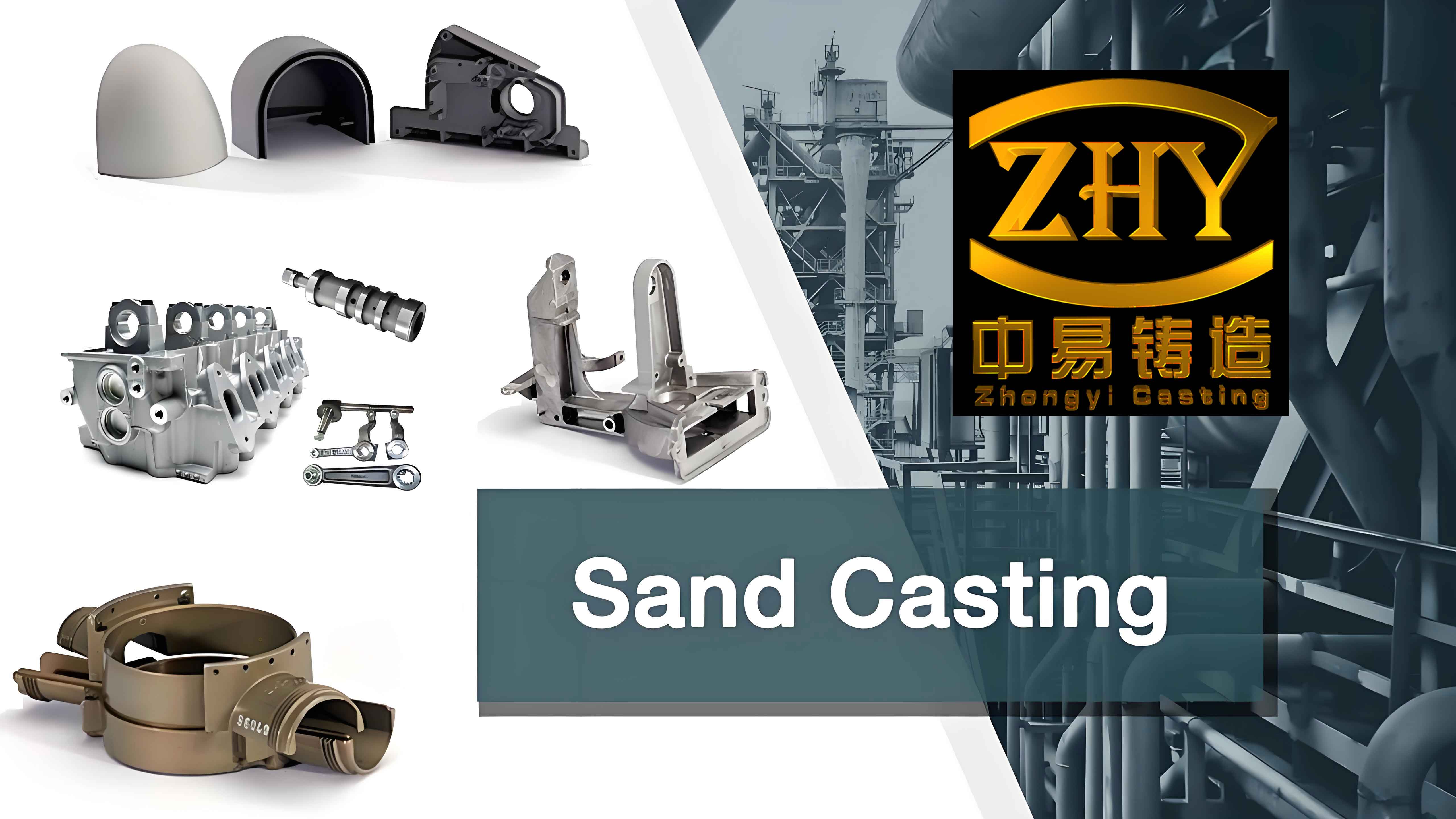
From a technical standpoint, the success of this technique hinges on a detailed process analysis. Consider an impeller with 15 blades arranged in a diameter of 50 mm, where the最小间隔 is only 6.5 mm, and the blades exhibit a twist from 31°30′ to 90°. Such sand casting parts necessitate cores with deviations no greater than 0.5 mm across a 280 mm diameter to avoid “缺肉” defects. My analysis revealed that the扭角 of the blades precludes the extraction of a solid pattern, thus mandating the use of a fusible pattern. By designing the blade pattern as a lost pattern, I achieved整体制芯, which eliminated assembly errors and ensured consistent dimensions across multiple sand casting parts. This analytical phase is crucial for任何砂型铸造零件, as it dictates the feasibility of lost pattern integration and guides subsequent manufacturing steps.
The manufacturing of the lost pattern itself is a pivotal aspect of this工艺. In my work, I have explored various materials and methods to optimize pattern performance for sand casting parts. The pattern material must have a melting temperature aligned with the core baking cycle to facilitate clean removal without damaging the sand core. Through experimentation, I identified that low-melting-point alloys with a melting range of 60–200°C are viable, but a temperature of 150 ± 5°C yields optimal results for sand casting parts. This is summarized in the table below, which correlates alloy melting points with core-making outcomes based on my trials:
| Alloy Melting Temperature (°C) | Core-Making Effect |
|---|---|
| > 200 | Sand core prone to breakage |
| 150 | High-quality sand core |
| < 100 | Sand core susceptible to deformation |
For the lost pattern, I utilized a quaternary low-melting-point alloy composed of bismuth, tin, lead, and cadmium, formulated to melt at 150 ± 5°C. This composition ensures that the pattern remains stable during core molding but flows out readily during baking, leaving a precise cavity for sand casting parts. The制造 of the lost pattern can be accomplished via sand casting or metal mold casting, each with distinct advantages for different production scales. In my experience, sand casting the pattern offers rapid prototyping for试制 or single-piece sand casting parts, though it requires additional finishing. Conversely, metal mold casting produces patterns with superior surface finish and dimensional accuracy, ideal for批量生产 of sand casting parts. The metal mold process involves creating halves from an aluminum blade pattern, as illustrated in my practice: first, casting the right half in a sand mold configured with the aluminum pattern; then, using this to cast the left half; after refining the surfaces and adding gates and vents, the metal mold is ready for pattern production. Each pattern must be inspected against a master template and weighed, with weight variations controlled within ±3 g to ensure consistency across sand casting parts.
The core-making process for these sand casting parts involves specific materials and parameters. I formulated a core sand mixture comprising 100% quartz sand (70–140 mesh), with additions of 2–2.3%桐油, 1.5%膨润土, 1%糊精, and适量 water. This配方 provides the necessary strength and collapsibility for sand casting parts. After molding the core with the lost pattern in place, the upper half of the core box is removed, and the assembly is baked in an electric furnace. The lost pattern melts and drains out, after which the core is re-baked to achieve full curing. This two-stage baking process, which I have optimized through trial and error, ensures that the core retains its shape without distortions, critical for the integrity of sand casting parts. The overall casting工艺 for the impeller, as implemented in my work, involves careful gating and riser design to facilitate metal flow and solidification, thereby minimizing defects in the final sand casting parts.
To quantify the benefits of this approach for sand casting parts, I conducted多次生产 runs. The dimensional accuracy of the impeller’s flow channels, particularly the outlet width along a 280 mm diameter, showed非平行度 deviations within 0.5 mm, surpassing standard砂型铸件 tolerances. This precision directly contributes to the performance of sand casting parts, such as achieving动平衡 offsets below 1 μ. In我的应用, two production batches totaling 13 impellers achieved a 100%合格率, demonstrating the robustness of this technique for sand casting parts. The table below summarizes key尺寸 parameters for the impeller blades, derived from my measurements, which underscore the complexity involved in producing such sand casting parts:
| Profile Diameter (mm) | Angle α | Length L (mm) | Dimensions A1-A4 (mm) | Dimensions B1-B3 (mm) |
|---|---|---|---|---|
| 50 | 47°7′ | 10.5 | 76.1, 75.1, 73.1, 71.3 | 41, 38.5, 36.7 |
| 86 | 31°30′ | 18 | 83, 71.5, 49.5, 47.5 | 63.2, 42, 32.5 |
| 134 | 33°26′ | 28.1 | 91, 68, 33.4, 31.1 | 81.5, 51.5, 25.1 |
| 160 | 62°32′ | 33.5 | 58.5, 51.2, 36.2, 28.5 | 33.3, 25.5 |
| 180 | 72°31′ | 37.7 | 47.4, 38.8, 31.5, 26.1 | 20.8, 12.5 |
| 220 | 79°7′ | 46.1 | 37.9, 35.7, 30.5, 26.1 | 6, 5 |
| 260 | 90° | 54.5 | 34.4, 34.4, 34.4, 26.1 | -8, -8, -8 |
| 280 | 90° | 58.6 | 33.3, 33.3, 34.4, 26.1 | -13, -13, -13 |
The mathematical modeling of this process further enhances its applicability to sand casting parts. For instance, the relationship between pattern melting and core baking can be expressed using heat transfer principles. The time required for the lost pattern to melt完全 can be approximated by Fourier’s law, considering the alloy’s thermal properties. In my analysis, I use the following formula to estimate the melting time \( t_m \) for a pattern of thickness \( d \):
$$ t_m = \frac{\rho \cdot L_f \cdot d^2}{2k \cdot (T_b – T_m)} $$
where \( \rho \) is the density of the alloy, \( L_f \) is the latent heat of fusion, \( k \) is the thermal conductivity, \( T_b \) is the baking temperature, and \( T_m \) is the melting temperature. This equation helps in optimizing baking cycles for various sand casting parts, ensuring efficient pattern removal without compromising core integrity. Additionally, the凝固 time of the aluminum alloy in the mold, critical for avoiding shrinkage defects in sand casting parts, can be modeled using Chvorinov’s rule:
$$ t_s = k_v \cdot \left( \frac{V}{A} \right)^n $$
where \( t_s \) is the solidification time, \( V \) is the volume of the casting, \( A \) is the surface area, \( k_v \) is a mold constant, and \( n \) is an exponent typically around 2. By applying such formulas, I can predict and control the casting parameters for sand casting parts, leading to consistent quality.
Beyond impellers, this lost pattern technique has broad implications for other sand casting parts. In my practice, I have adapted it to components like pump housings, valve bodies, and涡轮 blades, all of which benefit from整体制芯. The key is tailoring the alloy composition and pattern design to the specific requirements of each sand casting part. For example, for parts with thicker sections, I might use an alloy with a higher melting point to withstand longer baking times. Conversely, for delicate sand casting parts, a lower melting point ensures minimal thermal stress on the core. This flexibility makes the technique invaluable for diverse sand casting parts, enhancing their dimensional accuracy and surface finish across industries.
The economic and operational advantages of this method for sand casting parts are substantial. By eliminating the need for complex core assemblies, it reduces labor costs and production time. In my experience, the initial investment in pattern-making is offset by higher yield rates and reduced rework for sand casting parts. Moreover, the consistency achieved through metal mold patterns translates to better interchangeability in assembled systems, a critical factor for sand casting parts used in automotive or aerospace applications. To illustrate, I have compiled a comparison of traditional versus lost pattern methods for sand casting parts based on my data:
| Aspect | Traditional Combined Cores | Lost Pattern Overall Cores |
|---|---|---|
| Dimensional Accuracy | Moderate, with cumulative errors | High, with deviations < 0.5 mm |
| Surface Finish | Often requires post-processing | Smooth, as-cast surfaces |
| Production Cycle | Longer due to assembly | Shorter, streamlined process |
| Scrap Rate | Higher, especially for complex parts | Lower, near-zero in optimal cases |
| Applicability | Limited to simpler geometries | Broad, for intricate sand casting parts |
Looking forward, the integration of lost pattern technology with advanced sand casting techniques promises further innovations for sand casting parts. In my ongoing research, I am exploring the use of additive manufacturing to produce lost patterns directly from digital models, thereby accelerating prototyping for sand casting parts. Additionally, the development of environmentally friendly low-melting-point alloys could enhance the sustainability of this method for sand casting parts. These advancements align with the broader trend toward precision and efficiency in foundry operations, where sand casting parts continue to play a vital role in manufacturing.
In conclusion, my application of the lost pattern technique in sand casting has demonstrated its efficacy for producing high-quality sand casting parts with complex internal features. By leveraging low-melting-point alloys for整体制芯, I have achieved remarkable improvements in dimensional accuracy and surface finish for components like impellers. The methodology, encompassing careful process analysis, pattern manufacturing, and optimized core-making, provides a reliable framework for various sand casting parts. As the demand for precise sand casting parts grows, this technique offers a scalable solution that bridges traditional craftsmanship with modern engineering principles, ensuring that sand casting remains a competitive manufacturing process for intricate零件.