
The production of heavy-section sand casting parts from duplex stainless steels presents a significant metallurgical challenge, primarily centered on the control of cooling kinetics. In standard foundry practice, where sand casting parts are allowed to cool slowly within the mold, the inherent sluggish cooling rate traverses critical temperature ranges that promote the formation of brittle intermetallic phases. This phenomenon is a primary root cause of cracking, leading to high scrap rates and compromised component integrity. Based on extensive industrial experience, this article details the mechanisms behind these defects and presents a validated, production-viable cooling strategy to eliminate them, focusing specifically on thick-walled sand casting parts.
Duplex stainless steels, characterized by a microstructure comprising roughly equal proportions of ferrite and austenite, offer an exceptional combination of high strength and superior corrosion resistance, particularly in chloride-containing environments. This makes them ideal for demanding applications such as valves, pump casings, and marine components—often manufactured as large sand casting parts. The mechanical and corrosive properties are governed by maintaining this balanced two-phase structure. However, the high alloy content essential for performance—notably chromium, molybdenum, and nitrogen—also renders these steels highly susceptible to the precipitation of secondary phases during cooling, especially in the massive sections typical of heavy sand casting parts where heat extraction is slow.
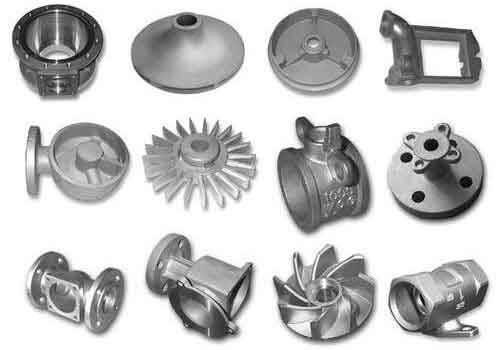
The core of the problem lies in the temperature window between approximately 600°C and 1000°C. During slow cooling, as is typical for sand casting parts left in their molds, there is sufficient time and thermal energy for atoms to diffuse and rearrange into ordered intermetallic compounds. The most deleterious of these is the sigma (σ) phase, a hard, brittle compound rich in chromium and molybdenum. Its formation is not merely a change in microstructure; it is accompanied by a localized volumetric expansion, inducing severe internal stresses. The embrittlement caused by σ phase precipitation drastically reduces the ductility and toughness of the steel, making the sand casting parts extremely vulnerable to crack initiation and propagation, often in a brittle manner. The tendency for σ phase formation increases exponentially with time within the critical temperature range, a relationship that can be conceptually described by an Arrhenius-type equation:
$$
\text{Precipitation Rate} \propto A \exp\left(-\frac{Q}{RT}\right)
$$
where \( Q \) is the activation energy for diffusion (high for Cr and Mo), \( R \) is the gas constant, \( T \) is the absolute temperature, and \( A \) is a pre-exponential factor. For thick sand casting parts, the prolonged residence time \( t \) in the 600-1000°C range makes the product \( \text{Rate} \times t \) large, leading to significant σ phase formation.
A secondary, related embrittlement mechanism occurs around 475°C, known as “475°C embrittlement.” This is primarily associated with the spinodal decomposition of the ferrite phase into chromium-rich α’ and chromium-poor α regions. While distinct from σ phase formation, it further reduces the toughness of the ferritic regions and synergistically exacerbates the overall脆性of the sand casting part if the cooling path is not properly managed. Therefore, the cooling strategy for duplex stainless steel sand casting parts must address both the high-temperature σ phase regime and the lower-temperature embrittlement zone.
Conventional wisdom for many steel sand casting parts is to allow them to cool to ambient temperature within the mold to avoid thermal shock. For duplex grades, this is a recipe for failure. Several alternative cooling methods have been explored in industrial settings, each with distinct advantages and severe limitations, especially for complex, heavy-section sand casting parts.
| Cooling Method | Procedure | Advantages | Disadvantages & Risks | Suitability for Heavy Sand Casting Parts |
|---|---|---|---|---|
| In-Mold Cooling to Ambient | Castings cool slowly in sand until completely cold. | Minimizes thermal shock; standard practice. | Maximizes σ phase & 475°C embrittlement; very high crack risk. | Not suitable. Guarantees cracking. |
| High-Temperature Quenching | Shake-out at ~900°C and immediate water quench. | Extremely rapid cooling through critical ranges; suppresses σ phase. | Extreme safety hazard (steam/sand explosions); difficult desanding; high distortion risk. | Too dangerous for production. Not viable. |
| Hot Shake-out + Furnace | Shake-out at ~900°C, transfer to hot furnace for solution treatment. | Avoids low-temperature脆性before heat treatment. | Logistically challenging; requires hot furnace; residual sand can cause furnace damage. | Impractical for most foundries. |
| Full Cooling + Subsequent HT | Cool to 100-150°C in mold, then heat treat. | Safe; easy desanding at lower temperature. | σ phase is already formed; requires very slow heating in HT to avoid cracking; long cycle time. | Risky for thick sections. Cracks may only appear after machining. |
| Controlled Forced Cooling | Hot shake-out, partial desanding, followed by forced air/mist cooling. | Rapid, controlled cooling; safe; production-friendly; suppresses σ phase. | Requires planning and equipment (fans, misters). | Highly Suitable. Optimal for complex, heavy sections. |
As the table illustrates, the method of Controlled Forced Cooling
The implementation protocol is critical. First, solidification must be complete. Using solidification simulation software, the exact time for total solidification of the sand casting part, including feeders, is determined. For a thick-section valve body weighing over 2000 kg, this may occur 3-4 hours after pouring. At this point, the sand casting part is mechanically extracted from the mold—a process known as hot shake-out. The temperature is typically between 850°C and 950°C. Immediate and complete desanding is neither safe nor feasible. Instead, a partial removal of the bulk sand and cores is performed to expose the main casting surfaces and improve heat transfer efficiency.
The core of the process follows: the sand casting part is immediately placed in a cooling station equipped with high-capacity directional fans. For optimal results, the sand casting part is positioned on a grating to allow airflow on all sides, and the fans are directed at the thickest sections—the thermal “hot spots.” The forced convection dramatically increases the heat transfer coefficient \( h \) compared to still air, which governs the cooling rate according to Newton’s law of cooling and the Biot number for the sand casting part geometry. The enhanced cooling rate \( v_c \) can be estimated for a plate-like section of thickness \( L \) by:
$$
v_c \approx \frac{T – T_{\text{air}}}{ \rho C_p \left( \frac{L}{2k} + \frac{1}{h} \right)^{-1} }
$$
where \( \rho \) is density, \( C_p \) is heat capacity, \( k \) is thermal conductivity, and \( T_{\text{air}} \) is the ambient air temperature. Increasing \( h \) via forced air directly increases \( v_c \).
For exceptionally heavy sections or highly restrained geometries, an even faster rate is needed. Here, a combination of water mist and forced air (air-mist cooling) is employed. The fine mist evaporating on the surface of the sand casting part absorbs a tremendous amount of latent heat, providing a cooling rate intermediate between air and full water quenching, but without the risks of bulk water contact. The cooling process is continued until the sand casting part’s temperature is well below 600°C, typically to around 300-400°C, ensuring a rapid transit through the entire σ phase formation zone. Subsequently, the sand casting part can be allowed to cool more slowly to ambient temperature for final cleaning, or proceed directly to cutting of feeders and gates if the temperature is sufficiently low to avoid introducing new stresses.
This method successfully addresses the 475°C脆性as well, as the faster cooling rate through this lower temperature range also suppresses the kinetics of ferrite decomposition. The final, essential step to dissolve any minor precipitates and restore the optimal duplex balance is a solution annealing heat treatment. The parameters for this treatment are crucial and depend on the specific grade, but generally involve holding at 1020-1100°C followed by rapid quenching in water. The prior controlled cooling step ensures the sand casting part enters this heat treatment without gross cracks or excessive σ phase, which might not be fully dissolved otherwise.
| Process Step | Key Parameter | Objective | Typical Value for A995-5A |
|---|---|---|---|
| Hot Shake-out | Temperature | Begin fast cooling before σ phase nucleation. | > 850°C |
| Forced Air Cooling | Air Velocity / Heat Transfer Coefficient (h) | Maximize cooling rate between 1000°C and 600°C. | h > 50 W/m²K (vs. ~5 for still air) |
| Cooling End Point | Temperature | Ensure passage through lower脆性range. | 300 – 400°C |
| Solution Annealing | Temperature & Time | Dissolve precipitates, restore phase balance. | 1040-1080°C, 1-2 hours per inch of thickness |
| Final Quench | Quench Medium | Preserve high-temperature microstructure. | Water |
The effectiveness of this approach is not merely operational but is grounded in physical metallurgy. The time-temperature-transformation (TTT) diagram for duplex stainless steels shows a pronounced “C-curve” for σ phase precipitation. The nose of this curve, where transformation occurs most rapidly, typically lies between 800°C and 900°C. The goal of forced cooling is to bypass this nose entirely. The critical cooling rate \( v_{crit} \) to avoid a specific volume fraction of σ phase can be derived from the TTT diagram. For a heavy sand casting part, achieving \( v_c > v_{crit} \) in the core is the challenge. While the surface cools quickly, the core lags. The temperature difference \( \Delta T \) within a sand casting part of characteristic dimension \( L \) cooling with a surface heat transfer coefficient \( h \) is governed by the Biot number \( Bi = hL/k \). For large \( Bi \) numbers (high \( h \) or large \( L \)), internal thermal gradients are significant. Therefore, the cooling strategy must be designed to ensure that even the thermal centerline experiences a cooling rate above \( v_{crit} \) through the critical range, which is why aggressive surface cooling (high \( h \)) is mandatory for thick sand casting parts.
Furthermore, composition plays a synergistic role with cooling rate. While the cooling strategy is paramount, tighter control of the balance between ferrite stabilizers (Cr, Mo, Si) and austenite stabilizers (Ni, N, C) can shift the TTT curves and improve the hardenability—the ability to suppress undesirable phases upon cooling. For sand casting parts, where segregation can occur, this is vital. The Pitting Resistance Equivalent Number (PREN) is a key metric for corrosion resistance, but the phase balance is critical for fabricability:
$$
\text{Ferrite Number (FN)} \approx f(Cr, Mo, Ni, N, …)
$$
Modern predictive formulas based on Schaeffler or DeLong diagrams modified for nitrogen are used to target an FN of 40-60 in the final heat-treated condition. Off-target chemistry can make even an optimized cooling process ineffective against cracking.
| Element | Role in Duplex Steel | Influence on Cracking Tendency | Target for Cast A995-5A |
|---|---|---|---|
| Chromium (Cr) | Primary ferrite stabilizer; increases corrosion resistance. | High Cr promotes σ phase formation. Essential but must be balanced. | 24.0-26.0% |
| Nickel (Ni) | Austenite stabilizer; increases toughness. | Balances ferrite/austenite; low Ni leads to excess ferrite, promoting σ phase. | 6.0-8.0% |
| Molybdenum (Mo) | Ferrite stabilizer; increases pitting resistance. | Strong promoter of σ phase; critical to control. | 4.0-5.0% |
| Nitrogen (N) | Powerful austenite stabilizer; increases strength. | Balances microstructure; suppresses excessive ferrite; key for weldability and phase stability. | 0.10-0.30% |
| Carbon (C) | Austenite stabilizer at high temperatures. | Very low levels required to avoid chromium carbides, which deplete Cr and can act as crack initiators. | < 0.03% |
In conclusion, preventing cracks in heavy-section duplex stainless steel sand casting parts is a multifaceted challenge that hinges on overriding the material’s natural tendency to form embrittling phases during slow cooling. The traditional foundry paradigm of in-mold cooling is entirely unsuitable. Among the various alternatives, a systematic approach of hot shake-out followed by controlled forced air or air-mist cooling has proven to be the most reliable, safe, and scalable industrial solution. This method actively manipulates the cooling curve to minimize the time spent in the critical σ phase precipitation window, a principle supported by the kinetics of diffusion-controlled transformations. Its success is evidenced by the consistent production of sound, crack-free heavy sand casting parts that pass rigorous non-destructive testing. This cooling strategy, coupled with precise chemical composition control and a correctly executed final solution heat treatment, forms an integrated manufacturing protocol essential for unlocking the full performance potential of duplex stainless steel sand casting parts in the most demanding applications. The methodology underscores a broader principle in advanced metal casting: for high-performance alloys, thermal management after solidification is as critically important as the pouring process itself.