
In my extensive experience with foundry operations, the production of tall, intricate components using the evaporative pattern casting process presents a unique set of challenges, particularly for grey iron casting. The inherent complexities of the method, combined with the specific solidification characteristics of grey iron, can lead to a variety of defects that significantly impact yield and component integrity. This analysis synthesizes practical insights and technical principles to delve deep into the defect mechanisms and present a comprehensive framework for their prevention.
The core challenge lies in managing the thermal decomposition of the expendable foam pattern—typically EPS (Expanded Polystyrene)—during the pouring of molten iron. For a successful grey iron casting, the pattern must degrade cleanly, allowing the metal to replicate the mold cavity precisely without incorporating residues or trapped gases. When casting tall components (e.g., heights exceeding 700mm), additional factors like significant metallostatic pressure and pronounced thermal gradients come into play, exacerbating potential issues. The primary defects encountered, as observed in complex parts with critical wall thicknesses around 12mm, are carbonaceous films (fold/wrinkle defects), gas and shrinkage porosity, and non-metallic inclusions leading to leaks under pressure. These defects often interrelate, making their simultaneous elimination a demanding task.
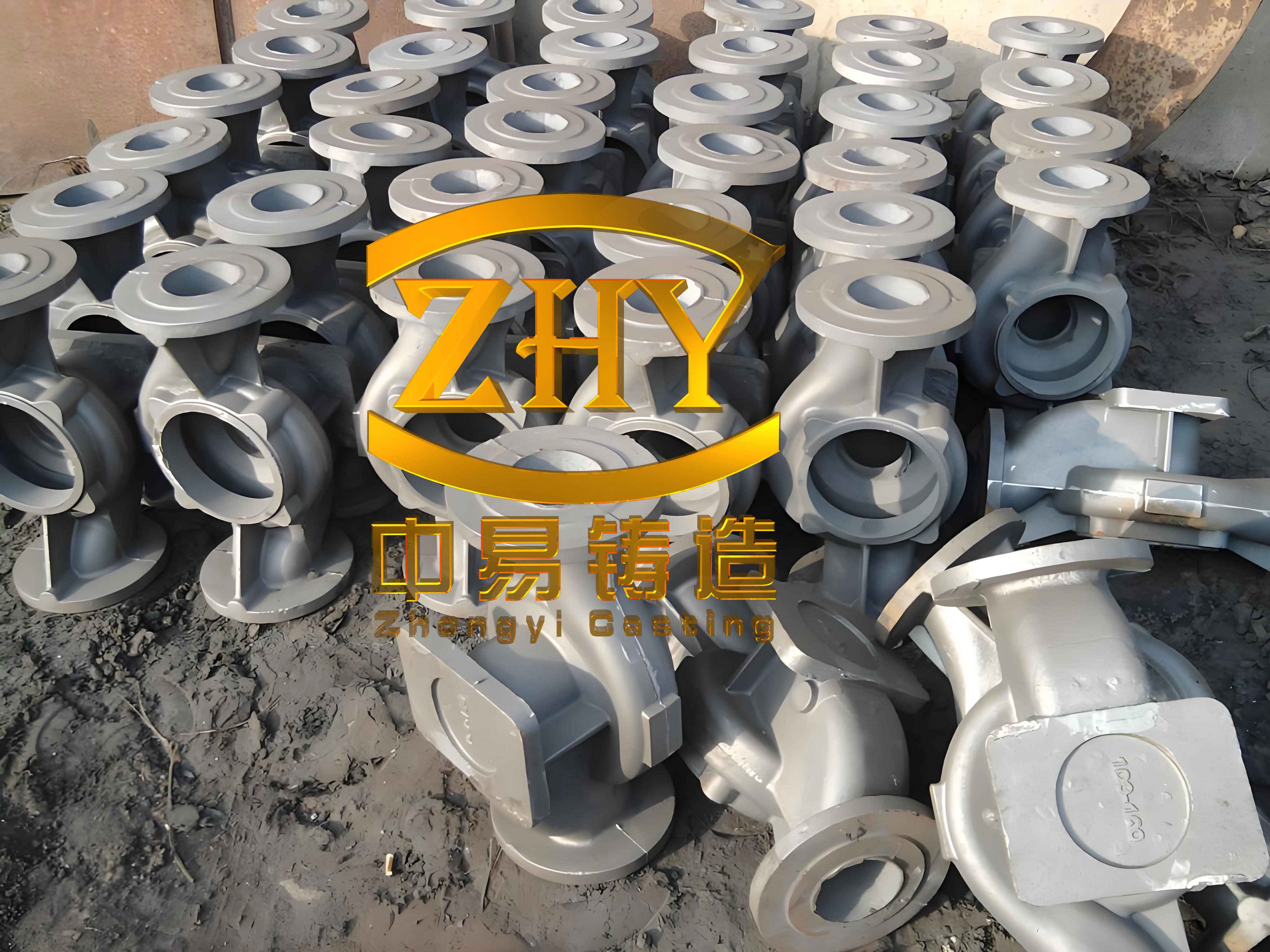
The formation of lustrous carbon or fold defects on large, flat surfaces is perhaps the most visually prominent issue in evaporative pattern casting of grey iron. This defect manifests as a wrinkled, carbon-rich film on the casting surface, which can lead to subsurface pinholes or slag inclusions after machining. The root cause is the incomplete gasification of the EPS pattern. At lower pouring temperatures (typically below 1420°C), the polystyrene undergoes depolymerization into a styrene monomer, which can further crack into solid carbon (soot) and hydrogen gas. If the thermal conditions and gas evacuation are not optimal, this carbon deposits at the advancing metal front, especially on horizontal surfaces where it can accumulate. The relationship can be conceptualized by considering the pyrolysis kinetics. The rate of gasification versus carbon formation is highly temperature-dependent. A simplified expression for the mass of carbon residue $m_c$ can be related to the pouring temperature $T_p$ and the local cooling rate $\dot{T}$:
$$ m_c \propto \int_{t_0}^{t_f} \exp\left(-\frac{E_a}{k \cdot T(t)}\right) \cdot f(\dot{T}) \, dt $$
where $E_a$ is an activation energy for the cracking reaction, $k$ is the Boltzmann constant, and $t_0$, $t_f$ define the period of pattern degradation. This underscores why higher pouring temperatures are crucial—they shift the decomposition pathway towards complete gasification.
Internal porosity in grey iron casting, which leads to leakage during hydrostatic testing, is a compound defect often stemming from both gas evolution and shrinkage. The sources are multifold:
- Gas from Pattern Decomposition: The large volume of gas generated must be evacuated through the coating and the sand aggregate. Insufficient permeability or excessive gas generation leads to back-pressure, forcing gas into the solidifying metal.
- Shrinkage of Grey Iron: While grey iron experiences graphitic expansion which can self-feed, in thin sections or under certain cooling conditions, isolated liquid pockets can shrink without compensation.
- Air Entrainment: Turbulent filling can aspirate air through the coating or from the sprue itself.
The total pore volume $V_{pore}$ in a grey iron casting can be considered a summation of these contributions:
$$ V_{pore} = V_{gas} + V_{shrink} – V_{comp} $$
where $V_{gas}$ is from pattern decomposition and air, $V_{shrink}$ is the net metallurgical shrinkage, and $V_{comp}$ is the compensation from graphitic expansion. The goal of process design is to minimize $V_{gas}$, control $V_{shrink}$ through thermal management, and maximize $V_{comp}$ via proper inoculation and carbon equivalent control.
The entrapment of coating material or degraded sand, leading to “sand holes” or inclusions in machined areas like threaded holes, is typically a filling dynamics issue. It occurs when the velocity of the molten grey iron is too high at the pattern-coating interface, causing erosion and particle entrainment.
A systematic analysis of the process parameters reveals their interconnected nature in determining the quality of the final grey iron casting. The table below summarizes the key parameters, their typical problematic ranges, and the primary defects they influence.
| Process Parameter | Problematic Condition | Primary Defect(s) Induced | Mechanism |
|---|---|---|---|
| Gating System Design | Bottom Gating / Top Gating | Carbon folds / Inclusions & Gas Porosity | Large thermal gradient traps residues / Turbulence entrains coating debris and air. |
| Pouring Temperature | Too Low (< 1420°C) | Severe Carbon Folds, Misruns | Incomplete pattern gasification leads to heavy carbon deposition. |
| Pouring Speed | Too Slow, Unsteady | Carbon Folds, Cold Shuts | Metal front advances slower than pattern degradation, allowing carbon buildup. |
| Pattern Density (EPS) | Too High (> 0.025 g/cm³) | Gas Porosity, Carbon Folds | Excessive mass of polymer generates more gas and liquid residue. |
| Molding Vacuum Level | Too Low or Too High | Gas Porosity, Carbon Folds / Turbulence Porosity | Insufficient gas removal / Excessive pressure differential causes violent filling. |
| Coating Permeability | Too Low | Gas Porosity, Blowholes | Decomposition gases cannot escape, creating back-pressure. |
Based on the failure analysis, a holistic set of corrective actions must be implemented to achieve a robust process for complex grey iron casting. The strategy focuses on controlling the pattern degradation products, managing thermal and hydraulic conditions during filling, and ensuring effective venting.
1. Optimized Gating and Feeding System: For tall grey iron castings, a stepped or intermediate-height gating system is ideal to balance temperature distribution. A practical solution is a choked/closed gating system attached at the mid-to-lower section of the casting. This promotes a more uniform thermal gradient compared to strict bottom gating. A key modification is incorporating a hollow sprue pattern. This dramatically reduces the volume of foam to be decomposed at the initial stage of pouring, lessening the gas load when the metal is most turbulent. The cross-sectional area ratios should follow the principle:
$$ A_{sprue} : A_{runner} : A_{ingates} \approx 1.0 : 1.2 : 1.5 $$
This ensures a pressurised, non-turbulent fill. A ceramic foam filter placed in the runner is indispensable for trapping any eroded coating particles. Furthermore, a small, strategically placed blind riser/slag trap at the end of the runner system collects the initial cold metal and debris.
2. Precise Control of Pouring Parameters: Pouring temperature is the most critical lever. For reliable production of thin-wall grey iron casting, the target range should be 1460-1480°C. This high thermal energy ensures the EPS pattern gasifies almost instantaneously upon contact, minimizing the window for carbon formation. The pouring practice must be “fast but smooth”: a brief initial slow pour to establish the metal in the sprue, followed by a rapid, uninterrupted fill to maintain a consistent metal front, tapering off at the end to prevent vortices. The theoretical fill time $t_f$ can be estimated using Bernoulli’s equation adapted for a vacuum-assisted rise:
$$ t_f \approx \frac{V_{casting}}{C_d \cdot A_{choke} \cdot \sqrt{2gH + \frac{2 \Delta P}{\rho}}} $$
where $V_{casting}$ is the cavity volume, $C_d$ is the discharge coefficient, $A_{choke}$ is the choke area, $g$ is gravity, $H$ is the effective sprue height, $\Delta P$ is the applied vacuum, and $\rho$ is the iron density. A faster fill time reduces pattern contact time.
3. Molding Vacuum Dynamics: Applied vacuum serves three purposes: it strengthens the unbonded sand mold, it evacuates pattern decomposition gases, and it increases the pressure differential to aid filling. An optimal range of 0.03 to 0.04 MPa (30-40 kPa) is typically effective for grey iron casting. Too low a vacuum leads to poor gas extraction and mold rigidity; too high can draw air through the sand or create excessive fill velocity leading to erosion. The vacuum must be applied just before pouring and maintained for several minutes after the pour to ensure all gases are removed from the mold cavity.
4. Pattern and Coating Quality Control: The EPS pattern density must be tightly controlled around 0.020 g/cm³. This provides sufficient strength for handling while minimizing gas generation. The bead size should be as fine as possible to ensure a smooth pattern surface, reducing the likelihood of coating penetration into crevices which can later dislodge. All pattern assembly adhesives should be low-foaming and used sparingly. The coating formulation must strike a critical balance between strength (to resist erosion) and high gas permeability. A zirconia-based coating with a controlled binder system, applied to a thickness not exceeding 1.5 mm, often works well. It must be thoroughly dried; any residual moisture will cause massive gas porosity in the grey iron casting.
5. Metallurgical Adjustments for Grey Iron: The chemical composition of the iron itself plays a role. A slightly lower Carbon Equivalent (CE) than for conventional sand casting can be beneficial. While grey iron relies on graphite expansion, a very high CE can increase the volume of pyrolysis carbon needing to be assimilated. Effective inoculation is non-negotiable to ensure a uniform Type A graphite distribution, which promotes the desired internal feeding during solidification and improves pressure tightness. The inoculant should be added in-stream during pouring for maximum effectiveness.
The efficacy of these integrated measures is best evaluated through a multi-criteria lens, as shown in the following summary table. It compares the state before and after implementation of the full corrective strategy for the production of complex grey iron casting.
| Process Area | Corrective Action | Target/Parameter | Primary Defect Mitigated | Expected Outcome |
|---|---|---|---|---|
| Gating Design | Intermediate closed system, hollow sprue, filter | Fill stability, reduced gas load | Inclusions, turbulence porosity | Cleaner metal in cavity, reduced sand holes. |
| Thermal Control | Increased pouring temperature & speed | ~1470°C, optimized fill time | Carbon folds, cold shuts | Complete pattern gasification, smooth surface finish. |
| Molding | Optimized vacuum & coating | 0.035 MPa, permeable coating ≤1.5mm | Gas porosity, mold collapse | Effective gas extraction, mold integrity. |
| Pattern Quality | Control EPS density & assembly | 0.020 g/cm³, minimal adhesive | General gas defects | Reduced and consistent gas generation. |
| Metallurgy | CE control & effective inoculation | Optimized CE, late inoculation | Shrinkage porosity, poor structure | Improved pressure tightness, consistent microstructure. |
In conclusion, producing sound, leak-tight, tall and complex grey iron casting via the evaporative pattern process is an exercise in integrated process control. It is not sufficient to optimize a single parameter. The solution lies in a synergistic approach that addresses the entire chain of events: from the polystyrene chemistry and pattern fabrication, through the rheology of metal filling and pattern degradation, to the solidification of the grey iron itself. By viewing the mold cavity as a dynamic reactor where foam pyrolysis, gas transport, and metal solidification occur simultaneously, foundry engineers can design a robust process. The implementation of a mid-level gating system with filtration, stringent control over pouring temperature and speed (using the theoretical frameworks as a guide), precise management of pattern density and coating, along with a disciplined metallurgical practice for grey iron, transforms a problematic production into a reliable one. This systematic methodology can elevate the yield of high-integrity grey iron casting from a problematic 50% to a stable 85% or higher, proving that the challenges of evaporative pattern casting for complex geometries are not just surmountable, but can be mastered to produce exceptional quality components.