
In my extensive experience developing and producing Volkswagen series engine blocks, a quintessential example of thin-walled castings, I have encountered and systematically resolved a spectrum of persistent sand casting defects. These components, with water jacket wall thicknesses around 3 mm and made from HT220 gray iron, are produced in green sand molds using high-pressure molding, with two blocks per mold. The cores are manufactured via the triethylamine cold-box process using washed and dried 50/100 mesh silica sand. The pursuit of quality in such demanding applications necessitates a deep understanding of the interaction between molding materials, process parameters, and the final casting integrity. The following is a detailed, first-person account of the major sand casting defect challenges faced and the comprehensive countermeasures implemented to achieve robust production.
1. Analysis and Resolution of Local Core Fracture in the Water Jacket Cavity
An early and significant sand casting defect encountered was the localized fracture of the water jacket core, specifically at the thin, central bottom areas at both ends of the jacket. This flaw, inaccessible to standard cleaning tools, compromised coolant flow and led to rejection rates sporadically exceeding 10%. The root cause was identified as a combination of factors concentrated at the core’s weakest point. These areas, approximately 3 mm thick and located near the blow head perimeter, were inherently prone to lower binder cohesion and potential looseness. During pouring, the silica sand in these zones undergoes a destructive phase transformation at 573°C (β-quartz to α-quartz), accompanied by rapid volumetric expansion. The resulting thermal stress, when it exceeded the diminished high-temperature strength of the resin bond at that location, caused micro-cracking. The subsequent impingement of molten iron then dislodged these fractured sections, creating the core fracture sand casting defect.
The strategies to combat this issue targeted the core material’s thermal stability and its overall integrity.
1.1 Substitution of Silica Sand with Specialty Sands
The primary approach was to mitigate the fundamental cause—silica expansion—by replacing the base silica sand with low- or non-expansive alternatives in the core sand mix. This directly addresses a key driver of this specific sand casting defect. Trials with various materials demonstrated clear improvements, as summarized below:
| Test Date | Core Sand Material | Pieces Cast | Local Fracture Defects | Defect Rate (%) | Comparative Silica Sand Defect Rate (%) |
|---|---|---|---|---|---|
| July 8 | Ceramic Sand | 102 | 2 | 2.0 | 11 |
| July 11 | Chromite Sand | 118 | 0 | 0.0 | 8 |
| July 14 | Calcined Sand | 100 | 2 | 2.0 | 9 |
| July 14 | Blended Sand | 100 | 3 | 3.0 | 9 |
The results were unequivocal: specialty sands dramatically reduced the incidence of this sand casting defect.
1.2 Enhancement of Core Coating Process
The standard practice of applying only a water-based refractory coating was modified to bolster the thermal resistance of vulnerable areas. A two-step process was adopted: first, a dedicated anti-veining coating was brushed onto the critical thin sections of the water jacket core, followed by the standard dipping in water-based coating before drying. The anti-veining formulation promotes the formation of a sintered glaze upon contact with hot metal, creating a thermal barrier that delays cracking and reinforces the core surface. The effectiveness of this process change in controlling this sand casting defect is shown below:
| Date | Coating Process | Test Quantity | Fracture Defects | Defect Rate (%) |
|---|---|---|---|---|
| 2007.07.22 | Water-based only | 120 | 3 | 2.5 |
| 2007.07.22 | Anti-veining + Water-based | 104 | 0 | 0.0 |
| 2007.07.23 | Water-based only | 100 | 3 | 3.0 |
| 2007.07.23 | Anti-veining + Water-based | 200 | 1 | 0.5 |
1.3 Rigorous Control of Raw Material and Process Parameters
Core strength begins with consistent materials. A critical parameter controlled was the sand’s acid demand value (ADV). High ADV indicates excessive impurities or alkaline materials, which can neutralize the polyisocyanate component (Part II) of the cold-box binder, preventing the complete urethane reaction with the phenolic resin (Part I) and yielding a weak core. This weakness directly predisposes the core to fracture, a classic sand casting defect. Data confirmed the correlation:
| Date | Sand Acid Demand Value (mL) | Pieces Cast | Local Fracture Defects | Defect Rate (%) |
|---|---|---|---|---|
| 2007.05.08 | 6.7 | 422 | 20 | 4.7 |
| 2007.06.09 | 7.1 | 608 | 27 | 4.4 |
| 2011.05.31 | 5.7 | 502 | 20 | 4.0 |
Maintaining a low, consistent ADV became a strict process requirement. Furthermore, sand moisture, temperature, and clay content were also tightly controlled to specifications derived from historical process capability data.
1.4 Ensuring and Maintaining Core Strength
Cold-box cores are hygroscopic; the cured polyurethane binder absorbs moisture from the atmosphere, leading to a steady decline in tensile strength over time. This reduction in strength increases susceptibility to the sand casting defect of fracture under thermal stress. Monitoring showed a significant drop after three days of storage. The relationship can be expressed as a general decay function:
$$ S_t = S_0 \cdot e^{-k \cdot t} $$
Where \( S_t \) is the strength at time \( t \), \( S_0 \) is the initial strength, and \( k \) is a decay constant dependent on environmental humidity. A firm rule was established: water jacket cores must be used within 72 hours of manufacture.
Additionally, equipment upkeep was vital. Leaking blow heads, blocked vent passages in core boxes, and worn tooling lead to incomplete core densification, especially in thin sections, creating inherent weak spots. A rigorous preventive maintenance program for core shooting equipment was essential to eliminate this source of variability and prevent this sand casting defect.
2. Analysis and Countermeasures for Scabbing on the Top Surface (Outer Water Jacket Wall)
Another persistent sand casting defect manifested as scabs on the top surface of the cast block, corresponding to the outer wall of the water jacket core in the cope mold. This area featured a large, flat plane between oil gallery bosses, a geometry prone to sand expansion defects, further exacerbated by the hot spots created at the boss roots. Rejection rates from this sand casting defect could exceed 3%. The defect mechanism involves the heating and expansion of the sand layer adjacent to the core, which can buckle and detach from the stronger, cooler sand mass behind it before being covered by the rising metal.
2.1 Application of Natural Sodium Bentonite
A key intervention was the partial replacement of artificially activated calcium bentonite with natural sodium bentonite in the molding sand. Natural sodium bentonite provides superior and more consistent hot strength and thermal stability compared to sodium-activated calcium bentonite, which can suffer from uneven activation. Its higher thermal durability helps the sand resist spalling and expansion, directly countering the scabbing sand casting defect. While its excellent reusability initially reduced system sand friability, balance was restored by blending in a proportion of calcium bentonite to maintain shakeout performance. The impact on defect rate was clear, with a marked and sustained reduction observed after the sand system reached equilibrium with the new binder formulation.
2.2 Minimizing Thermal Radiation Exposure Time
Prolonged exposure of the cope sand to radiant heat from the core before metal coverage encourages expansion and cracking. A frequent issue was metal penetration (“run-out”) between the water jacket and crankcase cores, which delayed the rise of the metal front. To eliminate this, the fit between these cores was precisely adjusted, and a ceramic fiber seal was placed at their interface. This simple measure stopped the run-out, allowing the metal to cover the critical area more quickly, thereby shortening the sand’s exposure time and mitigating this sand casting defect.
2.3 Enhancing Mold Venting and Reducing Core Gas Evolution
Inadequate venting increases back-pressure within the mold cavity, which can slow metal flow and exacerbate sand heating. Initially, the total cross-sectional area of the venting system was only 1.15 times that of the gating system, leading to pressurization and occasional “water spouting” from vents. To address this, the venting capacity was increased by adding explicit vent pins in the cope near the crankcase core prints and the water jacket wall area. Concurrently, gas generation from the cores was reduced by modifying core box designs to incorporate additional relief pockets and lighter sections. These changes improved metal rise kinetics and reduced cavity pressure, creating conditions less favorable for the formation of this sand casting defect.
3. Analysis and Solution for Metal Penetration (Burning-on) on the Outer Casting Surface
A high-priority cylinder block variant, with a complex structure and nominal wall thickness of 3.5 ±0.8 mm, required elevated pouring temperatures (up to 1450°C) to ensure complete filling and minimize mist runs. This high thermal load made the casting highly susceptible to severe metal penetration, a mechanical sand casting defect where molten iron infiltrates the inter-sand-grain pores of the mold. The defect was particularly acute on the drag-side flange, which contained the bottom-gated ingate and remained fluid for an extended period. This issue created massive cleaning challenges and led to tool wear and subsequent leakage failures during machining.
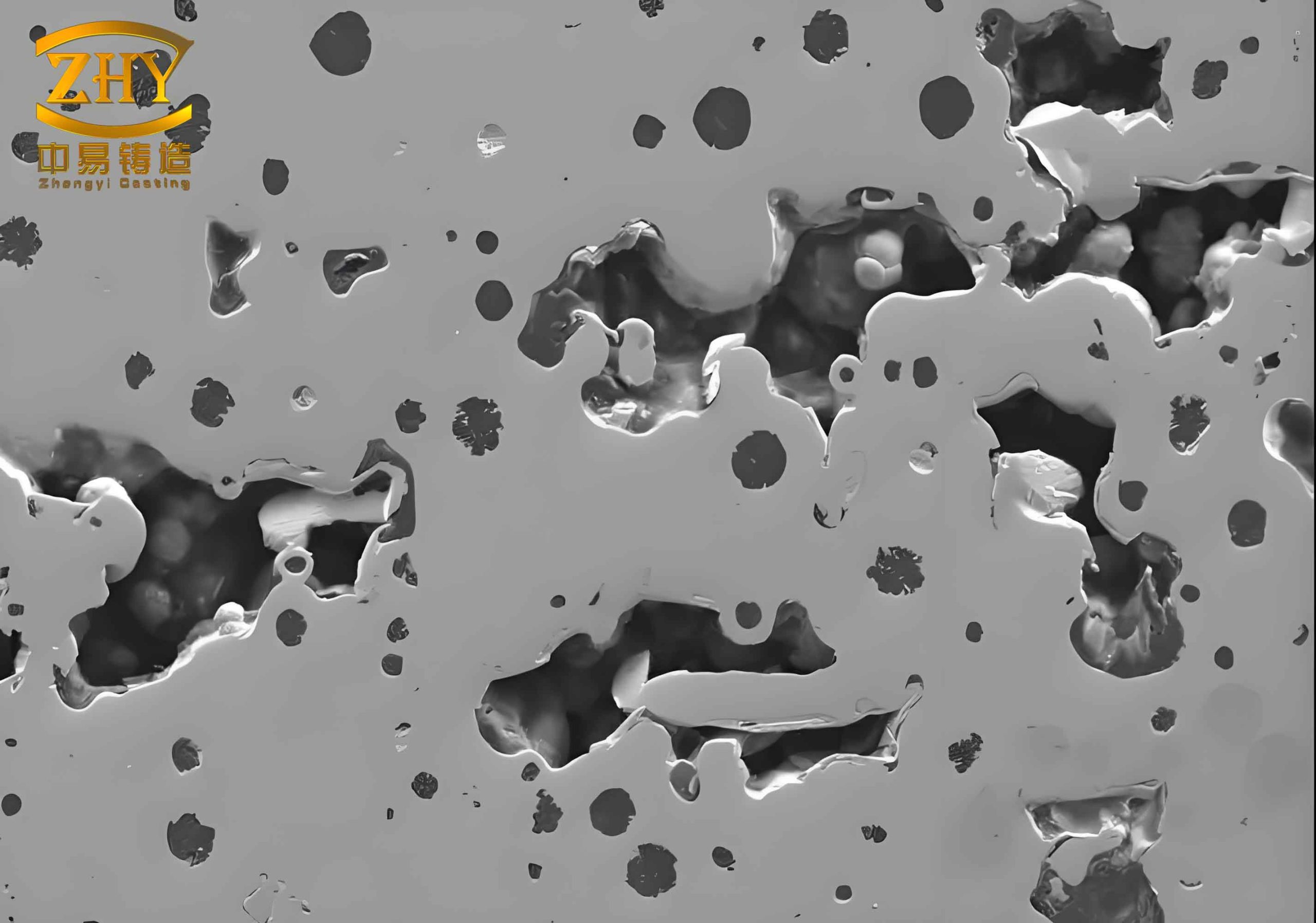
Analysis confirmed that over 85% of the adherence was mechanical metal penetration, not chemical reaction. The driving force for this sand casting defect is primarily the dynamic and static pressure of the liquid metal, which overcomes the resistance to flow presented by the sand pores. The key factors influencing this are sand fineness, gas back-pressure, and sand temperature/ moisture.
3.1 Refining Sand Granularity to Increase Pore Resistance
The continuous influx of 50/100 mesh core sand into the return sand system was coarsening the overall grain distribution. To counter this, 70/140 mesh base sand was systematically added to shift the system towards a finer, four-sieve distribution (50/140). The resistance to metal penetration \( R \) can be conceptually related to the effective pore diameter \( d_{eff} \). Finer sand reduces \( d_{eff} \), thereby increasing \( R \) according to a relationship analogous to flow in a capillary:
$$ R \propto \frac{1}{d_{eff}^2} $$
This increase in flow resistance made it harder for the metal to infiltrate, directly attacking this sand casting defect.
3.2 Increasing Gas Back-Pressure in the Mold
Gas back-pressure, the pressure of gases evolving from the sand within its pores, acts counter to the metal penetration pressure. It is a function of the sand’s gas evolution rate \( G \) and its permeability \( \mu \). A higher gas evolution or lower permeability increases back-pressure \( P_{back} \):
$$ P_{back} \propto \frac{G}{\mu} $$
Controlled trials were conducted to find the optimal gas evolution level—high enough to generate sufficient back-pressure to deter metal penetration, but not so high as to cause pin-holing or blows, another category of sand casting defect. Adjusting the carbonaceous additives and clay content allowed us to establish a new, higher target range for gas evolution that successfully suppressed penetration without creating new problems.
3.3 Controlling Return Sand Temperature and Moisture
An outdated sand system lacked active cooling, leading to high return sand temperatures, especially in summer. Hot sand (>50°C) loses moisture rapidly, leading to low, unpredictable moisture levels in the mixed sand, which degrades its compactability and strength. The relationship between water evaporation and temperature drop is approximately:
$$ \Delta T \approx 25 \cdot \Delta M $$
where \( \Delta T \) is the temperature drop in °C and \( \Delta M \) is the percentage of moisture evaporated. To restore control, water misting systems were installed on the return sand conveyors, with fans to aid evaporative cooling. This brought sand temperature and, more importantly, moisture consistency under control, which was fundamental to maintaining all other green sand properties and preventing this thermally-aggravated sand casting defect.
3.4 Systematic Optimization of Green Sand Parameters
A dynamic, seasonally-adjusted strategy for controlling green sand was implemented. Key parameters were optimized within tighter windows:
| Parameter | Summer/Autumn Strategy | Winter/Spring Strategy | Primary Impact on Defect |
|---|---|---|---|
| Compactability | Control at upper limit | Control at lower limit | Compensates for moisture loss/gain, ensures optimal strength and moldability. |
| Active Clay | Maintain at high level | Maintain at high level | Ensures sufficient bond strength and thermal stability. |
| Moisture | Monitor closely, adjust misting | Monitor closely | Directly affects compactability, strength, and cooling. |
| Permeability | Manage via grain distribution | Manage via grain distribution | Balances venting needs with back-pressure for penetration resistance. |
This holistic approach transformed the casting surface finish, effectively eliminating the severe metal penetration sand casting defect.
4. Internal Cavity Sintering and Metal Penetration
The same high pouring temperatures that caused external penetration also led to severe sintering and burning-on within the internal passages formed by the oil gallery and water jacket cores, particularly in sharp corners and hot spots. This internal sand casting defect was even more problematic due to difficult access for cleaning.
The multi-pronged solution involved core-specific improvements:
- Core Assembly: The oil gallery core assembly method was modified by reducing the size of fastening screws to lower assembly stress on the core.
- Core Material & Process: A switch was made to a blended specialty sand for the oil gallery cores to improve flowability during shooting, resulting in denser, more uniform cores with higher hot strength. The baking temperature for these cores was also reduced to prevent unnecessary strength loss from over-curing.
- Core Geometry: The fillet radius at a critical junction was slightly reduced to increase the cross-sectional area and thus the mechanical strength of the core at that point.
- Refractory Coating: After extensive testing, a specific high-alumina, low-veining coating formulation was identified and adopted for all complex internal cores. This coating provided a superior refractory barrier capable of withstanding the extreme thermal load.
These combined measures significantly reduced internal cleaning time and brought internal cavity quality within the strict acceptance standards of the engine manufacturer.
5. Conclusion
The journey to master the production of these demanding cylinder blocks has been a continuous exercise in problem-solving, deeply connecting material science with practical process engineering. Each sand casting defect—from core fracture and scabbing to external and internal metal penetration—required a tailored, often multi-faceted solution. The consistent themes have been proactive material selection (specialty sands, natural bentonite), precise control of process parameters (ADV, storage time, sand temperature), intelligent process design (coating strategies, venting, gating), and rigorous equipment maintenance. There is no single “silver bullet” for eliminating sand casting defects; rather, it is the disciplined and holistic control of the entire ecosystem of materials, machines, and methods that transforms a challenging casting process into a reliable and high-quality manufacturing operation. The results speak for themselves, as demonstrated by the significant reduction in overall machining rejection rates for our most complex block, from over 5% to consistently near 3%, a direct outcome of systematically addressing these fundamental sand casting defect challenges.