
In my extensive review of abrasive wear-resistant materials, I find that white cast iron stands as a cornerstone in industrial applications due to its exceptional hardness and durability. The journey of white cast iron began over a century ago, paralleling the development of malleable iron, and has since evolved through multiple generations, from ordinary white cast iron to nickel-hardened and high-chromium variants. This progression has been driven by the need for materials that can withstand severe grinding, crushing, and erosion in sectors like mining, cement production, and power generation. I will delve into the metallurgical principles, classification, production technologies, and applications of white cast iron, emphasizing how advancements have enhanced its performance. Throughout this discussion, I will use tables and formulas to summarize key data and theoretical aspects, ensuring a comprehensive understanding of this critical material.
The fundamental appeal of white cast iron lies in its high carbon content, which leads to the formation of hard carbides embedded in a metallic matrix. Initially, ordinary white cast iron featured pearlitic matrices and M3C-type carbides (e.g., cementite, Fe3C), but these suffered from brittleness due to continuous carbide networks. The innovation of alloying elements, particularly chromium, transformed white cast iron by promoting M7C3-type carbides, which are harder and more isolated, thereby improving toughness. I observe that the ratio of chromium to carbon is critical: when Cr/C exceeds 4, the formation of M7C3 carbides is favored, as described by the phase stability equation: $$M_7C_3 \leftrightarrow M_3C \quad \text{for} \quad \frac{Cr}{C} > 4.$$ This shift not only increases hardness—with M7C3 carbides reaching HV 1600-2100 compared to HV ~1100 for M3C—but also alters the solidification morphology, making the austenite matrix continuous and reducing crack propagation. In my analysis, the hardness of white cast iron can be approximated by a function of composition: $$HRC = k_1 \cdot C + k_2 \cdot Cr + k_3 \cdot Mo + \cdots,$$ where k coefficients depend on heat treatment and microstructure. For instance, high-chromium white cast iron typically achieves HRC 58-67 after quenching, with impact toughness ranging from 5 to 12 J/cm², making it suitable for high-stress abrasive environments.
To systematically categorize white cast iron, I have compiled a table based on international standards and research findings. This table outlines major types, their chemical compositions, and typical properties, highlighting the evolution from low-alloy to high-alloy grades. The data underscores how chromium content enhances wear resistance, while elements like molybdenum and nickel improve hardenability and toughness.
| Type of White Cast Iron | Chemical Composition (%) | Typical Hardness (HRC) | Impact Toughness (J/cm²) | Primary Carbide Type |
|---|---|---|---|---|
| Ordinary White Cast Iron | C: 3.0-3.6, Si: 0.3-0.5, Mn: 0.3-0.7 | 50-55 | 2-4 | M3C |
| Ni-Hard (Ni-Cr White Cast Iron) | C: 2.8-3.6, Ni: 3.3-5.0, Cr: 1.4-4.0 | 53-63 | 3-6 | M3C or M7C3 |
| High-Chromium White Cast Iron (15% Cr) | C: 2.0-3.5, Cr: 13-18, Mo: 0.5-3.0 | 58-67 | 5-10 | M7C3 |
| High-Chromium White Cast Iron (26% Cr) | C: 2.3-3.0, Cr: 23-28, Mo: 0-1.0 | 56-60 | 8-12 | M7C3 |
| High-Si/C Medium-Chromium White Cast Iron | C: 2.5-3.0, Cr: 7-9, Si: 1.5-2.5 | 55-62 | 8-12 | M7C3 |
The performance of white cast iron is intricately linked to its microstructure, which is controlled by composition and heat treatment. I emphasize that the base matrix—whether martensitic, austenitic, or a multiphase blend—plays a pivotal role in wear behavior. For low-stress abrasion, a martensitic matrix offers superior resistance, as its high hardness minimizes plastic deformation. However, under high-stress or impact conditions, a multiphase matrix (e.g., martensite-bainite-austenite) proves more effective by hindering crack propagation. This can be modeled using fracture mechanics: $$K_{IC} = \sigma \sqrt{\pi a},$$ where KIC is fracture toughness, σ is stress, and a is crack length; a multiphase structure increases KIC by deflecting cracks. In my experience, optimizing the matrix often involves alloying with elements like molybdenum, which enhances hardenability, as shown in the equation for critical cooling rate: $$V_c = \frac{A}{(C+Cr+Mo)},$$ where Vc is the minimum cooling rate to avoid pearlite, and A is a constant. Additionally, the volume fraction of carbides, fc, influences wear rate W, approximated by: $$W \propto \frac{1}{\sqrt{f_c \cdot H_{carbide}}},$$ with Hcarbide being carbide hardness. Thus, white cast iron with high chromium content achieves lower wear rates due to abundant M7C3 carbides.
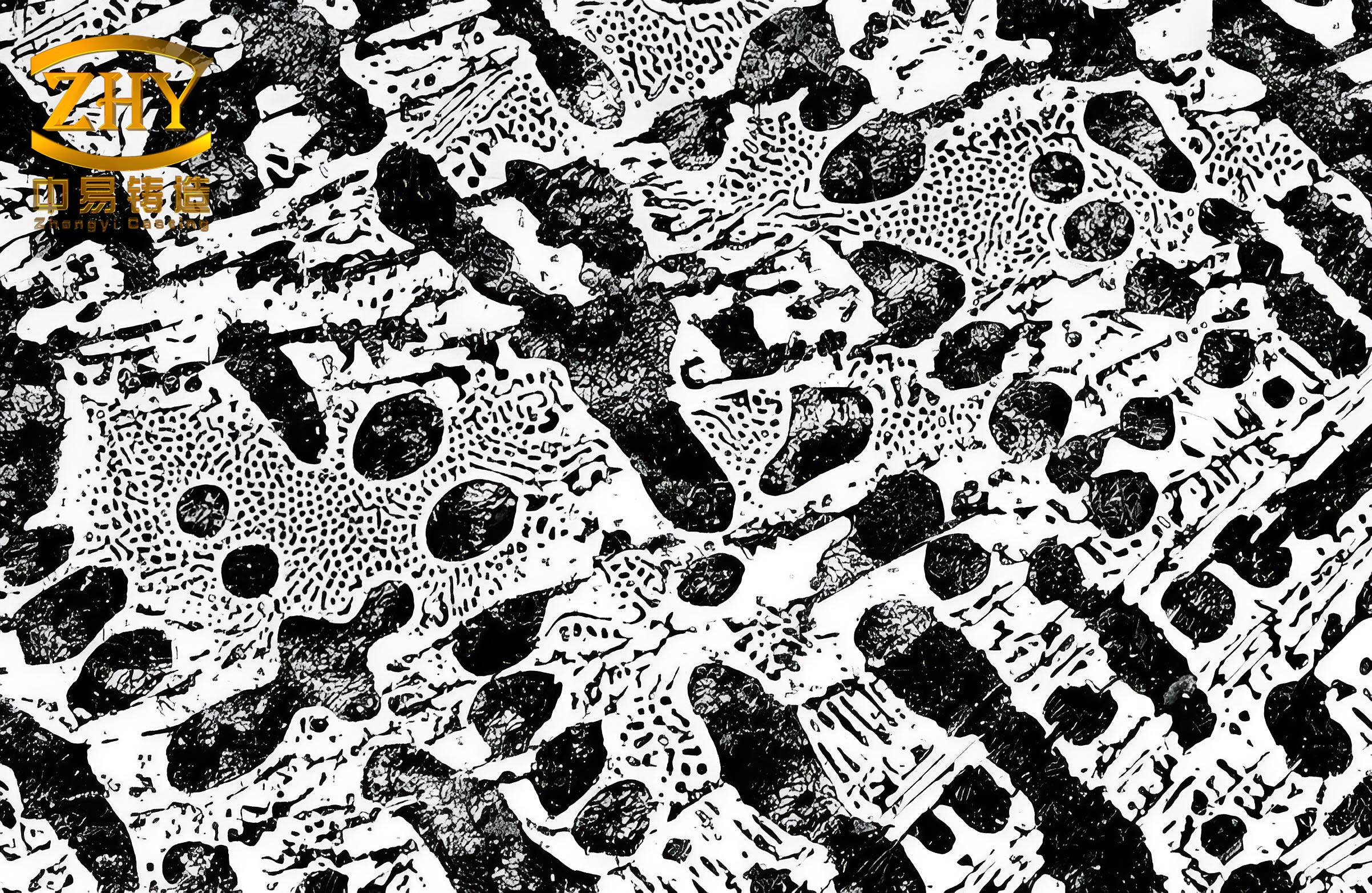
Production technologies for white cast iron have advanced significantly, focusing on improving casting quality and mechanical properties. I recall that traditional sand casting often leads to defects like microshrinkage and inclusions, which reduce fatigue life. In contrast, modern methods such as metal mold casting, with controlled cooling, enhance density and hardness uniformity. For example, simulation of solidification time for grinding balls shows that metal molds reduce porosity. The solidification time t can be estimated using Chvorinov’s rule: $$t = B \left( \frac{V}{A} \right)^n,$$ where V is volume, A is surface area, B is a mold constant, and n is an exponent (typically ~2). Faster cooling in metal molds refines carbides, improving toughness. Moreover, inoculation treatments with elements like titanium or vanadium modify carbide morphology, increasing the shape factor P/A (perimeter to area ratio), which reduces stress concentrations. A table comparing casting methods illustrates their impact on product performance, demonstrating that advanced techniques yield white cast iron components with longer service life.
| Casting Method | Product Example | Relative Service Life | Key Improvements |
|---|---|---|---|
| Sand Casting (Traditional) | Grinding Balls | 1.0 (Baseline) | Prone to defects, lower hardness uniformity |
| Metal Mold Casting | Grinding Balls | 1.3-1.4 | Higher density, reduced breakage, rounder shape |
| Lost Foam Casting (EPC) | Mill Liners | 1.5-2.0 | Better surface finish, dimensional accuracy |
| Bimetal Composite Casting | Crusher Hammers | 2.0-3.0 | Combines wear resistance of white cast iron with toughness of steel |
Heat treatment is another critical aspect I explore for white cast iron. Typically, austenitizing followed by quenching and tempering develops a martensitic matrix. The austenitizing temperature Ta depends on composition: $$T_a = 950 + 20 \cdot Cr – 30 \cdot C \, (\degree C),$$ ensuring carbide dissolution without grain growth. After quenching, retained austenite can be transformed via sub-zero treatment or tempering, with hardness HRC related to tempering temperature Tt by: $$HRC = HRC_0 – m \cdot T_t,$$ where HRC0 is as-quenched hardness and m is a material constant. For high-chromium white cast iron, I recommend tempering at 200-400°C to achieve a balance of hardness and toughness. Furthermore, isothermal quenching can produce bainitic structures, offering improved impact resistance for applications like grinding balls in wet milling, where corrosion-fatigue is a concern. The wear mechanism in such cases involves both abrasion and impact, with wear volume V described by Archard’s modified equation: $$V = k \cdot \frac{F \cdot L}{H} \cdot f(\text{impact}),$$ where k is a wear coefficient, F is load, L is sliding distance, H is hardness, and f(impact) accounts for kinetic energy.
The applications of white cast iron are vast, spanning mining, cement, and agricultural equipment. I have observed that grinding balls and mill liners made from high-chromium white cast iron outperform steel counterparts in terms of wear life, often by factors of 4 to 8. In cement ball mills, for instance, white cast iron balls reduce ball consumption to below 50 g per ton of cement, compared to hundreds of grams for inferior materials. The selection of white cast iron grade depends on operational conditions: for high-impact environments like jaw crusher plates, a ductile matrix is essential, whereas for slurry pumps, corrosion resistance is key. A table summarizing application-based material choices highlights how white cast iron is tailored to specific wear modes.
| Wear Condition | Typical Component | Recommended White Cast Iron Type | Expected Life Improvement |
|---|---|---|---|
| High-Stress Abrasion | Grinding Balls | High-Chromium (15% Cr) | 4-6x vs. forged steel |
| Impact-Abrasion | Crusher Hammers | Medium-Chromium with Multiphas e Matrix | 2-3x vs. high manganese steel |
| Corrosive-Abrasive | Slurry Pump Parts | High-Chromium with Cu/Ni Additions | 1.5-2x vs. Ni-Hard white cast iron |
| High-Temperature Abrasion | Kiln Liners | High-Chromium (26% Cr) | 3-4x vs. low-alloy cast iron |
Despite the advantages, challenges persist in the production and utilization of white cast iron. I note that inconsistency in casting quality, due to microshrinkage and impurity inclusions, remains a major issue, leading to premature failure. To address this, inoculation and filtering during melting are essential; for example, adding rare earth elements can reduce sulfur content, improving toughness. The effectiveness of inoculation can be quantified by the reduction in oxide inclusions, measured as: $$\Delta O = O_0 – O_i,$$ where O0 and Oi are initial and post-inoculation oxygen levels. Additionally, the development of bimetal composites—where white cast iron is bonded to a steel substrate—has gained traction, offering cost-effective solutions for large components like mill liners. The interfacial strength σi in such composites depends on diffusion bonding: $$\sigma_i = \sigma_0 \cdot e^{-Q/RT},$$ with Q as activation energy and T bonding temperature. Looking ahead, I advocate for standardized testing and quality control protocols to ensure white cast iron components meet international benchmarks, particularly in emerging markets where demand is growing.
In conclusion, white cast iron has evolved into a versatile family of wear-resistant materials, with high-chromium variants dominating severe abrasive applications. Through alloy design, advanced casting, and heat treatment, its performance can be optimized for diverse industrial needs. I believe that continued research into microstructure control and composite technologies will further expand the horizons of white cast iron, solidifying its role in sustainable manufacturing. As I reflect on the data and formulas presented, it is clear that white cast iron is not just a material but a dynamic field where metallurgy and engineering converge to combat wear, driving efficiency across global industries.