
As a foundry engineer specializing in the production of critical automotive components, I have encountered numerous challenges in manufacturing robust and reliable parts. Among these, the rear axle housing stands out as a quintessential example of a complex sand casting part. Its function as a structural backbone and power transmission conduit in a vehicle demands exceptional integrity, free from defects such as shrinkage porosity, gas holes, hot tears, and inclusions. This article delves into the intricate journey of developing a reliable resin sand casting process for such a demanding component, distilling lessons that apply broadly to the manufacture of high-integrity sand casting parts.
The manufacture of complex sand casting parts, like the axle housing under discussion, presents a formidable intersection of design, material science, and process engineering. These parts often feature varying wall thicknesses, interconnected sections, and internal geometries that create numerous thermal centers or “hot spots.” The primary challenge is to manage the solidification and feeding of molten metal within the rigid mold cavity to achieve soundness throughout the casting. For steel sand casting parts, this is further complicated by the material’s higher melting point and greater solidification shrinkage compared to cast iron, necessitating more aggressive feeding strategies and precise thermal control.
The foundational principle for such components is the implementation of a bottom-gating system coupled with directional solidification from the bottom upwards. This methodology is not merely a preference but a necessity for quality sand casting parts. A bottom-gating system minimizes turbulence during mold filling, preventing oxide film formation and sand erosion, which are precursors to inclusions and surface defects. More critically, it establishes a favorable temperature gradient. The metal entering at the bottom cools first, while the upper sections of the mold and the feeding risers remain hotter. This gradient promotes sequential, layer-by-layer solidification toward the risers, which act as reservoirs of liquid metal to compensate for volumetric shrinkage. The solidification time for a section can be estimated using Chvorinov’s rule:
$$ t = B \left( \frac{V}{A} \right)^n $$
where \( t \) is the solidification time, \( V \) is the volume of the casting section, \( A \) is its surface area, \( n \) is an exponent (typically ~2), and \( B \) is the mold constant. For effective feeding, the riser must solidify after the casting section it is intended to feed, requiring \( (V/A)_{riser} > (V/A)_{casting} \).
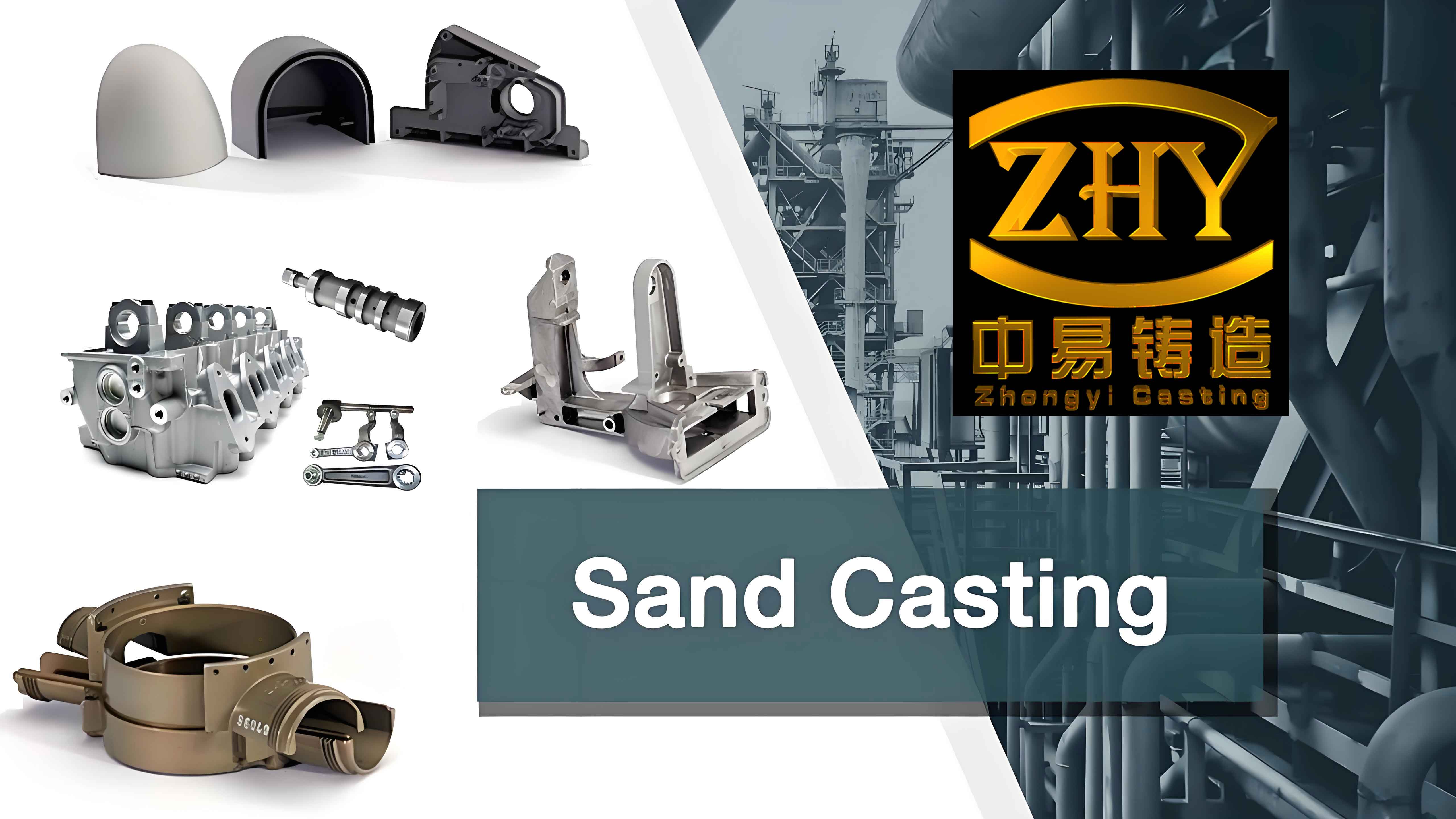
Initial process designs for complex sand casting parts are often guided by empirical rules and proportionality methods. For the axle housing, this meant placing multiple risers at strategic thermal centers: large open risers at the ends of the tubular section and smaller blind risers along the central housing. To intensify cooling at critical junctions and promote directional solidification, chills—in this case, crescent-shaped metallic chills—were incorporated into the mold at strategic locations. However, even a logically designed process can yield defective sand casting parts. The initial production runs revealed two persistent issues: micro-cracks in the machined tubular section and shrinkage-gas porosity clusters, particularly on the housing walls and flange tops. These defects are catastrophic for the part’s function and needed urgent resolution.
Critical Defect Analysis: A Deep Dive
The defects observed are common yet serious pitfalls in producing steel sand casting parts. Their root causes are interlinked with mold material behavior, thermal stresses, and gas evolution.
1. Micro-cracks (Hot Tears): These defects typically occur in the late stages of solidification when a coherent but fragile dendritic network exists. If the casting’s contraction is mechanically hindered by the rigid mold or core, tensile stresses develop in the weak semi-solid material, leading to tearing. For the axle housing, the long, tubular section is particularly susceptible. The high hot strength of the resin-bonded sand, especially when using materials like chromite sand, can provide significant resistance to contraction. The stress \( \sigma \) induced can be related to the hindered thermal strain:
$$ \sigma = E(T) \cdot \alpha \cdot \Delta T \cdot f_{hindrance} $$
where \( E(T) \) is the temperature-dependent elastic modulus of the semi-solid metal, \( \alpha \) is the coefficient of thermal contraction, \( \Delta T \) is the temperature drop over the vulnerable range, and \( f_{hindrance} \) is a factor representing the degree of mechanical restraint imposed by the mold.
2. Shrinkage Porosity and Gas Holes: The observed porosity was often a combination of both. Isolated, smooth-walled cavities indicate pure shrinkage, occurring where liquid metal was unavailable to feed the last region to solidify. Irregular, often subsurface cavities with oxidized surfaces are classic侵入性气孔 (intrusive gas holes). These form when gas pressure from the mold or core decomposition exceeds the metallostatic pressure of the liquid metal, pushing bubbles into the solidifying skin. The condition for bubble intrusion is given by:
$$ P_{gas} > P_{metal} + \frac{2\gamma}{r} + \sigma_{yield} $$
Here, \( P_{gas} \) is the pressure in the gas pocket at the mold/metal interface, \( P_{metal} = \rho g h \) is the metallostatic pressure, \( \gamma \) is the surface tension of the metal, \( r \) is the pore radius, and \( \sigma_{yield} \) is the yield strength of the solidifying skin. The use of organic resin binders, if not properly managed, is a major source of such gas.
The table below summarizes the root causes identified for the defects in these initial sand casting parts:
| Defect Type | Primary Root Cause | Contributing Factors |
|---|---|---|
| Micro-cracks | High mold/core restraint during contraction | High strength resin sand, lack of mold yield, sharp thermal gradients. |
| Shrinkage Porosity | Insufficient feeding to isolated hot spots | Riser size/distance inefficiency, unfavorable temperature gradient. |
| Intrusive Gas Holes | High gas pressure from mold/core decomposition | High moisture, inadequate core venting, high pouring temperature. |
A Multifaceted Strategy for Process Optimization
Resolving these issues required a holistic, interconnected set of improvements targeting every stage from melting to solidification.
1. Enhanced Melting and Pouring Practice
The quality of sand casting parts is forged in the melt. For steel castings, effective deoxidation is paramount to reduce the oxygen content that can lead to oxide inclusions and pinholing. We adopted a balanced deoxidation practice using aluminum and calcium-silicon alloys. Aluminum provides strong deoxidation, while calcium aids in modifying any remaining oxides into harmless, globular forms. Furthermore, we strictly controlled the pouring temperature. While higher temperatures improve fluidity, they drastically increase the total gas pickup from the mold and the severity of shrinkage. An optimal range of 1570-1580°C was established, coupled with a “fast pour” practice enabled by enlarging the gating system. The modified Reynolds number for the gating system ensures turbulent flow is minimized:
$$ Re = \frac{\rho v D}{\mu} $$
We aimed to keep \( Re \) below a critical threshold (often around 2000 in the ingate) by increasing the sprue diameter from 70mm to 80mm, which reduces the flow velocity \( v \) for a given volumetric flow rate.
2. Redesign of the Gating and Feeding System
The feeding system is the heart of producing sound sand casting parts. The initial riser design was refined based on feed path calculations. The effective feeding distance \( L_f \) of a riser in a steel casting can be approximated as:
$$ L_f = k \sqrt{T} $$
where \( T \) is the plate thickness and \( k \) is an empirical constant (~4.5 for steel with chills). We verified that all critical sections were within this distance from an effective riser. Crucially, to address the cracking issue, we introduced yield points in the mold. Polystyrene foam boards were placed between adjacent risers. As the metal rises, the foam vaporizes, creating a gap that allows the risers to move slightly inward during contraction, reducing stress on the casting. Simultaneously, dedicated vent holes (Ø20mm) were added from these riser junctions to the atmosphere to safely evacuate the pyrolysis gases, directly combating the source of intrusive gas holes.
3. Advanced Mold and Core Technology
The choice of mold materials is critical for complex sand casting parts. We implemented a composite mold strategy. For areas prone to hot tearing and requiring intense cooling (like the tubular section junctions), we used chromite sand bonded with alkaline phenol-formaldehyde resin. Chromite sand’s high thermal conductivity helps establish steep temperature gradients, promoting directional solidification. Its lower thermal expansion also reduces mold wall movement and stress on the casting. For other regions, standard silica sand sufficed. For cores, which are massive contributors to gas defects, we mandated:
- The use of hollow core irons to provide an internal escape path for gases.
- Thorough baking of all cores and assembled molds before pouring to eliminate moisture.
- Storing cores off the ground in dry, ventilated areas to prevent moisture absorption.
The gas evolution characteristics of the bonded sand are paramount. The alkaline phenolic resin used has the distinct advantage of being nitrogen-, sulfur-, and phosphorus-free, preventing related gas defects and hot tearing in alloy steels. Its low gas generation and favorable thermal softening behavior further reduce the risk of defects in these sensitive sand casting parts.
4. Scientific Use of Chills and Insulation
The strategic placement of chills and insulation is what directs solidification. We moved from a rule-of-thumb to a more calculated approach. Chills (metal or massive graphite) are used to eliminate isolated hot spots and create a defined solidification front. Their chilling power is related to their volume, thermal conductivity, and heat capacity. Insulating sleeves or toppings on risers are used to slow their solidification, ensuring they remain液态 longer than the casting. The efficacy of this system can be monitored by the temperature gradient \( G \) and solidification rate \( R \). Sound sand casting parts are produced when the \( G/R \) ratio is high at the solidification front, promoting planar or columnar growth that pushes impurities and shrinkage toward the riser.
The table below contrasts the key parameters before and after the process optimization for these sand casting parts:
| Process Parameter | Initial Process | Optimized Process | Impact on Sand Casting Parts |
|---|---|---|---|
| Pouring Temperature | 1560-1580°C | 1570-1580°C (Controlled Fast Pour) | Reduced gas pickup & shrinkage volume. |
| Gating System | Ø70 mm Sprue, Filter | Ø80 mm Sprue, No Filter | Lower velocity, faster fill, less turbulence. |
| Riser Design | Solid Connections | Foam Yield Boards + Dedicated Vents | Reduced hot tearing; eliminated gas entrapment. |
| Mold Material | Uniform Silica Sand | Composite: Chromite + Silica Sand | Targeted cooling, reduced stress, better gradients. |
| Core Management | Standard Practice | Hollow Irons, Mandatory Baking, Dry Storage | Dramatically reduced core gas defects. |
Quality Assurance and Production Validation
The ultimate validation of any process for critical sand casting parts lies in consistent, defect-free production. After implementing the optimized protocol, a statistical process control (SPC) chart was maintained for key variables: pouring temperature, chemical composition (especially CE, where \( CE = C + \frac{Mn}{6} + \frac{(Cr+Mo)}{5} \)), and mechanical properties from cast coupons. Non-destructive testing (NDT), including magnetic particle inspection for surface cracks and ultrasonic testing for internal shrinkage, became a 100% checkpoint for the first production batches.
The results were transformative. The incidence of micro-cracks in the tubular section dropped to near zero. The sporadic shrinkage and gas porosity clusters on the housing walls and flanges were completely eliminated. The yield of sound, machinable sand casting parts increased significantly, validating the technical and economic feasibility of the process. This success underscores a fundamental truth: producing high-integrity complex sand casting parts is not about a single silver bullet but about the meticulous control and synchronization of a chain of interdependent parameters—from the chemistry of the melt and the physics of the mold to the thermodynamics of solidification.
Conclusion
The journey to perfect the casting process for a complex component like a rear axle housing encapsulates the broader discipline of manufacturing high-performance sand casting parts. It demonstrates that success hinges on a deep understanding of the interplay between material properties, mold behavior, and thermal dynamics. Key takeaways for engineers include: the non-negotiable need for directional solidification via bottom gating and strategic thermal management; the critical importance of managing mold restraint and gas evolution through intelligent material selection and mold/core design; and the necessity of viewing the process as an integrated system where improvements in melting, pouring, gating, and molding must work in concert.
The principles elucidated here—controlled gradients, calculated feeding, managed restraint, and proactive gas evacuation—form a robust framework. They are directly applicable to a wide array of demanding sand casting parts across automotive, heavy machinery, and energy sectors. By adhering to this science-guided, holistic approach, foundries can consistently produce complex sand casting parts that meet the most stringent standards of quality, reliability, and performance.