
The production of motor housings has long been dominated by traditional sand casting methods. While functional, these methods are often plagued by low production efficiency, high labor intensity, and poor working environments. In my extensive experience, transitioning to the lost foam casting process presents a revolutionary alternative. This advanced, environmentally-friendly special casting technique utilizes unbonded dry sand combined with vacuum technology, fundamentally changing the production landscape. This article details my comprehensive approach to implementing the lost foam casting process for complex, thin-walled motor housings.
At its core, the lost foam casting process involves creating a precise replica of the final casting from expandable foam polymer. This pattern, coated with a refractory wash, is embedded in dry, unbonded sand within a flask. When molten metal is poured, the foam pattern vaporizes and decomposes, allowing the metal to exactly fill the cavity it once occupied. Upon cooling and solidification, a precise casting is obtained. The advantages I’ve consistently observed are significant: high dimensional accuracy, excellent surface finish, minimal machining allowances, high metal yield, reduced environmental impact, the ability to cast highly complex geometries, and a production flow that is easier to standardize. The entire lost foam casting process is systematically divided into three distinct zones: the White Area (pattern making), the Yellow Area (coating), and the Black Area (molding and pouring).
White Area Process Control: Foundation of the Pattern
The success of the entire lost foam casting process is critically dependent on the quality and properties of the foam pattern. Any compromise here propagates directly into the final casting.
Selection of Pattern Material
Choosing the correct foam material is the first critical decision. The three primary materials used are EPS (Expanded Polystyrene), EPMMA (Expanded Polymethyl Methacrylate), and STMMA (a co-polymer of Styrene and Methyl Methacrylate). Their characteristics are summarized below:
| Material | Key Characteristics | Carbon Content | Primary Challenge |
|---|---|---|---|
| EPS | Low cost, low gas generation. | ~92% | High carbon residue leading to carburization defects. |
| EPMMA | Excellent dimensional stability, low carbon residue. | ~60% | Very high gas generation, risk of pattern collapse or “wash” defects. |
| STMMA | Balanced properties, moderate gas and carbon levels. | ~62% | Higher cost than EPS, but optimal for critical applications. |
For motor housings, particularly with thin-wall sections like cooling fins that can be as thin as 0.3mm, controlling defect formation is paramount. The high carbon content of EPS can lead to slag inclusions and carburization in these thin sections. While EPMMA solves the carbon issue, its violent gasification can destabilize the mold during pour. Therefore, I exclusively specify STMMA co-polymer with a density between 15-18 g/L. This material offers a superb balance, minimizing both carbon pick-up and gas generation, which is essential for achieving sound, defect-free thin-walled castings in the lost foam casting process.
Pre-Expansion and Molding
The transformation of raw bead material into a dimensionally stable pattern involves two key stages.
Pre-Expansion
Raw STMMA beads are first pre-expanded in a steam chamber to achieve a target bulk density. The process follows a strict sequence: Preheating -> Charging -> Steam Pre-expansion -> Drying -> Aging. The key parameters I control are:
| Parameter | Value Range |
|---|---|
| Preheat Temperature | 90 – 95 °C |
| Steam Pressure | 0.12 – 0.15 MPa |
| Pre-expansion Temperature | 95 – 100 °C |
| Aging Temperature | 20 – 25 °C |
| Aging Time | 4 – 24 hours (until pressure stabilization) |
Aging is crucial. Freshly pre-expanded beads contain pentane gas and residual steam pressure. The aging period allows internal and external pressures to equalize, ensuring dimensional stability in the final molded pattern. Inadequate aging leads to post-molding shrinkage and warpage.
Foam Molding
Aged beads are then injected into a heated aluminum tool. Steam is introduced, causing the beads to expand further, fuse together, and take the exact shape of the motor housing cavity. The cycle is: Close & Clamp Tool -> Tool Preheat -> Fill with Beads -> Introduce Steam (Molding) -> Cool with Water -> Eject Pattern. The goal is a pattern with a smooth, sealed skin and a uniformly fused, fine-cell internal structure. The rate of heat transfer during this phase governs the final quality. A simplified model for the thermal energy required for molding a pattern of mass \(m_p\) can be expressed as:
$$ Q_{mold} \approx m_p \left[ C_{p, bead} \Delta T_{bead} + \Delta H_{fusion} \right] $$
where \(C_{p, bead}\) is the specific heat of the bead polymer, \(\Delta T_{bead}\) is the temperature rise from ambient to fusion, and \(\Delta H_{fusion}\) is the latent heat of fusion for the bead interfaces.
Pattern Assembly and Gating
Individual patterns and the foam gating system (sprue, runners, ingates) must be assembled into a cluster for casting. The adhesive used must vaporize cleanly without residue, just like the pattern itself. I prefer specialized hot-melt adhesives designed for the lost foam casting process. They provide rapid setting, high strength, and excellent gap-filling properties to ensure a perfectly sealed joint. The adhesive application must be minimal yet effective; excess glue creates localized high gas volumes and carbonaceous residue. The assembled cluster is the direct negative of the final casting assembly.
Yellow Area Process Control: The Critical Barrier
The coating applied to the foam cluster is not merely a refractory layer; it is a multi-functional engine that enables the lost foam casting process to work. Its functions extend far beyond preventing metal penetration:
- Reinforcement: It provides crucial green strength to the fragile foam cluster, allowing it to withstand the forces of sand filling and vibration compaction.
- Mold Integrity Barrier: It forms an impermeable barrier that separates the decomposing foam from the dry sand, preventing mold collapse when the foam disappears.
- Permeable Vent: It must be highly permeable to allow the massive volume of pyrolysis gases from the foam (estimated below) to escape rapidly into the sand and out through the vacuum system, preventing gas entrapment in the metal.
Coating Formulation and Application
I employ a two-layer coating strategy to balance surface finish, strength, and permeability.
| Layer | Composition (by weight) | Primary Function | Target Thickness |
|---|---|---|---|
| First Layer | Refractory Binder (e.g., Guilin #5) : 200-270 Mesh Graphite (Flaky & Amorphous) : Water = 1 : 10 : 15 | Provides a smooth, dense surface finish and initial strength. | 0.2 – 0.3 mm |
| Second Layer | Refractory Binder : 200 Mesh Silica Flour : Water = 1 : 10 : 6 | Provides high refractory strength, thermal insulation, and controlled high permeability. | 0.8 – 1.5 mm |
The mixing procedure is critical: dry-mix the binder and refractory powders thoroughly first to avoid agglomerates, then add water and mix for a minimum of 30 minutes to develop full rheological properties. The coating viscosity must be carefully controlled for dip application.
Drying
Proper drying is non-negotiable. Each coating layer must be completely dried before the next is applied. Incomplete drying traps moisture, which turns to steam during pouring, causing violent eruptions or porosity. I specify drying times of at least 12 hours per layer in a controlled, low-temperature (40-50°C) circulating air oven. The entire coated cluster typically requires over 48 hours of total drying time to ensure all moisture, including from the foam core, is eliminated. The drying process can be conceptually linked to the diffusion of moisture through the coating thickness \(L_c\):
$$ t_{dry} \propto \frac{L_c^2}{D_{eff}} $$
where \(D_{eff}\) is the effective diffusivity of water vapor through the porous coating, underscoring why thicker coatings require exponentially longer drying times.
Black Area Process Control: Transformation from Foam to Metal
This is where the lost foam casting process culminates. Every parameter here directly controls the final metallurgical quality and dimensional accuracy of the motor housing.
Gating System Design
The gating design for lost foam is distinct from conventional casting. The gates must handle not only liquid metal flow but also the counter-flow of pattern decomposition gases. I typically use bottom or stepped gating to promote a calm, upward fill with uniform thermal gradients. To accommodate the gas flow, the cross-sectional areas of the sprue, runners, and ingates are increased by 20-30% compared to equivalent sand casting gating. The goal is to achieve a fill velocity that balances clean mold filling with efficient foam degradation and gas evacuation.
Molding and Compaction
The process utilizes dry, unbonded silica sand, typically AFS 20/40 grain fineness for optimal permeability and surface finish. The molding sequence is precise:
- Inspect the dried cluster for uncoated spots (“holidays”) and repair.
- Place a base layer of sand (150-200mm) in the flask and vibrate.
- Position the coated cluster carefully.
- Add sand around the cluster in stages, using controlled vibration to achieve uniform compaction without distorting the fragile pattern. Patterns are spaced 100-150mm apart.
- Fill to the top of the sprue, vibrate, and cover the sand surface with a plastic film.
- Place the pouring cup and weight it down with sand before moving the flask to the pouring station.
Vibration parameters (frequency, amplitude, time) are optimized to achieve a high, stable bulk density of the sand bed, which resists metallostatic pressure and erosion.
Metal Melting and Chemistry
Motor housings are typically cast in gray iron grades like HT150 or HT200. The chemistry is tailored for the lost foam casting process, considering the slight carburizing tendency from foam decomposition. A typical target range is:
| Element | Target Composition (%) |
|---|---|
| Carbon (C) | 3.3 – 3.7 |
| Silicon (Si) | 1.9 – 2.2 |
| Manganese (Mn) | 0.5 – 0.8 |
| Phosphorus (P) | ≤ 0.30 |
| Sulfur (S) | ≤ 0.12 |
The Pouring Triad: Vacuum, Temperature, and Speed
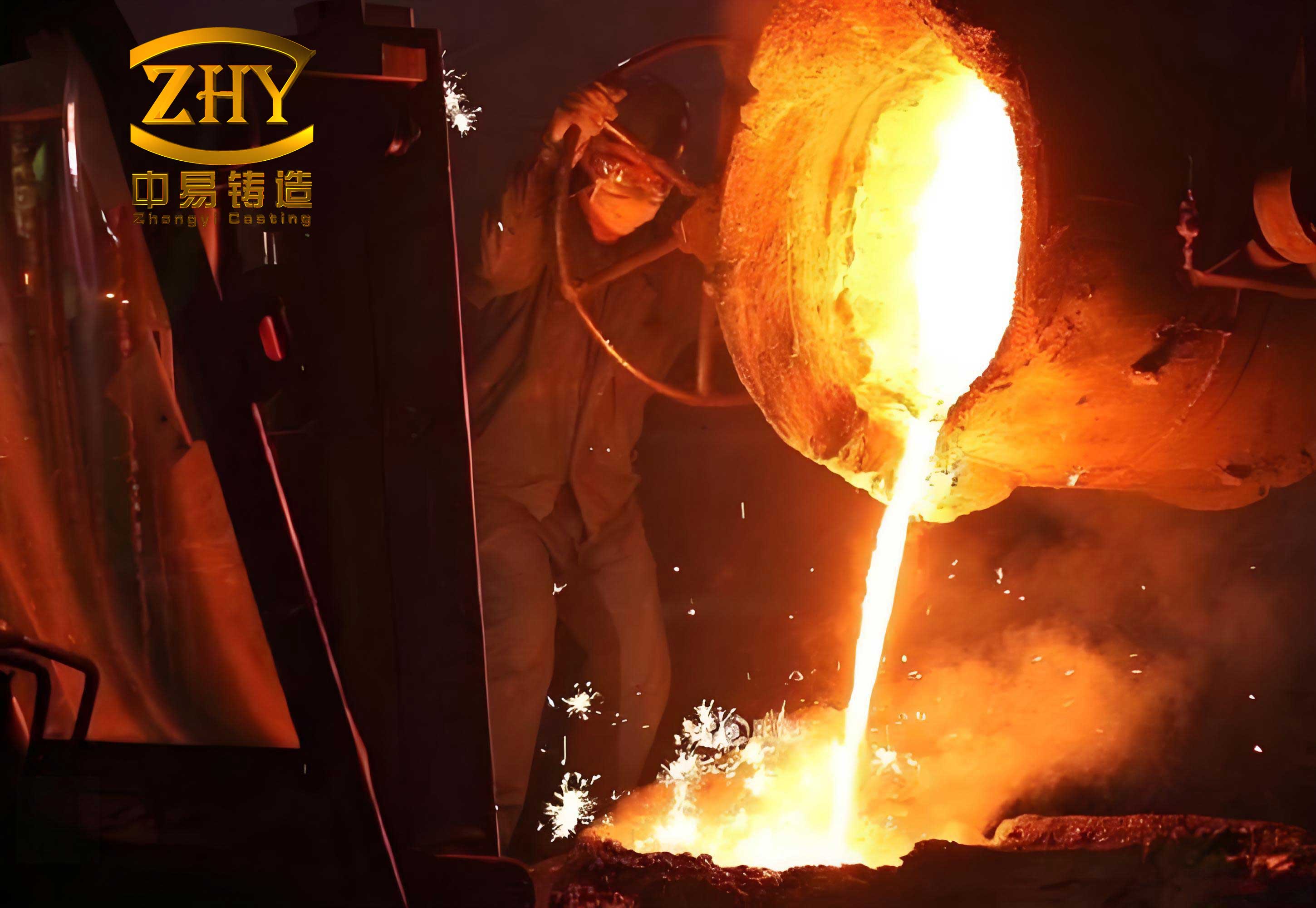
Pouring is the most dynamic phase of the lost foam casting process. Three interdependent parameters must be synchronized:
1. Vacuum Pressure: A vacuum of 0.03 MPa or higher is applied to the sand flask throughout pouring and for 5-8 minutes after. This serves multiple critical functions: it stabilizes the mold by compacting the sand, it actively evacuates foam pyrolysis gases through the coating and sand, and it helps draw the metal into the cavity. The vacuum level directly influences the rate of gas removal. The volumetric gas generation rate \( \dot{V}_{gas} \) from the vaporizing foam can be significant and must be matched by the vacuum system’s pumping capacity.
2. Pouring Temperature: The metal must supply the energy to decompose the foam. The energy balance at the metal front involves heating and gasifying the foam. Therefore, pouring temperatures are elevated by 30-80°C compared to sand casting. For gray iron motor housings, I maintain a range of 1420-1520°C. Too low a temperature leads to incomplete foam decomposition and carbonaceous defects; too high can cause mold erosion or excessive metal penetration. The required superheat \(\Delta T\) can be related to the foam’s enthalpy of decomposition \(\Delta H_{decomp}\) and mass \(m_f\):
$$ m_{metal} C_{p, metal} \Delta T \geq m_f \Delta H_{decomp} $$
This simplified inequality highlights the need for sufficient thermal energy in the metal.
3. Pouring Speed: I employ a “slow-fast-slow” pouring practice. An initial slow fill establishes a stable metal base and initiates controlled foam degradation. The pour is then accelerated to maintain a steady, non-turbulent rise, preventing cold shuts or mistruns. Finally, it is slowed near the top to reduce turbulence in the pouring cup. The pour must never be interrupted. A constant metal head in the pouring cup is vital to maintain the driving pressure for fill and to suppress back-flow of gases into the metal stream.
Advantages Realized Through the Lost Foam Casting Process
Successfully implementing this methodology for motor housings yields compelling technical and economic benefits compared to conventional sand casting:
- Labor & Environment: The elimination of bonded sand molds drastically reduces heavy labor. The process generates negligible dust, lowers noise, and with ~95% sand reclamation, minimizes waste, enabling cleaner production.
- Quality & Yield: The integration of gating and the absence of parting lines or core joints result in superior dimensional accuracy and surface finish. This directly translates to reduced machining costs and higher overall yield.
- Design Freedom: The ability to produce complex, thin-walled geometries like integrated cooling fins in a single piece is unparalleled, opening new avenues for motor design and performance.
- Process Standardization: The discrete, repeatable stages of the lost foam casting process lend themselves to a high degree of control and automation, leading to consistent, high-quality output.
In conclusion, mastering the lost foam casting process for components like motor housings requires a holistic, controlled approach across the white, yellow, and black zones. From the careful selection of STMMA material and precise pattern-making, through the application of a multi-functional refractory coating, to the synchronized control of vacuum, temperature, and pour dynamics during casting, each step is interlinked. When executed with precision, this process transitions from a mere alternative to a superior manufacturing solution, delivering high-integrity castings with significant economic and environmental advantages. The continued refinement and understanding of the underlying physics—from gas generation to heat transfer—will further solidify the position of the lost foam casting process in modern foundry practice.