
The production of large, intricate pressure-containing components via sand casting presents a significant set of challenges. These challenges are amplified when the material of choice is silicon brass, specifically ZCuZn16Si4, prized for its corrosion resistance and castability but sensitive to specific defects. In my extensive experience with sand casting parts for critical applications, achieving leak-proof integrity in complex valve bodies is a pinnacle of foundry practice. This article delves into a comprehensive technical analysis and methodology for successfully sand casting a large silicon brass selector valve shell, transforming theoretical knowledge into a reliable, batch-production-ready process.
The alloy at the heart of this discussion is ZCuZn16Si4. Its widespread use in pump casings, impellers, and valve bodies stems from a favorable balance of properties. While its mechanical strength surpasses tin bronze, its true value for sand casting parts lies in its excellent casting fluidity and good resistance to atmospheric and aqueous corrosion. However, its propensity for gas absorption during melting and its sensitivity to certain impurity elements demand meticulous process control. The typical chemical composition and room-temperature mechanical properties under sand casting conditions are foundational and are summarized below.
| Element / Property | Specification / Value | Key Influence & Notes |
|---|---|---|
| Copper (Cu) | 79.0 – 81.0 % | Base element, provides fundamental corrosion resistance. |
| Silicon (Si) | 2.5 – 4.5 % | Improves castability, fluidity, and pressure tightness. Forms a protective SiO2 film. |
| Zinc (Zn) | Balance | Lowers cost, improves strength and ductility. Low content reduces “zinc fume” but increases gas solubility. |
| Iron (Fe) | ≤ 0.60 % | Harmful impurity. Increases intergranular porosity, degrading leak-tightness. |
| Aluminum (Al) | ≤ 0.10 % | Harmful impurity. Forms hard Al2O3 inclusions, creating potential leak paths. |
| Manganese (Mn) | ≤ 0.50 % | Harmful impurity. Reduces fluidity, negatively impacting soundness. |
| Tensile Strength (Rm) | ≥ 345 MPa | Suitable for pressurized components. |
| Elongation (A) | ≥ 15 % | Provides necessary ductility. |
| Brinell Hardness (HBW) | ≈ 85 | Indicates good machinability post-casting. |
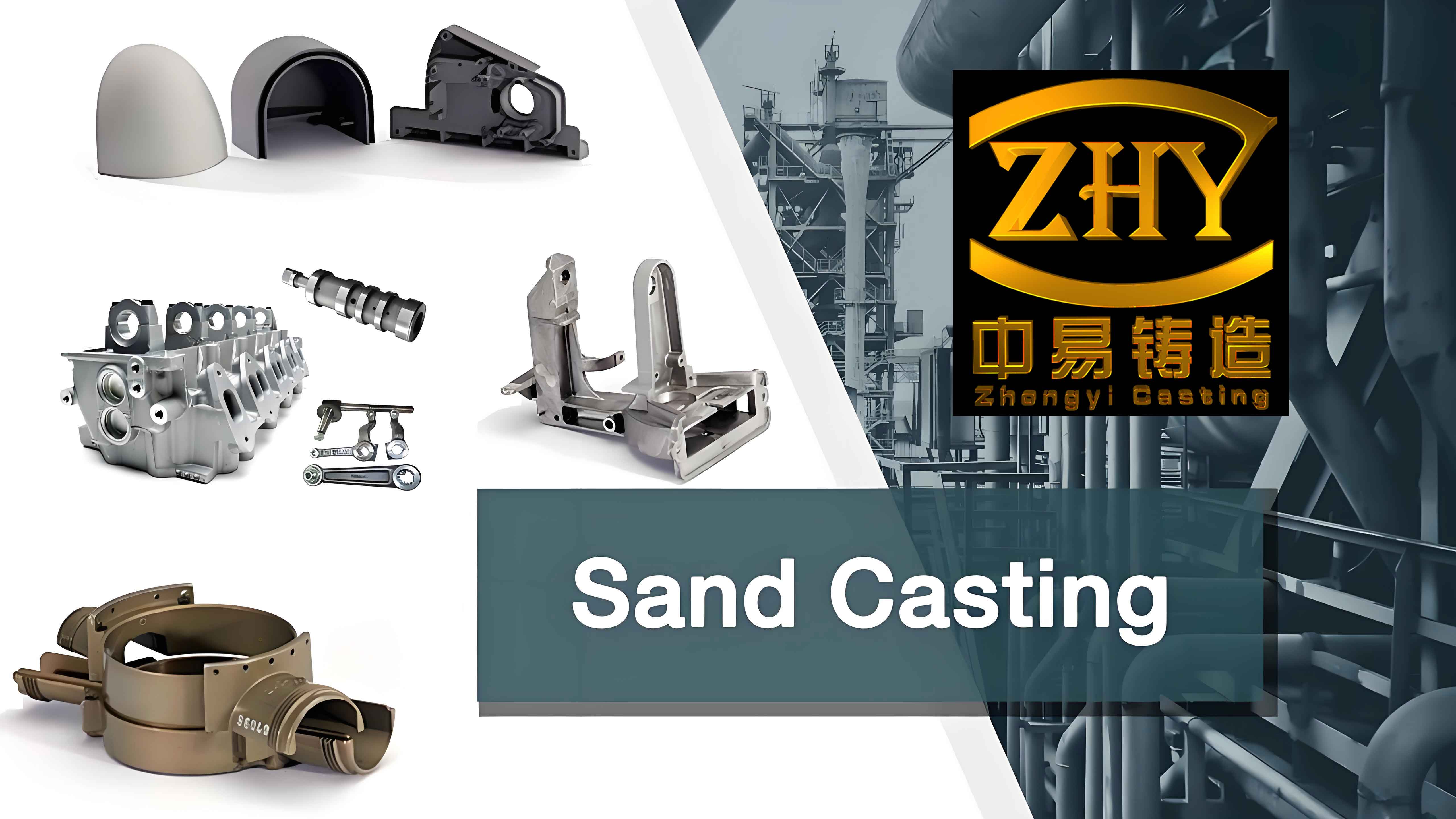
The casting process for such components is almost exclusively green sand molding. The flexibility and cost-effectiveness of green sand are indispensable for the complex geometries typical of valve bodies. A successful sand casting process must manage the entire journey of the metal, from the furnace to a solidified, sound casting. The following schematic represents typical sand casting parts in process.
The specific component under analysis is a large selector valve shell with overall dimensions of approximately 380 mm x 319 mm x 335 mm. Its design features multiple internal chambers, five flanges of varying thickness, and a main body wall thickness as low as 9 mm, with flange sections up to 25 mm thick. This geometry creates three primary, interconnected risks for defects that can lead to failure during hydrostatic testing (e.g., 0.9 MPa for 5 minutes).
| Defect Type | Root Cause in This Geometry | Consequence |
|---|---|---|
| Cold Shuts & Lap Defects | Long, tortuous flow paths through thin sections. Metal front loses heat and velocity before filling is complete. | Planar discontinuities in the wall, creating direct leak paths. |
| Shrinkage Porosity & Tears | Isolated heavy sections (thick flanges, junction hot spots) solidify last without adequate feed metal. | Spongy, weak areas or cracks that fail under pressure. |
| Oxide Inclusions & Entrapped Gas | Turbulent filling of complex cores, metal waterfall effects, and dissolved gas from melting. | Non-metallic films or bubbles trapped within the wall, compromising integrity. |
The engineering of the sand casting process is fundamentally a coordinated campaign to defeat these three threats. The strategy is built on several interdependent pillars: intelligent gating and feeding, controlled cooling, and melt management.
Process Design Philosophy and Calculations
The first step is establishing foundational parameters. For sand casting parts of this size and complexity, machining allowances must account for potential core shift and finishing needs. Critical sealing surfaces inside the bore were given a 6 mm allowance, while standard external surfaces received 5 mm. The patternmaker’s contraction rule must also be selected carefully. The green sand mold wall will give way slightly during solidification shrinkage, while a dry sand core is more rigid. Therefore, a pattern shrinkage allowance of 1.5% is used for the external mold, and 1.0% for the core boxes.
The choice of pouring orientation is critical. For silicon brass valve bodies, a horizontal (flat) parting line is overwhelmingly preferred over vertical (cope and drag) pouring. While vertical pouring can aid slag separation, the extreme complexity of the valve core makes pattern withdrawal from a vertically parted mold exceedingly difficult. Horizontal parting simplifies molding and patternmaking significantly.
The heart of soundness for these sand casting parts lies in the feeding system. The gating and risering design must simultaneously ensure rapid, tranquil filling and provide directed, thermally efficient feeding to heavy sections. The system implemented is a “pressurized-to-open” side-gated design. A downsprue with a diameter of 35 mm is chosen to ensure a high initial pouring rate, combating cold shuts. The key feature is a ceramic foam filter placed in the horizontal runner. This filter intercepts primary oxide dross and dramatically reduces turbulence. The metal then flows into open horizontal runners that feed directly into side risers attached to the flanges.
The filling fluid dynamics can be conceptually framed by the basic Bernoulli and continuity equations. To achieve rapid filling of thin sections, the initial metal velocity at the gate is crucial. The theoretical velocity \( v \) at the base of the downsprue (ignoring friction for estimation) is given by:
$$ v = \sqrt{2gh} $$
where \( g \) is gravity and \( h \) is the effective sprue height. A larger sprue diameter maintains a higher flow rate \( Q \):
$$ Q = A \cdot v = \frac{\pi d^2}{4} \cdot v $$
where \( d \) is the sprue diameter and \( A \) its cross-sectional area. Maximizing \( Q \) early in the pour is a primary defense against cold shuts.
The risering strategy is based on the principle of directional solidification towards the feeders. The heaviest top flange is crowned with a large, rectangular “live” riser (a riser fed directly by the gating system). Two additional side risers are placed on opposing flanges along the valve’s length. This triangular arrangement of feeders ensures that all major sections of the casting are within effective feeding range, minimizing the “feeding distance” to vulnerable thin walls. The size of these risers is not arbitrary; it is based on the required volumetric compensation for shrinkage. The total volumetric shrinkage \( V_{shrink} \) of the alloy can be estimated as a percentage of the casting volume \( V_{casting} \). The riser must provide this volume plus an excess to ensure it remains liquid long enough:
$$ V_{riser} \geq \frac{V_{shrink}}{\eta} = \frac{\beta \cdot V_{casting}}{\eta} $$
where \( \beta \) is the volumetric shrinkage coefficient for silicon brass (typically 4-5%), and \( \eta \) is the feeding efficiency factor of the riser (often 10-15% for side risers). This calculation underpins the final yield, which for leak-critical, large sand casting parts like this, is typically a modest 55-60%.
The Critical Role of Chills and Mold Media
While risers feed shrinkage, chills control local solidification structure and rate. Their use is strategic and multi-functional. Graphite chills are preferred for sand casting parts in non-ferrous alloys due to their excellent thermal conductivity, ease of machining to complex contours, and non-wetting characteristics. A thin coating of oil prevents moisture pickup.
In this valve, chills serve three distinct purposes:
- Molding Aid: In the deep, narrow recess between the heavy top flange and the body, green sand lacks strength. A segmented graphite chill forms this cavity definitively.
- Hot Spot Control: At junctions where three walls meet, creating an isolated thermal mass, thick (25 mm) graphite chills are placed to accelerate cooling and eliminate shrinkage porosity.
- Surface Densification: Chills are placed on the underside of the bottom flange (farthest from risers) and on critical internal sealing bore surfaces. By rapidly extracting heat at the mold/metal interface, they promote a fine-grained, dense skin on the casting, directly enhancing pressure tightness.
The use of a “green sand mold with dry sand cores” process leverages this further. The dry core, being more rigid, minimizes mold wall movement that can contribute to microporosity, while the green sand mold provides the necessary collapsibility post-solidification.
| Location | Chill Type & Size | Primary Function |
|---|---|---|
| Top Flange / Body Recess | Graphite, 4 x 90° segments | Molding aid for unsustainable sand geometry. |
| Junction Hot Spots (x3) | Graphite plates, 25 mm thick | Eliminate shrinkage porosity at wall intersections. |
| Bottom Flange (underside) | Graphite, 2 x 180° segments, 25mm thick | Surface densification and thermal control for riser-distal area. | Internal Sealing Bore Surfaces | Graphite, 4 x 90° segments, 18mm thick | Create fine-grained, leak-tight surface layer. |
The gate design into the side risers requires precision. The ingate connecting the riser to the casting must be sized to promote a “hot link” for feeding but prevent “reverse shrinkage” (where the riser draws metal from the casting). A width limit of 20 mm is enforced. Furthermore, the ingate is tapered in depth—shallower at the top and deeper at the bottom—ensuring metal enters the mold cavity smoothly from the lower portion of the riser, minimizing splashing and oxide generation.
Melt Practice and Solidification Control
Excellent mold design can be undone by poor melt quality. For silicon brass, the melt must be managed to minimize gas (hydrogen) absorption and oxidation. This involves using clean, preheated charge materials, employing a protective flux cover during melting, and avoiding excessive superheating. Degassing practices, such as the use of nitrogen or argon purging, are often essential. Rigorous control of harmful impurities like Fe, Al, and Mn, as outlined in Table 1, is non-negotiable for achieving the required metallurgical soundness in the final sand casting parts.
After pouring, the control of solidification continues. The casting is allowed to cool in the mold until it reaches a dark red heat (approximately 600-700°C) before shakeout. This controlled cooling in the insulating sand prevents warping and minimizes thermal stress. Quenching in water is avoided for a component of this size and complexity to prevent distortion or stress cracking. The early shakeout at elevated temperature allows the casting to air-cool more rapidly through the lower temperature range, which can help in reducing intergranular precipitation and improving overall pressure tightness.
Production Validation and Conclusion
This integrated process methodology was validated through batch production. Initial pilot casts confirmed the accuracy of the pattern and the efficacy of the feeding and chilling layout. No major defects were observed. Subsequent production batches incorporated the refinement of optimized shakeout timing. All castings underwent machining and hydrostatic pressure testing to the specification of 0.9 MPa for 5 minutes, with a 100% success rate and no leakage incidents, confirming the robustness of the process for volume manufacturing of high-integrity sand casting parts.
In conclusion, the successful sand casting of large, leak-proof silicon brass components is a systems engineering achievement. It requires a holistic approach that addresses material behavior, geometric challenges, and process physics simultaneously. The key takeaways for producing such demanding sand casting parts are:
- Defeat Cold Shuts by designing high-velocity initial gating, minimizing flow path lengths, and using chills judiciously to avoid blocking flow fronts.
- Eliminate Shrinkage Defects by placing risers strategically on heavy sections to ensure short feeding paths, and using chills aggressively on thermal hot spots to control solidification order.
- Prevent Oxide Inclusions by employing filtration in the gating system, designing ingates for smooth, non-turbulent cavity entry, and maintaining exemplary melt hygiene and degassing practices.
Through the meticulous application of these principles, the inherent challenges of crafting complex, pressure-tight silicon brass valve bodies via sand casting are not just met but mastered, enabling reliable and economical series production.