
In my extensive research on lost foam casting processes, I have dedicated significant effort to understanding the formation of surface wrinkles in cast iron parts. These defects, characterized by irregular, wavy surfaces, severely compromise the aesthetic and functional integrity of cast iron parts, leading to increased rejection rates and production costs. Through experimental observations and theoretical analysis, I have developed a comprehensive model that explains wrinkle formation as a consequence of pulsating flow during mold filling. This article delves into the underlying mechanisms, key influencing factors, and practical strategies to mitigate such defects, with a particular focus on ensuring the production of high-quality cast iron parts.
The core of my proposed mechanism revolves around the dynamic interaction between the molten metal, the decomposing foam pattern, and the gaseous products within the mold cavity. When molten cast iron is poured into a lost foam mold, the heat from the metal causes the polystyrene foam to degrade, generating gaseous and liquid residues. This creates a pressurized gas zone (which I will refer to as Zone A) ahead of the advancing metal front. The pressure in Zone A resists the flow of the metal. As the metal flows, a portion of these gases escapes through the coating layer, causing the pressure in Zone A to drop. This pressure reduction allows the liquid metal to resume its flow until a new equilibrium is reached. This cycle of flow, pressure build-up, gas escape, and renewed flow repeats, creating what I term a “pulsating flow.” This pulsating nature is fundamental to wrinkle initiation in cast iron parts.
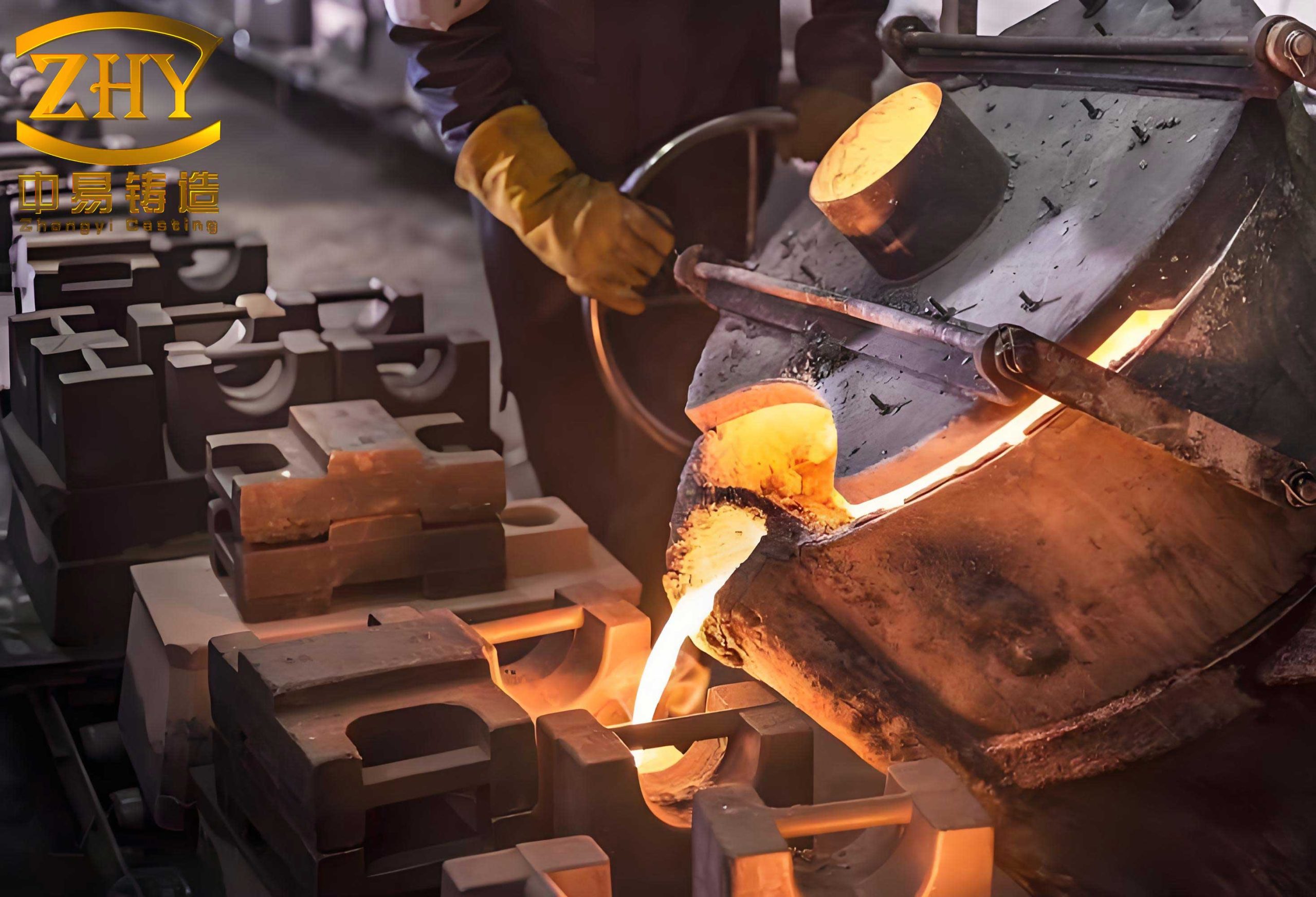
During this pulsating filling process, the temperature at the flow front of the molten cast iron part gradually decreases due to heat loss to the coating and the endothermic foam degradation. After flowing a certain distance, the front temperature can fall below the liquidus temperature, $T_L$. At the moment the flow momentarily stops, a thin, semi-solid shell forms at the metal front. When the gas pressure in Zone A subsequently decreases, the metal, driven by the metallostatic head, breaks through this shell and continues to flow, pressing the shell against the mold wall. However, as this shell has already acquired some strength and hardness, it cannot conform perfectly to the wall. This results in a wavy imprint, or a wrinkle. If the subsequent flow of molten iron cannot remelt this shell, the wrinkle becomes permanently fixed on the surface of the cast iron part. This process repeats with each pulsation until the metal finally ceases to flow. Therefore, the critical condition for wrinkle formation is intrinsically linked to the temperature at the moment flow stops. My experiments confirm that wrinkles begin to appear when the metal temperature at the flow front is between the liquidus and the eutectic temperature, typically slightly above the eutectic range for gray cast iron parts.
To quantify this relationship, I conducted a series of experiments using different foam patterns and coatings. The temperature corresponding to the transition from a smooth surface to a wrinkled surface was meticulously measured. The data, summarized in the table below, clearly shows that the wrinkle initiation temperature, $T_W$, for the tested gray cast iron parts (composition: C 3.2-3.4%, Si 1.8-2.1%, Mn 0.6-0.8%, P < 0.1%, S < 0.1%) lies within a specific range below $T_L$.
| Sample ID | Foam Type | Coating Type | Smooth Surface Length (mm) | Wrinkle Initiation Temp, $T_W$ (°C) |
|---|---|---|---|---|
| 1 | EPS-A | Coating 1 (High Permeability) | 150 | 1180 |
| 2 | EPS-A | Coating 2 (Low Permeability) | 95 | 1195 |
| 3 | EPS-B | Coating 1 | 180 | 1170 |
| 4 | EPS-B | Coating 2 | 110 | 1200 |
From the iron-carbon-silicon pseudo-binary phase diagram, the liquidus temperature $T_L$ for this composition is approximately 1220°C, and the eutectic temperature range $T_E$ is around 1150°C. The data indicates $T_E < T_W < T_L$, supporting the mechanism that wrinkles form when the metal stops flowing at a temperature where a stable shell can exist but is not fully remelted. This finding is pivotal for controlling the quality of cast iron parts. Essentially, if the temperature throughout the cast iron part remains above $T_W$ (approximately 1200°C in this case) at all points during filling, smooth surfaces can be guaranteed.
The thermal dynamics can be partially described by considering the heat balance at the flow front. The temperature change along the flow length $x$ can be modeled as:
$$ T(x) = T_{pour} – \int_0^x \left( \frac{h_c (T – T_{mold})}{\rho_m C_p v} + \frac{\dot{q}_{foam}}{\rho_m C_p v} \right) dx $$
Where $T_{pour}$ is the pouring temperature, $h_c$ is an effective heat transfer coefficient, $T_{mold}$ is the mold temperature, $\rho_m$ is the metal density, $C_p$ is the specific heat, $v$ is the local flow velocity (which is itself a function of gas pressure), and $\dot{q}_{foam}$ is the volumetric heat sink rate due to foam degradation. The pulsating flow makes $v$ discontinuous, but the integral form highlights the cumulative cooling effect.
Factors Influencing Wrinkle Formation in Cast Iron Parts
Any factor that alters the temperature distribution along the flow path or the dynamics of the pulsating flow will inevitably affect the formation of wrinkles on cast iron parts. My investigation has primarily focused on two material-based factors: coating permeability and foam pattern properties.
1. Influence of Coating Permeability on Temperature Distribution
The coating layer serves as the primary barrier between the molten cast iron part and the sand mold, and its gas permeability is crucial. I prepared identical foam patterns (using type EPS-A) and applied two different coatings. Coating 1 had high permeability, while Coating 2 had low permeability. The permeability was measured by the time required for a fixed volume of gas at a set pressure to pass through a standard area and thickness of the coating layer. The results were $t_1 = 18$ seconds for Coating 1 and $t_2 = 65$ seconds for Coating 2. During pouring, I measured the temperature at several points along the length of the resulting cast iron part. The data is presented below.
| Distance from Pouring Point (mm) | Temperature with Coating 1, $T_1$ (°C) | Temperature with Coating 2, $T_2$ (°C) | Temperature Difference $\Delta T = T_1 – T_2$ (°C) |
|---|---|---|---|
| 50 | 1250 | 1242 | 8 |
| 100 | 1225 | 1210 | 15 |
| 150 | 1205 | 1180 | 25 |
The temperature was consistently higher for the cast iron part produced with the high-permeability coating (Coating 1). The difference increased with flow distance, reaching 25°C at the third measurement point. This demonstrates that higher coating permeability reduces gas back-pressure, allowing faster filling and minimizing heat loss. Consequently, the length of smooth surface on the cast iron part is increased, and wrinkle formation is suppressed. The gas escape rate can be approximated by Darcy’s law:
$$ Q = \frac{k A \Delta P}{\mu L} $$
where $Q$ is the volumetric flow rate of gas, $k$ is the coating permeability, $A$ is the area, $\Delta P$ is the pressure difference across the coating, $\mu$ is the gas viscosity, and $L$ is the coating thickness. A higher $k$ leads to a higher $Q$, faster pressure relief in Zone A, less pulsation, and a more continuous fill for the cast iron part.
2. Influence of Foam Pattern Properties on Temperature Distribution
The properties of the expandable polystyrene (EPS) foam pattern itself are equally critical. I tested two foam types, EPS-A and EPS-B, with distinct physical properties as measured in my lab. Their key characteristics are summarized in the following table.
| Foam Type | Density $\rho_f$ (kg/m³) | Degradation Latent Heat $L_f$ (kJ/kg) | Gas Generation Volume $V_g$ (cm³/g) |
|---|---|---|---|
| EPS-A | 22 | 800 | 120 |
| EPS-B | 18 | 550 | 95 |
Under identical conditions (same coating, pouring temperature), I measured the temperature distribution along the cast iron part. The results were striking. At every measured point, the temperature for the cast iron part made with EPS-B foam was significantly higher—by over 30°C at the farthest point—compared to the one made with EPS-A. The lower degradation latent heat $L_f$ of EPS-B means less energy is absorbed from the molten metal to decompose the foam, resulting in less cooling. Similarly, lower gas generation $V_g$ reduces the pressure in Zone A, minimizing flow resistance and pulsation. My analysis indicates that the degradation latent heat plays a more dominant role than gas generation in affecting the thermal history of the cast iron part. The heat absorbed by the foam per unit volume, $q_{abs}$, can be expressed as:
$$ q_{abs} = \rho_f (C_{p,f} \Delta T_f + L_f) $$
where $C_{p,f}$ is the specific heat of the foam and $\Delta T_f$ is its temperature rise. Minimizing $q_{abs}$, particularly the $L_f$ term, is essential for maintaining high metal temperature and producing wrinkle-free cast iron parts.
Comprehensive Discussion on Process Optimization
The synthesis of my mechanistic model and experimental data leads to clear guidelines for preventing wrinkle defects in lost foam cast iron parts. The fundamental principle is to ensure that the temperature of the molten metal at every location within the mold cavity remains above the wrinkle initiation temperature $T_W$ at the moment local flow ceases. In practice, for typical gray cast iron parts, this means maintaining temperatures above approximately 1200°C throughout the filling process.
Based on my findings, I recommend a multi-faceted approach:
- Optimize Coating Permeability: Use coatings specifically designed for lost foam casting with high gas permeability. This facilitates rapid venting of decomposition gases, reduces back-pressure, promotes steady (non-pulsating) flow, and minimizes heat loss, all contributing to smoother cast iron parts.
- Select Appropriate Foam Material: Source foam patterns with low density, low degradation latent heat, and low gas generation. These are often specially modified for casting applications, not generic packaging materials. The use of low-heat-absorption foam is perhaps the most direct way to preserve the thermal energy of the molten cast iron part.
- Increase Pouring Temperature and Metallostatic Head: While often constrained by metallurgical considerations, a higher pouring temperature provides a greater thermal buffer against cooling. A higher metallostatic pressure head (e.g., from a taller sprue) provides greater driving force to overcome gas pressure and break through any forming shells, ensuring continuous flow and better surface replication in the cast iron part.
The historical association of heavy carbon deposits with severe wrinkling is consistent with my model. Extensive carbon deposition indicates very low permeability of the coating or mold system, which leads to exceptionally high gas pressure in Zone A. This intensifies the pulsating flow mechanism, making wrinkles more pronounced and widespread on the cast iron part. Therefore, controlling gas evacuation is key to controlling both carbon defects and surface wrinkles.
Many production facilities struggle with wrinkle defects due to a combination of suboptimal conditions: using low-temperature melting furnaces (e.g., cupolas), employing unmodified packaging-grade foam with poor properties, and lacking specialized high-permeability lost foam coatings. Addressing these three pillars is essential for the commercial production of high-integrity cast iron parts via the lost foam process.
To further elaborate on the thermal management, consider the energy equation for the advancing metal front in a one-dimensional model:
$$ \rho_m C_p \frac{\partial T}{\partial t} + \rho_m C_p v \frac{\partial T}{\partial x} = k_m \frac{\partial^2 T}{\partial x^2} – h_{eff}(T – T_\infty) – \dot{S}_{foam}(x,t) $$
Here, $k_m$ is the thermal conductivity of the metal, $h_{eff}$ is an effective heat loss coefficient to the surroundings, $T_\infty$ is the ambient mold temperature, and $\dot{S}_{foam}$ is the distributed heat sink term due to foam degradation, which is a complex function of position and time. Solving this equation, even numerically, with appropriate boundary conditions (pouring temperature, pulsating velocity $v(t)$) would predict the temperature field $T(x,t)$ and help identify regions where $T$ falls below $T_W$, pinpointing potential wrinkle sites in a cast iron part of given geometry.
Extended Analysis and Future Considerations
My research also suggests investigating the interplay between alloy composition and wrinkle formation. While this study focused on a specific gray cast iron, the principles apply to other alloys used for cast iron parts, such as ductile iron. The liquidus and eutectic temperatures vary with composition, altering the window $T_W$. For instance, a higher carbon equivalent might lower $T_L$, potentially making the cast iron part more susceptible to wrinkles if other factors are not adjusted. A generalized criterion for wrinkle avoidance could be formulated as:
$$ \min_{x \in [0, L]} T(x, t_{stop}(x)) > T_L – \Delta T_{crit} $$
where $t_{stop}(x)$ is the time flow stops at position $x$, and $\Delta T_{crit}$ is a critical undercooling derived from material properties, typically 20-50°C for cast iron parts.
Furthermore, the role of mold vacuum in lost foam casting is crucial. Applying a vacuum to the sand mold can dramatically enhance gas extraction through the coating, effectively increasing its apparent permeability. This practice can suppress pulsating flow and is highly recommended for producing complex, thin-walled cast iron parts where temperature drop is rapid.
The economic implication of controlling wrinkles is substantial. A reject rate reduction of even a few percentage points translates to significant savings in energy, materials, and labor for foundries specializing in cast iron parts. Therefore, investing in proper foam patterns, coatings, and process monitoring is justified.
In summary, the journey to a flawless cast iron part in lost foam casting hinges on mastering the thermal and hydrodynamic landscape inside the mold. By viewing the process through the lens of pulsating flow and its temperature-dependent consequences, foundry engineers can make informed decisions to eliminate surface defects. The continuous pursuit of optimized materials—foams with minimal thermal disruption and coatings with maximal gas transit—will remain at the forefront of quality enhancement for cast iron parts manufactured via this versatile casting technique. The integration of real-time temperature monitoring and adaptive process control could be the next frontier in ensuring that every cast iron part emerges from the mold with a pristine, wrinkle-free surface.