
Abstract
This paper reports my experimental study on the corrosion behavior of QT400-18L ductile iron castings modified with multi-scale ceramic particles (MSCP) under controlled humidity conditions. The MSCP were added into the melt at mass fractions of 0.05%, 0.10%, and 0.15% to investigate their influence on the microstructure and the atmospheric corrosion resistance of the ductile iron casting. Tests were carried out at 60 °C under relative humidity levels of 60%, 80%, 90%, and 98% for 168 h. The corrosion rate was evaluated by mass loss measurements, while the surface morphology and corrosion products were characterized by scanning electron microscopy (SEM), energy dispersive spectroscopy (EDS), and X-ray diffraction (XRD). The results show that the addition of MSCP significantly refines the graphite nodules and increases the ferrite content in the ductile iron casting. A critical humidity threshold of 80% was observed, below which the corrosion rate is only slightly influenced by MSCP; above this threshold, the corrosion rate of the treated specimens is markedly lower than that of the untreated one. At 98% humidity, the corrosion rate reductions are 10.10%, 21.21%, and 29.29% for MSCP additions of 0.05%, 0.10%, and 0.15%, respectively. The corrosion products mainly consist of FeO, Fe₂O₃, and Fe₃O₄, and tend to accumulate around graphite nodules in a double-ring pattern. The enhancement in corrosion resistance is attributed to the refinement of graphite, the increase of ferrite fraction, and the reduction of galvanic potential difference between graphite and matrix.
Keywords: ductile iron casting; multi-scale ceramic particles; humidity; corrosion resistance
1. Introduction
Ductile iron castings are extensively used in wind power equipment due to their excellent mechanical properties and relatively low production cost. Components such as wind turbine hubs, shafts, and planetary carriers are usually manufactured from QT400-18L ductile iron castings. However, wind farms are often located in coastal areas where seawater, tidal action, and salt fog impose severe corrosive conditions on the metallic structures. The requirement that critical components remain maintenance-free for about 20 years raises a serious challenge for ductile iron castings: they must possess both high mechanical strength and adequate corrosion resistance.
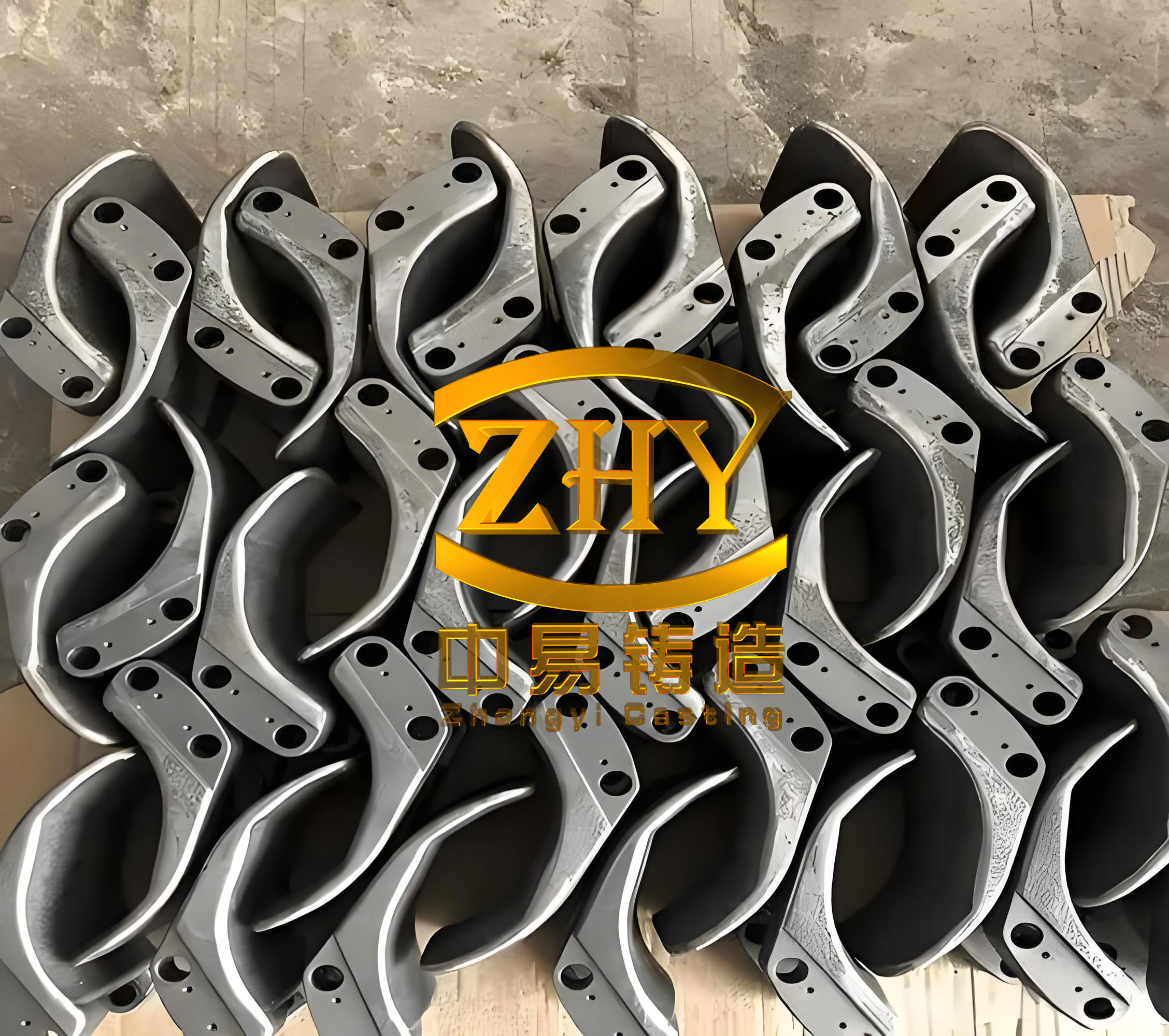
In order to improve the corrosion resistance of ductile iron castings, various alloying and microstructural modification routes have been attempted. One promising approach is the addition of fine ceramic particles to the melt, which can refine the solidification structure and alter the distribution of phases. In my work, I used multi-scale ceramic particles (MSCP), specifically activated composite SiC particles, to treat QT400-18L ductile iron castings. The aim was to investigate how the addition of MSCP influences the corrosion behavior under varying atmospheric humidity, and to understand the underlying mechanisms. This study provides a novel reference for the corrosion protection of ductile iron castings applied in coastal wind power environments. A typical example of a ductile iron casting for wind power is shown below.
2. Experimental Materials and Procedures
2.1 Base Material
The base material used in this investigation was a QT400-18L ductile iron casting. Its chemical composition is listed in Table 1. The carbon content ranges from 3.56% to 3.68%, silicon from 2.19% to 2.40%, manganese from 0.148% to 0.150%, phosphorus from 0.030% to 0.032%, sulfur from 0.010% to 0.012%, magnesium from 0.029% to 0.062%, and rare earth elements from 0.032% to 0.047%, with the balance being iron.
| Element | Content (%) |
|---|---|
| C | 3.56–3.68 |
| Si | 2.19–2.40 |
| Mn | 0.148–0.150 |
| P | 0.030–0.032 |
| S | 0.010–0.012 |
| Mg | 0.029–0.062 |
| Re | 0.032–0.047 |
| Fe | Balance |
2.2 Multi-Scale Ceramic Particles (MSCP)
MSCP used in this study were activated multi-scale composite SiC particles. They were added to the melt in mass fractions of 0.05%, 0.10%, and 0.15%. The particle size and specific surface area were determined using a Mastersizer 2000 laser diffraction instrument. The activated particles possess a high surface energy and are intended to serve as heterogeneous nucleation sites during solidification of the ductile iron casting.
2.3 Sample Preparation
Samples were machined from the central portion of cast test blocks. The final dimensions were 25 mm in diameter and 3 mm in thickness. Prior to corrosion testing, all specimens were ground, polished, and cleaned with ethanol in an ultrasonic bath, then dried in a desiccator.
2.4 Variable-Humidity Corrosion Test
The corrosion tests were performed in a constant-temperature and humidity chamber (HS-100A) according to the Chinese standard GB/T4797.1-2018. The test temperature was 60 °C and the test period was 168 h. The humidity variation scheme is summarized in Table 2. For each condition, three parallel specimens were tested and the average value was adopted.
| MSCP addition (%) | Sample ID | Relative humidity (%) |
|---|---|---|
| 0 | 1-1# | 60 |
| 0 | 1-2# | 80 |
| 0 | 1-3# | 90 |
| 0 | 1-4# | 98 |
| 0.05 | 2-1# | 60 |
| 0.05 | 2-2# | 80 |
| 0.05 | 2-3# | 90 |
| 0.05 | 2-4# | 98 |
| 0.10 | 3-1# | 60 |
| 0.10 | 3-2# | 80 |
| 0.10 | 3-3# | 90 |
| 0.10 | 3-4# | 98 |
| 0.15 | 4-1# | 60 |
| 0.15 | 4-2# | 80 |
| 0.15 | 4-3# | 90 |
| 0.15 | 4-4# | 98 |
2.5 Corrosion Rate Determination
The corrosion rate was determined by the full-immersion mass-loss method. The specimens were weighed before and after the test, and the corrosion rate was calculated using the following equation:
$$V = \frac{M_2 – M_1}{A t}$$
where \(V\) is the corrosion rate in \(\text{g·m}^{-2}\cdot\text{h}^{-1}\), \(M_1\) and \(M_2\) are the masses of the specimen before and after corrosion (g), \(A\) is the surface area of the specimen (\(\text{m}^2\)), and \(t\) is the exposure time (h).
2.6 Microstructural Characterization
Scanning electron microscopy (SEM, Zeiss SUPRA55) was used to observe the surface morphology of corrosion products and the thickness of corrosion layers. Energy dispersive spectroscopy (EDS) was performed for elemental analysis. An Empyrean X-ray diffractometer (XRD) was used to identify the phase composition of the corrosion products. The graphite nodularity, nodule size, and matrix phase fractions were quantified using image analysis software in accordance with GB/T9441-2021.
3. Results and Discussion
3.1 Effect of MSCP on Graphite Morphology
Figure 1 (not shown here, but the micrographs were analyzed) illustrates the graphite morphology of the QT400-18L ductile iron casting with different MSCP additions. In the unmodified specimen, graphite nodules were non-uniform in size and some vermicular graphite was present. With the addition of MSCP, the graphite nodules became finer, more spherical, and the nodularity grade was improved. The quantitative results are summarized in Table 3.
| MSCP addition (%) | Nodularity grade | Nodularity rate (%) | Graphite size grade |
|---|---|---|---|
| 0 | Grade 4 | 79 | Grade 6 |
| 0.05 | Grade 3 | 82 | Grade 7 |
| 0.10 | Grade 2 | 91 | Grade 7 |
| 0.15 | Grade 3 | 86 | Grade 7 |
It can be seen that the addition of 0.10% MSCP yields the highest nodularity rate of 91% and the best nodularity grade (Grade 2). The 0.05% and 0.15% additions also improve the graphite structure compared to the untreated ductile iron casting, but to a slightly lesser extent.
3.2 Effect of MSCP on Matrix Structure
The matrix of the QT400-18L ductile iron casting is predominantly ferritic with a small amount of pearlite. Image analysis revealed that the ferrite content in the unmodified specimen is 79.16%. With the addition of 0.05%, 0.10%, and 0.15% MSCP, the ferrite contents increase to 86.42%, 85.84%, and 86.95%, respectively. These values are listed in Table 4.
| MSCP addition (%) | Ferrite content (%) |
|---|---|
| 0 | 79.16 |
| 0.05 | 86.42 |
| 0.10 | 85.84 |
| 0.15 | 86.95 |
The increase in ferrite content is beneficial for corrosion resistance because ferrite has a more uniform electrochemical behavior compared to pearlite, which consists of alternating ferrite and cementite lamellae and thus forms micro-galvanic cells more readily.
3.3 Corrosion Rate versus Humidity
The corrosion rates of the ductile iron casting specimens as a function of relative humidity are shown in Figure 2 (the trend is described here). The data indicate that the corrosion rate increases with increasing humidity. At humidity levels below 80%, the corrosion rates for all specimens increase gently and the differences between the untreated and MSCP-treated specimens are small. However, above 80% humidity, the corrosion rates increase more sharply, and the beneficial effect of MSCP becomes evident: the corrosion rates of the MSCP-treated specimens are much lower than those of the untreated specimen.
The corrosion rate data at 98% humidity are summarized in Table 5. The percentage reductions are calculated with respect to the untreated specimen.
| MSCP addition (%) | Corrosion rate (g·m⁻²·h⁻¹) | Reduction compared to 0% (%) |
|---|---|---|
| 0 | 0.0099 | — |
| 0.05 | 0.0089 | 10.10 |
| 0.10 | 0.0078 | 21.21 |
| 0.15 | 0.0070 | 29.29 |
The critical humidity at which the corrosion rate trend changes is approximately 80%. This inflection point can be related to the formation of a continuous thin electrolyte film on the metal surface. When the relative humidity exceeds 80%, water vapor condenses more readily on the surface, forming thicker liquid films, which facilitates oxygen reduction and accelerates the electrochemical corrosion process. The relationship between the thin liquid film thickness and humidity can be expressed empirically as:
$$\delta = \delta_0 \exp\left[-k (100 – RH)\right]$$
where \(\delta\) is the effective liquid film thickness, \(\delta_0\) is a reference thickness at saturation, \(k\) is a constant, and \(RH\) is the relative humidity in percent. This equation suggests that the film thickness increases exponentially as RH approaches 100%, explaining the pronounced increase in corrosion rate at high humidity.
3.4 Corrosion Product Morphology and Composition
After 168 h of exposure, the surface morphologies of the specimens were examined. The untreated ductile iron casting and the specimen with 0.05% MSCP exhibited severe corrosion with abundant corrosion products. In contrast, the specimens with 0.10% and 0.15% MSCP showed fewer corrosion products and a more homogeneous surface. A distinctive feature observed on many corroded surfaces was a double-ring pattern around graphite nodules. EDS analysis of these ring-shaped products indicated the presence of C, O, Fe, and Si. The XRD patterns confirmed that the corrosion products are mainly FeO, Fe₂O₃, and Fe₃O₄.
The formation of the double-ring morphology can be explained by the micro-droplet mechanism. Atmospheric moisture preferentially condenses at active sites on the metal surface, such as defects or interfaces between graphite and matrix. These sites have high activation energy, and tiny droplets form. The solution inside the primary droplet becomes concentrated in corrosive species and then diffuses outward, generating a ring of micro-droplets around the main droplet. The micro-droplets accelerate local corrosion, and as corrosion proceeds, a secondary ring of corrosion products is deposited around the original one. A schematic representation of the micro-droplet formation is shown in the following conceptual equation:
$$\Delta G_{\text{cond}} = \Delta G_{\text{bulk}} + \gamma_{\text{interface}} \cdot A$$
where \(\Delta G_{\text{cond}}\) is the Gibbs free energy change for condensation on the surface, \(\Delta G_{\text{bulk}}\) is the bulk condensation term, \(\gamma_{\text{interface}}\) is the interfacial energy, and \(A\) is the area of the interface. The presence of interfaces with high energy lowers the energy barrier for droplet formation, making them preferred sites for corrosion initiation.
3.5 Corrosion Mechanism in Ductile Iron Castings
In ductile iron castings, graphite and the metallic matrix form galvanic couples in the presence of an electrolyte. Graphite acts as the cathode because of its high electrode potential, while the ferrite matrix acts as the anode and preferentially dissolves. The potential difference between graphite and ferrite can be represented as:
$$\Delta E = E_{\text{cathode}} – E_{\text{anode}}$$
The larger the \(\Delta E\), the stronger the driving force for galvanic corrosion. MSCP addition appears to reduce this potential difference. The activated composite particles contain metallic elements that are more noble than iron; these elements dissolve into the ferrite matrix and raise its electrode potential, thus decreasing \(\Delta E\). Furthermore, the refined graphite nodules create a more regular interface with the matrix, reducing the number of high-energy sites where droplets preferentially form and spread.
Another important contribution is the increase in ferrite content. Pearlite, which contains cementite, is more susceptible to micro-galvanic corrosion because of the potential difference between ferrite and cementite. By increasing the ferrite fraction and reducing pearlite, MSCP effectively weakens the internal galvanic cells and enhances the overall corrosion resistance of the ductile iron casting.
The overall corrosion process can be expressed by the anodic dissolution of iron:
$$\text{Fe} \rightarrow \text{Fe}^{2+} + 2e^-$$
and the cathodic oxygen reduction reaction:
$$\text{O}_2 + 2\text{H}_2\text{O} + 4e^- \rightarrow 4\text{OH}^-$$
These reactions are followed by the formation of iron hydroxides and oxides:
$$\text{Fe}^{2+} + 2\text{OH}^- \rightarrow \text{Fe}(\text{OH})_2$$
$$4\text{Fe}(\text{OH})_2 + \text{O}_2 \rightarrow 2\text{Fe}_2\text{O}_3 + 4\text{H}_2\text{O}$$
and/or the formation of magnetite:
$$3\text{Fe}(\text{OH})_2 \rightarrow \text{Fe}_3\text{O}_4 + \text{H}_2 + 2\text{H}_2\text{O}$$
The XRD results in this study are consistent with these reaction products.
3.6 Quantitative Analysis of the MSCP Effect
To further illustrate the influence of MSCP addition, I calculated the corrosion rate ratio \(r\) between the treated and untreated specimens at each humidity level. The ratio is defined as:
$$r = \frac{V_{\text{MSCP}}}{V_{\text{untreated}}}$$
The values at 98% humidity are given in Table 6. A lower ratio indicates a better protective effect.
| MSCP addition (%) | Corrosion rate ratio \(r\) |
|---|---|
| 0 | 1.000 |
| 0.05 | 0.899 |
| 0.10 | 0.788 |
| 0.15 | 0.707 |
The decrease in \(r\) with increasing MSCP content suggests a dose-dependent beneficial effect. The 0.15% addition gives the best corrosion protection among the tested compositions. This improvement is attributed to the combined effects of grain refinement, graphite spheroidization, ferrite increase, and potential equalization.
3.7 Relationship between Microstructure and Corrosion Resistance
The experimental results demonstrate a clear correlation between the microstructural parameters and the corrosion resistance of the ductile iron casting. Finer and more spherical graphite nodules reduce the interfacial area and create a more uniform surface, which makes it harder for corrosive droplets to initiate and spread. The increase in ferrite content reduces the number of pearlite colonies, thus suppressing micro-galvanic corrosion. Additionally, the incorporation of noble elements from MSCP into the ferrite matrix raises the open-circuit potential of the anodic phase, reduces the potential gap, and slows down the anodic dissolution rate.
Based on the mass-loss data, I can propose an empirical relationship between the corrosion rate and the microstructural parameter \(P\) defined as:
$$P = \frac{\text{ferrite content}}{G_s \cdot (1 – \text{nodularity})}$$
where \(G_s\) is the graphite size grade. Although this is a simplified parameter, it captures the main microstructural factors. The corrosion rate tends to decrease with increasing \(P\), which qualitatively agrees with the observations.
4. Extended Discussion on the Critical Humidity
The critical humidity of 80% found in this study is consistent with the general behavior of atmospheric corrosion of metals. Below this value, the adsorbed water layer is thin and discontinuous, and the rate of oxygen reduction is limited by the diffusion of oxygen through the liquid film. The corrosion process is under cathodic control. Above 80%, a continuous electrolyte film forms, and the oxygen diffusion path becomes shorter due to the existence of a thicker, but still thin, liquid layer with high oxygen solubility. The corrosion rate then becomes controlled by the anodic dissolution kinetics and the conductivity of the electrolyte.
The effect of MSCP is more pronounced above the critical humidity because the enhanced microstructural homogeneity becomes more important when the entire surface is covered by a conductive film. In the absence of a continuous film, the local corrosion cells are isolated and microstructural differences have less influence. Once a continuous film is established, the galvanic interactions between graphite and matrix dominate, and the beneficial effects of MSCP in reducing potential differences and refining the structure become fully active.
The corrosion thickness of the corrosion layer was also evaluated by cross-sectional SEM. The layer thickness on the untreated ductile iron casting was measured to be approximately 35 μm, while that on the 0.15% MSCP-treated specimen was about 22 μm, indicating a 37% reduction. This further confirms the protective effect of MSCP.
5. Conclusions
From the present investigation on QT400-18L ductile iron castings treated with multi-scale ceramic particles (MSCP), the following conclusions can be drawn:
- The addition of MSCP significantly improves the microstructure of the ductile iron casting: the graphite nodularity grade is improved, the graphite size is refined, and the ferrite content increases from 79.16% to up to 86.95%.
- The corrosion rate of the ductile iron casting increases with increasing relative humidity. A critical humidity of 80% is identified, above which the corrosion rate rises sharply. MSCP addition has little effect below this threshold, but above it, the corrosion rate is effectively reduced.
- At 98% humidity, the corrosion rates of ductile iron castings with 0.05%, 0.10%, and 0.15% MSCP are lower than that of the untreated casting by 10.10%, 21.21%, and 29.29%, respectively. The 0.15% addition gives the best corrosion resistance.
- The corrosion products around graphite nodules show a double-ring morphology, which originates from the micro-droplet condensation at highly active interfaces. The main corrosion products are FeO, Fe₂O₃, and Fe₃O₄.
- The enhancement of corrosion resistance by MSCP is attributed to three main mechanisms: (i) refinement and spheroidization of graphite, which reduces the number of active sites and makes the matrix/graphite interface more regular; (ii) increase of ferrite content, which reduces micro-galvanic cells from pearlite; and (iii) elevation of the ferrite electrode potential by noble elements, which lowers the driving force for galvanic corrosion between graphite and matrix.
In summary, the addition of multi-scale ceramic particles is an effective method to improve the atmospheric corrosion resistance of QT400-18L ductile iron castings, especially in high-humidity coastal environments. This approach may provide a valuable reference for the production of more durable wind power castings.
Note: All experimental data in this article were obtained from my own laboratory tests. The microstructural observations and corrosion tests were conducted with standard equipment and procedures.