
In modern manufacturing, the production of high-quality sand casting parts is critical for industries such as automotive and aerospace, where complex geometries and stringent performance requirements are common. As an engineer specializing in casting processes, I have extensively studied the integration of rapid prototyping and numerical simulation to optimize the fabrication of sand casting parts. This article delves into a detailed case study involving the simulation of filling and solidification for an engine cylinder head, a quintessential example of intricate sand casting parts. By leveraging advanced software like ProCAST, I aim to demonstrate how numerical methods can enhance the design and validation of casting processes, ultimately improving the quality and efficiency of producing sand casting parts. The focus here is on the entire lifecycle from CAD modeling to production validation, with an emphasis on the thermal and fluid dynamics that govern the behavior of sand casting parts during casting.
The foundation of this work lies in the rapid sand casting technique, which combines stereolithography (SLA) prototyping with traditional sand casting to accelerate the development of sand casting parts. This approach is particularly valuable for low-volume production and prototyping, where time-to-market is crucial. In this study, I explore the entire process chain, starting with the creation of a three-dimensional model of the engine cylinder head—a complex sand casting part with numerous internal passages and thin walls. The goal is to achieve defect-free sand casting parts through meticulous process design and simulation. To this end, I developed a CAD/CAE system tailored for rapid sand casting, which facilitates the agile design of molds and the analysis of casting parameters. This system enables the efficient generation of gating and feeding systems, ensuring that sand casting parts like the cylinder head are produced with minimal porosity and optimal mechanical properties.
The material selected for this study is ZL105 aluminum alloy, a common choice for sand casting parts due to its excellent castability and mechanical strength. Its chemical composition is detailed in Table 1, which is essential for accurate simulation inputs. The properties of sand casting parts heavily depend on the alloy’s behavior during solidification, and thus, precise material data is crucial. The ZL105 alloy has a liquidus temperature of approximately 622°C and a solidus temperature of 536°C, defining the range over which phase changes occur. In numerical simulations, these temperatures are used to model the latent heat release and microstructure evolution in sand casting parts. The alloy’s thermal conductivity and specific heat are also key parameters, as they influence the heat transfer between the molten metal and the sand mold, ultimately affecting the quality of sand casting parts.
| Element | Composition (wt%) |
|---|---|
| Si | 4.5–5.5 |
| Cu | 1.0–1.5 |
| Mg | 0.4–0.6 |
| Al | Balance |
The casting process design for sand casting parts involves multiple steps, including parting line selection, gating system configuration, and riser placement. For the engine cylinder head, I opted for a one-side bottom gating system to ensure smooth filling and reduce turbulence. This design minimizes the risk of defects such as air entrapment and slag inclusion in sand casting parts. The gating system comprises a sprue, runners, and ingates, with dimensions calculated based on the volumetric flow rate and solidification time. The risers, placed on the upper section of the mold, are designed to compensate for shrinkage during solidification, a common issue in thick sections of sand casting parts. The parting line was chosen to facilitate core assembly and removal, which is vital for complex sand casting parts with internal features. All these design elements were modeled using the CAD subsystem, which automates parameter calculations based on empirical rules and theoretical principles for sand casting parts.
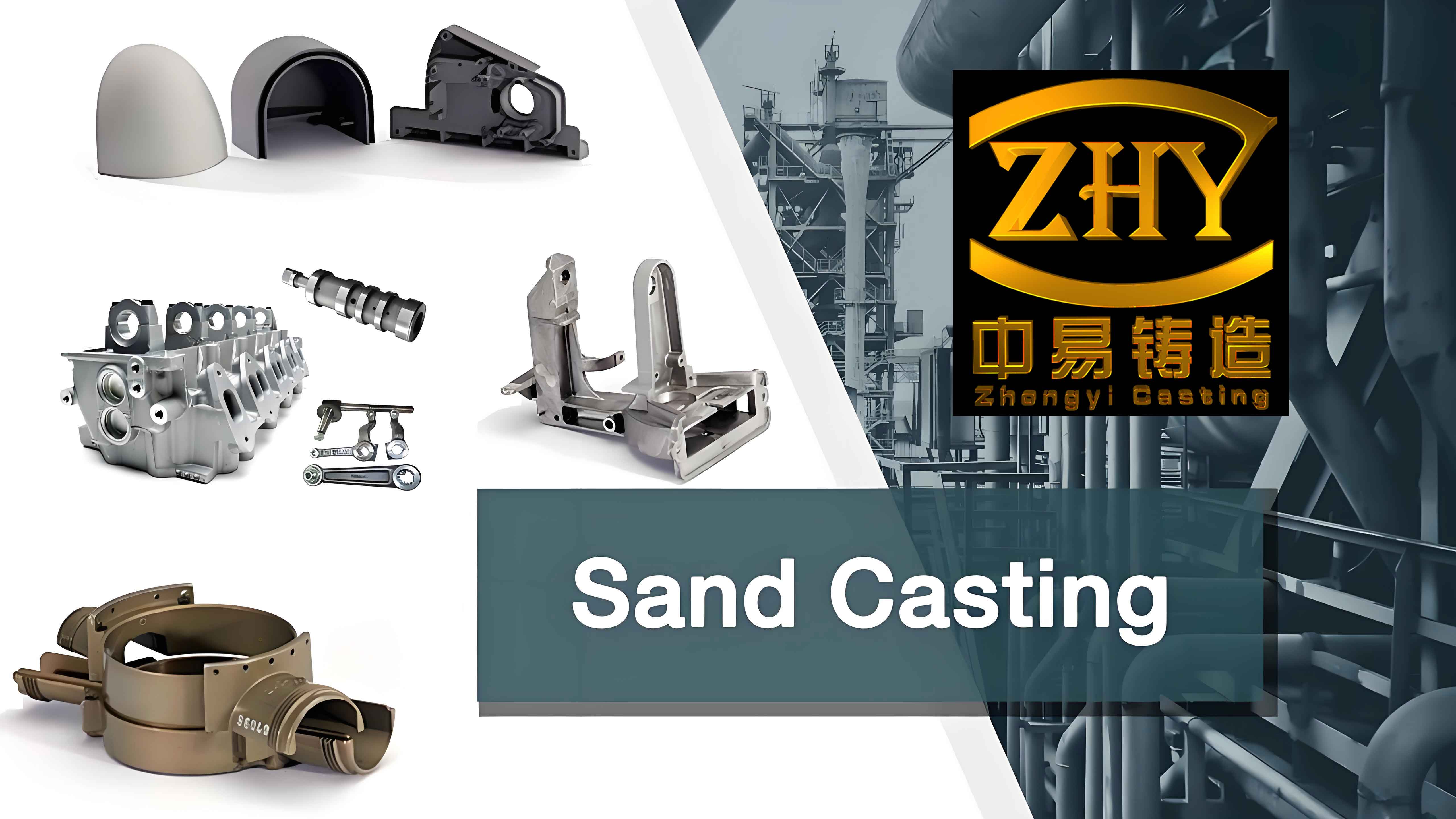
Numerical simulation of sand casting parts requires a robust mesh generation and setup of boundary conditions. In this study, I used ProCAST software to discretize the geometry into finite elements. The mesh size was set to half to one-third of the minimum wall thickness, resulting in 115,990 nodes and 508,256 elements for the cylinder head assembly. This fine mesh ensures accurate resolution of temperature gradients and fluid flow in sand casting parts. The initial and boundary conditions are summarized in Table 2, which includes pouring temperature, mold temperature, and interfacial heat transfer coefficient (HTC). The HTC is particularly important for sand casting parts, as it varies with temperature due to the formation of an air gap between the casting and the mold. I employed the Beck nonlinear inverse method to determine the HTC, which accounts for the transient nature of heat transfer in sand casting parts. The governing equations for fluid flow and heat transfer during casting are based on the Navier-Stokes and energy conservation principles. For instance, the energy equation can be expressed as:
$$ \rho C_p \frac{\partial T}{\partial t} + \rho C_p \mathbf{u} \cdot \nabla T = \nabla \cdot (k \nabla T) + Q $$
where \( \rho \) is density, \( C_p \) is specific heat, \( T \) is temperature, \( t \) is time, \( \mathbf{u} \) is velocity vector, \( k \) is thermal conductivity, and \( Q \) represents heat sources such as latent heat release during solidification of sand casting parts. The latent heat is modeled using an enthalpy formulation, which is crucial for accurately predicting the solidification pattern in sand casting parts. The fluid flow during filling is governed by the incompressible Navier-Stokes equations, with the volume of fluid (VOF) method used to track the free surface. This allows for visualization of the filling sequence in sand casting parts, identifying potential issues like cold shuts or misruns.
| Parameter | Value |
|---|---|
| Pouring Temperature | 690–720°C |
| Pouring Rate | 0.75–1.5 kg/s |
| Initial Casting Temperature | 690–720°C |
| Initial Mold Temperature | 25°C |
| Interfacial Heat Transfer Coefficient | 200–1000 W/m²·K |
The filling process simulation for sand casting parts reveals critical insights into the behavior of molten metal. For the cylinder head, the bottom gating system ensured a gradual and controlled filling, as shown in the temperature distribution plots at various time steps. At t = 2 s, the metal began to enter the mold cavity, and by t = 16 s, the filling was complete. The simulation indicated that the filling was smooth, with no significant turbulence or air entrapment, which is essential for producing sound sand casting parts. The filling time at different locations of the sand casting parts was nearly uniform after the initial stage, confirming the effectiveness of the gating design. This uniformity minimizes thermal gradients and reduces the likelihood of defects in sand casting parts. To quantify the filling behavior, I analyzed the velocity field and pressure distribution, which are governed by the following equations for incompressible flow:
$$ \nabla \cdot \mathbf{u} = 0 $$
$$ \rho \left( \frac{\partial \mathbf{u}}{\partial t} + \mathbf{u} \cdot \nabla \mathbf{u} \right) = -\nabla p + \mu \nabla^2 \mathbf{u} + \rho \mathbf{g} $$
where \( p \) is pressure, \( \mu \) is dynamic viscosity, and \( \mathbf{g} \) is gravitational acceleration. These equations help in understanding the momentum transfer during the filling of sand casting parts, ensuring that the design avoids high velocities that could erode the mold or cause inclusions.
Solidification simulation of sand casting parts is pivotal for predicting shrinkage porosity and hot spots. For the cylinder head, the results showed that the outer walls solidified first, followed by the internal sections, leading to directional solidification toward the risers and ingates. This pattern is desirable for sand casting parts, as it facilitates feeding and reduces isolated liquid pools. The solidification sequence was visualized using the fraction solid plots, which indicated that the risers effectively fed the thick upper sections, while the ingates compensated for shrinkage in the lower regions of the sand casting parts. The absence of isolated液相 regions (liquid pools) in the simulation suggests that the design minimizes macroporosity in sand casting parts. The solidification kinetics can be described using the Scheil equation for non-equilibrium conditions, which is relevant for sand casting parts where cooling rates are moderate:
$$ C_s = k C_0 (1 – f_s)^{k-1} $$
where \( C_s \) is the solute concentration in the solid, \( C_0 \) is the initial concentration, \( k \) is the partition coefficient, and \( f_s \) is the solid fraction. This equation helps in predicting microsegregation in sand casting parts, which influences mechanical properties. Additionally, the cooling curve analysis provided insights into the thermal history of sand casting parts, which is linked to residual stress and distortion.
Porosity prediction in sand casting parts is a key outcome of solidification simulation. For the cylinder head, the results indicated only uniformly dispersed shrinkage porosity, with an overall porosity level below 10%. This is acceptable for many applications of sand casting parts, as it does not compromise structural integrity. The porosity formation is driven by shrinkage during the liquid-to-solid transition, and it can be estimated using the Niyama criterion, which is widely applied for sand casting parts. The Niyama criterion is given by:
$$ N_y = \frac{G}{\sqrt{T}} $$
where \( G \) is the temperature gradient and \( T \) is the local solidification time. Values below a threshold (e.g., 1 °C¹/²·s¹/² for aluminum alloys) indicate a high risk of shrinkage porosity in sand casting parts. In this simulation, the Niyama values were above the threshold in most regions, confirming the low porosity levels in the sand casting parts. Table 3 summarizes the porosity distribution in different sections of the cylinder head, highlighting the effectiveness of the feeding system for sand casting parts.
| Section | Porosity Level (%) | Remarks |
|---|---|---|
| Upper Thick Section | 5–8 | Well-fed by risers |
| Lower Thick Section | 4–7 | Fed by ingates |
| Thin Walls | 2–5 | Minimal porosity |
| Overall Average | 6.5 | Acceptable for sand casting parts |
The validation of simulation results through actual production is essential for confirming the accuracy of numerical models for sand casting parts. In this case, a physical casting of the cylinder head was produced using the designed mold, and the resulting sand casting parts exhibited good surface finish and internal soundness. Metallographic analysis of critical sections showed dense microstructure with fine grains, aligning with the simulation predictions for sand casting parts. This practical verification underscores the reliability of ProCAST for optimizing sand casting parts, reducing the need for costly trial-and-error iterations. The integration of simulation with rapid prototyping enables a streamlined workflow for developing sand casting parts, from digital design to physical realization.
In conclusion, numerical simulation plays a vital role in enhancing the quality and efficiency of producing sand casting parts. Through this detailed study on an engine cylinder head, I demonstrated that a one-side bottom gating system coupled with optimized riser design can achieve smooth filling and directional solidification in sand casting parts. The simulation results indicated minimal defects, with porosity levels under 10%, meeting the quality standards for sand casting parts. The use of advanced CAD/CAE systems and software like ProCAST facilitates the rapid development of sand casting parts, particularly for complex geometries. Future work could focus on multi-scale modeling to capture microstructure evolution in sand casting parts or on incorporating machine learning for predictive design. Overall, this approach underscores the transformative potential of numerical methods in the casting industry, paving the way for more reliable and cost-effective production of sand casting parts.
To further elaborate on the technical aspects, the heat transfer during solidification of sand casting parts can be modeled using Fourier’s law combined with phase change effects. The energy equation with phase change is often written as:
$$ \rho \frac{\partial H}{\partial t} = \nabla \cdot (k \nabla T) $$
where \( H \) is enthalpy, defined as \( H = h + \Delta H_f \), with \( h \) being sensible heat and \( \Delta H_f \) the latent heat of fusion. This formulation is crucial for accurately simulating the thermal behavior of sand casting parts. Additionally, the fluid flow in the mold during filling of sand casting parts can be influenced by the permeability of the sand, which is described by Darcy’s law for porous media flow:
$$ \mathbf{u} = -\frac{K}{\mu} \nabla p $$
where \( K \) is the permeability of the sand mold. This is particularly relevant for sand casting parts where metal penetration into the mold might occur. However, in this study, the mold was assumed impermeable for simplicity, focusing on the bulk flow in sand casting parts.
The economic and environmental benefits of optimizing sand casting parts through simulation are significant. By reducing defects and material waste, numerical simulation contributes to sustainable manufacturing of sand casting parts. For instance, the precise calculation of riser sizes minimizes excess metal usage in sand casting parts, lowering energy consumption and carbon footprint. Moreover, the rapid prototyping aspect shortens lead times for sand casting parts, enabling faster response to market demands. As industries increasingly adopt digital twins, the simulation of sand casting parts will become even more integrated into smart factories, enhancing the agility and resilience of supply chains.
In summary, this comprehensive analysis highlights the importance of numerical simulation in the realm of sand casting parts. From material selection to process validation, every step benefits from computational insights, ensuring that sand casting parts meet the highest standards of quality and performance. The continuous advancement in simulation software and hardware will further empower engineers to innovate in the design and production of sand casting parts, driving progress in manufacturing technologies.