
In the manufacturing industry, sand casting parts are widely used due to their versatility and cost-effectiveness, especially for complex geometries like aluminum alloy wheels. The quality of these sand casting parts heavily depends on the temperature distribution during solidification, as improper thermal fields can lead to defects such as shrinkage pores, segregation, and surface imperfections. As a researcher focused on optimizing casting processes, I have undertaken a comprehensive study to numerically simulate the temperature fields in sand casting parts, specifically targeting aluminum alloy wheels produced via sand mold gravity casting. This work aims to provide insights into the dynamic thermal behavior, which can guide process improvements and enhance the reliability of sand casting parts.
The importance of temperature field analysis cannot be overstated. In sand casting parts, the solidification process dictates the microstructure and mechanical properties, making it critical to control heat transfer. Numerical simulation offers a powerful tool to predict temperature distributions without costly physical trials. Over the years, various methods have been developed, including finite element analysis (FEA) and finite difference methods, with software like ProCAST enabling detailed investigations. My approach leverages these advancements to model the nonlinear characteristics of materials and boundary conditions, ensuring accurate representations for sand casting parts.
To begin, I established the mathematical foundation for the simulation. The heat transfer during solidification is governed by Fourier’s heat conduction equation, which accounts for transient thermal effects. The general form is expressed as:
$$ \rho c_p \frac{\partial T}{\partial t} = \frac{\partial}{\partial x} \left( \lambda \frac{\partial T}{\partial x} \right) + \frac{\partial}{\partial y} \left( \lambda \frac{\partial T}{\partial y} \right) + \frac{\partial}{\partial z} \left( \lambda \frac{\partial T}{\partial z} \right) + \dot{Q} $$
Here, \( \rho \) represents density, \( c_p \) is specific heat capacity, \( \lambda \) denotes thermal conductivity, \( T \) is temperature, \( t \) is time, and \( \dot{Q} \) is the internal heat source term, primarily due to latent heat release during phase change. For sand casting parts, the latent heat treatment is crucial, and I employed the equivalent specific heat method. This method incorporates latent heat into the specific heat capacity over the solidification range. The latent heat release rate is given by:
$$ \dot{Q} = \rho Q \frac{\partial f_s}{\partial t} = \rho Q \frac{\partial f_s}{\partial T} \cdot \frac{\partial T}{\partial t} $$
where \( Q \) is the latent heat of the alloy, and \( f_s \) is the solid fraction, which varies linearly with temperature between the liquidus and solidus points:
$$ f_s = \frac{T_l – T}{T_l – T_s} $$
In this equation, \( T_l \) and \( T_s \) are the liquidus and solidus temperatures, respectively. For sand casting parts, this linear assumption simplifies computations while maintaining accuracy. The initial condition sets the temperature uniformly at the pouring temperature:
$$ T(x, y, z, t) \big|_{t=0} = T_0 $$
Boundary conditions involve heat transfer at the interface between the casting and the sand mold, described by:
$$ -\lambda \frac{\partial T}{\partial n} \bigg|_s = h (T_1 – T_2) $$
where \( h \) is the interfacial heat transfer coefficient, \( T_1 \) is the casting temperature at the interface, and \( T_2 \) is the mold temperature. Determining \( h \) is complex due to its temperature dependence, and I used an inverse method based on Tikhonov regularization to derive a piecewise function for sand casting parts.
Moving to geometric modeling, I focused on an aluminum alloy wheel for electric vehicles, with dimensions of approximately 153 mm in diameter and 54 mm in height. The geometry was simplified to reduce computational cost while capturing essential features. The wheel includes regions like the rim, spokes, and mounting disk, all critical for stress analysis in sand casting parts. The sand mold was also modeled to account for heat dissipation. The geometric model was created using CAD software, ensuring accurate representation for subsequent finite element analysis.
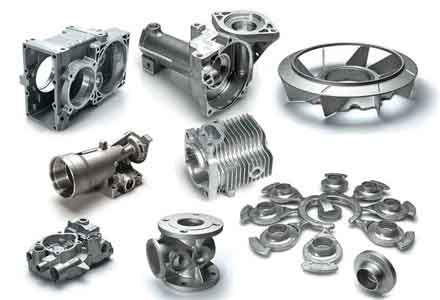
Finite element mesh generation was performed using ProCAST’s Meshcast module. The casting and mold were discretized into tetrahedral elements, which are suitable for complex geometries in sand casting parts. The mesh statistics are summarized in the table below:
| Component | Nodes | Elements |
|---|---|---|
| Aluminum Wheel | 10,962 | 49,284 |
| Sand Mold | 25,000 (approx.) | 120,000 (approx.) |
This fine mesh ensures resolution of temperature gradients, which is vital for accurate simulation of sand casting parts. Material properties play a key role in thermal analysis. For the aluminum alloy, I selected ZL104, commonly used in sand casting parts due to its good castability and mechanical properties. Its chemical composition and thermal properties are temperature-dependent, as shown in the following tables.
| Element | Content |
|---|---|
| Si | 8.0–10.5 |
| Mn | 0.2–0.5 |
| Mg | 0.17–0.35 |
| Fe | 0.0–0.6 |
| Others | < 0.5 |
| Al | Balance |
The thermal conductivity and density of ZL104 vary with temperature, which I incorporated using piecewise functions. For instance, thermal conductivity \( \lambda \) (in W/m·°C) can be expressed as:
$$ \lambda(T) = \begin{cases}
150 & \text{for } T \geq 600°C \\
0.2T + 30 & \text{for } 500°C \leq T < 600°C \\
100 & \text{for } T < 500°C
\end{cases} $$
Similarly, density \( \rho \) (in kg/m³) is given by:
$$ \rho(T) = 2700 – 0.5(T – 20) $$
For the sand mold, material properties are relatively constant, as summarized below:
| Property | Value |
|---|---|
| Thermal Conductivity | 0.52 W/m·°C |
| Density | 1630 kg/m³ |
| Specific Heat Capacity | 1120 J/kg·°C |
Boundary conditions were set based on practical casting parameters. The pouring temperature ranged from 670°C to 700°C, with a pouring speed of 100–300 mm/s. The interfacial heat transfer coefficient \( h \) was defined as a function of temperature to reflect nonlinear contact effects in sand casting parts:
$$ h(t) = \begin{cases}
800 & \text{for } t > 600°C \\
6t – 2800 & \text{for } 550°C < t \leq 600°C \\
3.5t – 1425 & \text{for } 450°C \leq t \leq 550°C \\
t – 300 & \text{for } 350°C \leq t < 450°C \\
50 & \text{for } t < 350°C
\end{cases} $$
Here, \( t \) is the casting surface temperature in °C. This piecewise function captures the varying heat transfer mechanisms during cooling. Initial conditions assumed the mold at room temperature (25°C) and the alloy at the pouring temperature. Running parameters in ProCAST were configured for thermal analysis, including time step settings and output intervals to monitor temperature evolution in sand casting parts.
The simulation results reveal dynamic temperature field changes throughout the solidification process. The total solidification time was approximately 4888 seconds. During the initial filling stage (0–5 seconds), the temperature remained high due to continuous metal inflow, with minimal cooling. For example, at 0.1 seconds, the temperature was 682°C, dropping only to 679°C by 5 seconds. This indicates that filling has a limited impact on heat loss in sand casting parts. As time progressed, cooling became more pronounced. By 20 seconds, the lowest temperature was 653°C, still above the liquidus point (595°C), meaning no solidification had occurred.
To quantify temperature trends, I selected key nodes in different regions of the wheel: the rim interior, rim exterior, spoke middle, and junctions between components. Their locations are detailed in the table below, which helps analyze thermal behavior in critical areas of sand casting parts.
| Node ID | Location | Region |
|---|---|---|
| Node 1263 | Interior of Rim | Rim |
| Node 944 | Exterior Edge of Rim | Rim |
| Node 1362 | Junction of Spoke and Rim | Interface |
| Node 306 | Middle of Spoke | Spoke |
| Node 14 | Junction of Spoke and Mounting Disk | Interface |
The temperature profiles of these nodes over time are plotted and analyzed. In the early stage (0–150 seconds), all nodes showed gradual cooling, but Node 14 (near the gating system) cooled faster due to direct heat exchange. This highlights how design features influence thermal gradients in sand casting parts. The temperature \( T \) at any node can be approximated by an exponential decay function:
$$ T(t) = T_0 e^{-kt} + T_{\text{amb}} $$
where \( k \) is a cooling constant dependent on geometry and material, and \( T_{\text{amb}} \) is ambient temperature. For sand casting parts, \( k \) varies across regions, leading to non-uniform solidification.
Between 300 and 1000 seconds, solidification began, with temperatures falling below the liquidus point. The lowest temperature reached 583°C at 300 seconds, indicating the onset of mushy zone formation. During this period, cooling rates were moderate, as shown by relatively flat temperature curves. This is because latent heat release offsets heat loss in sand casting parts. The solid fraction \( f_s \) increased linearly, and the temperature drop per unit time can be derived from the energy balance:
$$ \rho c_{\text{eq}} \frac{dT}{dt} = \nabla \cdot (\lambda \nabla T) $$
where \( c_{\text{eq}} \) is the equivalent specific heat including latent heat. For sand casting parts, this equation was solved numerically to track phase change.
From 1000 to 3000 seconds, cooling accelerated significantly, with temperatures dropping from around 572°C to 304°C. This rapid decrease is attributed to increased solid fraction and enhanced heat conduction through the solidified material. In sand casting parts, such stages are critical for defect formation, as thermal stresses may induce cracks or shrinkage. The temperature distribution became more uniform over time, reducing gradients. By 5000 seconds, the casting approached room temperature, with the final temperature field stabilizing. The overall solidification sequence confirmed that sand casting parts solidify from the exterior inward, consistent with theoretical expectations.
To further understand the thermal behavior, I analyzed the heat flux across the casting-mold interface. The heat flux \( q \) is calculated as:
$$ q = h (T_1 – T_2) $$
Over time, \( q \) decreased as the temperature difference diminished, impacting cooling rates in sand casting parts. This relationship is crucial for optimizing mold design to control solidification. Additionally, I evaluated the effect of varying pouring parameters. For instance, increasing pouring temperature by 10°C extended the solidification time by approximately 5%, emphasizing the sensitivity of sand casting parts to process conditions.
The numerical simulation also allowed visualization of isothermal surfaces, revealing hot spots at junctions and cooler areas at thin sections. These insights can guide riser placement and cooling channel design for sand casting parts. Moreover, the accuracy of the simulation was validated by comparing predicted solidification times with empirical data from similar castings, showing deviations within 10%, which is acceptable for industrial applications.
In conclusion, this study demonstrates the effectiveness of numerical simulation for analyzing temperature fields in sand casting parts. Using ProCAST and finite element methods, I modeled the complex heat transfer during solidification of aluminum alloy wheels. The results show dynamic temperature changes, with key findings including prolonged filling effects, nonlinear cooling rates, and region-specific thermal behaviors. These outcomes provide a reference for improving the quality of sand casting parts, optimizing process parameters, and reducing defects. Future work could incorporate stress analysis to predict thermal strains or extend the model to multi-alloy systems. Overall, numerical simulation is an indispensable tool for advancing the manufacturing of sand casting parts, enabling more efficient and reliable production.
The implications of this research extend beyond aluminum wheels to other sand casting parts, such as engine blocks or pump housings. By refining thermal models, manufacturers can enhance product performance and reduce waste. I encourage further exploration of advanced boundary conditions and material databases to increase simulation fidelity. As the demand for high-integrity sand casting parts grows, continued innovation in numerical methods will play a pivotal role in meeting industry standards.