
In the realm of metal casting, lost foam casting has emerged as a pivotal technique for producing complex ductile iron components, offering advantages such as reduced machining requirements and enhanced design flexibility. However, this method often grapples with defects like shrinkage porosity and slag inclusions, particularly in thick-section areas. Through my extensive experience in lost foam casting, I have developed and refined a process design that addresses these challenges by integrating simulation-based analysis, gating system optimization, and riser design. This article delves into the intricacies of lost foam casting for ductile iron parts, emphasizing the prevention of shrinkage-related defects. I will explore the fundamental principles, experimental validations, and practical improvements that have significantly elevated casting quality. The lost foam casting process involves evaporative patterns embedded in unbonded sand, where molten metal replaces the foam, leading to unique solidification dynamics. By leveraging computational tools and empirical data, I have established a robust framework for minimizing defects, ensuring that the lost foam casting technique remains a reliable choice for high-integrity applications.
The structural analysis of the ductile iron casting, weighing approximately 180 kg with dimensions of 430 mm × 620 mm × 684 mm, revealed critical thick sections prone to shrinkage. For instance, a region measuring 183 mm × 40 mm × 59 mm acts as a thermal hotspot, necessitating careful gating and riser design in lost foam casting. Additionally, the part features oil passages over 500 mm long, which must be free of defects to meet stringent leak-test requirements. In lost foam casting, the gating system plays a dual role: facilitating smooth metal flow and enabling effective feeding during solidification. I evaluated four gating configurations—side bottom gating, top gating, step gating, and bottom gating—using MAGMA simulation software to predict shrinkage risks. The simulations highlighted that areas like the upper face and thick junctions are susceptible to porosity due to inadequate feeding. For example, in side bottom gating, the solidification sequence showed thinner sections freezing first, leaving thick zones vulnerable. The modulus method, central to riser design in lost foam casting, calculates the cooling characteristics as $$ M = \frac{V}{A} $$ where \( M \) is the modulus, \( V \) is the volume, and \( A \) is the surface area. This formula guides the sizing of risers to match the thermal demands of the casting, ensuring that the lost foam casting process compensates for volumetric shrinkage effectively.
| Gating System Type | Key Simulation Findings | Shrinkage Risk Level |
|---|---|---|
| Side Bottom Gating | Early solidification of thin sections; poor feeding to upper face and thick junctions | High |
| Top Gating | Similar shrinkage zones as side bottom gating; turbulence may introduce slag | High |
| Step Gating | Multiple gates close sequentially, but upper face lacks post-gate solidification feeding | Moderate to High |
| Bottom Gating with Riser | Improved feeding to hot spots; requires optimized riser parameters for full effectiveness | Low with adjustments |
Based on the simulation outcomes, I proceeded with experimental trials focusing on bottom gating combined with risers, as this configuration in lost foam casting promotes directional solidification and enhances feeding. The initial design incorporated a riser with a modulus equal to that of the hot spot (\( M_R = M_S \)) and a neck modulus of \( M_N = 0.8M_R \). However, this approach resulted in a 37% rejection rate due to shrinkage cavities on the upper face, as confirmed during rough machining. The defects manifested as visible pores at the intersection of planar structures and the top surface, underscoring the limitations of undersized risers in lost foam casting. To address this, I revised the riser design by increasing its modulus to \( M_R = 1.5M_S \) and reducing the neck modulus to \( M_N = 0.6M_R \), which amplified the feeding capacity and prolonged the liquid metal availability. The solidification process in lost foam casting involves distinct pressure phases: initially, the gating system supplies metal until the gates freeze; then, contraction occurs, lowering pressure in the riser; finally, eutectic expansion from graphite precipitation replenishes the riser, provided the mold rigidity is sufficient. The pressure dynamics can be modeled as $$ P(t) = P_0 – \Delta P_c + \Delta P_e $$ where \( P(t) \) is the instantaneous pressure, \( P_0 \) is the initial pressure, \( \Delta P_c \) is the contraction-induced pressure drop, and \( \Delta P_e \) is the expansion-induced pressure increase. This equation highlights the importance of maintaining mold integrity in lost foam casting to harness eutectic expansion for defect mitigation.
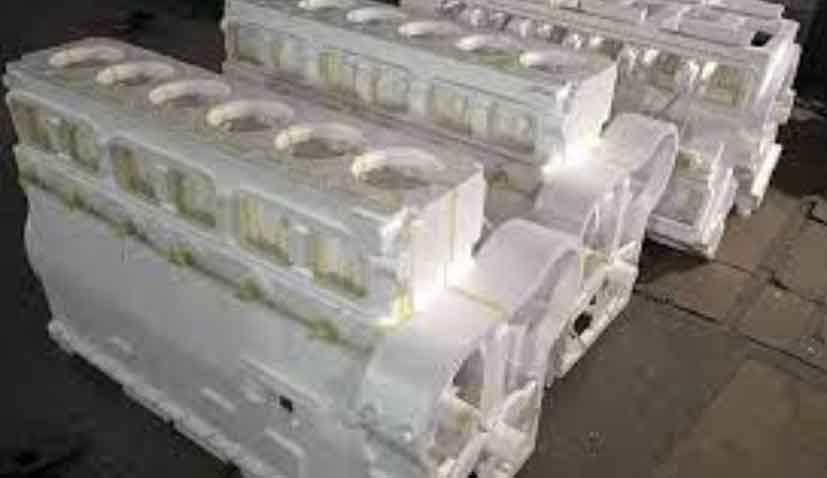
The defect analysis revealed that shrinkage in lost foam casting primarily stems from the mushy solidification behavior of ductile iron, where graphite nucleation and growth cause volumetric changes. Unlike skin-forming alloys, ductile iron in lost foam casting exhibits a pasty freeze, leading to internal porosity if feeding is inadequate. The eutectic expansion, while beneficial, can induce mold wall movement if the sand compactness is low, exacerbating shrinkage. In my experiments, the lost foam casting process was coupled with rigorous process controls, such as ensuring high sand compaction, maintaining a vacuum pressure of 0.4–0.6 bar during pouring, and extending the pressure hold time beyond 15 minutes to stabilize the mold. These measures enhanced the system’s ability to counteract shrinkage in lost foam casting. The improved riser design, with \( M_R = 1.5M_S \), demonstrated a notable reduction in defects: post-machining inspection showed no macroscopic shrinkage on the upper face, though minor discrete pores were observed. These were eliminated through additional machining allowances, affirming that the lost foam casting process can achieve high integrity with tailored parameters. The table below summarizes the riser design iterations and their outcomes in the context of lost foam casting.
| Riser Design | Modulus Ratio (\( M_R / M_S \)) | Neck Modulus Ratio (\( M_N / M_R \)) | Defect Observation | Rejection Rate |
|---|---|---|---|---|
| Initial (1# Riser) | 1.0 | 0.8 | Macroscopic shrinkage cavities on upper face | 37% |
| Improved (2# Riser) | 1.5 | 0.6 | No major shrinkage; minor pores removed by machining | ~5% |
Furthermore, the feeding efficiency in lost foam casting can be quantified using the feeding modulus concept, where the required riser volume \( V_R \) is derived from the casting volume \( V_C \) and the solidification shrinkage factor \( \beta \), typically 4–6% for ductile iron. The relationship is expressed as $$ V_R = \frac{\beta V_C}{1 – \beta} $$ This formula, when applied to the lost foam casting process, ensures that the riser provides sufficient metal to compensate for contraction. In practice, I also integrated slag traps into the gating system to minimize inclusions, which are common in lost foam casting due to foam decomposition products. The overall process optimization involved iterative simulations and real-world trials, emphasizing that lost foam casting demands a holistic approach—from pattern making to pouring—to achieve consistency. For instance, controlling the coating thickness on foam patterns to 0.5–1.0 mm and ensuring uniform drying reduced gas-related defects, thereby enhancing the lost foam casting efficacy.
In conclusion, the lost foam casting process for ductile iron components can be significantly improved through a combination of bottom gating, appropriately sized risers, and stringent process controls. My experiments validate that a riser modulus 1.5 times that of the hot spot, coupled with a reduced neck modulus, effectively mitigates shrinkage porosity in lost foam casting. The integration of simulation tools like MAGMA allows for predictive design, reducing trial-and-error efforts. Additionally, maintaining mold rigidity and extended pressure holding during solidification harnesses the benefits of eutectic expansion, a hallmark of ductile iron behavior in lost foam casting. As industries increasingly adopt lost foam casting for complex parts, these insights provide a reliable framework for achieving high-quality castings with minimal defects. Future work could explore advanced materials for foam patterns or real-time monitoring systems to further refine the lost foam casting technique, ensuring its continued evolution in the manufacturing landscape.