
The pursuit of components capable of withstanding extreme impact and abrasive wear conditions in industries such as mining, cement, and metallurgy is a constant engineering challenge. These parts require a rare combination of high hardness for wear resistance and sufficient toughness to absorb repeated impacts without catastrophic failure. Achieving this balance through traditional casting methods for large, thick-section components is particularly difficult due to inherent defects like shrinkage porosity. This study focuses on the application and optimization of lost foam casting (LFC) for manufacturing a high-chromium cast iron (HCCI) hammer, a critical wear part. The lost foam casting process, while simplifying mold preparation, introduces unique complexities related to foam decomposition and its interaction with the molten metal. Through systematic numerical simulation, we investigate various gating, risering, and chilling strategies to eliminate shrinkage defects and propose an optimal, validated production methodology.
The component under investigation is a large hammer with approximate dimensions of 760 mm x 420 mm x 140 mm and a weight of 340 kg. Its simple, block-like geometry belies the significant challenge it presents: as a thick-section casting, it is highly prone to internal shrinkage cavities and porosity during solidification. High chromium cast iron, typically with chromium content between 12-28%, was selected for its excellent abrasion resistance derived from hard (Fe,Cr)7C3 carbides embedded in a martensitic or austenitic matrix. However, its relatively high volumetric shrinkage during solidification exacerbates the feeding challenge.
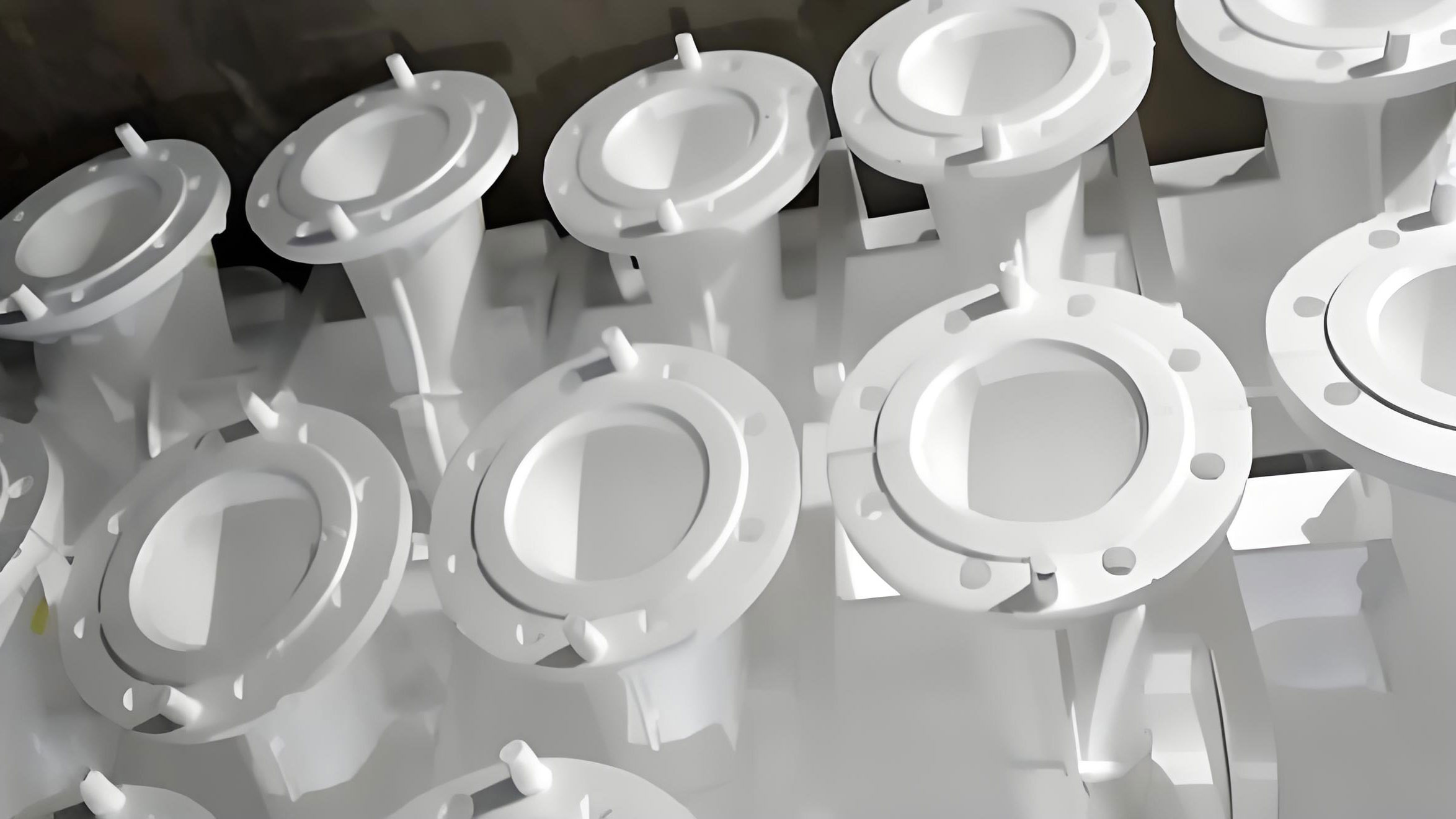
The lost foam casting process fundamentally differs from conventional empty-mold casting. The mold cavity is filled with an expandable polystyrene (EPS) foam pattern. During pouring, molten metal rapidly replaces the vaporizing foam. This interaction involves complex endothermic reactions, gas generation, and transient back-pressure, affecting fluid flow, heat transfer, and final defect formation. Consequently, designing a lost foam casting process requires careful consideration of these phenomena alongside standard foundry principles. The use of dry, unbonded sand allows remarkable flexibility in placing chills and risers, which are critical tools for controlling solidification.
1. Foundational Principles and Simulation Methodology
The core challenge in casting the HCCI hammer is managing solidification shrinkage. The total volumetric shrinkage (εv) from pouring temperature to room temperature can be approximated as the sum of liquid contraction, liquid-to-solid contraction (solidification shrinkage), and solid-state contraction:
$$ \epsilon_v = \alpha_l \Delta T_l + \beta + \alpha_s \Delta T_s $$
where $\alpha_l$ and $\alpha_s$ are the coefficients of thermal expansion for the liquid and solid states, $\Delta T_l$ and $\Delta T_s$ are the respective temperature ranges, and $\beta$ is the solidification shrinkage parameter, which is particularly significant for cast irons. For HCCI, $\beta$ can range from 4% to 7%. Without adequate feeding, this shrinkage manifests as macro- or micro-porosity.
In lost foam casting, the cooling rate is also influenced by the decomposition of the foam. The energy balance at the metal-foam interface must account for the heat of vaporization of the foam ($\Delta H_{vap}$):
$$ q_{interface} = k_{eff} \frac{\partial T}{\partial x} = \rho_{metal} C_p \frac{\partial T}{\partial t} + \dot{m}_{foam} \Delta H_{vap} $$
where $q_{interface}$ is the heat flux, $k_{eff}$ is the effective thermal conductivity, and $\dot{m}_{foam}$ is the mass rate of foam degradation. This endothermic reaction can slightly slow the initial cooling of the metal skin.
To address these coupled physics, we employed a commercial finite-element-based simulation software capable of modeling the lost foam casting process. The key material properties and process parameters used in the simulation are summarized in Table 1.
| Parameter Category | Specific Parameter | Value / Description |
|---|---|---|
| Material (HCCI) | Liquidus Temperature | ~1280 °C |
| Solidus Temperature | ~1200 °C | |
| Solidification Shrinkage (β) | 5.5% (assumed for simulation) | |
| Foam Pattern | Material | Expandable Polystyrene (EPS) |
| Density | 10 kg/m³ | |
| Decomposition Model | Pyrolysis gas generation model | |
| Process Conditions | Sand Type | Dry, unbonded silica sand |
| Mold Vacuum Level | -0.06 MPa (gauge) | |
| Simulated Pouring Temperatures | 1320°C, 1350°C, 1380°C |
The simulation solves the transient equations for fluid flow (Navier-Stokes with free surface), heat transfer (including conduction, convection, and radiation), and solidification (using an enthalpy-porosity technique). The evolution of gas gaps from the decomposing foam and the resulting back-pressure are also modeled, which is crucial for an accurate lost foam casting simulation.
2. Design and Evaluation of Lost Foam Casting Process Schemes
Initial calculations based on the geometric modulus (Chvorinov’s rule) indicated that a traditional riser large enough to feed the massive hammer section would be impractically large, leading to poor yield. Therefore, the strategic use of chills became essential. Internal chills, embedded within the foam pattern, are highly effective in lost foam casting as they can be precisely positioned and anchored by extending into the sand. For this study, steel plate chills of 15 mm thickness were designed to be placed internally.
Five distinct lost foam casting process schemes were designed to systematically evaluate the effects of risers, chills, gating orientation, and pouring temperature:
- Scheme A: No Riser, With Chill, Bottom Gating.
- Scheme B: With Riser (D=320mm), No Chill, Top Gating.
- Scheme C: With Riser (D=320mm), No Chill, Bottom Gating.
- Scheme D: With Riser (D=250mm), With Chill, Top Gating.
- Scheme E: With Riser (D=250mm), With Chill, Bottom Gating.
All risers were equipped with a rectangular neck (50 mm x 120 mm) connecting to the hammer body. Each scheme was simulated at three different pouring temperatures. The primary evaluation criterion was the predicted severity and location of shrinkage porosity, with secondary attention to filling patterns and potential for slag entrapment.
The comprehensive simulation results for all schemes are consolidated in Table 2. The output clearly differentiates between schemes that result in massive, centralized shrinkage and those that distribute or minimize the defect.
| Scheme | Pouring Temp. | Predicted Shrinkage Defect Outcome |
|---|---|---|
| A (No Riser, Chill, Bottom Gate) | 1320°C | Severe shrinkage porosity on the upper surface. |
| 1350°C | Extensive macro-shrinkage cavities on the upper surface. | |
| 1380°C | Extensive macro-shrinkage cavities on the upper surface. | |
| B (Riser, No Chill, Top Gate) | 1320°C | Blocky shrinkage persists in the center below the riser. |
| 1350°C | Blocky shrinkage persists in the center below the riser. | |
| 1380°C | Riser insufficient; shrinkage extends into hammer body. Central blocky porosity. | |
| C (Riser, No Chill, Bottom Gate) | 1320°C | Blocky shrinkage persists in the center below the riser. |
| 1350°C | Blocky shrinkage persists in the center below the riser. | |
| 1380°C | Blocky center porosity. Minor external shrinkage at riser neck, removable by grinding. | |
| D (Riser, Chill, Top Gate) | 1320°C | Porosity localized within the two holes of the internal chill. Minor surface shrinkage. |
| 1350°C | Porosity localized within the two holes of the internal chill. Minor surface shrinkage. | |
| 1380°C | Porosity localized within chill holes. External shrinkage at riser neck, removable. | |
| E (Riser, Chill, Bottom Gate) | 1320°C | Porosity localized within the two holes of the internal chill. Minor surface shrinkage. |
| 1350°C | Porosity localized within the two holes of the internal chill. Minor surface shrinkage. | |
| 1380°C | Porosity confined strictly within the holes of the internal chill. No significant surface defects. |
3. In-Depth Analysis and Optimization for Lost Foam Casting
The simulation data reveals critical trends. Schemes using only a large riser (B & C) failed to prevent a concentrated block of porosity in the thermal center of the hammer, indicating that riser feeding alone is inadequate for this section modulus in a lost foam casting environment. The negative pressure in the mold can slightly reduce the effective feeding pressure from the riser compared to gravity feeding.
Schemes incorporating internal chills (D & E) dramatically altered the solidification pattern. The chills act as intense heat sinks, creating directional solidification towards them. This transforms the problematic massive shrinkage into localized porosity within the chill holes themselves—a far more acceptable outcome, especially if these holes are non-critical or can be machined. At 1380°C, Scheme E (bottom gating) showed the best result, with porosity completely confined to the chill holes and no surface defects.
This finding leads to an important insight: the combination of a riser and an internal chill in this lost foam casting setup can be viewed as an approximation of a bimetallic composite casting. The chill area solidifies first with a very fine microstructure, potentially offering high hardness, while the riser feeds the remaining body, promoting soundness. This aligns perfectly with the service requirement of the hammer: a hard, wear-resistant working surface and a tough, reliable core.
A deeper analysis of Schemes D and E at 1380°C using temperature history curves at critical points (e.g., at the riser neck, hammer surface, and near the chill) confirms the mechanism. The temperature at the hammer surface remains consistently below that of the riser neck during the critical feeding period, allowing for effective surface feeding from the riser and preventing surface sinks or porosity.
The final selection between top-gating (Scheme D) and bottom-gating (Scheme E) hinges on the fill analysis inherent to lost foam casting. Simulation of the gas gap evolution reveals crucial differences:
- Scheme D (Top-Gating): Metal flow is aligned with gravity, leading to turbulent advancement and potential for mold erosion. More critically, the decomposition gases from the foam are forced downward against the rising metal, creating prolonged gas pressure and a higher risk of mold collapse (fold) or foam residue entrapment for this thick casting. Fill time was shorter (~10.86 s).
- Scheme E (Bottom-Gating): Metal rises steadily, with foam gas products flowing upward in the same direction, facilitating their evacuation through the coating and sand. The flow is inherently more stable, minimizing turbulence and slag entrainment. Although the fill time is longer (~16.06 s), the high pouring temperature (1380°C) ensures the metal retains sufficient superheat to fully decompose the foam upon reaching the top sections, preventing cold laps or poor surface finish.
The solidification shrinkage results for the optimal schemes are visually distinct. The simulation predicts a well-defined riser pipe and porosity isolated to the chill holes for Scheme E, whereas Scheme D shows a similar chill-hole defect but with a minor external shrinkage at the riser junction.
Therefore, the comprehensive analysis dictates that Scheme E – featuring a top riser (D=250mm), internal plate chills, bottom gating, and a high pouring temperature of 1380°C – is the optimal lost foam casting process for the high-chromium iron hammer. This configuration ensures stable filling, maximizes feeding efficiency through combined riser and chill action, and localizes any remaining porosity to non-critical, internal regions.
4. Validation and Concluding Remarks
To validate the numerical findings, actual castings were produced in a foundry setting using the process parameters from the simulation. Two conditions were trialed: 1) Scheme A (Chill, No Riser) at 1350°C, and 2) the optimized Scheme E (Riser + Chill, Bottom Gating) at 1380°C.
The hammer produced via Scheme A exhibited severe shrinkage cavities on the upper surface, matching the simulation prediction almost exactly. The chill drew solidification inwards, causing the upper surface to shrink without a liquid feed source.
The hammer produced via the optimized Scheme E was sound in its working surfaces. Post-casting measurement confirmed an increase in weight of approximately 7 kg compared to an unfed casting, directly attributable to the metal fed from the riser. Subsequent wear testing and inspection of scrapped hammers confirmed the absence of shrinkage defects on critical working faces. The porosity was contained as predicted, validating the accuracy of the lost foam casting simulation model.
In conclusion, this study demonstrates the powerful role of numerical simulation in optimizing complex foundry processes like lost foam casting. For thick-section, high-shrinkage alloys like high chromium cast iron, traditional risering alone is insufficient. The synergistic use of internal chills to control solidification direction and a riser to provide liquid feed, combined with a stable bottom-gating system and elevated pouring temperature, was proven to be the optimal strategy. The lost foam casting process, with its design flexibility for chill placement, is well-suited to implement this optimized methodology, resulting in cast components with enhanced integrity, performance, and cost-effectiveness for demanding industrial applications.