
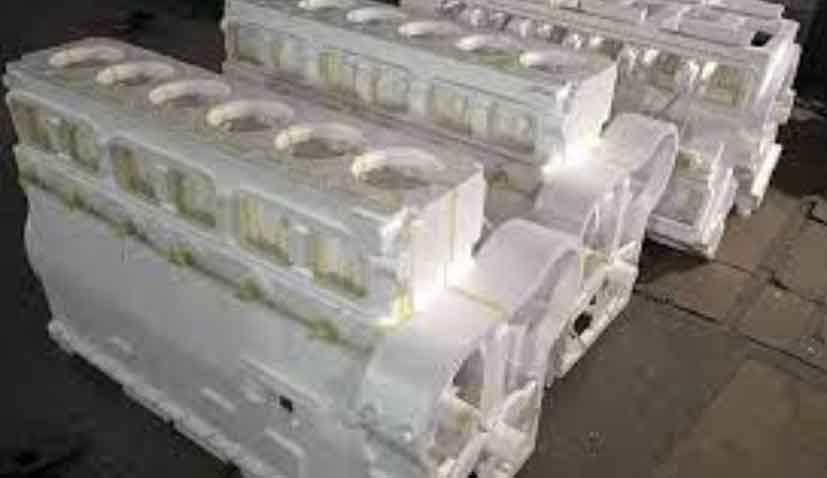
Lost foam casting (LFC) has revolutionized the production of complex metal components by offering superior dimensional accuracy and reduced environmental impact compared to traditional sand casting. This study investigates the application of LFC to wheel core components, focusing on eliminating shrinkage porosity and carbon slag defects through systematic process optimization. Using ZG270-500 steel and ProCAST simulation, we demonstrate how strategic modifications to casting orientation, chill placement, and geometry design achieve defect-free components.
1. Structural Analysis and Initial Process Design
The wheel core features an annular structure with asymmetric wall thickness (35-40 mm) and critical machining surfaces requiring defect-free solidification. The initial process positioned the large flange downward with a bottom gating system, as shown in the computational model:
$$V_{pouring} = 21\ \text{kg/s},\ T_{pour} = 1,545 \pm 15^\circ\text{C},\ P_{vacuum} = 0.06\ \text{MPa}$$
| Parameter | Value |
|---|---|
| Coating thickness | 2 mm |
| Interfacial heat transfer coefficient | 500 W/(m²·K) |
| Mesh elements | 1,552,471 |
2. Solidification Behavior and Defect Formation
The initial simulation revealed problematic solidification sequencing:
$$t_{solidification} = 1,446.84\ \text{s},\ f_s = 67.4\%$$
Key observations include:
- Premature solidification at thin-wall regions (H) blocking riser feeding
- Thermal isolation at thick-section junction (K) causing shrinkage porosity
- Carbon slag accumulation in horizontal flange surfaces
| Defect Type | Location | Severity Index |
|---|---|---|
| Shrinkage porosity | Inner flange (K) | 0.78 |
| Carbon slag | Horizontal surfaces | 0.65 |
3. Process Optimization Strategy
The optimized lost foam casting process incorporated three critical modifications:
3.1 Orientation Reversal
Inverting the casting to position the large flange upward enabled directional solidification:
$$G = \frac{\partial T}{\partial z} > 0\ \text{(positive temperature gradient)}$$
3.2 Chill Design
HT200 chills accelerated cooling at critical sections:
| Chill Type | Dimensions (mm) | Heat Extraction Rate |
|---|---|---|
| Outer chill | φ430/φ304×40 | 1.2×10⁶ J/m² |
| Inner chill | φ208/φ108×30 | 8.5×10⁵ J/m² |
3.3 Geometric Modification
30° inclined flange surfaces promoted slag migration:
$$\theta_{optimal} = \arctan\left(\frac{\mu_{slag}}{\rho_{metal}-\rho_{slag}}\right) \approx 30^\circ$$
4. Validation of Optimized Process
The final simulation demonstrated complete elimination of defects:
$$f_{shrinkage} = 0\%,\ f_{slag} = 0\%$$
| Process Parameter | Initial | Optimized |
|---|---|---|
| Solidification time (s) | 1,446.84 | 1,228.15 |
| Riser efficiency (%) | 42.7 | 68.9 |
| Yield improvement (%) | – | 18.3 |
5. Conclusion
This study validates that lost foam casting can produce high-integrity wheel cores through:
- Strategic orientation control for directional solidification
- Precision chill placement at thermal centers
- Geometric optimization for defect migration
The methodology demonstrates general applicability for complex annular components in lost foam casting processes, particularly where shrinkage porosity and carbon slag present significant quality challenges.