
In my extensive experience in metalworking technologies, including casting, forging, and welding, I have encountered numerous challenges in producing high-quality components. This article delves into two critical case studies: the welding of high-strength steel for telescopic booms and the optimization of sand casting parts for machine tool components. Both areas require meticulous process control to achieve desired mechanical properties and dimensional accuracy. I will share insights on parameter selection, defect mitigation, and innovative techniques, with a particular focus on sand casting parts, as they are ubiquitous in industrial applications. Throughout this discussion, I aim to provide practical data and formulas to guide engineers and technicians. The integration of advanced methods can significantly enhance the performance and reliability of sand casting parts and welded assemblies.
Let me begin with the welding of high-strength steel structures. In one project, I worked on the fabrication of a telescopic boom for an aerial work platform using HG70D high-strength steel, which has a yield strength of around 700 MPa. This material offers excellent strength-to-weight ratio but poses welding difficulties due to its susceptibility to distortion and residual stresses. The boom consisted of thin plates that needed to be joined with minimal twisting. To address this, my team and I designed special fixtures and adopted a synchronized welding procedure. We used four welders simultaneously, starting from the center and moving outward, as illustrated in the process. This ensured uniform heat distribution and reduced deformation. Post-welding, we performed stress-relief annealing and shot peening to eliminate residual stresses, resulting in a straightness that met design specifications. The key to success was controlling heat input, which can be calculated using the formula: $$ Q = \eta \cdot I \cdot U / v $$ where \( Q \) is the heat input (in J/mm), \( \eta \) is the arc efficiency (typically 0.8 for TIG welding), \( I \) is the current (A), \( U \) is the voltage (V), and \( v \) is the welding speed (mm/s). By optimizing these parameters, we achieved Class I welds per national standards. This experience underscores the importance of precise thermal management in welding high-strength alloys.
| Welding Parameter | Value Range | Effect on Quality |
|---|---|---|
| Current (I) | 150-200 A | Higher current increases penetration but may cause distortion. |
| Voltage (U) | 20-25 V | Affects arc stability and bead width. |
| Welding Speed (v) | 5-10 mm/s | Slower speed increases heat input, raising distortion risk. |
| Heat Input (Q) | 500-800 J/mm | Critical for minimizing residual stresses in high-strength steel. |
Moving on to sand casting parts, I recall a project involving the production of X62W milling machine elevator platforms using furan resin sand molds. These sand casting parts, made of MTVTi20/HT250 cast iron, initially suffered from high rejection rates of 15-20% due to defects like gas holes, slag inclusions, sand inclusions, and micro-shrinkage. Through systematic analysis, my team and I identified root causes and implemented optimized processes. Sand casting parts often exhibit such issues when process parameters are not aligned. For instance, gas holes form due to low pouring temperatures or turbulent metal flow, while slag inclusions arise from inadequate molten metal filtration. Micro-shrinkage, a common problem in sand casting parts, results from improper solidification patterns. To quantify the composition effects, we used the carbon equivalent formula: $$ CE = C + \frac{Si}{3} + \frac{P}{3} $$ where CE influences the fluidity and shrinkage behavior of cast iron. By adjusting CE to the upper limit of the specification, we improved metal flow without causing graphite flotation.
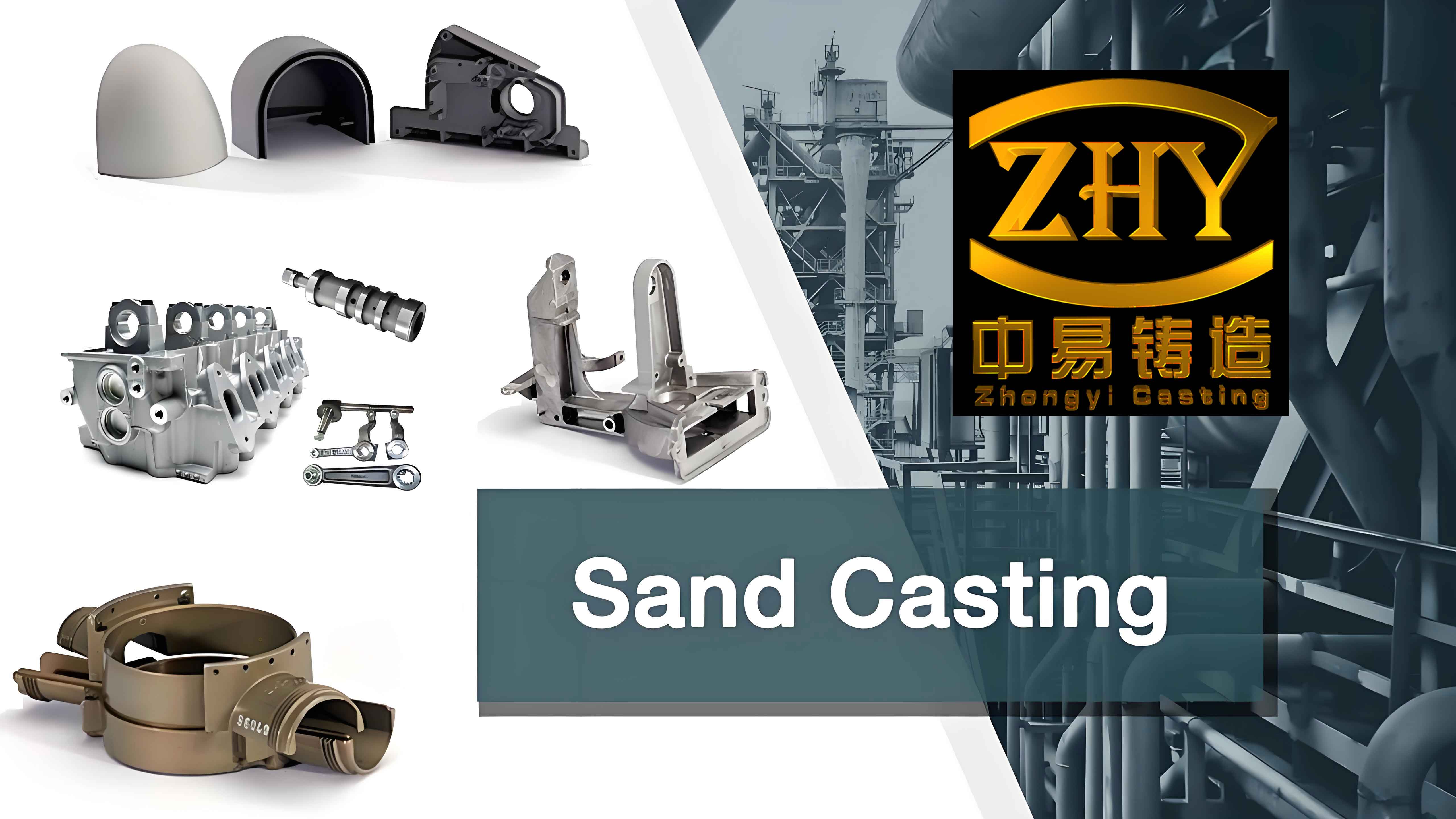
The optimization of sand casting parts involved redesigning the gating system. Originally, the gating led to turbulence and poor feeding. We switched to a dispersed layout with multiple ingates and added ceramic filters at key junctions. This reduced slag entrapment and promoted directional solidification. Moreover, we increased the pouring temperature from 1360-1380°C to 1380-1400°C and enhanced venting in the cope mold to allow gas escape. These changes significantly lowered defect rates in sand casting parts, bringing the rejection rate down to 5-6%. The table below summarizes the common defects in sand casting parts and our countermeasures.
| Defect Type | Possible Causes | Preventive Measures |
|---|---|---|
| Gas Holes | Low pouring temperature, turbulent flow | Increase temperature, improve gating design for laminar flow. |
| Slag Inclusions | Inadequate metal filtration, oxidation | Use ceramic filters, implement closed gating systems. |
| Sand Inclusions | Erosion of mold surfaces, poor compaction | Increase pouring speed, add more vents in the mold. |
| Micro-shrinkage | Inadequate feeding, low carbon equivalent | Optimize riser design, adjust composition to higher CE. |
In another instance, I applied similar principles to the TIG welding of a copper shell for a 220kV cable intermediate joint. This component, made from pure copper, required full penetration welds with minimal distortion. We used a steel backing strip to support the weld pool and employed TIG welding with non-deoxidized copper wire. The key parameters included high current and preheating to overcome copper’s high thermal conductivity. The heat input formula mentioned earlier was crucial here, as excessive heat could lead to grain growth and reduced strength. For sand casting parts, such thermal considerations are equally vital during melting and pouring stages. The synergy between welding and casting processes lies in controlling thermal cycles to achieve defect-free components.
To further elaborate on sand casting parts, let me discuss the mathematical modeling of solidification. The solidification time \( t_s \) for a sand casting part can be estimated using Chvorinov’s rule: $$ t_s = k \cdot V^n / A^m $$ where \( V \) is the volume of the casting, \( A \) is the surface area, and \( k \), \( n \), and \( m \) are constants dependent on the mold material and metal properties. For sand molds, \( n \) and \( m \) are often close to 2, simplifying to \( t_s = k \cdot (V/A)^2 \). This rule helps in designing risers for sand casting parts to prevent shrinkage defects. In our X62W platform project, we applied this by ensuring uniform section thicknesses to promote simultaneous solidification. Additionally, the use of insulating sleeves on risers can extend feeding paths, a technique beneficial for complex sand casting parts.
The economic impact of optimizing sand casting parts cannot be overstated. By reducing scrap rates, we saved on material costs and improved production throughput. For example, in the milling machine project, the enhanced process allowed for consistent delivery schedules and lower per-unit costs. Similarly, in welding, minimizing rework through precise parameter control reduced labor expenses. Both cases highlight the value of data-driven approaches. I often utilize statistical process control (SPC) charts to monitor key variables like pouring temperature or weld heat input. This proactive stance prevents defects in sand casting parts and welded joints before they occur.
In terms of material science, the interaction between microstructure and properties is paramount. For sand casting parts, the graphite morphology in cast iron affects tensile strength and damping capacity. We can model this using equations like: $$ \sigma_u = \alpha \cdot (CE)^{-1} + \beta $$ where \( \sigma_u \) is the ultimate tensile strength, and \( \alpha \) and \( \beta \) are material constants. By optimizing CE through alloy adjustments, we enhanced the performance of sand casting parts. In welding, the microstructure of the heat-affected zone (HAZ) determines toughness. For high-strength steels, the cooling rate \( T_{cool} \) can be approximated by: $$ T_{cool} = \frac{2\pi k (T – T_0)}{Q} $$ where \( k \) is thermal conductivity, \( T \) is peak temperature, and \( T_0 \) is ambient temperature. Controlling \( T_{cool} \) via preheat or interpass temperature avoids brittle phases.
Looking at broader applications, sand casting parts are used in sectors from automotive to aerospace, where weight and strength are critical. My work has shown that integrating simulation software, such as finite element analysis (FEA), can predict defect formation in sand casting parts. For instance, simulating mold filling helps identify regions prone to turbulence, allowing for gating modifications. Similarly, welding simulations can forecast distortion patterns, enabling fixture design adjustments. These tools, combined with empirical data, form a robust framework for manufacturing excellence.
To summarize, the journey through these case studies reinforces the importance of holistic process optimization. Whether dealing with high-strength steel welds or intricate sand casting parts, the principles of thermal management, material selection, and defect analysis remain consistent. I encourage practitioners to adopt a systematic approach: define requirements, analyze failures, implement solutions, and validate results. For sand casting parts, this might mean regular mold inspections and melt quality checks. For welding, it involves calibrating equipment and training operators. The ultimate goal is to produce reliable components that meet stringent standards, and with the methods discussed here, that goal is within reach. As technology evolves, continuous learning and adaptation will be key to advancing the field of metalworking.