
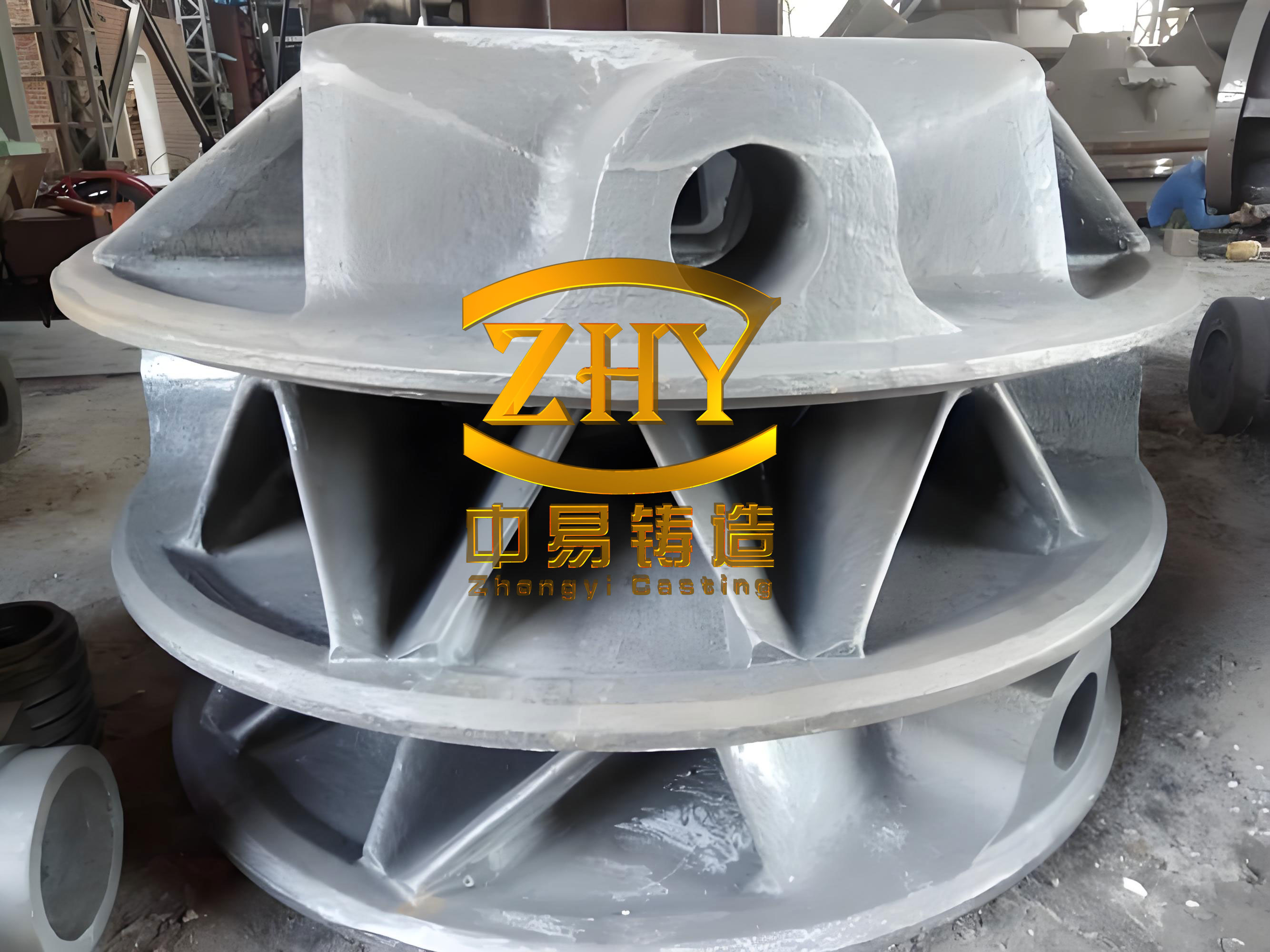
As a researcher deeply engaged in the field of ferrous casting metallurgy, I have devoted significant effort to resolving the persistent quality challenges associated with the production of high-performance ductile iron casting components intended for marine applications. In this study, I conducted a comprehensive investigation into the sand-lined metal mould casting of a secondary planetary carrier used within a deep-sea gearbox. The working environment for this component is exceptionally demanding, characterized by high hydrostatic pressure, low ambient temperatures, and fluctuating mechanical loads. These conditions impose rigorous requirements on the mechanical properties, microstructural integrity, and internal soundness of the ductile iron casting. The planet carrier, serving as the core force-transmitting element within the planetary gear set, experiences the maximum external torque in the entire mechanism. Consequently, its service reliability is of paramount concern, as any internal defect such as shrinkage porosity could lead to catastrophic failure under cyclic loading in deep-sea operations. My investigation focused on the QT1000-5 ductile iron casting, produced through the sand-lined metal mould (also referred to as iron mould sand-coated) casting process. This process combines the rapid cooling characteristics of permanent metal moulds with the collapsibility and surface finish offered by thin resin-coated sand layers. The inherent rigidity of the locked metal mould enables the exploitation of graphitic expansion during eutectic solidification, potentially facilitating riserless casting under optimal conditions. However, in actual production, a significant proportion of the planetary carriers exhibited internal shrinkage cavities and mold collapse defects, prompting the present optimization work.
Material Selection and Initial Process Rationale
Given the extreme deep-sea service conditions, the planetary carrier casting was required to achieve a minimum ultimate tensile strength of 1000 MPa after heat treatment. Additionally, ultrasonic inspection was mandated to meet Class I requirements of the standard GB/T 7233.1—2023. My preliminary investigation compared two candidate materials: austempered ductile iron and high-strength high-ductility ductile iron. Both material systems offer promising combinations of strength and wear resistance. However, the high-strength high-ductility ductile iron QT1000-5 was ultimately selected due to its superior combination of fatigue strength, fracture toughness, and wear resistance. Importantly, this grade contains 25% to 50% retained austenite, which enhances fatigue resistance by imparting a transformation-induced plasticity effect. This material behavior is critical for the cyclic loading conditions encountered by the deep-sea gearbox. The chemical composition range for this ductile iron casting is presented in Table 1. The sand-lined metal mould method was chosen as the manufacturing route because its locked metal mould provides excellent rigidity and dimensional accuracy. The thin sand coating promotes rapid heat extraction, leading to finer grain structures and improved mechanical properties compared to conventional green sand casting.
| Element | C | Si | Mn | Mg | P | S | RE | Fe |
|---|---|---|---|---|---|---|---|---|
| Content | 3.2-3.8 | 2.2-2.8 | 0.2-0.6 | 0.03-0.06 | <0.08 | <0.02 | 0.01-0.04 | Balance |
The original sand-lined metal mould casting process utilized a horizontally parted mould system. The moulding machine manufactured both the upper and lower sand boxes sequentially. The boxes were then closed with the pattern equipment, and the operational sequence proceeded through sand shooting, curing, and stripping. Thereafter, the assembly steps included mold closing, pouring, cooling, mold opening, casting removal, and metal mould cleaning. A graphical representation of this overall process is illustrated in Figure 1 below.
The process flow involves critical stages from pattern stripping to pouring, which formed the focus of my optimization strategy. In the original production scheme, the pouring temperature was set at 1450 °C, the ambient temperature was maintained at 26 °C, and the sand coating thickness was 5 mm. Gravity pouring was employed. The secondary planetary carrier dimensions measured 214 mm × 214 mm × 190 mm, with a maximum wall thickness of 53 mm and a minimum wall thickness of 17.45 mm. The total mass of the ductile iron casting was approximately 20 kg.
Analysis of Casting Defects in the Original Scheme
During the initial development phase, the casting process encountered two significant challenges. First, mold collapse defects were observed. Second, approximately 30% of the produced ductile iron casting components exhibited internal shrinkage cavities and porosity, with measured cavity depths exceeding 10 mm. I determined that the formation of these defects was intimately connected to the solidification behavior of ductile iron and the rigidity constraints of the mold assembly. To understand the fundamental mechanisms, I employed the Niyama criterion, which is a well-established parameter for predicting shrinkage porosity in castings. Typically, when the ratio G / √R is less than a critical value Kr, shrinkage porosity is anticipated in the ductile iron casting. The variable G represents the local temperature gradient in the casting, while R denotes the cooling rate. Tian Xuelei and colleagues extended this approach by incorporating the influence of metallostatic pressure and flow pressure, yielding the following relation:
$$ P_r = P_j – K_r \frac{\sqrt{R}}{G} \tag{1} $$
In this equation, Pr is the local pressure within a specific region of the ductile iron casting, and Pj is the metallostatic pressure of the molten iron. It follows that when Pr becomes less than or equal to zero, the liquid metal is unable to feed the solidification shrinkage effectively, causing progressive formation of shrinkage cavities. By algebraic rearrangement, this condition can be expressed as Pj G / √R ≤ Kr, demonstrating that shrinkage porosity is governed not only by thermal parameters but also by the effective feeding pressure available within the molten metal.
Carlson and Beckermann introduced an improved dimensionless Niyama criterion, which accounts for additional factors such as pressure drops in the mushy zone, alloy composition, and solidification characteristics. Their formulation is given by:
$$ N_y^* = \frac{C_\lambda G}{\sqrt[6]{R^5}} \sqrt{\frac{\Delta P_{cr}}{\mu \beta (T_{liq} – T_{sol})}} \tag{2} $$
where Cλ is a material constant, ΔPcr is the critical pressure drop in the mushy zone, μ is the dynamic viscosity of the liquid, β is the total solidification shrinkage, Tliq is the liquidus temperature, and Tsol is the temperature at which solidification is essentially complete. According to this criterion, the appearance of shrinkage defects corresponds to Ny* ≤ 0. The model has been validated through comparisons with experimental porosity measurements. From Equation (2), it is evident that the shrinkage behavior in ductile iron casting is related to the liquid pressure, melt composition, and the liquidus and solidus temperatures of the alloy. The QT1000-5 ductile iron grade exhibits tight control over chemical composition and microstructure compared to conventional ductile irons. The reduced carbon content, combined with alloying additions of copper and molybdenum, promotes the formation of a pearlitic matrix. However, the lower carbon concentration also decreases the amount of graphitic carbon available for expansion during eutectic solidification. This diminished graphitic expansion reduces the inherent self-feeding capacity of the ductile iron casting. I interpreted this as a critical factor contributing to shrinkage porosity, because the graphitic expansion pressure was insufficient to compensate for the volumetric contraction of the solidifying liquid metal.
Although the total expansion of QT1000-5 is reduced due to its lower carbon equivalent, its solidification rate is comparatively fast. This rapid solidification may lead to a sudden pressure accumulation. If the mold rigidity is inadequate, the mold cavity walls may experience inward micro-displacement under atmospheric or metallostatic pressures. Such displacement effectively counteracts the graphitic expansion pressure, consuming the expansion energy without effectively compensating for shrinkage. Consequently, both internal shrinkage cavities and mold collapse are observed in the ductile iron casting process. This understanding formed the foundation for my subsequent optimization measures.
Optimization Strategy for Ductile Iron Casting
Based on the mechanistic analysis of defect formation in sand-lined metal mould ductile iron casting, I identified several key process parameters that could be adjusted to minimize shrinkage porosity and mold collapse defects. These parameters included the pouring temperature, the thickness of the sand coating, the chemical composition of the molten metal, and modifications to the mold structure. Each optimization measure was carefully considered and its theoretical rationale is elaborated below.
Regarding the pouring temperature, I recognized that by controlling this parameter and directing the flow of molten iron from thinner sections, the liquid would solidify more rapidly and seal off the feeding channels within the ductile iron casting. During eutectic solidification, graphite precipitates from the melt, and because the specific volume of graphite is greater than that of liquid iron, a volumetric expansion occurs. The sand mould strength facilitates the development of internal pressure, contributing to self-feeding. Lower pouring temperatures introduce less heat into the mold cavity, reduce thermal equalization capabilities, and generate steeper temperature gradients. These conditions are generally conducive to reducing porosity defects. However, excessively low temperatures may hinder the dissolution of inoculants, leading to incomplete graphitization and a higher risk of shrinkage porosity. Therefore, I established the pouring temperature control range at 1350 °C to 1400 °C.
In terms of melt composition, I focused on the carbon and silicon contents. During my analysis, I observed that when the carbon content approaches approximately 4.3% and the silicon content is maintained at a lower level, increasing carbon within a certain range enables the graphitic expansion to exceed contraction, reducing the probability of shrinkage formation. Additionally, magnesium distribution in the melt tends to be non-uniform, which may promote a chilling tendency. Non-uniform magnesium distribution and the enrichment of inclusions can contribute to shrinkage defects. The addition of elements such as phosphorus, manganese, and vanadium to the molten iron can decrease the thermal conductivity, thereby increasing fluidity distance and mitigating pressure loss during solidification. This effect aids in reducing shrinkage defects. Given that the initial melt contained approximately 3.9% to 4.1% carbon, 0.037% to 0.045% rare earth elements, 2.3% to 2.6% silicon, and 0.040% to 0.047% magnesium, I adjusted the final carbon content to exceed 4.3% and the silicon content to the range 2.6% to 2.7%. The rare earth and magnesium contents were both maintained below 0.05%.
As for the sand coating thickness, I reasoned that variations in this parameter directly influence the solidification rate of the ductile iron casting. A thinner sand coating accelerates the cooling of the molten metal, reducing the liquid contraction period and thereby partially suppressing porosity formation. The sand coating acts as a thermal barrier between the molten metal and the metal mould; a reduction in its thickness enhances the chilling effect of the iron mould. In the original process, the sand coating thickness was 5 mm, which I proposed to reduce to 3 mm.
Mold rigidity is another important factor. If the mold lacks sufficient overall rigidity, the graphitic expansion pressure is dissipated by mold wall movement, which fails to aid internal feeding and leads to shrinkage cavities. Conversely, inadequate local rigidity may cause concentrated expansion pressure to trigger mold collapse. I concluded that increasing the thickness of the sand box, or otherwise enhancing the mold structure rigidity, would mitigate both issues. Accordingly, I optimized the pattern structure to reinforce critical sections and fixed the loose pieces to enhance their stability within the mold assembly. The optimized casting process, including the gating and riser system design, was developed and is schematically represented in Figure 4. The optimized configuration aimed to improve the rigidity of the mold and secure all moving parts, ensuring consistent solidification conditions across the ductile iron casting.
Numerical Simulation of the Optimization Process
To quantitatively evaluate the effects of the proposed process modifications, I employed the ProCAST software package. The porosity fraction of the ductile iron casting, representing the percentage of shrinkage porosity relative to total volume, was used as the primary evaluation metric. I also applied the Niyama criterion within the simulation to identify regions susceptible to shrinkage defects. Table 2 summarizes the simulation parameters used for the optimization before and after the adjustments. The baseline simulation, representing the original parameters, revealed severe shrinkage porosity distributed throughout the ductile iron casting.
| Parameter | Pouring temp. (°C) | Sand coating thickness (mm) | Carbon content (%) | Silicon content (%) |
|---|---|---|---|---|
| Before optimization | 1500 | 5 | 3.9-4.1 | 2.3-2.6 |
| After optimization | 1400 | 3 | ≥4.3 | 2.6-2.7 |
The simulation output, shown in Figure 5, displayed porosity fractions ranging from 60% to 82% within the interior of the casting. The Niyama criterion values were around 9 K1/2·s1/2·cm−1, indicating a high probability of defect formation in the base process. These simulation results were consistent with the observed casting defects and validated the reliability of the simulation model.
Influence of Pouring Temperature
When I systematically reduced the pouring temperature from 1500 °C to 1400 °C, while keeping all other conditions constant, a substantial improvement was observed in the simulation results. The primary shrinkage cavity location shifted from the interior of the planetary carrier toward the pouring cup region. The porosity fraction decreased significantly to approximately 25-33%. Concurrently, the Niyama criterion value improved to around 9.6 K1/2·s1/2·cm−1. This finding confirmed that controlling the pouring temperature is an effective measure for minimizing internal shrinkage defects within the ductile iron casting. The thermal gradient within the casting became more favorable for directional solidification, enabling improved feeding efficiency.
Influence of Melt Composition
In the second set of simulations, I adjusted the chemical composition of the molten iron while maintaining the original pouring temperature and sand coating thickness. The carbon content was increased to exceed 4.3%, the rare earth concentration was maintained below 0.05%, and the silicon content was increased to 2.6-2.7%. The simulation results revealed that the porosity fraction decreased to approximately 35-41%. The Niyama criterion value was enhanced to approximately 9.5 K1/2·s1/2·cm−1. Although the effect was slightly less pronounced than the pouring temperature modification, optimizing the melt composition nonetheless contributed positively to the reduction of shrinkage porosity in the ductile iron casting. The enhanced graphitic expansion associated with higher carbon content helped to improve the internal feeding behavior during solidification.
Influence of Sand Coating Thickness
Finally, I investigated the effect of reducing the sand coating thickness from 5 mm to 3 mm. The simulation results showed a maximum porosity reduction to around 40-58%. The Niyama criterion value increased to approximately 9.22 K1/2·s1/2·cm−1. This result indicated that a thinner sand coating provides a beneficial chilling effect, accelerating the solidification of the ductile iron casting and thereby reducing the time available for shrinkage to develop. However, the relative influence of this parameter was less significant compared to both pouring temperature and melt composition.
Combined Optimization Simulation
Having evaluated each parameter in isolation, I proceeded to integrate all optimized parameters into a comprehensive casting simulation. This overall optimization included the simultaneous reduction of pouring temperature to 1400 °C, the adjustment of the chemical composition according to the optimized ranges, and the reduction of the sand coating thickness to 3 mm. The mold filling simulation for the optimized ductile iron casting process demonstrated stable flow behavior. The maximum temperature during filling was 1400 °C, the minimum was 1304 °C, and the average temperature was approximately 1365 °C. These values satisfied the pouring temperature control requirements and indicated a low risk of cold shut formation.
Comparison of the solidification process between the original and optimized parameters showed a notable reduction in solidification time, from 430 seconds in the original process to 344 seconds in the optimized process. This accelerated solidification reduced the time available for liquid contraction, allowing the graphitic expansion force in ductile iron casting to more effectively compensate for the volumetric shrinkage. This outcome was consistent with the theoretical prediction of the Ny* criterion, which suggests that an increased cooling rate reduces the tendency for shrinkage porosity. The numerical simulation results aligned well with the theoretical expectations derived from the Niyama criterion.
Through further porosity and Niyama criterion analyses, I confirmed a significant decrease in the shrinkage porosity of the optimized ductile iron casting. The porosity fraction was reduced to the range of 10-20%. Notably, the mild shrinkage band in the center of the casting was markedly reduced, indicating a much higher degree of soundness in the casting interior. The Niyama criterion value was now increased to approximately 11.2 K1/2·s1/2·cm−1. These strong simulation results provided reassuring evidence for the feasibility of the proposed manufacturing approach. A comparative summary of the effects of each parameter on porosity and Niyama values is provided in Table 3.
| Optimization stage | Porosity fraction (%) | Niyama criterion (K1/2·s1/2·cm−1) | Observation |
|---|---|---|---|
| Original scheme | 60-82 | 9.0 | Severe shrinkage defects |
| Pouring temperature only | 25-33 | 9.6 | Defects shifted to feeder |
| Melt composition only | 35-41 | 9.5 | Moderate improvement |
| Sand coating thickness only | 40-58 | 9.22 | Mild improvement |
| Combined optimization | 10-20 | 11.2 | Significant reduction in defects |
It is noteworthy that the relative influence of the three process parameters on shrinkage porosity, in descending order of significance, is pouring temperature, melt composition, and sand coating thickness. This hierarchy was consistently reflected in the simulation results, with the pouring temperature providing the largest single contribution to defect reduction. The combined optimization provided a cumulative benefit, reducing porosity to within the 10-20% range while substantially enhancing the Niyama criterion values throughout the ductile iron casting.
Production Validation of the Optimized Ductile Iron Casting
Following the positive simulation outcomes, I proceeded to implement the optimized sand-lined metal mould casting process in actual production. The controlled pouring temperature was maintained between 1350 °C and 1400 °C, the actual pouring time ranged from 15 to 20 seconds, and the sand coating thickness was set at 3 mm. The ambient temperature remained at 26 °C. The pouring method was gravity tilt pouring. The castings produced under these conditions exhibited a significantly reduced defect frequency. Only about 2% of the produced ductile iron casting components showed any shrinkage cavity, and the measured cavity depth was in the range of 3-5 mm. This represented a 93.3% reduction in the shrinkage defect occurrence rate relative to the original process. More importantly, the complete batch of product successfully passed ultrasonic third-party inspection. The ultrasonic testing results confirmed that the castings conformed to Class I requirements of the standard GB/T 7233.1—2023, making them fully qualified for deployment in deep-sea systems. The finished castings demonstrated not only improved internal soundness but also superior dimensional accuracy and surface quality, reflecting the benefits of the refined process parameters. The quality consistency of the finished product was substantially improved, which is of great advantage for the production of high-end marine equipment components.
This successful validation underscores the utility of combined numerical simulation and the Niyama criterion in optimizing sand-lined metal mould casting processes for high-performance ductile iron casting components. The methodology provided a quantitative basis for the selection and integration of multiple process parameters, avoiding reliance solely on empirical trial-and-error. The consistency between simulation results and actual production outcomes affirmed the reliability of the simulation model and the comprehensiveness of the theoretical framework.
Summary and Conclusions
In summary, this comprehensive investigation successfully resolved the internal shrinkage porosity and mold collapse defects associated with a QT1000-5 ductile iron casting for a deep-sea gearbox planetary carrier. I analyzed the underlying solidification and pressure-drop mechanisms using the Niyama criterion and its dimensionless extension, identifying the key process parameters responsible for defect formation. Through systematic numerical simulation using ProCAST, I separately evaluated the effects of pouring temperature, melt composition, and sand coating thickness on the porosity of the ductile iron casting. The results demonstrated that the pouring temperature had the greatest influence on shrinkage defects, followed by the melt composition, with the sand coating thickness having the smallest effect. The overall optimized sand-lined metal mould casting scheme, incorporating all three modifications along with enhanced mold structure rigidity, reduced the casting solidification time by 25%, lowered the maximum porosity fraction to 10-20%, and markedly reduced the shrinkage band at the casting core. Production verification confirmed that the optimized ductile iron casting exhibited a 93.3% reduction in shrinkage defect rate and successfully passed ultrasonic inspection, thereby confirming its suitability for use in deep-sea transmission reducers. The complete methodology, from initial defect analysis to computational optimization and production confirmation, offers a robust framework for quality improvement in ductile iron casting manufacturing. This work therefore provides valuable reference for the production of complex ductile iron casting components subjected to stringent internal soundness requirements, and reinforces the practical significance of coupling advanced simulation-based approaches with rigorous experimental validation in modern ductile iron casting technology.