
The evolution of modern foundry operations towards larger-capacity melting and pouring equipment presents unique challenges when the product mix includes a significant proportion of small-to-medium steel castings. Operating a large-tonnage electric arc furnace in conjunction with a high-capacity bottom-pour ladle for casting individual pieces weighing only a few hundred kilograms is inherently inefficient. The extended pouring times required to fill multiple molds sequentially from a single ladle lead to excessive heat loss in the remaining steel, increased refractory wear in the ladle, and a higher propensity for casting defects. The solution, which I have implemented and refined extensively, lies in adapting the lost foam casting process to facilitate the group pouring, or “cluster pouring,” of these smaller components. This report details the methodology, technical considerations, and quantified benefits of this integrated approach.
The core principle is elegantly simple: by strategically assembling multiple expendable foam patterns (clusters) into a single, larger gating system, we effectively transform a batch of small castings into one large casting for the purpose of pouring. This cluster is then poured in one continuous action from the large bottom-pour ladle. The advantages are multifold and significant:
- Minimized Pouring Time per Ladle: Filling one large cluster is drastically faster than filling dozens of individual molds. This preserves the superheat of the molten steel.
- Reduced Number of Pouring Events: A single ladle of steel can serve multiple clusters, but with far fewer start-stop cycles of the ladle stopper rod, enhancing control and reducing temperature fluctuation.
- Improved Thermal Management: Rapid pouring minimizes the time for radiative and convective heat loss, maintaining optimal fluidity for mold filling and feeding.
- Enhanced Metallurgical Quality: The swift, quiescent flow from a bottom-pour ladle minimizes turbulence and reoxidation. In lost foam casting, a faster fill rate also helps manage the gaseous decomposition products of the foam, potentially reducing carbon defect incidence.
To illustrate this process, I will use a practical case study involving the production of jaw crusher pulley wheels, a demanding steel casting.
1. Technical Foundation and Cluster Design Philosophy
The successful implementation of cluster pouring in lost foam casting rests on a holistic understanding of the interdependent “Three Fields”: the Flow Field, the Thermal Field, and the Pressure (Vacuum) Field. The design must synchronize all three.
1.1 Flow Field & Gating System Design: The goal is to achieve smooth, progressive filling with minimal turbulence. For the pulley wheels, an “in-cavity gating” or “stacked” approach was employed, where the sprue feeds directly into the lower parts of the casting cavities, effectively creating a bottom-filling scenario even with a top-poured cluster. The key design equation for the choke area in a pressurized system, critical for controlling flow rate, is:
$$A_c = \frac{W}{\rho \cdot t \cdot C_d \cdot \sqrt{2gH}}$$
Where:
$A_c$ = Choke cross-sectional area (e.g., at sprue base)
$W$ = Total weight of the cluster (metal)
$\rho$ = Density of molten steel
$t$ = Desired pouring time
$C_d$ = Discharge coefficient (accounts for friction)
$g$ = Acceleration due to gravity
$H$ = Effective metallostatic head
For cluster pouring, $W$ is the sum of all pattern weights in the cluster, and $t$ must be optimized for the entire assembly.
1.2 Thermal Field & Feeding: The orientation and grouping of patterns must create favorable thermal gradients directed toward the risers. Placing castings vertically and feeding from a central downgate promotes directional solidification. The required riser volume can be estimated using Chvorinov’s Rule and the modulus method. The solidification time $t_s$ for a casting section is proportional to the square of its volume-to-surface-area ratio (modulus, $M$):
$$t_s = k \cdot M^n = k \cdot \left(\frac{V}{A}\right)^n$$
Where $k$ is the mold constant. Risers must be designed with a larger modulus than the casting section they feed to ensure they remain liquid longest.
1.3 Pressure (Vacuum) Field: Consistent and adequate vacuum through the compacted sand is non-negotiable. It ensures pattern degradation gases are evacuated, maintains mold rigidity to prevent wall movement, and counteracts the back-pressure from foam pyrolysis. The vacuum level must be calibrated for the cluster’s total gas generation.
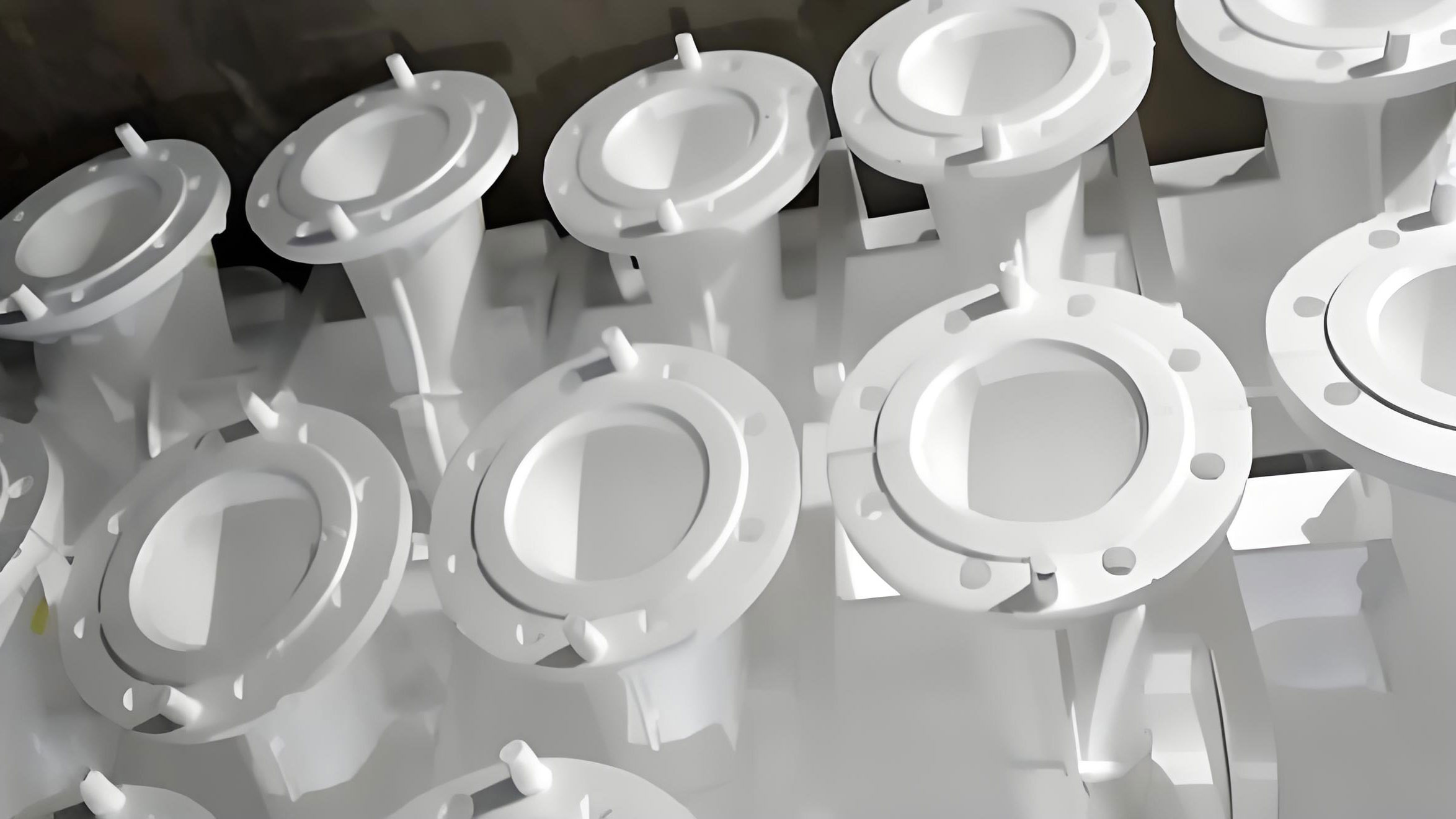
2. Process Implementation: A Step-by-Step Case Study (Jaw Crusher Pulley)
Casting Details: Material: ZG270-500 (Cast Steel); Weight: 500 kg per piece; Key Quality Requirements: Non-destructive testing (NDT), no repair permitted, sharp definition on identifying lettering.
2.1 Pattern Assembly & Cluster Construction:
We use Expandable Polystyrene (EPS) foam of density ~18 g/L. Patterns are hand-cut and glued. The critical preparatory step is pre-assembling individual patterns into stable sub-units.
- Single Pattern Preparation: Each pulley pattern is assembled with its integrated gating (ingates) and risers (“cat-ear” risers were used on the heavy rim section).
- Forming Stable Sub-Clusters: Two patterns are glued back-to-back, ensuring their ingate connection points are perfectly aligned on the same plane. This creates a stable, symmetrical module for easy handling.
- Final Cluster Assembly: For a typical flask, we combine two of these double-pattern modules to form a 4-piece cluster. All sprue, runner, and ingate connections must be meticulously trimmed, glued with minimal adhesive, and the seams sealed with adhesive tape before a reinforcing coat of paint is applied.
The pattern assembly stage is where the “cluster pour” concept physically takes shape. Precision here is critical for leak-free filling.
2.2 Coating Application and Drying: A high-grade zircon-flour-based refractory coating is applied. Coating thickness is a controlled parameter:
| Component | Target Coating Thickness | Purpose |
|---|---|---|
| Pattern (Casting Surface) | ≥ 3 mm | Provides refractory barrier, allows gas permeation, ensures surface finish. |
| Gating System | ≥ 6 mm | Enhanced erosion resistance due to higher metal velocity and prolonged contact. |
Drying is conducted under controlled conditions (35-40°C, 10-20% humidity). A post-drying inspection is mandatory to identify and repair any cracks, bare spots, or delaminations using an alcohol-based quick-dry coating. Any flaw is a potential site for metal penetration (“burn-on”).
2.3 Molding (Flask Filling): After calculating and compacting a level base layer of dry silica sand, the pre-assembled foam cluster is carefully lowered into the flask. The cluster must be positioned to optimize sand flow and vacuum line placement. The sand is then filled and vibrated in stages to achieve uniform compaction around the complex cluster geometry without causing pattern distortion. Vacuum lines are embedded and connected to a manifold ensuring even draw across the entire cluster volume.
2.4 Pouring with Large Bottom-Pour Ladle: This is the stage where the synergies of the process converge. The large ladle, tapped from the electric arc furnace, delivers metal to the cluster.
| Process Factor | Benefit in Cluster Pouring | Quantitative/Qualitative Impact |
|---|---|---|
| Ladle Capacity | Enables pouring of multiple heavy clusters sequentially. | Reduces total furnace taps needed for a batch of small castings. |
| Bottom-Pour Design | Clean, non-turbulent metal entry from below the slag layer. | Minimizes oxide inclusion formation; improves metal cleanliness. |
| Rapid Pour Rate | Fills the large cluster volume quickly. | Maintains thermal gradient; reduces foam gas generation per unit time, easing vapor evacuation. |
| Controlled Stopper Rod | Precise start/stop of stream for each cluster. | Avoids spillage and ensures proper gating system prime. |
After pouring, the vacuum is maintained until solidification is complete. The flask is then evacuated after a cooling period (e.g., 8 hours).
2.5 Post-Casting Processing: Upon shakeout, the cluster is broken apart at the designed weak connections in the gating system. Castings are shot blasted. The final machined components exhibited no defects, meeting all dimensional and NDT standards.
3. Critical Analysis and Advantages of the Integrated Approach
The case study demonstrates that the cluster pour technique within lost foam casting is not merely a logistical improvement but a quality-enhancing methodology. The table below contrasts key aspects with hypothetical sequential pouring of single patterns.
| Aspect | Cluster Pouring (Lost Foam) | Sequential Single-Pattern Pouring | Advantage of Cluster Pouring |
|---|---|---|---|
| Pouring Time per Ladle | Short, single continuous pour per cluster. | Very long, many intermittent pours. | Preserves superheat; improves ladle life. |
| Metal Temperature Drop | Minimized. | Significant, especially towards end of ladle. | Ensures consistent fluidity, reduces mistruns. |
| Thermal Gradient Control | Excellent, due to designed cluster geometry and rapid fill. | Variable, dependent on individual mold filling. | Promotes sound feeding, reduces shrinkage. |
| Gas Management (Foam Degradation) | High fill rate evac. gases quickly; vacuum stable for one large volume. | Slower fill per mold may allow gas buildup. | Lowers risk of carbon defects and gas porosity. |
| Surface Detail (e.g., Lettering) | Exceptional. Shrinkage is countered by vacuum, creating sharp corners. | In other processes, shrinkage creates radii. | Eliminates need for special facing sands for detail. |
| Productivity (Casts per Ladle) | High. One ladle pour yields 4+ castings. | Low. Multiple pours for same number of castings. | Increases throughput and energy efficiency. |
3.1 The Unique Advantage for Surface Definition: A particular strength of lost foam casting highlighted here is its ability to produce castings with exceptionally sharp features and lettering. In green sand or resin sand casting, the natural shrinkage of the metal away from the mold wall produces a radius on sharp corners. In lost foam casting, the foam pattern vaporizes, and the metal occupies the exact space while being subjected to the compressive force of the atmospheric pressure acting through the vacuum. This counteracts the initial shrinkage pull, allowing the metal to maintain intimate contact with the mold wall, resulting in the replication of true, sharp corners and pristine letter definition without secondary processing.
3.2 Metallurgical and Quality Consistency: The use of a large bottom-pour ladle inherently provides cleaner metal. When combined with the fast, controlled fill of a well-designed cluster, the conditions for producing sound, high-integrity castings are optimized. The thermal consistency across all castings in a cluster poured simultaneously is far superior to that of castings poured at the beginning versus the end of a long ladle cycle.
4. Summary and Concluding Formulas for Practice
The integration of large-ladle melting, cluster pattern assembly, and the lost foam casting process represents a powerful strategy for foundries dealing with a mix of casting sizes. It turns a logistical challenge into a quality and efficiency opportunity.
Key design and control takeaways can be summarized by these fundamental relationships:
- Cluster Pouring Time Estimate:
$$t_{pour} = \frac{\sum_{i=1}^{n} W_i}{\rho \cdot A_c \cdot C_d \cdot \sqrt{2g \cdot H_{avg}}}$$
Where $n$ is the number of patterns in the cluster. Target a $t_{pour}$ that is fast enough to maintain thermal profile but controlled enough to avoid excessive turbulence. - Vacuum Requirement Consideration: The total gas volume $V_{gas}$ from foam degradation is proportional to the cluster’s foam mass. Ensure the vacuum system pumping capacity $Q_{pump}$ satisfies:
$$Q_{pump} >> \frac{V_{gas}}{t_{pour}}$$
to maintain stable negative pressure. - Economic/Efficiency Metric: The efficiency gain can be viewed as the reduction in pouring events:
$$\text{Reduction Factor} = 1 – \frac{\text{Number of Clusters}}{\text{Number of Individual Patterns}}$$
For 40 patterns poured as 10 clusters of 4: $RF = 1 – 10/40 = 0.75$ or a 75% reduction in ladle start/stop cycles.
In conclusion, the lost foam casting process is uniquely adaptable to the cluster pouring methodology. By viewing a group of small castings as a single hydraulic and thermal system, foundries can leverage the capabilities of large modern melting and pouring equipment to achieve superior quality, consistency, and productivity for small-to-medium steel castings. The success hinges on meticulous pattern cluster design, robust process control across coating, molding, and pouring, and a deep understanding of the interacting physical fields governing the lost foam casting process.