
The rapid expansion of offshore wind power, particularly the shift towards 8-12 MW turbines, has escalated the demand for massive, thick-section structural components. Critical parts like hubs, main shafts, and bearing housings, typically manufactured from high-integrity spheroidal graphite cast iron, often weigh between 20 to 60 tonnes. A significant production bottleneck arises when the weight of a single casting exceeds the safe melting capacity of a foundry’s largest available furnace. This precludes single-heat melting and necessitates a synchronized multi-heat melting process where molten metal from several furnaces is poured simultaneously into a single mold. This introduces a complex production scheduling puzzle: how to efficiently allocate a diverse set of casting orders, each with varying weights, material grades, and due dates, across multiple furnaces in a way that satisfies technical constraints while maximizing resource utilization and meeting delivery commitments.
Traditional furnace charge planning or “heat scheduling” models are predicated on the assumption that no single job’s weight surpasses a furnace’s capacity. These models focus on grouping smaller castings of the same material grade into a single heat to optimize furnace fill rate, minimize setup changes, and reduce total melting time or cost. However, they fail entirely when confronted with “super-heavy” castings that must be split across furnaces. The problem transforms from a classic bin-packing or batch scheduling problem into a hybrid one with two distinct job types: divisible jobs (large castings) whose weight can be distributed across multiple furnaces, and indivisible jobs (smaller castings) that must be assigned wholly to a single furnace. Furthermore, all jobs assigned to furnaces melting concurrently for a shared pour must be of the identical spheroidal graphite cast iron grade (e.g., QT400-18, QT500-7). The core challenge is to create a daily or shift-based melting schedule that determines which set of castings will be produced together in a simultaneous pouring event and exactly how their weight is allocated to each available furnace.
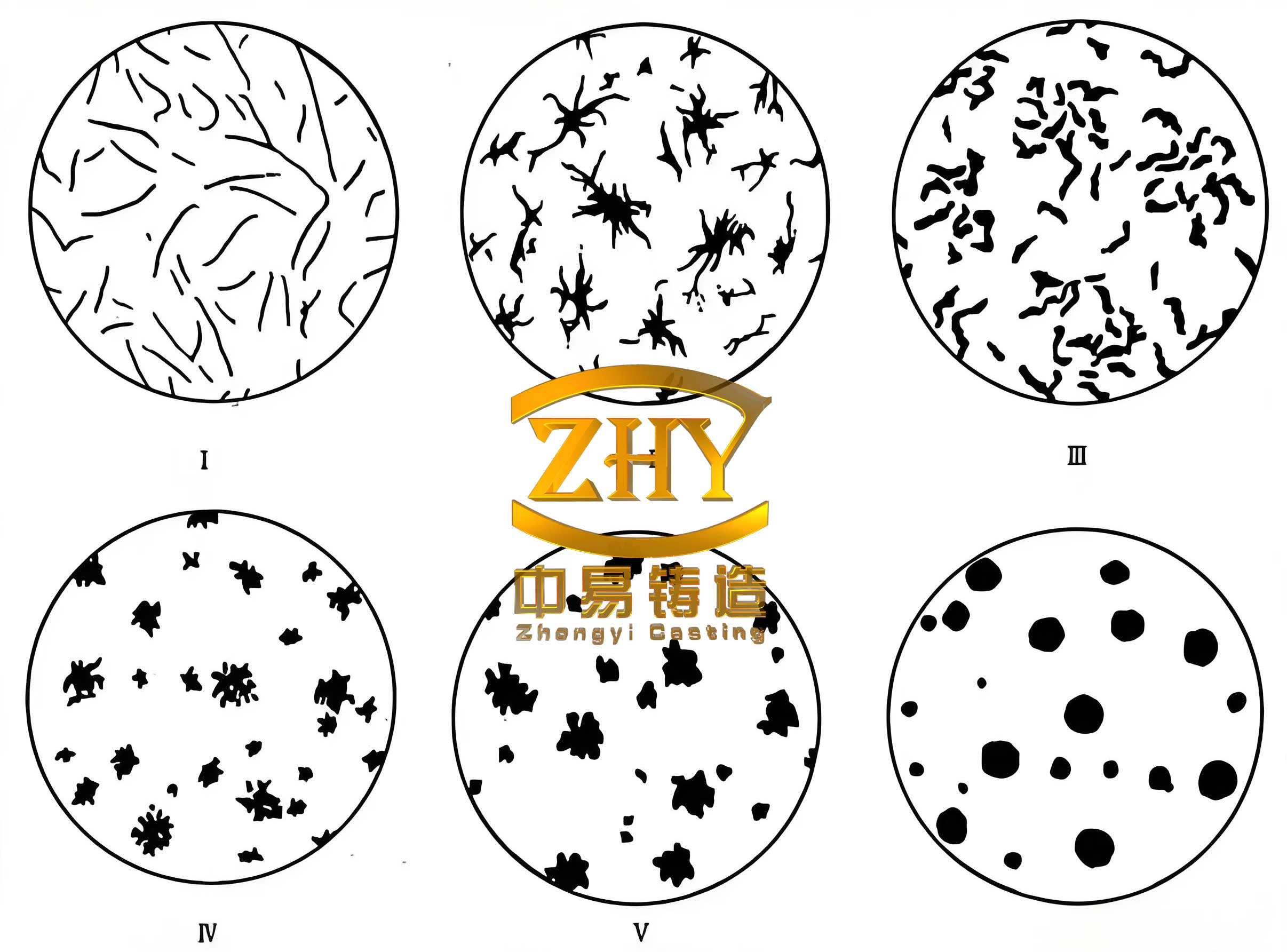
This work addresses this gap by developing a multi-heat planning model specifically designed for foundries producing heavy spheroidal graphite iron castings. The model’s objective is dual-fold: to prioritize castings with tighter deadlines and to maximize the utilization of furnace capacity in each planned melting event. A novel Hybrid Genetic Whale Optimization Algorithm (HGWOA) is proposed to solve this NP-hard scheduling problem efficiently. Validation using real-world data from a wind component foundry demonstrates substantial improvements in furnace utilization and reduction in total heats required compared to manual planning methods.
Problem Formulation and Mathematical Model
The melting stage is typically the bottleneck in a foundry producing large spheroidal graphite iron castings. We consider a planning horizon (e.g., one night shift) during which a set of \( K \) identical furnaces, each with a safe melting capacity \( Q \), are available. A set of \( L \) casting orders, or jobs, are pending. Each job \( l \) has a specified gross weight \( N_l \), a required material grade \( M_l \) (from a set of \( N \) possible grades), and a remaining time to delivery \( V_l \). The fundamental constraint is that the total weight allocated to any furnace in a single heat cannot exceed \( Q \).
The key feature is the job’s divisibility based on its weight relative to \( Q \):
- If \( N_l > Q \), the job is divisible and must be processed. Its weight must be distributed across two or more furnaces melting concurrently.
- If \( N_l \leq Q \), the job is indivisible. It can either be selected for production in its entirety on one furnace or not selected at all.
All jobs assigned to furnaces operating in the same synchronized heat must share the same material grade \( M_l \). The goal is to form a sequence of planned “pouring groups” (each group comprising one synchronized heat from multiple furnaces) that processes a subset of the jobs.
Mathematical Model
Decision Variable:
Let \( P_{lk} \) be the fraction of job \( l \)’s weight assigned to furnace \( k \) for a given planned heat. For indivisible jobs (\( N_l \leq Q \)), \( P_{lk} \) is binary (0 or 1). For divisible jobs (\( N_l > Q \)), \( P_{lk} \) is continuous between 0 and 1.
Job Priority:
To incorporate due date urgency, a priority weight \( \alpha_l \) is assigned to each job. A common formulation is an inverse function of the remaining time, ensuring jobs closer to their deadline have higher priority. For instance:
$$ \alpha_l = \frac{1}{1 + \log(V_l + 1)} $$
This results in values between 0 and 1.
Objective Function:
We aim to maximize the total melting value of a planned heat. Simply maximizing total weight could neglect due dates, while solely maximizing priority could lead to poor furnace utilization. Therefore, we define the value contributed by a job as the product of its weight and its priority, \( N_l \cdot \alpha_l \). The objective for a single planned heat (involving furnaces \( k=1…K \)) is to maximize the sum of these values for all assigned jobs:
$$ \text{Maximize } Z = \sum_{l=1}^{L} \sum_{k=1}^{K} (N_l \cdot \alpha_l) \cdot P_{lk} $$
This multiplicative formulation inherently favors schedules that include high-priority jobs and fill the furnaces as much as possible.
Constraints:
- Job Assignment Integrity: A job is either fully processed in this heat or not at all.
$$ \sum_{k=1}^{K} P_{lk} \in \{0, 1\} \quad \forall l \in \{1,…,L\} $$ - Furnace Capacity: The total weight on any furnace cannot exceed its limit. Accounting for a typical yield/casting yield factor \( \gamma \) (e.g., 1.1 for 10% system yield),
$$ \sum_{l=1}^{L} N_l \cdot P_{lk} \leq \gamma \cdot Q \quad \forall k \in \{1,…,K\} $$ - Material Grade Compatibility: All jobs assigned to any furnace in this synchronized heat must be of the same spheroidal graphite iron grade. This can be modeled by ensuring that if \( P_{lk} > 0 \) and \( P_{l’k’} > 0 \) for any furnaces \( k, k’ \) in this heat, then \( M_l = M_{l’} \). This is a combinatorial constraint handled during the solution strategy.
- Variable Domain:
$$ P_{lk} \in \{0,1\} \quad \text{if } N_l \leq Q $$
$$ P_{lk} \in [0,1] \quad \text{if } N_l > Q $$
The model must be solved sequentially to generate a full schedule covering multiple heats until all urgent jobs or a shift’s capacity are accounted for.
Solution Methodology: A Three-Phase Hybrid Approach
The model’s complexity, stemming from the mix of binary and continuous variables under material compatibility constraints, necessitates a tailored heuristic approach. We decompose the problem into three sequential phases applied iteratively to plan one synchronized multi-furnace heat at a time.
Phase 1: Job Grouping by Material and Size Class
Pending jobs are first partitioned into groups based on their required grade of spheroidal graphite cast iron (e.g., QT400, QT500). Scheduling is then performed independently for each material group. Within a material group, jobs are classified as “Large” (\( N_l > Q \)) or “Small” (\( N_l \leq Q \)). A critical feasibility check is performed: the number of “Large” jobs selected for a heat cannot exceed the number of available furnaces \( K \), as each large job requires at least one furnace dedicated to a portion of its weight.
Phase 2: Selecting a Batch of Jobs for a Heat (HGWOA)
For a given material group, selecting an optimal subset of jobs to form a heat is analogous to a complex 0-1 knapsack problem with an additional cardinality constraint for large jobs. The “knapsack” has a capacity of \( K \cdot Q \), and each job has a “value” of \( N_l \cdot \alpha_l \). We propose a Hybrid Genetic Whale Optimization Algorithm (HGWOA) to solve this.
Algorithm Design: Standard Whale Optimization Algorithm (WOA) is effective for continuous problems but lacks operators for discrete binary search. The Genetic Algorithm (GA) is well-suited for combinatorial problems but can converge slowly. HGWOA synergizes them:
- Encoding & Population: A solution is a binary chromosome of length \( L \), where gene \( l \) is 1 if job \( l \) is selected for the current heat.
- Fitness Evaluation: The fitness of a chromosome is the sum \( \sum (N_l \cdot \alpha_l) \) for all selected jobs, provided the total weight constraint \( \sum N_l \leq K \cdot Q \) and the “Large job count ≤ K” constraint are met.
- WOA-inspired Search: The standard WOA search mechanisms (encircling prey, bubble-net attacking) guide the selection of individuals for crossover. The parameter \( p \) and vector \( A \) from WOA determine whether to perform crossover with a random individual (\(|A| \geq 1\)) or the current best individual (\(|A| < 1\)).
- Genetic Operators: A standard crossover operator (e.g., single-point) and a mutation operator (bit-flip) are applied as dictated by the WOA logic, enhancing exploitation and exploration.
- Repair Mechanism: Infeasible chromosomes violating the weight or large-job constraint are repaired using a greedy heuristic: genes for selected jobs are set to 0, starting from the job with the smallest \( N_l \cdot \alpha_l \) value, until feasibility is restored.
The HGWOA iterates until convergence, outputting the fittest chromosome representing the best batch of jobs for the next heat.
Phase 3: Weight Allocation to Furnaces (Linear Programming)
Given the selected batch of jobs \( B \) from Phase 2, the final step is to determine the exact weight fraction \( P_{lk} \) for each job on each furnace. This is a linear programming (LP) problem with the objective of maximizing the same value function (now a linear sum since the jobs are fixed) subject to furnace capacity and job integrity constraints (1 & 2 from the model). For indivisible jobs, the LP includes integer constraints, making it a Mixed-Integer Linear Program (MILP), solvable with standard solvers. The result is a precise schedule, as illustrated conceptually below for a batch with one large divisible job and several small jobs.
| Job ID | Type | Weight (kg) | Furnace 1 Allocation | Furnace 2 Allocation |
|---|---|---|---|---|
| 98 | Large (Divisible) | 21,800 | P=0.85 (18,530 kg) | P=0.15 (3,270 kg) |
| 15 | Small (Indivisible) | 1,033 | P=0 | P=1 (1,033 kg) |
| 71 | Small (Indivisible) | 1,240 | P=1 (1,240 kg) | P=0 |
This three-phase process is repeated: jobs successfully scheduled are removed from the pending list, and the next heat is planned until a shift’s furnace availability is exhausted or all high-priority spheroidal graphite iron castings are scheduled.
Experimental Validation and Results
The model and HGWOA were tested using real order data from a specialty foundry producing wind turbine components from spheroidal graphite iron. The foundry operates two 20-tonne medium-frequency furnaces per shift, typically planning for 4 heats per furnace per night (8 heats total). A yield factor \( \gamma \) of 1.1 was used. A dataset of 191 casting orders across three common grades (QT400, QT500, QT600) was used.
Effectiveness of the Intelligent Schedule
The algorithm generated a complete production schedule. A snapshot of one planned heat for QT400 spheroidal graphite iron is shown below:
| Planned Heat | Furnace | Jobs Allocated | Calculated Melt Weight (kg) | Furnace Utilization |
|---|---|---|---|---|
| Heat 1 (QT400) | #1 | Job98 (partial), Job71 | 19,886 | 99.43% |
| #2 | Job98 (partial), Job15, Job23 | 20,000 | 100.00% |
The algorithm successfully handled the large, divisible Job98 (21.8t) by splitting it across both furnaces while packing smaller jobs to achieve near-100% utilization. The performance was evaluated over a full production period required to clear the test dataset and compared against the foundry’s historical manual scheduling outcomes.
| Performance Metric | Manual Scheduling | Intelligent Scheduling (HGWOA) | Improvement |
|---|---|---|---|
| Average Furnace Utilization | 86.57% | 95.89% | +10.76% |
| Total Number of Heats Required | 42 | 39 | -7.14% (3 heats saved) |
The results confirm the model’s efficacy. The 10.76% boost in utilization represents a direct reduction in energy waste per tonne of molten spheroidal graphite iron produced. Reducing the total number of heats by 3 saves significant furnace cycling time, refractory wear, and overhead costs, enhancing overall productivity and cost-effectiveness for the heavy casting foundry.
Algorithm Performance Comparison
The HGWOA was benchmarked against standard Particle Swarm Optimization (PSO) and Genetic Algorithm (GA). All algorithms were run 20 times on test sets of varying complexity (grouped by number of material types). Key metrics are average runtime and the best-found fitness value (total melting value per major heat).
| # of Material Groups | Algorithm | Avg. Time (s) | Best Fitness (×10⁴) | Avg. Fitness (×10⁴) |
|---|---|---|---|---|
| 1 | PSO | 2.25 | 3.1842 | 2.9935 |
| GA | 6.34 | 3.2178 | 3.0114 | |
| HGWOA | 2.53 | 3.1918 | 3.0230 | |
| 3 | PSO | 11.12 | 3.2945 | 3.0521 |
| GA | 17.24 | 3.2961 | 3.1121 | |
| HGWOA | 12.18 | 3.2969 | 3.1125 |
Analysis shows PSO is fastest but converges to lower-quality solutions due to premature convergence in this discrete space. GA finds high-quality solutions but is slower. HGWOA consistently matches or slightly surpasses GA’s solution quality while being significantly faster, demonstrating its superior balance between exploration (from GA operators and WOA’s random search) and exploitation (from WOA’s attraction to best solutions and crossover). Its convergence curve is steeper, reaching a high fitness level in fewer iterations.
Conclusion
This work presents a practical and effective solution to a real-world production scheduling challenge in foundries manufacturing heavy-section spheroidal graphite iron castings for the wind energy sector. The developed multi-heat planning model successfully integrates the critical constraints of furnace capacity, job divisibility, and material compatibility for spheroidal graphite iron grades, with an objective function that jointly optimizes for delivery urgency and resource efficiency.
The proposed three-phase hybrid solution method, centered on the Hybrid Genetic Whale Optimization Algorithm (HGWOA), effectively decomposes the complex problem into manageable parts: material grouping, batch selection, and weight allocation. Experimental validation with industrial data proves the model’s operational value, delivering a substantial increase in average furnace utilization (over 10%) and a reduction in the total number of heats required. This translates directly into lower energy consumption, reduced production time, and higher throughput for capital-intensive melting equipment.
For foundries grappling with the logistics of producing ultra-heavy spheroidal graphite iron castings, this intelligent scheduling approach provides a significant competitive advantage. It ensures that valuable furnace capacity is used optimally while respecting the stringent technical and deadline requirements of modern wind turbine component manufacturing. Future work may integrate upstream constraints from molding capacity and downstream constraints from pouring and cooling logistics to create an even more comprehensive production planning system.