
In the sand casting production of cylinder blocks and similar complex, thin-walled cast iron parts, addressing shrinkage defects in thick sections remains a persistent technical challenge. From my extensive experience in foundry process design, I have observed that many factories still rely on traditional riser designs, such as ear risers or joint flash risers, for these critical areas. While these traditional types offer good venting and some overflow capacity, they often prove inadequate for effectively feeding the isolated, heavy hot spots located in the “central” or upper regions of a casting, frequently leading to shrinkage porosity, dispersed shrinkage, and associated leakage issues.
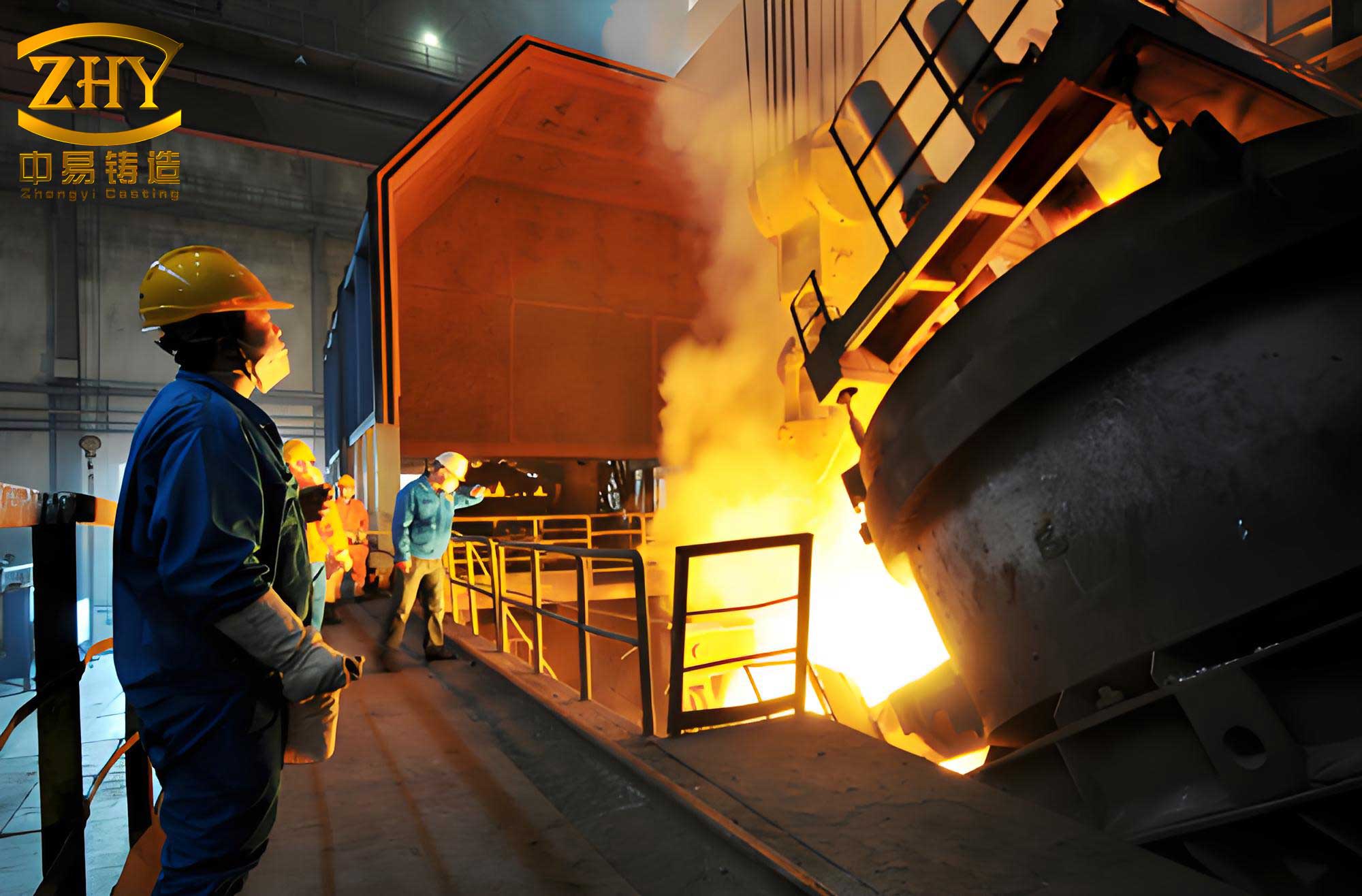
The core of the problem lies in the solidification dynamics of these cast iron parts. Heavy hot spots, often at junctions of walls, under bosses, or at the top of water jackets, solidify last. If the feeding path from the riser is not optimal or the riser itself lacks sufficient feeding pressure or volume, the liquid metal contraction during solidification cannot be compensated, resulting in internal voids. For pressurized components like engine blocks, these micro-shrinkages are primary causes of leakage failures. Over the years, I’ve seen various supplementary measures employed, such as stringent control of chemistry (particularly low lead levels), specialized inoculation practices, use of tellurium washes, or application of insulating riser sleeves. However, these often address the symptom rather than the root cause—the riser design itself.
My philosophy has shifted towards a more fundamental solution: optimizing the riser geometry and its connection to the casting to ensure directional solidification towards the riser and efficient transfer of feed metal. For cast iron parts, particularly those with lower shrinkage propensity like grey iron, the goal is not necessarily a large, classic side riser but a well-designed, efficient feeding channel that can also vent and act as a flow-off. Two riser types have proven exceptionally effective in this regard: the kiss (or press) riser and, more innovatively for complex geometries, the necking riser.
The Limitations of Traditional Approaches and the Case for Optimization
Before delving into optimized designs, it’s crucial to understand why standard practices fall short for central hot spots in cast iron parts. Traditional ear risers are often placed on the sides of a casting. Feeding a top-facing hot spot from a side riser requires a long, horizontal feeding path, which can easily be blocked by premature solidification, especially in thin-walled sections. Joint flash or vent risers, while excellent for gas escape, typically have a wide, flat connection that solidifies too quickly to act as an effective feeding channel.
The following table contrasts the key characteristics of traditional versus optimized riser designs for heavy hot spots:
| Feature | Traditional Ear/Joint Flash Riser | Optimized Kiss/Necking Riser |
|---|---|---|
| Primary Function | Venting, overflow, limited feeding | Targeted feeding, venting, overflow |
| Feeding Path | Often long and indirect | Short, direct, and controllable |
| Connection Geometry | Wide or variable, solidifies early | Designed narrow “neck,” delays seal-off |
| Applicability to Central Hot Spots | Poor (requires side access) | Excellent (can be placed directly on top) |
| Self-Regulating Capacity | Low | High (adaptive metal flow) |
| Sand Space Efficiency | Low (often large footprint) | High (compact, placed on casting) |
The fundamental principle guiding the optimized designs is to create a riser-casting junction that remains liquid longer than the surrounding hot spot, establishing a temperature gradient that draws feed metal from the riser reservoir. The required feed metal volume $V_{feed}$ can be approximated by:
$$V_{feed} = \varepsilon \cdot V_{hotspot}$$
where $\varepsilon$ is the volumetric shrinkage of the cast iron (typically 1-4% for grey iron, depending on carbon equivalent and cooling rate), and $V_{hotspot}$ is the volume of the heavy section. The riser must supply this volume before its neck solidifies.
The Kiss Riser: Simplicity and Effectiveness for Accessible Locations
For hot spots situated at the highest points or edges of a casting, the kiss riser is my first choice. Its design is elegantly simple—a riser placed directly on the casting with a narrow, linear contact (the “kiss” line). This configuration offers several advantages for producing sound cast iron parts. Firstly, it provides excellent feeding pressure due to the metallostatic head from the riser. Secondly, the narrow contact area creates a hot spot at the junction, delaying solidification and keeping the feeding channel open long enough to compensate for shrinkage in the casting section beneath it. Thirdly, it acts as an effective vent and an excellent receiver for first, cooler metal and slag.
The key design parameters for a kiss riser on cast iron parts are the contact length (L) and width (e). The contact length should be sufficient to cover the thermal center of the hot spot. The contact width, or “edge thickness,” is critical; it must be narrow enough to create the desired thermal concentration but wide enough to allow adequate feed metal flow. Based on my practice, the following formula provides a good starting point for grey iron castings:
$$e \approx (0.4 \text{ to } 0.6) \times d_{hotspot}$$
where $d_{hotspot}$ is the diameter of the inscribed thermal circle of the hot spot. Typically, ‘e’ is maintained between 8 mm and 15 mm. The riser volume itself should be 3 to 5 times the volume of the hot spot it is intended to feed, ensuring an adequate reservoir.
| Hot Spot Modulus $M_{hs}$ (cm) | Recommended Kiss Width $e$ (mm) | Riser Volume Multiplier |
|---|---|---|
| 1.0 – 1.5 | 8 – 10 | 3 – 4 |
| 1.5 – 2.0 | 10 – 12 | 4 – 5 |
| > 2.0 | 12 – 15 | 5 – 6 |
Application often requires minor mold modifications. For instance, when the hot spot is not on a flat top surface but adjacent to a core, a small extension or “step” can be added to the core print to create a localized high point where the kiss riser can be effectively placed. This technique has consistently yielded sound castings in problematic areas.
The Necking Riser: A Breakthrough for Complex, Central Hot Spots
Many of the most troublesome heavy sections in cylinder blocks are not at the periphery but buried in the central geometry, surrounded by thin walls and complex cores. Traditional risers cannot reach these areas. This is where the necking riser concept becomes invaluable. The core idea is to design a riser that sits on top of the mold cavity, connected to the isolated hot spot below through a specially designed, often narrow, “neck” formed by a small sand core. This creates a direct, vertical feeding path to the heart of the problem area in the cast iron parts.
The design is highly adaptable. The neck’s cross-sectional geometry is tailored to match the shape of the hot spot it feeds, which can be rectangular, circular, or an irregular (“follow-form”) shape. The design focuses on three main aspects: the riser body volume, the neck dimensions, and the small core geometry.
1. Riser Body Volume: The riser must contain enough liquid metal to feed the shrinkage of the hot spot. I size it using a modulus extension principle. The riser modulus $M_r$ should be greater than the hot spot modulus $M_{hs}$. A safe rule for cast iron parts is:
$$M_r > 1.2 \times M_{hs}$$
Given the riser volume $V_r$ and surface area $A_r$, its modulus is $M_r = V_r / A_r$. For a cylindrical riser, this simplifies calculations. The hot spot modulus is estimated from its geometry. The riser volume is typically 4 to 8 times the hot spot volume, providing a substantial safety factor.
2. Neck Design (The Critical Channel): The neck is the engineered gateway. Its width ‘e’ must be narrow enough to ensure it solidifies after the hot spot, creating the necessary directional solidification. However, it must be wide enough to allow sufficient metal flow for feeding. My empirical formula is:
$$e = k \cdot d_{hs}$$
where $d_{hs}$ is the characteristic dimension (diameter or thickness) of the hot spot, and $k$ is a factor between 0.25 and 0.33. In practice, ‘e’ is usually between 9 mm and 16 mm. The neck height ‘h’ is also critical; too short and it lacks thermal mass, too long and it becomes a riser itself. A height of 15 mm to 20 mm works well, acting as a small chiller that delays solidification at its root. The neck cross-sectional area $A_{neck}$ must satisfy the feeding flow requirement, which can be checked against Chvorinov’s rule for solidification time $t$:
$$t_{neck} \propto (V/A)_{neck}^2 > t_{hotspot} \propto (V/A)_{hotspot}^2$$
By designing $(V/A)_{neck}$ to be greater than $(V/A)_{hotspot}$, we ensure the neck stays open longer.
3. Small Core Design and Stabilization: The core that forms the neck must be precisely located and extremely stable. Any movement or displacement will scrap the casting. The core print must have a tight, secure fit in the mold with a clearance of only 0.1-0.15 mm. The core’s vertical location must be accurate to maintain consistent machining allowance on the cast iron part.
The following table summarizes the design logic for different hot spot geometries commonly found in cast iron parts like engine blocks:
| Hot Spot Geometry | Necking Riser Type | Neck Cross-Section | Key Design Rule | Typical Application |
|---|---|---|---|---|
| Rectangular (e.g., along a wall) | Single, Double, or Multi-neck | Rectangular slot(s) | Use multiple necks if $d_{hs}$ > 60mm. Neck width $e = d_{hs}/4$. | Top of thick deck sections, bulkheads. |
| Circular (e.g., under a boss) | Single or Dual Circular Neck | Circular or two circular holes | Neck diameter $D_n \approx 0.3 \cdot D_{hs}$. Dual neck for larger bosses. | Bolt boss pads, pushrod housings. |
| Irregular/Follow-form | Custom-shaped Neck | Matches hot spot contour | Maintain minimum neck width ‘e’ across the entire contact perimeter. | Junctions of crankcase walls, water jacket ends. |
The choice between a single, double, or multiple neck depends on the size and shape of the hot spot area. A single narrow neck is sufficient for a concentrated, circular hot spot. For an elongated rectangular hot spot, two or more necks distribute the feeding points more effectively, preventing isolated shrinkage between them. The width of the sand core between necks ‘k’ is kept between 8-12 mm to ensure core strength.
Practical Implementation and Synergistic Effects
Implementing these optimized risers often reveals synergistic benefits. For example, the necking riser provides an excellent vent for gases trapped in the upper reaches of complex sand cores, directly addressing another common defect source in cast iron parts. Furthermore, it serves as a perfect flow-off for cooler, potentially oxide-laden metal that arrives first at that high point during filling, improving overall casting integrity.
To enhance the efficiency of both kiss and necking risers, I frequently combine them with a simple practice: manually enlarging the top of the riser cavity in the mold pattern (or via a post-patternmaking operation). This increases the riser volume and its modulus without significantly increasing its footprint, improving its feeding capacity at a low cost. The enlarged top can be roughly shaped, as it will be removed during cleaning.
The success of this optimization is measured not just by the elimination of shrinkage defects, but also by improved yield. Because these risers are often smaller and more strategically placed than large conventional side risers, they reduce the amount of metal poured per casting that ends up as remelt scrap. For high-volume production of cast iron parts like cylinder blocks, this yield improvement translates directly to significant material and energy savings.
In conclusion, overcoming shrinkage in heavy sections of complex cast iron parts requires moving beyond traditional, generic riser designs. A targeted approach using kiss risers for accessible locations and innovatively designed necking risers for isolated, central hot spots provides a highly effective solution. This methodology focuses on controlling the solidification sequence by engineering the geometry of the feeding channel itself. The result is a robust process that consistently produces sound, leak-free castings while optimizing the use of materials. The principles of adaptive neck geometry, controlled modulus, and secure core design are universally applicable and have proven their worth across a wide range of challenging cast iron parts.