
The performance demands on casting parts for wind turbine applications are exceptionally stringent. These components, such as hubs, bedplates, and notably, torsion arms, are required to operate reliably in harsh, elevated environments for decades. Any compromise in their metallurgical integrity can lead to catastrophic failure, underscoring the critical role of material science in their manufacturing. My research focus lies in enhancing the properties of ductile iron, the material of choice for these critical casting parts, through meticulous control of its solidification microstructure.
The superior mechanical properties of ductile iron casting parts are intrinsically linked to the morphology and distribution of graphite nodules within the ferritic matrix. A high count of small, uniformly distributed, and spherical graphite nodules is paramount. These nodules act as intrinsic “cracks” that blunt propagating stress, significantly enhancing toughness and ductility. Conversely, irregular graphite shapes or low nodule counts can become stress concentrators, severely degrading performance, especially under dynamic or low-temperature loading conditions common in wind farm operations. Therefore, the quest for high-performance casting parts is fundamentally a quest for optimal graphite formation.
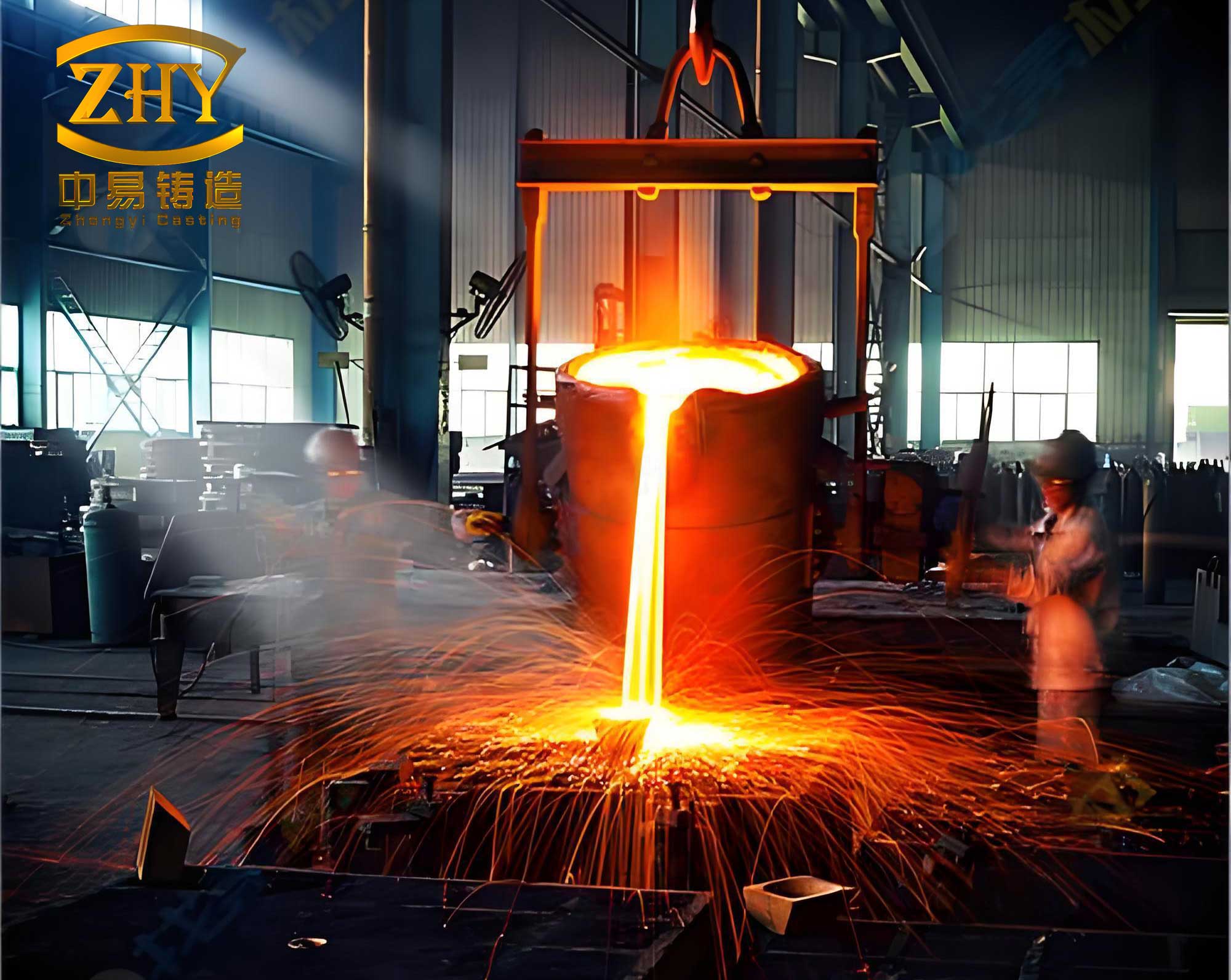
The primary tool for achieving this ideal microstructure is inoculation. Inoculation introduces foreign particles (e.g., from ferrosilicon-based alloys) into the melt that act as substrates for graphite nucleation, promoting the formation of numerous graphite nodules and preventing the undesired formation of carbides. However, a significant challenge in producing large, heavy-section casting parts is “fade” – the gradual loss of inoculation potency due to the dissolution and settling of inoculant particles over time. This is exacerbated by extended pouring sequences. In our production setup, we employ a quantitative ladle pouring system. While excellent for process control, the inherent time delay (approximately 1.5 minutes) for slag removal and pouring initiation creates a window where inoculation fade can occur. Our initial secondary inoculation practice involved adding fine-grade inoculant (0.2-0.8 mm) via a stream inoculation method at the beginning of the pour. Preliminary analysis revealed that this led to suboptimal graphite characteristics in the final casting parts, likely due to premature dissolution and fade before the bulk of the metal solidified.
This investigation details my systematic effort to optimize the secondary inoculation process specifically for the production of 5-ton QT400-18AL torsion arm casting parts. The core hypothesis was that modifying the inoculant characteristics and its method of addition could counteract fade, improve graphite nucleation efficiency, and thereby enhance the consistency and level of mechanical properties in these critical wind energy components.
1. Experimental Methodology and Material Basis
1.1 Materials and Melting Practice
The foundation for high-quality casting parts is laid with carefully selected charge materials. The melt was prepared in a medium-frequency induction furnace with a nominal capacity of 5 tons. The charge consisted of a blend of high-purity pig iron (Q10 grade), high-quality carbon steel, and carefully controlled returns (recycled material) to ensure consistent and low levels of trace elements detrimental to ductile iron, such as titanium, lead, and antimony. The target base composition was tailored for a fully ferritic grade with excellent low-temperature toughness.
The chemical compositions of the primary raw materials used are summarized in Table 1. This consistency in input materials is crucial for isolating the effect of the inoculation variable on the final casting parts.
| Material | C | Si | Mn | P | S | Mg | RE | Al | Ca | Ba | Fe |
|---|---|---|---|---|---|---|---|---|---|---|---|
| Q10 Pig Iron | 4.54 | 0.62 | 0.076 | 0.025 | 0.012 | – | – | – | – | – | Bal. |
| Carbon Steel | 0.04 | 0.01 | 0.222 | 0.014 | 0.006 | – | – | – | – | – | Bal. |
| 75SiFe | – | 75 | – | – | – | – | – | – | – | – | Bal. |
| Primary Inoculant (High-Ca/Ba) | – | 72.40 | – | – | – | – | – | 0.92 | 0.72 | 1.85 | Bal. |
| Secondary Inoculant (Si-Al) | – | 72.35 | – | – | – | – | – | 4.16 | 0.55 | – | Bal. |
The treatment process followed a standard sandwich method in a treatment ladle. The spheroidizing agent was a low-rare-earth Mg6RE alloy, added at 1.05 wt.%. Simultaneously, a primary inoculation was performed using a high-calcium/barium ferrosilicon inoculant (3-8 mm) at 0.35 wt.% to ensure initial nodule formation stability. The tapping temperature was tightly controlled at 1,470 °C.
1.2 Design of the Secondary Inoculation Trials
The variable under investigation was the secondary inoculation practice. Two distinct methods were employed on separate production heats, each producing 10 torsion arm casting parts.
- Process A (Baseline): This represented our standard practice. Secondary inoculation was achieved using a fine-grained (0.2-0.8 mm) silicon-aluminum inoculant, added at 0.20 wt.% via a calibrated feeder into the metal stream as it flowed from the treatment ladle into the quantitative pouring ladle (stream inoculation).
- Process B (Optimized): This was the proposed optimization. The secondary inoculant was switched to a coarse-grained (10-50 mm) silicon-aluminum alloy, maintaining the same addition rate of 0.20 wt.%. Instead of stream addition, this coarse inoculant was placed onto the surface of the molten iron in the receiving ladle after treatment. The metal was then transferred (“teemed”) into the quantitative pouring ladle, allowing for a more prolonged interaction and dissolution period during transfer and the subsequent holding period before pouring.
For both processes, the pouring temperature was maintained between 1,370-1,380 °C to ensure adequate fluidity for the large, complex casting parts.
1.3 Evaluation and Characterization
Each torsion arm casting was cast with an attached keel block (70 mm x 70 mm x 180 mm) to represent the properties of the casting part itself. From each of the 20 blocks (10 per process), samples were extracted for comprehensive analysis.
- Chemical Analysis: The final composition of each casting part was verified using optical emission spectrometry to ensure consistency across the trial.
- Mechanical Testing: Tensile tests were conducted at room temperature according to ASTM/ISO standards. Low-temperature Charpy V-notch impact tests were performed at -20 °C. Brinell hardness measurements were also taken.
- Metallographic Analysis: Samples were prepared for examination under an optical microscope. Unetched samples were used to evaluate graphite morphology: nodule count (per mm²), nodule size distribution, and spheroidization grade (according to ISO 945-4). Etched samples (using nital) were used to determine the matrix microstructure, specifically the volume fraction of ferrite and pearlite.
- Statistical Analysis: Data dispersion was analyzed using standard deviation and coefficient of variation (CV) to assess the process stability and consistency imparted to the casting parts.
2. Results and In-Depth Analysis
2.1 Chemical Consistency
Spectrometric analysis confirmed excellent control over the final melt chemistry for all casting parts produced under both Process A and B. Key elements for ferritic ductile iron were within the following narrow ranges, establishing a constant baseline for comparing inoculation effects:
$$ \text{C: } 3.85-3.87\%, \quad \text{Si: } 2.10-2.15\%, \quad \text{Mg: } 0.045-0.055\%, \quad \text{Mn: } 0.11-0.13\%, \quad \text{S: } <0.012\% $$
The consistency here is vital; it allows us to attribute differences in the properties of the final casting parts primarily to the changes in solidification structure induced by the inoculation practice.
2.2 Mechanical Performance of the Casting Parts
The average mechanical properties derived from the attached test blocks, which are indicative of the casting parts’ performance, are compiled in Table 2. A clear trend is observable.
| Process | Tensile Strength (MPa) | Yield Strength (MPa) | Elongation (%) | Hardness (HBW) | -20°C Impact Energy (J) |
|---|---|---|---|---|---|
| A (Baseline) | 374.7 | 233.3 | 26.15 | 139.0 | 13.22 |
| B (Optimized) | 379.2 | 237.9 | 24.75 | 140.4 | 13.20 |
| Difference (B-A) | +4.5 | +4.6 | -1.4 | +1.4 | -0.02 |
The optimized secondary inoculation (Process B) resulted in a consistent increase in strength properties for the casting parts: a +4.5 MPa gain in tensile strength and a +4.6 MPa gain in yield strength. Hardness showed a marginal increase. Interestingly, the elongation showed an average decrease of 1.4%, while the low-temperature impact toughness remained virtually identical. This trade-off hinted at a microstructural change—likely a refinement of the graphite structure which increases strength but can slightly reduce ductility if not perfectly uniform.
Beyond average values, the consistency of properties is paramount for reliable casting parts. Statistical analysis of the data dispersion provides crucial insights (Table 3). The Coefficient of Variation (CV) is a normalized measure of dispersion.
| Property | Process | Standard Deviation (σ) | Coefficient of Variation (CV%) | Interpretation for Casting Parts |
|---|---|---|---|---|
| Tensile Strength | A | 3.24 | 0.86 | Process B showed improved consistency. |
| B | 2.15 | 0.57 | ||
| Yield Strength | A | 2.87 | 1.23 | Process B showed significantly improved consistency. |
| B | 2.18 | 0.92 | ||
| Elongation | A | 0.88 | 3.36 | Process A was more consistent; B introduced higher variability. |
| B | 1.86 | 7.52 | ||
| -20°C Impact | A | 0.80 | 6.05 | Process B showed slightly improved consistency. |
| B | 0.71 | 5.38 | ||
| Hardness | A | 2.36 | 1.70 | Process B showed improved consistency. |
| B | 1.71 | 1.22 |
The data reveals a compelling narrative: Process B (Optimized) generally produced casting parts with more consistent strength, hardness, and impact properties, as evidenced by lower CV values. This suggests the coarse inoculant addition method provided a more stable and fade-resistant nucleation effect throughout the pouring sequence. However, the increased variability in elongation (higher CV for Process B) is a critical finding. It indicates that while the optimized process improved average strength and general consistency, it may have introduced less uniformity in the factors governing ductility across different regions of the large casting parts or between individual casts.
2.3 Microstructural Evolution in the Casting Parts
The explanation for the mechanical property shifts lies in the graphite microstructure. Metallographic analysis yielded the quantitative data shown in Table 4.
| Process | Avg. Nodule Count (nodules/mm²) | Spheroidization Grade (%) | Nodule Size (ISO Grade) | Matrix Structure |
|---|---|---|---|---|
| A (Baseline) | 135 | 95 | 5-6 | >95% Ferrite, <5% Pearlite |
| B (Optimized) | 177 | 95 | 5-6 | >95% Ferrite, <5% Pearlite |
| Difference | +42 | 0 | – | – |
The most significant outcome is the substantial 31% increase in graphite nodule count (from 135 to 177 nodules/mm²) achieved with Process B. This directly correlates with the observed increase in yield and tensile strength. According to classic theory, the yield strength of ductile iron can be related to the nodule count (N) and the mean free path in the ferrite matrix (λ). A simple relationship can be conceptualized:
$$ \sigma_y \propto \frac{1}{\lambda} $$
where the mean free path λ is inversely related to the nodule count and size. A higher nodule count refines the matrix structure, creating a shorter mean free path for dislocation movement, thereby increasing strength. The spheroidization quality remained excellent at 95% for both processes, confirming that the base treatment was sound.
However, a deeper look at the dispersion of the nodule count data is revealing. While the average increased, the standard deviation of the nodule count was higher for Process B (approximately ±20 nodules/mm²) compared to Process A (approximately ±15 nodules/mm²). This greater variability in microstructure aligns perfectly with the observed higher variability in elongation. Ductility is highly sensitive to local microstructural inhomogeneities. If some areas of the casting part have a very high nodule count and others are closer to the baseline, the overall elongation can average out, but its consistency from sample to sample suffers.
The mechanism behind these results can be theorized. In Process A, the fine inoculant dissolves rapidly and provides a large number of nuclei immediately, but these nuclei are susceptible to fading during the hold time in the pouring ladle. This leads to a moderate, somewhat more uniform but ultimately lower final nodule count in the casting parts. In Process B, the coarse inoculant dissolves more slowly and progressively. It acts as a sustained-release source of nuclei throughout the transfer and holding period, potentially providing nucleation sites at a later stage closer to the solidification of the casting part itself. This “late” nucleation boost increases the total nodule count. However, the dissolution and distribution of these large particles may be less uniform within the ladle, leading to greater spatial variation in effective inoculant concentration and, consequently, in the final nodule count within the casting parts. The effectiveness of this process can be modeled by considering the dissolution rate of a spherical particle, given approximately by:
$$ \frac{dm}{dt} = -k A (C_s – C_b) $$
where \( dm/dt \) is the dissolution rate, \( k \) is a mass transfer coefficient, \( A \) is the surface area of the inoculant particle, \( C_s \) is the silicon concentration at the particle surface (saturation), and \( C_b \) is the bulk silicon concentration. For a coarse particle (larger initial mass \( m_0 \) and smaller surface-area-to-volume ratio), the duration of silicon release is extended, potentially bridging the fade window.
3. Conclusion and Implications for Casting Parts Production
This systematic investigation into secondary inoculation optimization for heavy-section ductile iron casting parts yielded clear and actionable results:
- The optimized secondary inoculation process (coarse inoculant, ladle addition) successfully enhanced the key strength characteristics of the QT400-18AL casting parts, providing an average increase of ~4.5 MPa in both tensile and yield strength. This improvement is directly attributable to a significant 31% increase in the graphite nodule count, which refines the matrix structure.
- The process modification also improved the general consistency (reduced property scatter) for strength, hardness, and impact toughness across multiple production casts. This points to better resistance against inoculation fade, leading to more reliable and predictable performance in the final casting parts.
- A critical trade-off was identified: the increased nodule count and strength came with greater variability in ductility (elongation). The higher standard deviation in both elongation and nodule count for the optimized process suggests less uniform dissemination of nucleation sites. For casting parts subjected to complex, multi-axial stresses, consistency in ductility can be as important as the average value.
- The matrix microstructure remained overwhelmingly ferritic in all cases, ensuring the required low-temperature toughness was maintained. The low-temperature impact properties were not negatively affected by the optimization.
Forward Path for Premium Casting Parts: The optimization is a definitive success in countering fade and boosting strength. However, the challenge of achieving simultaneously high strength, high ductility, and exceptional microstructural uniformity in large casting parts remains. The next logical step is to refine Process B further. This could involve:
- Investigating an intermediate inoculant grain size (e.g., 2-10 mm) to balance sustained release with more rapid initial distribution.
- Optimizing the method of adding coarse inoculant to the ladle (e.g., placement, use of plunging bells, or protective shrouds) to ensure more consistent dissolution and distribution throughout the metal volume before it is cast into the final mold.
- Exploring the potential of compound inoculants combining different grain sizes or nucleation catalysts to provide both immediate and delayed nucleation effects.
The ultimate goal is a stable, predictable process that pushes the microstructure of these critical casting parts closer to the ideal defined by the highest grades in standards like ISO 945-4, ensuring every torsion arm—and by extension, every wind turbine—operates at peak reliability for its designed lifetime.