
In my extensive experience with foundry technologies, the lost foam casting process has emerged as a pivotal method for producing complex castings, particularly for box and shell components like transmission cases and compressor housings. This process, which involves embedding a foam pattern in unbonded sand and replacing it with molten metal, offers distinct advantages over traditional sand casting, such as reduced labor for core assembly and lower environmental impact from binders. However, the success of the lost foam casting process heavily relies on the design and materials of the gating system, which directs metal flow into the mold. Over the years, I have witnessed a significant evolution in gating materials—from solid foam to ceramic tubes—and now, the advent of paper sprue tubes represents a groundbreaking advancement. This article delves into the superiority of paper sprue technology in the lost foam casting process, highlighting its benefits through detailed analysis, tables, and formulas to underscore its role in enhancing casting quality, sustainability, and efficiency.
The lost foam casting process is characterized by rapid filling and stable mold filling to ensure complete part formation. In this process, the foam pattern vaporizes upon contact with molten metal, and the gating system must facilitate smooth metal flow while managing the byproducts of foam decomposition. Key parameters include filling velocity, foam pyrolysis rate, and venting of gases. For instance, the metal flow rate \( Q \) in the gating system can be expressed as \( Q = A \cdot v \), where \( A \) is the cross-sectional area of the sprue and \( v \) is the flow velocity. To prevent defects like mistruns or gas porosity, the filling speed must align with the foam’s thermal degradation. The pyrolysis rate \( r \) of the foam can be modeled using the Arrhenius equation: \( r = k e^{-E/RT} \), where \( k \) is a pre-exponential factor, \( E \) is the activation energy, \( R \) is the universal gas constant, and \( T \) is the temperature. Optimizing these factors is critical, and the gating material plays a crucial role in maintaining thermal balance and minimizing turbulence.
Historically, gating systems in the lost foam casting process were crafted from solid foam sheets, but these led to issues like excessive gas generation and “backfire” during pouring. The transition to hollow gating systems, first with foam and then ceramic tubes, aimed to reduce gas evolution. Ceramic tubes offered high refractoriness and erosion resistance, but they were brittle, prone to damage, and often bonded with molten metal, increasing waste. In contrast, paper sprue tubes, developed through collaborative research, present a superior alternative. These tubes are manufactured from pulp fibers, high-temperature resistant materials, binders, and additives, formed under pressure in specialized molds and dried to create hollow, lightweight components. Their composition ensures durability and ease of use, making them ideal for the dynamic conditions of the lost foam casting process.
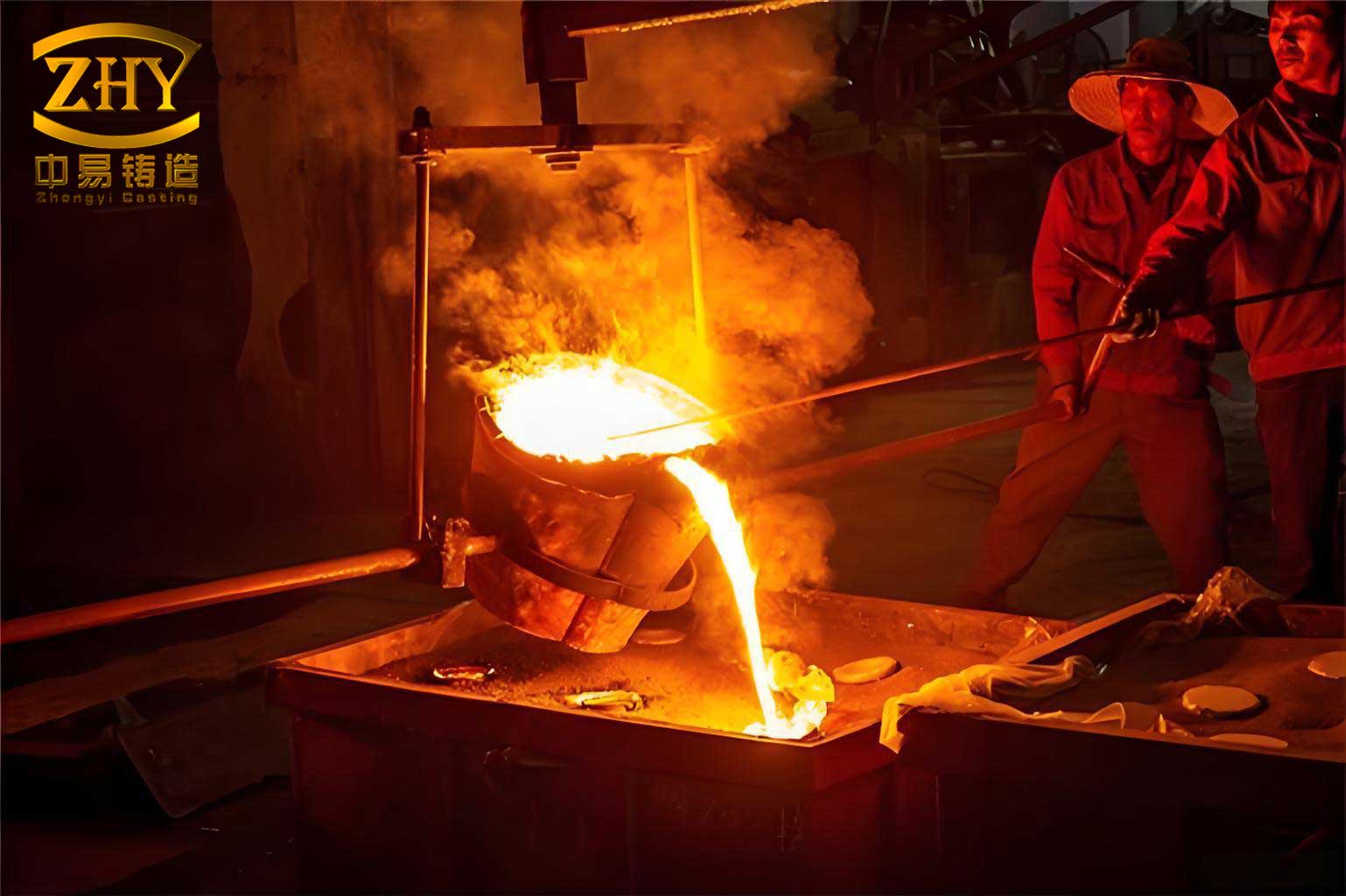
The application of paper sprue tubes in the lost foam casting process begins with gating system design. Based on principles similar to traditional sand casting, the cross-sectional area of the ingate is determined first, followed by the runner and sprue dimensions. However, the lost foam casting process demands faster pouring to match foam decomposition. The relationship can be summarized with the formula for filling time \( t \): \( t = \frac{V}{Q} \), where \( V \) is the mold cavity volume. Using paper sprue tubes, the reduced weight and improved connectivity help maintain a consistent flow, minimizing turbulence. The tubes are easily cut and assembled via socket connections, allowing for flexible configurations with elbows, tees, and reducers. This adaptability is vital for complex castings in the lost foam casting process, where precise metal delivery is essential to avoid defects like sand inclusion or cold shuts.
To illustrate the advantages of paper sprue tubes over previous materials, consider the following comparison table, which summarizes key properties relevant to the lost foam casting process:
| Property | Solid Foam Gating | Ceramic Sprue Tubes | Paper Sprue Tubes |
|---|---|---|---|
| Weight | Light but gas-prone | Heavy (~10× paper) | Very light |
| Refractoriness | Low (decomposes) | High | High |
| Erosion Resistance | Poor | Excellent | Excellent |
| Installation Ease | Moderate (cutting needed) | Complex (requires bonding) | Easy (plug-and-play) |
| Solid Waste Post-Casting | High (foam residue) | High (metal adhesion) | Low (easy removal) |
| Environmental Impact | High (VOCs from foam) | Moderate (ceramic disposal) | Low (biodegradable) |
| Cost Efficiency | Low (defect rates) | Moderate (fragility) | High (reusable aspects) |
From this table, it is evident that paper sprue tubes excel in multiple facets, directly benefiting the lost foam casting process by reducing defects and enhancing sustainability. The lightweight nature of paper tubes, for example, minimizes handling fatigue and allows for quicker assembly. In terms of thermal performance, the high refractoriness can be quantified through the material’s thermal conductivity \( k \) and specific heat capacity \( c_p \), which influence heat loss during pouring. The heat transfer equation \( q = -k \nabla T \) shows that paper’s insulating properties help maintain metal fluidity, crucial for thin-walled castings in the lost foam casting process.
One of the most significant advantages of paper sprue tubes in the lost foam casting process is their resistance to carbon pick-up. In ceramic tubes, interactions with molten iron can lead to carburization, affecting the final casting’s metallurgy. This can be described using Fick’s law of diffusion: \( J = -D \frac{\partial C}{\partial x} \), where \( J \) is the diffusion flux, \( D \) is the diffusion coefficient, and \( \frac{\partial C}{\partial x} \) is the concentration gradient. Paper tubes, being inert, prevent such reactions, ensuring consistent material properties. Moreover, the reduction in solid waste aligns with green manufacturing goals. After pouring, paper tubes become friable and easy to strip, unlike ceramic tubes that often fuse with metal. The waste volume \( W \) can be approximated as \( W = \rho \cdot V_{\text{tube}} \), where \( \rho \) is density and \( V_{\text{tube}} \) is volume; paper’s lower density results in less disposal mass, supporting circular economy principles in the lost foam casting process.
In practice, the integration of paper sprue tubes into the lost foam casting process has shown remarkable results. For instance, in producing large loader gearbox castings, workers report easier installation and reduced incidence of “backfire.” This safety improvement stems from the tubes’ ability to withstand initial metal impact without excessive gas generation. The gating system’s performance can be evaluated using fluid dynamics formulas, such as the Bernoulli equation for incompressible flow: \( P_1 + \frac{1}{2}\rho v_1^2 + \rho g h_1 = P_2 + \frac{1}{2}\rho v_2^2 + \rho g h_2 \), where \( P \) is pressure, \( \rho \) is density, \( v \) is velocity, \( g \) is gravity, and \( h \) is height. Paper tubes’ smooth interiors promote laminar flow, reducing pressure drops and turbulence that could otherwise cause mold collapse or slag entrapment in the lost foam casting process.
Furthermore, the economic benefits of paper sprue tubes are substantial. By lowering rejection rates, they enhance productivity in the lost foam casting process. The defect reduction rate \( \Delta D \) can be expressed as \( \Delta D = D_{\text{old}} – D_{\text{new}} \), where \( D_{\text{old}} \) and \( D_{\text{new}} \) are defect percentages with ceramic and paper tubes, respectively. Field data suggest \( \Delta D \) can exceed 15% for complex castings. Additionally, the ease of recycling paper tubes—often made from renewable resources—reduces raw material costs. A lifecycle assessment might use formulas like the environmental impact score \( E = \sum (m_i \cdot e_i) \), where \( m_i \) is mass of material \( i \) and \( e_i \) is its impact factor; paper tubes score lower due to biodegradability and lower energy consumption in production.
However, the lost foam casting process with paper sprue tubes still faces challenges, such as enhancing slag trapping capability. Future improvements could involve modifying tube geometry or adding filter elements. The efficiency of slag capture \( \eta \) might be modeled as \( \eta = 1 – \frac{C_{\text{out}}}{C_{\text{in}}} \), where \( C_{\text{in}} \) and \( C_{\text{out}} \) are impurity concentrations at entry and exit. Research into multi-layered paper composites could yield better filtration without compromising flow. Another area is optimizing tube dimensions for specific alloys; for example, the sprue diameter \( d \) can be derived from Chvorinov’s rule for solidification time \( t_s = k \left( \frac{V}{A} \right)^2 \), where \( k \) is a constant, \( V \) is volume, and \( A \) is surface area. Adjusting \( d \) to control cooling rates can minimize shrinkage defects in the lost foam casting process.
To further elucidate the technical aspects, consider the following table summarizing key formulas and their relevance to the lost foam casting process with paper sprue tubes:
| Formula | Description | Application in Lost Foam Casting |
|---|---|---|
| \( Q = A \cdot v \) | Flow rate in gating system | Determines sprue size for rapid filling |
| \( r = k e^{-E/RT} \) | Foam pyrolysis rate | Ensures synchronization with metal flow |
| \( t = \frac{V}{Q} \) | Filling time | Optimized to prevent cold shuts |
| \( J = -D \frac{\partial C}{\partial x} \) | Diffusion law for carbon pick-up | Highlights paper’s inertness |
| \( q = -k \nabla T \) | Heat conduction | Paper’s insulation preserves metal temperature |
| \( \eta = 1 – \frac{C_{\text{out}}}{C_{\text{in}}} \) | Slag capture efficiency | Target for future paper tube designs |
The widespread adoption of paper sprue tubes in the lost foam casting process is driven by their alignment with modern manufacturing trends toward lightweight, eco-friendly solutions. As industries demand higher precision and lower environmental footprint, this technology offers a viable path. In my observations, foundries that switch to paper tubes report not only better casting quality but also improved worker safety and reduced cleanup time. The lost foam casting process, with its unique challenges, benefits immensely from such material innovations. For example, the reduction in “backfire” incidents can be quantified through risk assessment models, where the probability \( P \) of an event is reduced by factors like better gas venting from paper tubes.
Looking ahead, the evolution of paper sprue technology will likely focus on enhancing performance metrics. Potential developments include smart tubes with embedded sensors to monitor temperature and flow in real-time during the lost foam casting process. This could integrate with Industry 4.0 frameworks, using data analytics to predict defects. The overall impact on the lost foam casting process can be summarized through a holistic efficiency metric \( E_{\text{total}} = \alpha \cdot Q_{\text{quality}} + \beta \cdot E_{\text{env}} + \gamma \cdot C_{\text{cost}} \), where \( \alpha, \beta, \gamma \) are weighting factors for quality, environmental, and cost dimensions. Paper sprue tubes score high across all, underscoring their transformative potential.
In conclusion, the integration of paper sprue tubes into the lost foam casting process marks a significant leap forward in foundry technology. From their lightweight and easy installation to their high refractoriness and environmental benefits, these tubes address longstanding issues in gating system design. Through detailed analysis with tables and formulas, I have highlighted how they improve metal flow, reduce defects, and support sustainable practices. While challenges like slag control remain, ongoing research promises further refinements. The lost foam casting process, as a critical method for complex castings, stands to gain immensely from this innovation, driving the industry toward greener, more efficient production. As we continue to refine these materials, the future of casting looks brighter, with paper sprue tubes at the forefront of this evolution.