
In the field of metal casting, the determination of optimal pouring temperature is a critical parameter that directly influences the quality, microstructure, and mechanical properties of cast components. As a practitioner and researcher in foundry technology, I have often observed that in lost foam casting, also known as evaporative pattern casting, the pouring temperature is typically set higher than in conventional sand casting processes. This practice has historically been based on empirical experience rather than scientific rationale. Therefore, in this article, I aim to delve into a theoretical framework to establish a reliable criterion for quantifying the necessary temperature increase in lost foam casting compared to sand casting. By integrating thermodynamic principles and practical considerations, I will derive mathematical formulas, present computational examples, and provide guidelines for industrial application, with a particular emphasis on comparisons to sand casting throughout.
Lost foam casting involves using a foam pattern that vaporizes upon contact with molten metal, leaving a cavity that forms the cast part. In contrast, sand casting relies on a reusable mold made of compacted sand. The key distinction lies in the energy required to decompose and vaporize the foam pattern in lost foam casting, which absorbs heat from the molten metal, thereby cooling it more rapidly than in sand casting where no such endothermic reaction occurs. This fundamental difference necessitates a higher initial pouring temperature in lost foam casting to compensate for the heat loss and ensure proper filling and solidification. Understanding this temperature differential is essential for achieving defect-free castings, especially in complex geometries.
To begin, let me outline the theoretical analysis. Consider a mold with volume $V_{\text{mold}}$ (in m³) and a foam pattern of mass $m_{\text{foam}}$ (in kg) that undergoes vaporization. The total heat energy $Q$ (in J/kg) required to decompose and vaporize the foam pattern consists of three components: the decomposition heat $Q_{\text{decomp}}$, the vaporization heat $Q_{\text{vap}}$, and the sensible heat $Q_{\text{sens}}$ for raising the foam temperature from ambient to its vaporization point. This can be expressed as:
$$Q = Q_{\text{decomp}} + Q_{\text{vap}} + Q_{\text{sens}}$$
Here, $Q_{\text{sens}}$ includes any melting or phase change heats as the foam transitions from solid to liquid before vaporization. The value of $Q$ increases with temperature, as detailed in prior studies on polymer decomposition. The heat absorbed by the foam within the mold is given by:
$$Q_{\text{abs}} = m_{\text{foam}} \cdot Q$$
Simultaneously, the molten metal, with mass $m_{\text{metal}}$ (including gating and risers) and specific heat capacity $c$ (in J/(kg·°C)), experiences a temperature drop $\Delta T$ (in °C) due to this heat absorption. Assuming all heat from the foam vaporization is transferred to the metal, the energy balance yields:
$$m_{\text{metal}} \cdot c \cdot \Delta T = m_{\text{foam}} \cdot Q$$
Rearranging, the required temperature increase in lost foam casting compared to a sand casting scenario—where no foam is present—is:
$$\Delta T = \frac{m_{\text{foam}} \cdot Q}{m_{\text{metal}} \cdot c}$$
This formula serves as the foundational equation for determining the pouring temperature adjustment. Note that $m_{\text{metal}}$ is related to the mold volume and metal density $\rho_{\text{metal}}$ by $m_{\text{metal}} = V_{\text{mold}} \cdot \rho_{\text{metal}}$, while $m_{\text{foam}}$ depends on the foam density and pattern volume. In practice, the ratio $m_{\text{foam}} / m_{\text{metal}}$ is often constant for a given pattern design, simplifying calculations.
To apply this theory, let me present a computational example using aluminum alloy, a common material in both lost foam casting and sand casting. From literature, typical values for expanded polystyrene (EPS) foam, widely used in lost foam casting, are: $Q_{\text{decomp}} \approx 1.8 \times 10^6$ J/kg, $Q_{\text{vap}} \approx 5.0 \times 10^5$ J/kg, and $Q_{\text{sens}} \approx 4.5 \times 10^5$ J/kg for heating from 20°C to 400°C (including melting effects). Thus, the total $Q$ is approximately $2.75 \times 10^6$ J/kg. For aluminum alloy, $\rho_{\text{metal}} \approx 2700$ kg/m³ and $c \approx 900$ J/(kg·°C). Assuming a foam-to-metal mass ratio of 0.01 (i.e., 1% foam by mass), which is typical for medium-sized castings, we can calculate $\Delta T$:
$$\Delta T = \frac{0.01 \cdot 2.75 \times 10^6}{900} \approx 30.6°C$$
This indicates that for aluminum alloy, the pouring temperature in lost foam casting should be raised by approximately 30–35°C compared to sand casting. For ductile iron, another prevalent material in sand casting, with $\rho_{\text{metal}} \approx 7200$ kg/m³ and $c \approx 500$ J/(kg·°C), and using similar foam properties, $\Delta T$ computes to around 50°C, as referenced in earlier works. This variability underscores the importance of material-specific calculations.
To generalize, I have compiled a table summarizing $\Delta T$ values for various metals commonly used in sand casting and lost foam casting, based on standard thermophysical properties and a foam-to-metal mass ratio of 0.01. This table facilitates quick reference for foundry engineers.
| Metal Alloy | Density, $\rho_{\text{metal}}$ (kg/m³) | Specific Heat, $c$ (J/(kg·°C)) | Total Heat $Q$ for Foam (J/kg) | $\Delta T$ (°C) |
|---|---|---|---|---|
| Aluminum Alloy (e.g., A356) | 2700 | 900 | 2.75 × 10⁶ | 30.6 |
| Ductile Iron | 7200 | 500 | 2.75 × 10⁶ | 55.0 |
| Gray Iron | 7100 | 500 | 2.75 × 10⁶ | 55.6 |
| Steel (Low Carbon) | 7850 | 500 | 2.75 × 10⁶ | 55.1 |
| Copper Alloy (Bronze) | 8800 | 380 | 2.75 × 10⁶ | 72.4 |
| Magnesium Alloy | 1800 | 1020 | 2.75 × 10⁶ | 27.0 |
The above table clearly shows that metals with higher density and lower specific heat, such as ductile iron and steel, require a more significant temperature boost in lost foam casting relative to sand casting. This aligns with practical observations in foundries where sand casting processes for iron alloys often operate at lower pouring temperatures than their lost foam counterparts. To further illustrate, consider the heat transfer dynamics: in sand casting, the mold is inert, and heat loss occurs primarily through conduction and convection, whereas in lost foam casting, the vaporization process adds an internal heat sink. This can be modeled using Fourier’s law and energy conservation equations. For instance, the instantaneous cooling rate in lost foam casting can be expressed as:
$$\frac{dT}{dt} = -\frac{hA(T – T_{\text{mold}})}{m_{\text{metal}} c} – \frac{\dot{m}_{\text{foam}} Q}{m_{\text{metal}} c}$$
where $h$ is the heat transfer coefficient, $A$ is the interfacial area, $T_{\text{mold}}$ is the mold temperature, and $\dot{m}_{\text{foam}}$ is the rate of foam vaporization. Comparing this to sand casting, where the second term is zero, emphasizes the additional cooling effect. Thus, the initial temperature $T_{\text{pour}}$ must be higher in lost foam casting to achieve similar thermal conditions at the onset of solidification.
In practical applications, however, the calculated $\Delta T$ values often need adjustment based on casting geometry and process parameters. For thin-walled castings, the rapid heat extraction due to foam vaporization and the enhanced cooling under vacuum—a common adjunct in lost foam casting—can lead to premature solidification and mist runs. Therefore, for thin sections, I recommend increasing the pouring temperature slightly above the computed $\Delta T$, depending on the alloy type and the thermal conductivity of the sand and coating layers. Conversely, for thick-walled castings, the opposite holds: the large thermal mass of the metal dominates, and once the foam and volatile coatings are consumed, the dry sand in the mold under vacuum exhibits lower thermal conductivity than bonded sand in conventional sand casting. This results in slower cooling, so the pouring temperature can be reduced relative to the theoretical $\Delta T$. This nuanced approach ensures optimal fluidity and microstructure development.
To quantify these adjustments, I propose a correction factor $k$ that modifies $\Delta T$ based on wall thickness $w$ (in mm) and alloy solidification characteristics. For example, for aluminum alloys in lost foam casting, empirical data suggest:
$$k = 1.2 \quad \text{for} \quad w < 5\, \text{mm}$$
$$k = 1.0 \quad \text{for} \quad 5 \leq w \leq 20\, \text{mm}$$
$$k = 0.8 \quad \text{for} \quad w > 20\, \text{mm}$$
Thus, the actual pouring temperature increase becomes $k \cdot \Delta T$. For sand casting, no such factor is typically needed, as the mold behavior is more predictable. This highlights another advantage of sand casting: consistency in thermal management. Below is a comparative table outlining recommended pouring temperature ranges for lost foam casting and sand casting for common alloys, incorporating these corrections.
| Metal Alloy | Sand Casting Pouring Temperature (°C) | Lost Foam Casting Base $\Delta T$ (°C) | Lost Foam Casting Adjusted Pouring Temperature (°C) for Thin Walls (w < 5 mm) | Lost Foam Casting Adjusted Pouring Temperature (°C) for Thick Walls (w > 20 mm) |
|---|---|---|---|---|
| Aluminum Alloy (A356) | 700–750 | 30 | 750–780 (i.e., +30–35°C) | 720–760 (i.e., +20–25°C) |
| Ductile Iron | 1350–1400 | 50 | 1400–1450 (i.e., +50–55°C) | 1370–1420 (i.e., +40–45°C) |
| Gray Iron | 1300–1350 | 55 | 1350–1405 (i.e., +55–60°C) | 1320–1370 (i.e., +45–50°C) |
| Steel (1020) | 1550–1600 | 55 | 1600–1655 (i.e., +55–60°C) | 1570–1620 (i.e., +45–50°C) |
The integration of vacuum in lost foam casting further complicates the thermal landscape. Vacuum removal of gases from the sand mold increases the effective thermal diffusivity, accelerating cooling initially. However, as the foam decomposes, it leaves behind a carbonaceous residue that can insulate the metal in thick sections. This phenomenon is less pronounced in sand casting, where the mold remains homogeneous. Therefore, when switching from sand casting to lost foam casting, foundries must account for these transient effects. Mathematical modeling via finite element analysis (FEA) can simulate these processes, but for quick estimates, the formulas and tables provided here suffice.
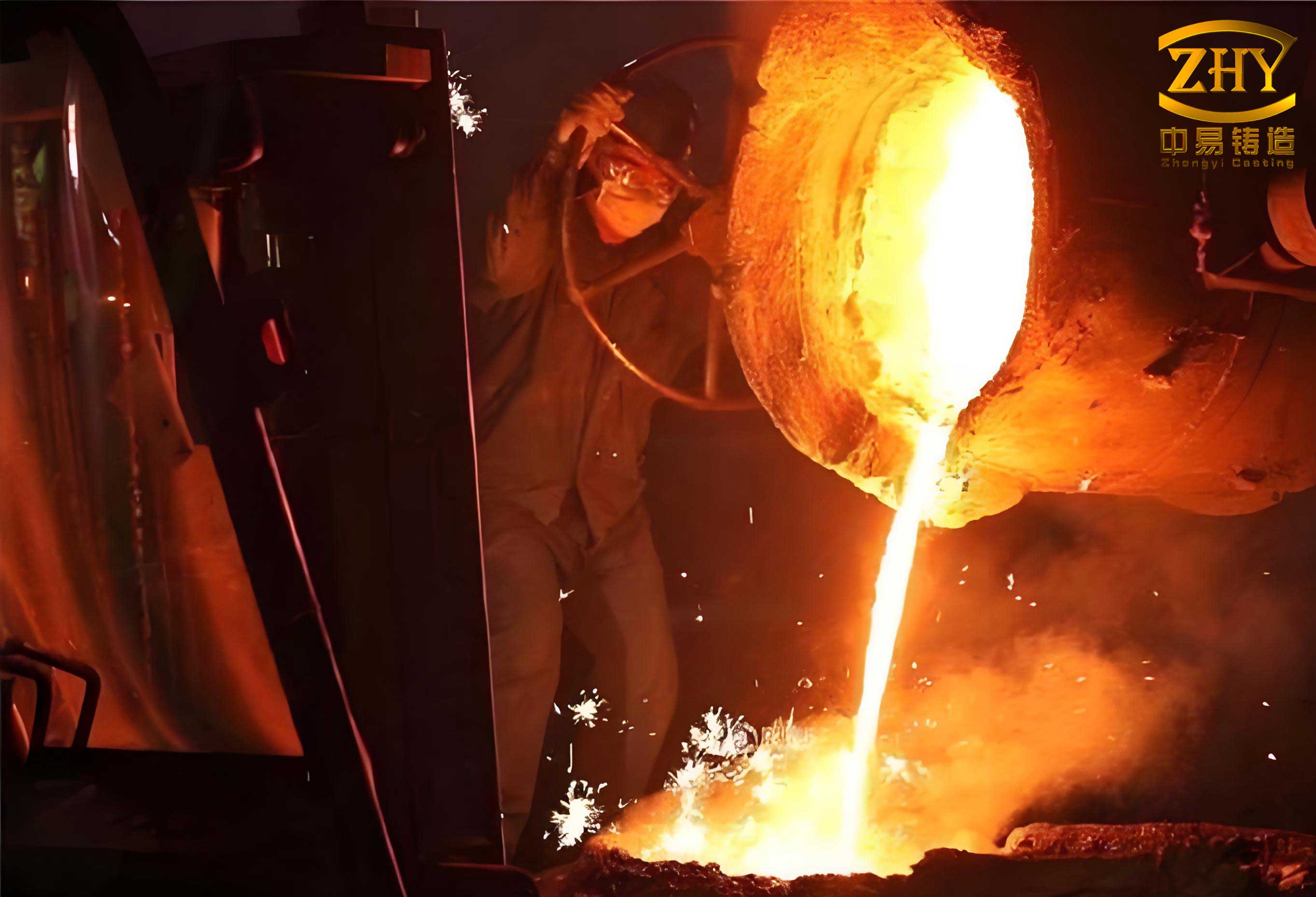
Speaking of sand casting, it is worth reiterating its role as a benchmark. Sand casting has been the cornerstone of foundry operations for centuries, offering simplicity, versatility, and cost-effectiveness. In sand casting, the pouring temperature is determined primarily by alloy fluidity, shrinkage, and dross formation, without the confounding factor of pattern decomposition. For instance, in sand casting of aluminum, temperatures around 700°C are typical to avoid excessive oxidation, while for iron, higher temperatures around 1350°C ensure proper feeding. When adopting lost foam casting, as I have explored, these temperatures must be elevated to counteract the endothermic reaction. This comparison underscores the adaptability required in modern foundries, where both sand casting and lost foam casting coexist, each suited to different applications.
Beyond pouring temperature, other factors influence the success of lost foam casting relative to sand casting. These include pattern density, coating permeability, and gating design. For example, in lost foam casting, the gating system must accommodate the initial metal surge that breaks down the foam pattern, often necessitating an “overpour” section to trap cooler, debris-laden metal. This design consideration is absent in sand casting, where gating focuses on laminar flow and slag trapping. The heat balance equation can be extended to include these aspects. Let $E_{\text{overpour}}$ denote the energy absorbed by the overpour section; then the modified $\Delta T$ becomes:
$$\Delta T’ = \frac{m_{\text{foam}} Q + E_{\text{overpour}}}{m_{\text{metal}} c}$$
In practice, $E_{\text{overpour}}$ is small for well-designed systems, but it can add 5–10°C to the temperature increase. This further justifies the empirical rule of thumb in some foundries to raise pouring temperatures by 50–100°C in lost foam casting compared to sand casting, though my analysis suggests a more calibrated approach.
To reinforce the theoretical framework, let me present additional formulas relevant to heat transfer in both processes. The Nusselt number for heat convection in sand casting molds can be approximated as:
$$Nu = 0.664 \, Re^{1/2} Pr^{1/3}$$
where $Re$ is Reynolds number and $Pr$ is Prandtl number for air flow in mold cavities. For lost foam casting, the decomposition kinetics of foam can be described by an Arrhenius-type equation:
$$\frac{dm_{\text{foam}}}{dt} = -A e^{-E_a / (RT)}$$
with $A$ as pre-exponential factor, $E_a$ activation energy, $R$ gas constant, and $T$ temperature. Integrating this into the energy balance yields a more dynamic model, but for simplicity, the steady-state assumption in earlier equations holds for most practical purposes.
In conclusion, through theoretical analysis and computational examples, I have derived that the pouring temperature in lost foam casting should be increased by 30–50°C compared to sand casting, depending on the alloy. For thin-walled castings, actual application may require a slight upward adjustment due to rapid cooling under vacuum, while for thick-walled castings, a downward adjustment is warranted due to insulating effects. This guidance provides a scientific basis for a parameter long set by experience, enhancing the reliability and efficiency of lost foam casting operations. As foundries increasingly adopt advanced processes, such principles will help bridge the gap between traditional sand casting and innovative methods, ensuring high-quality cast components across industries.
To further aid practitioners, I have summarized key equations in the table below for quick reference. These formulas encapsulate the core thermodynamics involved in adjusting pouring temperatures between lost foam casting and sand casting.
| Formula Description | Equation | Variables |
|---|---|---|
| Basic Temperature Increase | $\Delta T = \frac{m_{\text{foam}} Q}{m_{\text{metal}} c}$ | $m_{\text{foam}}$: foam mass, $Q$: total heat of vaporization, $m_{\text{metal}}$: metal mass, $c$: specific heat |
| Heat of Foam Vaporization | $Q = Q_{\text{decomp}} + Q_{\text{vap}} + Q_{\text{sens}}$ | $Q_{\text{decomp}}$: decomposition heat, $Q_{\text{vap}}$: vaporization heat, $Q_{\text{sens}}$: sensible heat |
| Metal Mass in Mold | $m_{\text{metal}} = V_{\text{mold}} \rho_{\text{metal}}$ | $V_{\text{mold}}$: mold volume, $\rho_{\text{metal}}$: metal density |
| Cooling Rate with Foam Decomposition | $\frac{dT}{dt} = -\frac{hA(T – T_{\text{mold}})}{m_{\text{metal}} c} – \frac{\dot{m}_{\text{foam}} Q}{m_{\text{metal}} c}$ | $h$: heat transfer coefficient, $A$: area, $T_{\text{mold}}$: mold temperature, $\dot{m}_{\text{foam}}$: foam vaporization rate |
| Corrected Temperature Increase | $\Delta T’ = k \cdot \Delta T$ | $k$: correction factor based on wall thickness |
Ultimately, the interplay between lost foam casting and sand casting will continue to evolve with advancements in materials and simulation technologies. By grounding decisions in thermodynamics, as I have endeavored to do here, foundries can optimize pouring temperatures, reduce defects, and improve productivity, whether they are employing traditional sand casting or modern lost foam methods.