
In the realm of modern foundry engineering, the production of large and intricate cast iron parts presents significant challenges, particularly in controlling solidification behavior, minimizing defects, and optimizing post-casting processes. As a researcher deeply involved in this field, I have extensively utilized computer-aided engineering (CAE) simulations to address these issues, focusing on practical applications that enhance the manufacturing of cast iron parts. This article delves into my experiences and methodologies in employing casting simulation software, specifically ADSTEFAN, to predict and optimize key aspects such as shake-out timing, heat treatment temperature distributions, and residual stress estimation for large complex cast iron parts. The goal is to demonstrate how simulation tools can be extended beyond conventional uses to deliver tangible benefits in industrial settings, ensuring higher quality and efficiency in producing cast iron parts.
The foundation of my work lies in the integration of three-dimensional computer-aided design (3D CAD) models with advanced simulation capabilities. Typically, I create detailed models of cast iron parts and their gating systems using CAD software, exporting them in STL format for import into ADSTEFAN. This software automatically meshes the models into finite difference grids, allowing for comprehensive fluid flow and solidification analyses. However, my approach extends the standard functionality by continuing solidification calculations beyond 100% solidification rates until specified times, enabling predictions for cooling, heat treatment, and stress-related phenomena. This expanded method forms the core of my practical research, as detailed in the following sections, which include tables and formulas to summarize key findings and methodologies. Throughout this discussion, I emphasize the application to cast iron parts, highlighting how simulation-driven insights can mitigate common production issues.
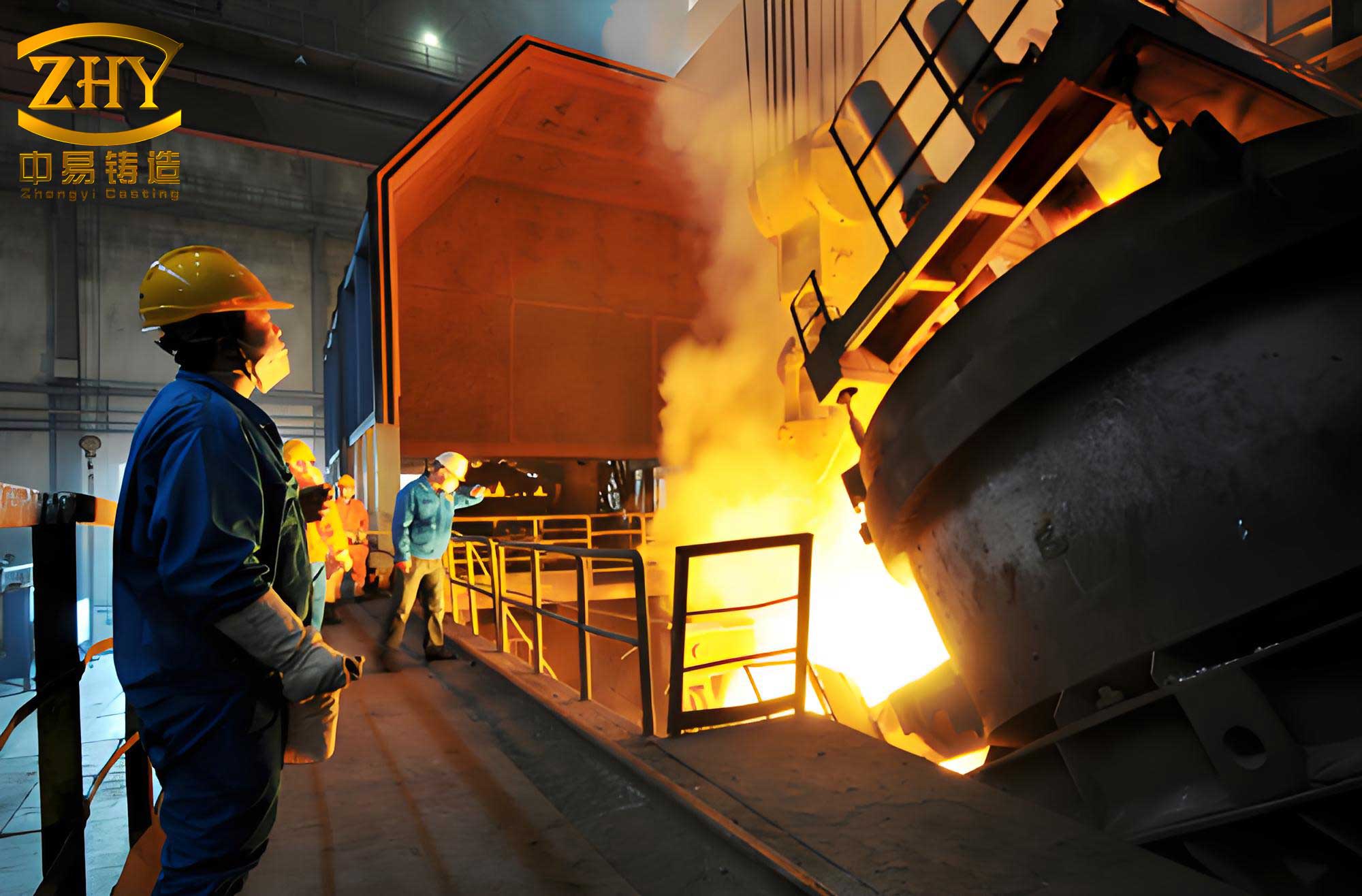
One of the most critical aspects in producing large cast iron parts is determining the optimal shake-out timing, as premature removal from molds can lead to cracking and distortions due to uneven cooling. In my research, I focused on a massive marine engine cylinder block, a gray iron casting weighing approximately 40 tons, with wall thicknesses exceeding 300 mm. Traditionally, such cast iron parts required extended cooling periods of 7 to 9 days before shake-out, significantly prolonging production cycles. To optimize this, I set a target of cooling for 5 days until the thickest surface temperature dropped below 350°C, based on empirical knowledge to prevent thermal stresses. Using ADSTEFAN’s solidification analysis with extended computation, I simulated the cooling process, initially verifying material property accuracy by comparing calculated and measured temperatures. The standard database properties were adjusted to match real-world conditions, as summarized in Table 1, which lists the physical parameters used for the simulation of cast iron parts and molding materials.
| Material | Density (kg/m³) | Thermal Conductivity (W/m·K) | Specific Heat Capacity (kJ/kg·K) | Latent Heat (kJ/kg) | Liquidus Temperature (°C) | Solidus Temperature (°C) | Initial Temperature (°C) |
|---|---|---|---|---|---|---|---|
| Cast Iron | 7000 | 29.3 | 0.837 | 209 | 1180 | 1140 | 1350 |
| Resin Sand | 1500 | 0.418 | 1.13 | – | – | – | 20 |
The simulation results revealed that after two days of cooling, heat dissipation from the sand mold became sluggish, hindering temperature reduction. To achieve the 5-day target, I explored methods to enhance heat removal, such as increasing the sand’s thermal conductivity by 50%. However, modifying resin sand composition proved impractical. Instead, I proposed inserting steel cooling plates into the mold at a distance d from the casting surface. Through iterative simulations, I derived an optimal distance of d = 50 mm, which successfully reduced the cooling time to 5 days while maintaining surface temperatures below 350°C. This approach can be generalized using heat transfer principles, where the temperature distribution in the mold follows Fourier’s law: $$ \frac{\partial T}{\partial t} = \alpha \nabla^2 T $$ Here, $\alpha$ represents thermal diffusivity, calculated as $\alpha = \frac{k}{\rho c_p}$, with $k$ being thermal conductivity, $\rho$ density, and $c_p$ specific heat capacity. For cast iron parts, this equation underscores the importance of mold material properties in controlling cooling rates. The shake-out timing optimization not only shortens production cycles but also enhances the integrity of cast iron parts by minimizing thermal gradients.
Another practical application of casting simulation lies in predicting temperature distributions during heat treatment processes for cast iron parts. Stress relief annealing is commonly employed to mitigate residual stresses in complex castings, but improper temperature control can lead to distortions or cracks. In my study, I examined a machine tool component with significant wall thickness variations, subjecting it to a stress relief heat treatment. By extending ADSTEFAN’s solidification analysis to simulate the furnace environment, I modeled the furnace atmosphere as a mold material (air), refractory bricks as mold walls, and the casting car as a brick structure. Thermocouple positions were set at the furnace top, with temperature monitoring points at the casting’s thick and thin sections. The simulation commenced from an initial temperature of 560°C, post-solidification, and computed cooling curves over time. The results, illustrated in Figure 5 (though not shown here, described textually), indicated substantial discrepancies between thermocouple readings and actual casting surface temperatures. For instance, when the thermocouple indicated 250°C, the casting surface temperatures were around 500°C, potentially reintroducing stresses if the cast iron parts were cooled prematurely. This insight emphasizes the need for careful temperature monitoring during heat treatment of cast iron parts, ensuring uniform cooling to achieve effective stress relief. The heat transfer during this process can be modeled using Newton’s law of cooling: $$ \frac{dT}{dt} = -h A (T – T_{\infty}) $$ where $h$ is the heat transfer coefficient, $A$ is surface area, $T$ is casting temperature, and $T_{\infty}$ is ambient temperature. By integrating such formulas into simulations, foundries can optimize heat treatment protocols for cast iron parts, reducing defects and improving dimensional stability.
Residual stress estimation is crucial for preventing distortions and cracks in cast iron parts, especially those with abrupt wall thickness changes. While dedicated stress simulation software exists, I developed a simplified method using ADSTEFAN’s extended solidification analysis and basic mechanical models. For a machine tool component with a cross-sectional area ratio of 10:1 between thick and thin sections, I applied a straightforward stress model derived from casting handbooks. The stresses in the thin ($\sigma_1$) and thick ($\sigma_2$) sections can be estimated as: $$ \sigma_1 = -\left( \frac{A_2}{A_1 + A_2} \right) E \alpha \Delta T_G $$ $$ \sigma_2 = \left( \frac{A_1}{A_1 + A_2} \right) E \alpha \Delta T_G $$ In these equations, $A_1$ and $A_2$ represent the cross-sectional areas of thin and thick sections, respectively; $E$ is Young’s modulus (for gray iron, $E = 1.08 \times 10^5$ MPa); $\alpha$ is the thermal contraction coefficient (for gray iron, $\alpha = 1 \times 10^{-5}$ K⁻¹); $T_G$ is the elastic-plastic transition temperature (typically 500–600°C for gray iron); and $\Delta T_G$ is the temperature difference between thick and thin sections when the thick section reaches $T_G$. Using ADSTEFAN, I computed the temperature distribution during cooling for the original design, finding an average $\Delta T_G$ of 255°C. Substituting into the formula yielded a residual stress magnitude of 250 MPa in the thin section, posing a risk of failure. To mitigate this, I proposed a design modification by gradually increasing the thin section thickness, as depicted in Figure 6 (described textually), which reduced $\Delta T_G$ to 165°C and residual stress to 151 MPa—a 40% decrease. This simplified approach offers a cost-effective alternative for stress assessment in cast iron parts, leveraging temperature data from standard solidification simulations. The underlying principle relates to thermal strain: $$ \epsilon = \alpha \Delta T $$ where $\epsilon$ is strain, and the resulting stress is $\sigma = E \epsilon$ in the elastic regime. By optimizing geometry, manufacturers can enhance the durability of cast iron parts without extensive stress analysis tools.
To further elucidate the practical benefits, I have compiled key insights from my research in Table 2, which summarizes the applications, methods, and outcomes of casting simulation for large complex cast iron parts. This table highlights how simulation extensions can address specific production challenges, from shake-out timing to stress management.
| Application | Simulation Method | Key Parameters | Outcome for Cast Iron Parts |
|---|---|---|---|
| Shake-out Timing Optimization | Extended solidification analysis with mold cooling enhancements | Thermal conductivity, cooling plate distance, surface temperature | Reduced cooling time from 7–9 days to 5 days, minimized cracking risk |
| Heat Treatment Temperature Prediction | Solidification analysis extended to furnace environment | Heat transfer coefficients, thermocouple vs. casting temperatures | Improved temperature uniformity, effective stress relief, reduced distortions |
| Residual Stress Estimation | Simplified stress model based on temperature differences | Cross-sectional areas, Young’s modulus, thermal contraction, $\Delta T_G$ | Stress reduction by 40% through design modifications, enhanced part integrity |
The integration of these simulation techniques into daily foundry operations has proven invaluable for producing high-quality cast iron parts. For instance, in shake-out optimization, the ability to predict temperature profiles allows for proactive adjustments, such as modifying mold materials or inserting cooling elements. This not only accelerates production but also conserves energy by reducing unnecessary cooling periods. Similarly, in heat treatment, simulations reveal hidden temperature gradients that could compromise the effectiveness of stress relief annealing for cast iron parts. By aligning furnace operations with simulation insights, foundries can ensure that cast iron parts undergo uniform heating and cooling, preserving dimensional accuracy. Moreover, the simplified stress analysis provides a quick assessment tool for design validation, enabling engineers to iterate on geometries before physical prototyping. This is particularly relevant for cast iron parts with complex geometries, where traditional trial-and-error methods are time-consuming and costly.
In my research, I also explored the theoretical foundations supporting these practical applications. The solidification process in cast iron parts involves phase transformations and heat transfer phenomena that can be described by governing equations. For example, the energy equation during solidification is: $$ \rho c_p \frac{\partial T}{\partial t} = \nabla \cdot (k \nabla T) + \rho L \frac{\partial f_s}{\partial t} $$ Here, $L$ is latent heat, and $f_s$ is solid fraction. By solving this numerically, ADSTEFAN captures the evolution of temperature and solidification fronts in cast iron parts. Extending the computation beyond full solidification allows for modeling of cooling and heat treatment stages, where similar equations apply but without phase change terms. This computational framework enables accurate predictions for large cast iron parts, where experimental measurements are often impractical. Furthermore, the stress model leverages Hooke’s law in the elastic range: $$ \sigma = E \epsilon $$ and thermal strain relationships, providing a bridge between thermal history and mechanical behavior. These formulas underscore the interdisciplinary nature of casting simulation, combining materials science, heat transfer, and mechanics to optimize cast iron parts production.
Looking ahead, the potential for casting simulation in enhancing the manufacturing of cast iron parts is vast. Future work could involve coupling fluid flow analysis with extended solidification to predict defect formation, such as shrinkage porosity or hot tears, in real-time. Additionally, integrating artificial intelligence with simulation data could enable predictive maintenance and adaptive process control for cast iron parts foundries. For example, machine learning algorithms could analyze historical simulation results to recommend optimal shake-out times or heat treatment cycles based on casting geometry and material properties. Another avenue is the incorporation of microstructure prediction models, which would allow for tailoring mechanical properties in cast iron parts by simulating cooling rates and alloy compositions. These advancements would further solidify the role of CAE tools in the digital transformation of foundry industries, making the production of cast iron parts more efficient, sustainable, and reliable.
In conclusion, my practical research demonstrates that casting simulation, when extended beyond conventional uses, offers powerful solutions for the challenges associated with large complex cast iron parts. Through shake-out timing optimization, heat treatment temperature prediction, and residual stress estimation, simulation tools like ADSTEFAN provide critical insights that enhance productivity and part quality. The methods described here—leveraging extended solidification analysis, simplified stress models, and heat transfer principles—are readily applicable in industrial settings, offering a cost-effective means to innovate in cast iron parts manufacturing. As foundries continue to adopt digital technologies, the integration of simulation into everyday practice will become increasingly essential, driving improvements in the design, production, and performance of cast iron parts across various sectors, from automotive to heavy machinery. By embracing these approaches, manufacturers can not only reduce costs and lead times but also ensure the durability and reliability of cast iron parts in demanding applications.