
In my experience within the investment casting field, producing critical components like impellers for high-speed train cooling systems presents a unique set of challenges and opportunities. The requirement for high dimensional accuracy, excellent surface finish, and controlled metallurgical properties makes precision casting the ideal choice. This article details the comprehensive process I employed to successfully batch-produce HT200 gray cast iron impellers, focusing on the intricate interplay of materials, process control, and quality assurance. The term ‘gray cast iron’ will be central to our discussion, as achieving its specific graphite morphology and matrix structure is the cornerstone of this technical endeavor.
The component in question is a small impeller, a vital part of an oil pump system. Its complex geometry, featuring thin-walled blades with a 3° arc angle and numerous intricate details, necessitates a manufacturing method capable of replicating fine features without extensive machining. The material specification is HT200 gray cast iron, demanding a tensile strength exceeding 200 MPa, a Brinell hardness between 175 and 195, and a very specific microstructure. The matrix must consist of at least 95% pearlite, with no cementite or phosphide eutectic allowed. The graphite morphology is strictly required to be predominantly Type A (over 90%) with some permitted Type B, uniformly distributed at a size rating of 4 to 6. Controlling the formation of undercooled (Type D/E) graphite, which can detrimentally affect mechanical properties, is a primary challenge when casting thin sections in gray cast iron.
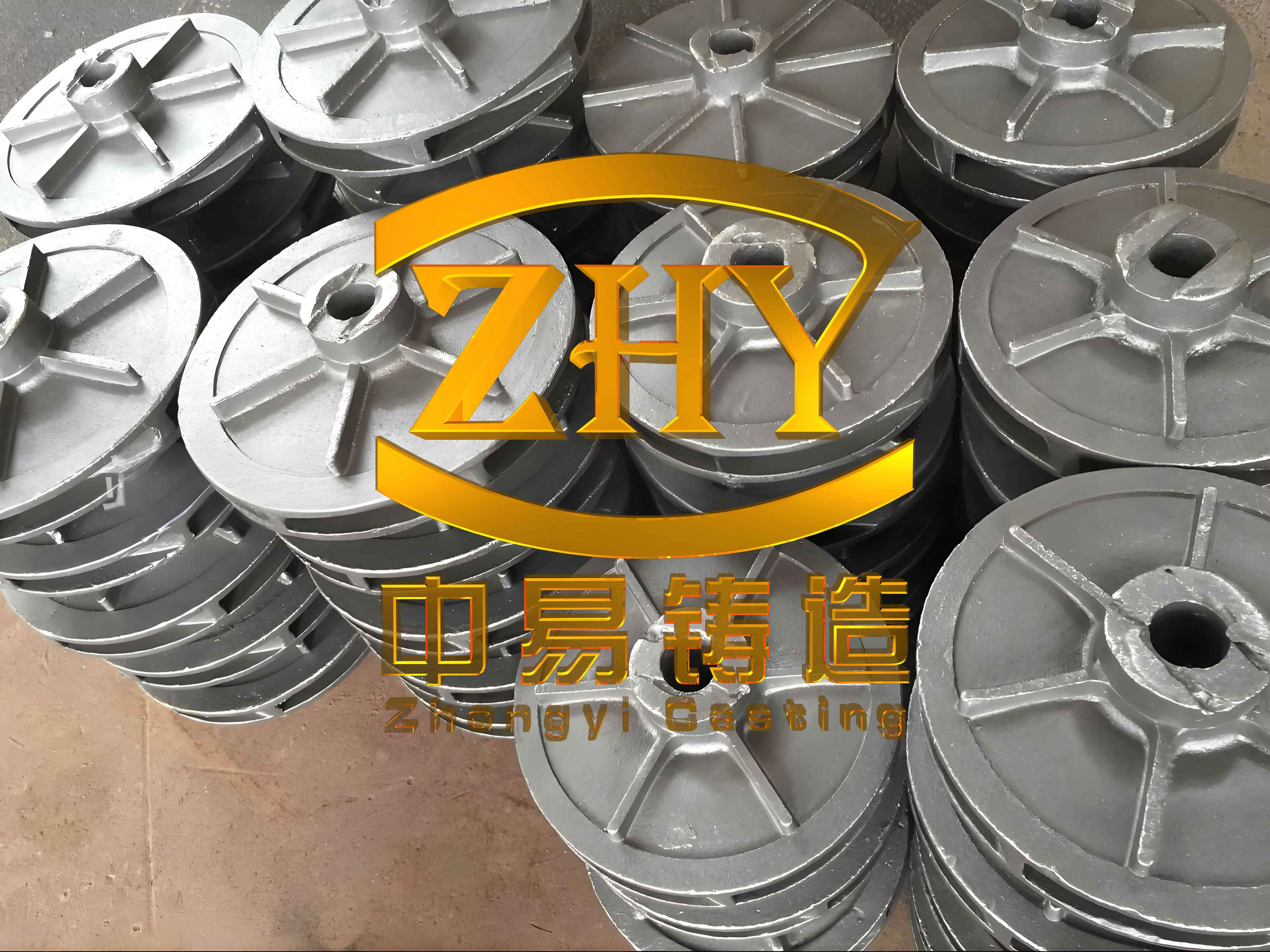
To meet these stringent requirements, a fully equipped precision casting line was essential. The selection of equipment was driven by the need for stability, precision, and repeatability at every stage. The following table summarizes the core production equipment utilized in this project for the gray cast iron impeller.
| Process Stage | Equipment Model/Type | Primary Function |
|---|---|---|
| Wax Pattern Injection | M225 Series Injection Machine | High-pressure formation of precise wax patterns using medium-temperature wax. |
| Shell Building (Slurry) | ZL60 Slurry Dipping Machine | Ensures consistent and uniform coating of ceramic slurry on wax assemblies. |
| Shell Building (Stucco) | MFS80 Fluidized Bed Stucco Unit | Applies refractory sand uniformly to the slurry-coated pattern. |
| Wax Removal | DN800/1000 Electric Dewaxing Autoclave | Uses high-pressure steam to rapidly melt and remove wax without shell damage. |
| Shell Firing | YJX100×100-12RF Firing Furnace | Heats ceramic shells to high temperature to develop strength and remove volatiles. |
| Melting | KYPS 150kg Medium-Frequency Induction Furnace | Melts and superheats the gray cast iron charge with precise temperature control. |
| Chemical Analysis | ARL MA-536 Optical Emission Spectrometer | Provides rapid, accurate composition analysis of the molten gray cast iron. |
| Cleaning | Q476B Lift-Type Shot Blasting Machine | Removes residual ceramic shell and cleans the cast gray cast iron surface. |
The heart of the process lies in the strategic selection of consumables and the underlying process philosophy. For the wax pattern, a medium-temperature wax formulation was chosen. Its higher softening point and superior thermal stability are crucial for minimizing distortion in the delicate, thin-walled impeller wax patterns, especially given the 3° blade geometry. This directly contributes to the dimensional fidelity of the final gray cast iron casting. The binder system for the ceramic shell was colloidal silica (silica sol). Silica sol-based shells are renowned for their high surface finish, excellent dimensional stability due to low high-temperature deformation, and good permeability when properly controlled. This combination is ideal for producing the high-integrity molds needed for complex gray cast iron parts. Perhaps the most critical process integration was the use of an intelligent thermal analysis system for on-line molten metal quality detection. This system provides a real-time assessment of key metallurgical parameters, allowing for immediate corrective action to ensure the gray cast iron meets its mechanical specification before pouring.
The complexity of the impeller geometry necessitated an innovative approach to mold design. A single-cavity mold capable of forming the entire wax pattern was impractical due to deep undercuts and the slender blade profiles. Therefore, I adopted a split-mold strategy based on the part’s natural surfaces. The wax pattern was divided into two major components: the upper cover and the main body (hub with blades). Each component required its own precision mold. A critical feature was the incorporation of small (10mm x 2mm x 3mm) locating tabs on each blade. These tabs ensured perfect alignment between the cover and body wax patterns during subsequent assembly. The mold cavities were initially machined on a CNC machining center and finished with a CNC engraving machine to achieve the necessary surface finish and dimensional accuracy for the gray cast iron part. The design of the 3° draft angle on the blade arcs was vital for smooth pattern ejection from the mold. The relationship between draft angle (α), surface tension (γ), and friction (μ) can be considered to minimize sticking, though the primary driver was geometric releasability. A simplified force balance for ejection suggests that the component of friction parallel to the mold wall must be overcome: $$ F_{eject} > N \cdot \mu \cdot \cos(\alpha) $$ where \( F_{eject} \) is the ejection force, \( N \) is the normal force, and \( \mu \) is the coefficient of friction. Minimizing \( \alpha \) while ensuring release is a key design compromise.
The design of the gating and feeding system is paramount in investment casting, especially for a material like gray cast iron which undergoes graphitic expansion during solidification. For this impeller, a top-pouring gating system was employed. This design promotes rapid mold filling and helps maintain a favorable temperature gradient. The system consisted of a pour cup, a horizontal runner, and ingates attached to the top of the impeller hub. The dimensions were optimized through experience and simulation principles to minimize turbulence but ensure adequate feed metal to compensate for shrinkage in the initial liquid and contraction phases before graphitic expansion begins. The volume flow rate \( Q \) can be approximated by: $$ Q = A_{choke} \cdot v $$ where \( A_{choke} \) is the minimum cross-sectional area (choke area) and \( v \) is the theoretical flow velocity. For gray cast iron, a slightly pressurized system is often beneficial. The key dimensions used are summarized below:
| Gating Element | Dimensions | Function |
|---|---|---|
| Pour Cup | Ø60 mm x 60 mm height | Receives molten metal, helps maintain a constant head pressure. |
| Horizontal Runner | 40 mm x 30 mm cross-section | Distributes metal from the sprue to multiple ingates. |
| Ingate | Ø30 mm x 10 mm (at connection) | Controls final metal entry into the impeller cavity. |
Producing the wax pattern assembly requires meticulous control. The medium-temperature wax was injected at a carefully controlled temperature of (50 ± 2)°C and a pressure of 3-5 MPa. These parameters are critical to avoid sink marks on the thin sections and to ensure complete replication of fine details like the small lettering on the hub. After injection, each wax component is meticulously inspected and trimmed to remove any flash or surface imperfections. The assembly of the two main wax components is a delicate manual operation. Each blade’s locating tabs on the body are precisely aligned with corresponding features on the cover wax pattern. Once aligned, a low-viscosity liquid wax is applied along the seam line using a fine tool, fusing the two halves into a single, integral impeller wax pattern. This assembled pattern is then welded onto a pre-fabricated wax gating system using similar techniques, creating the complete “wax tree” ready for shell building. The integrity of this wax assembly directly dictates the quality of the final gray cast iron casting.
Building the ceramic shell is a multi-step, cyclical process that demands strict environmental and parameter control. For this gray cast iron application, a combination of refractories was used: zircon flour and sand for the face coat (first layer) to achieve a smooth casting surface, and mullite flour and sand for the subsequent backup coats to provide strength and insulation. The process involves repeated cycles of dipping the wax tree into ceramic slurry, draining, applying refractory stucco sand, and drying. The impeller’s complexity, with its sharp corners and fine lettering, posed a risk of entrapped air bubbles leading to “vestige” or “fin” defects on the final gray cast iron part. To mitigate this, after each slurry dip—especially the critical first coat—a soft brush and gentle compressed air were used to dislodge bubbles from recesses and lettering. Shell parameters were tightly controlled, as summarized in this table:
| Shell Layer | Slurry Type | Viscosity (Ford Cup, sec) | Stucco Material | Drying Time (hrs, ~50% RH) |
|---|---|---|---|---|
| 1 (Face Coat) | Zircon flour + Silica Sol | 50 ± 2 | Zircon Sand (Fine) | 8 – 10 |
| 2 (Backup 1) | Mullite flour + Silica Sol | 22 ± 2 | Mullite Sand (Medium) | 6 – 8 |
| 3 (Backup 2) | Mullite flour + Silica Sol | 20 ± 2 | Mullite Sand (Coarse) | 6 – 8 |
| 4 (Backup 3) | Mullite flour + Silica Sol | 18 ± 2 | Mullite Sand (Coarse) | 6 – 8 |
| 5 (Backup 4) | Mullite flour + Silica Sol | 18 ± 2 | Mullite Sand (Coarse) | 6 – 8 |
| Seal Coat | Mullite flour + Silica Sol | High (Brush-on) | N/A | 24 (Final Dry) |
A total of 5.5 layers were applied to ensure sufficient strength for handling and to withstand the metallostatic pressure of the dense gray cast iron. The carefully controlled viscosity of the backup slurries (18-25 seconds) ensures adequate drainage and promotes shell permeability, which is crucial for venting gases during the pour of gray cast iron. After the final drying period of at least 48 hours, the wax is removed in an autoclave using high-pressure steam. The rapid heating melts the medium-temperature wax, which flows out, leaving a hollow ceramic shell or mold.
Prior to casting, the ceramic shell must be fired to develop its final strength, eliminate any residual volatiles, and bring it to an appropriate temperature for receiving the molten metal. The shells were fired at 1050°C for approximately 35 minutes. This high temperature sinters the silica binder, creating a strong, chemically stable mold. The melting and pouring of the gray cast iron is the most critical metallurgical operation. The charge, calculated to yield the desired HT200 composition, was melted in a medium-frequency induction furnace. The target composition for this grade of gray cast iron is as follows:
| Element | Target Range (wt.%) |
|---|---|
| Carbon (C) | 3.3 – 3.6 |
| Silicon (Si) | 1.8 – 2.17 |
| Manganese (Mn) | 0.65 – 0.85 |
| Phosphorus (P) | ≤ 0.080 |
| Sulfur (S) | ≤ 0.120 |
| Iron (Fe) | Balance |
A key step is superheating the melt to 1500-1510°C and holding for about 10 minutes. This practice refines the melt structure, reduces oxide inclusions, and significantly enhances the “incubation potential” or receptiveness of the iron to later inoculation. The superheat above the liquidus temperature (\( T_L \approx 1150-1200°C \) for this gray cast iron) can be related to the driving force for nucleation. After superheating, the temperature is lowered to the pouring range. Inoculation is performed in the furnace at 1440-1450°C using 0.3% FeSi75 (75% Si) inoculant, with a carefully controlled grain size of 3-5 mm. The inoculant is evenly dispersed on the melt surface and covered with a flux to prevent oxidation. A low power setting is used for 5 minutes to allow for dissolution and distribution without excessive agitation. The effectiveness of inoculation in gray cast iron is time-sensitive due to fade. The fraction of active nuclei \( N(t) \) can be modeled as decreasing exponentially: $$ N(t) = N_0 \cdot e^{-kt} $$ where \( N_0 \) is the initial nuclei count and \( k \) is a fade constant dependent on melt conditions. Therefore, post-inoculation actions must be swift. Immediately after inoculation, slag is removed, the temperature is verified, and the intelligent thermal analysis system is employed. This system analyzes the cooling curve of a small sample of the gray cast iron, providing an instantaneous prediction of tensile strength, carbon equivalent, and graphite formation tendency, allowing for a final “go/no-go” decision before pouring the entire heat.
The pouring temperature was maintained at 1380°C. To minimize inoculation fade, the entire furnace contents were poured within 5 minutes of treatment completion. The fired shells, still hot from the furnace (around 500°C, not glowing red), were arranged for pouring directly from the furnace spout. Immediately after filling the pour cup, a layer of waste wax was sprinkled on top of the molten metal to act as an exothermic/protective cover, and a steel box was placed over the shell. This practice is crucial for gray cast iron investment castings to minimize surface decarburization, which can lead to soft spots and altered microstructure. The decarburization depth \( d \) can be approximated by a parabolic growth law related to time \( t \) and a diffusion coefficient \( D \): $$ d \propto \sqrt{D \cdot t} $$ Covering the mold reduces exposure to oxidizing atmospheres at high temperature, effectively reducing the effective time for carbon diffusion out of the surface layer of the gray cast iron casting.
After shakeout and cleaning via shot blasting, the cast impellers underwent rigorous inspection. Chemical composition was verified by spectrometry. Mechanical testing confirmed the properties exceeded specifications: tensile strength averaged 220 MPa, and Brinell hardness averaged 185. Most importantly, metallographic examination revealed the successfully controlled microstructure that defines quality gray cast iron. The matrix structure consisted of approximately 96% pearlite with a minimal ferrite network, and no cementite or phosphide eutectic was observed. The graphite morphology was excellent, with over 93% being well-formed, uniformly distributed Type A graphite with some Type B, achieving a size rating of 4. This meets and exceeds the stringent requirements, confirming that the process successfully suppressed the formation of undesirable undercooled graphite in this complex, thin-walled gray cast iron component. The relationship between cooling rate \( \dot{T} \), undercooling \( \Delta T \), and graphite morphology is key. For flake graphite formation in gray cast iron, a moderate cooling rate is needed. The process succeeded by using a mold with appropriate thermal properties (silica sol shell) and controlled metal and mold temperatures to maintain a cooling rate within the window that promotes Type A graphite: $$ \text{Type A Graphite Domain} \propto \frac{1}{\dot{T}} < K $$ where \( K \) is a material-dependent constant.
In conclusion, the successful batch production of high-quality HT200 gray cast iron impellers was achieved through a holistic and tightly controlled precision casting methodology. The synergy of medium-temperature wax patterns for dimensional stability, high-strength silica sol ceramic shells for fine detail reproduction, and—most critically—the integration of intelligent molten metal analysis for real-time metallurgical control proved to be a winning combination. This approach effectively managed the inherent challenges of casting complex thin-walled geometries in gray cast iron, specifically controlling hardness, suppressing carbide formation, and promoting the desired Type A graphite structure. The consistent results validate the process parameters and control measures documented here, providing a reliable framework for the investment casting of other demanding components in gray cast iron and similar alloys. The fundamental principles of controlling solidification kinetics, inoculation efficiency, and mold-metal interaction remain universally applicable in the quest for superior gray cast iron castings.