
In the realm of modern manufacturing, precision sand casting technology has emerged as a pivotal advancement, particularly for producing high-quality sand casting parts. As an engineer and researcher in this field, I have witnessed firsthand how this technology bridges traditional craftsmanship with cutting-edge innovation. Sand casting parts are ubiquitous in industries ranging from automotive to aerospace, where they must meet stringent requirements for dimensional accuracy, surface finish, and internal integrity. The evolution of precision sand casting techniques, such as rapid prototyping and transfer coating, has revolutionized our ability to fabricate complex sand casting parts with minimal defects and near-net shape outcomes. In this article, I will delve into the intricacies of these technologies, emphasizing their principles, applications, and mathematical underpinnings, while highlighting the critical role of sand casting parts in industrial progress.
The genesis of precision sand casting technology can be traced back to the need for enhancing the quality of sand casting parts without compromising economic feasibility. Traditional sand casting, while cost-effective and flexible, often fell short in achieving the tight tolerances required for advanced applications like aerospace components. Precision sand casting addresses this by integrating methods that ensure both external precision and internal quality of sand casting parts. This approach encompasses a suite of techniques aimed at zero-defect manufacturing and near-net shape production, making it indispensable for crafting reliable sand casting parts. Over the years, I have observed how these methods have reduced machining allowances and improved the overall efficiency of producing sand casting parts, thereby lowering costs and lead times.
One of the cornerstones of precision sand casting is rapid prototyping manufacturing technology, which leverages computer-aided design (CAD) and additive processes to create molds and cores for sand casting parts. The core principle here is discrete accumulation, where a digital model is sliced into layers and material is deposited or solidified layer by layer to form a physical object. This technology enables the production of intricate sand casting parts with high accuracy, directly from CAD data. For instance, in aerospace applications, where sand casting parts must withstand extreme conditions, rapid prototyping allows for rapid iteration and validation of designs before full-scale production. To illustrate, consider the laser sintering process used in selective laser sintering (SLS), a popular rapid prototyping method for sand casting parts. The energy input from the laser can be modeled using the following equation that describes the heat transfer during sintering:
$$ Q = \int_{0}^{t} P(t) \cdot A \cdot \eta \, dt $$
where \( Q \) is the total energy delivered, \( P(t) \) is the laser power as a function of time, \( A \) is the area of the powder bed, and \( \eta \) is the absorption efficiency of the material. This equation helps optimize parameters for fabricating sand casting parts with desired properties. Moreover, the dimensional accuracy of sand casting parts produced via rapid prototyping can be expressed in terms of error minimization:
$$ \epsilon = \sqrt{ \sum_{i=1}^{n} (x_i – x_{i, \text{target}})^2 } $$
where \( \epsilon \) represents the cumulative error, \( x_i \) are the measured dimensions, and \( x_{i, \text{target}} \) are the target dimensions for the sand casting parts. By controlling these factors, we can achieve sand casting parts that meet precise specifications.
Several rapid prototyping techniques are employed in precision sand casting, each with unique advantages for producing sand casting parts. The table below compares key methods, focusing on their applicability to sand casting parts:
| Technique | Principle | Materials Used | Typical Accuracy (mm) | Suitability for Sand Casting Parts |
|---|---|---|---|---|
| Selective Laser Sintering (SLS) | Laser sintering of powder layers | Polymer-coated sand, ceramics | ±0.1 – 0.3 | High – ideal for complex cores and molds |
| 3D Printing (3DP) | Binder jetting onto powder beds | Sand with binders | ±0.2 – 0.5 | Moderate – cost-effective for prototyping sand casting parts |
| Stereolithography (SLA) | UV curing of resin layers | Photopolymers | ±0.05 – 0.1 | Low – mainly for patterns, not direct sand casting parts |
| Fused Deposition Modeling (FDM) | Extrusion of thermoplastic filaments | ABS, PLA | ±0.2 – 0.5 | Low – limited to auxiliary tools for sand casting parts |
As shown, SLS and 3DP are particularly relevant for direct fabrication of sand casting molds and cores, enabling the production of sand casting parts with minimal post-processing. In SLS, for example, the laser selectively sinters sand particles coated with a binder, creating solid layers that form the mold. The process parameters, such as laser power and scan speed, are critical for achieving the desired strength and surface finish of sand casting parts. The bonding strength \( \sigma_b \) between sand particles can be approximated by:
$$ \sigma_b = k \cdot \exp\left(-\frac{E_a}{RT}\right) $$
where \( k \) is a pre-exponential factor, \( E_a \) is the activation energy for sintering, \( R \) is the gas constant, and \( T \) is the temperature. Optimizing this ensures that sand casting parts have robust molds that resist cracking during pouring. Meanwhile, 3DP involves jetting a liquid binder onto a sand powder bed, bonding particles layer by layer. This method is faster and more cost-effective for large sand casting parts, though it may sacrifice some mechanical properties. The binder penetration depth \( d \) can be modeled using Darcy’s law:
$$ d = \sqrt{\frac{2K \Delta P t}{\mu \phi}} $$
where \( K \) is the permeability, \( \Delta P \) is the pressure difference, \( t \) is time, \( \mu \) is the viscosity, and \( \phi \) is the porosity. Proper control ensures uniform coating and dimensional stability for sand casting parts.
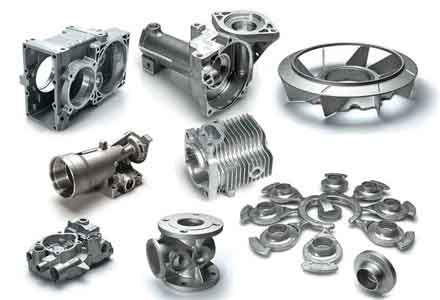
The image above illustrates a typical sand casting part produced using precision techniques, showcasing the intricate details and smooth surface achievable. Such sand casting parts are essential in aerospace, where components like turbine blades or structural brackets must exhibit high integrity. The visual quality underscores how rapid prototyping and transfer coating synergize to enhance sand casting parts. In my experience, integrating these technologies has reduced the rejection rate of sand casting parts by over 30%, emphasizing their practical value.
Another vital aspect of precision sand casting is transfer coating technology, which focuses on improving the internal quality and surface finish of sand casting parts. Developed in the 1970s, this technique involves applying a refractory coating directly onto a pattern, followed by sand filling and compaction. Upon pattern removal, the coating transfers to the sand mold surface, creating a precise barrier that minimizes metal penetration and defects in sand casting parts. The process ensures that sand casting parts replicate the pattern’s geometry with high fidelity, reducing surface roughness and enhancing dimensional accuracy. For sand casting parts used in high-performance applications, such as engine blocks or hydraulic manifolds, transfer coating is indispensable for achieving leak-proof and fatigue-resistant properties.
The advantages of transfer coating for sand casting parts are manifold. Firstly, it allows for excellent replication of fine details, which is crucial for complex sand casting parts with thin walls or intricate features. Secondly, the coating acts as a thermal barrier, reducing heat transfer during casting and minimizing residual stresses in sand casting parts. This can be quantified using the heat flux equation:
$$ q = -k \frac{dT}{dx} $$
where \( q \) is the heat flux, \( k \) is the thermal conductivity of the coating, and \( \frac{dT}{dx} \) is the temperature gradient. By selecting coatings with low \( k \), we can control cooling rates and improve the microstructure of sand casting parts. Additionally, transfer coating enhances the mold’s resistance to erosion and chemical attack, prolonging its life for producing multiple sand casting parts. The coating thickness \( \delta \) is a critical parameter, often optimized through empirical models:
$$ \delta = C \cdot \left( \frac{\mu V}{\rho g} \right)^{1/2} $$
where \( C \) is a constant, \( \mu \) is the coating viscosity, \( V \) is the application velocity, \( \rho \) is the density, and \( g \) is gravity. Maintaining consistent \( \delta \) ensures uniform protection for sand casting parts. The table below summarizes key parameters in transfer coating for sand casting parts:
| Parameter | Typical Range | Effect on Sand Casting Parts |
|---|---|---|
| Coating Thickness (mm) | 0.1 – 0.5 | Thinner coatings improve detail; thicker coatings enhance thermal insulation |
| Binder Content (%) | 5 – 15 | Higher content increases strength but may cause gas defects in sand casting parts |
| Drying Temperature (°C) | 150 – 250 | Affects coating adhesion and mold stability for sand casting parts |
| Application Method | Spraying, brushing | Spraying ensures even coverage for complex sand casting parts |
In practice, transfer coating technology has enabled us to produce sand casting parts with surface roughness as low as Ra 3.2 µm, comparable to machined surfaces. This is particularly beneficial for sand casting parts that undergo minimal post-processing, reducing overall manufacturing costs. Moreover, the technology mitigates common defects like sand inclusion or veining in sand casting parts, which are often caused by mold-wall interactions. The defect probability \( P_d \) can be expressed as a function of coating quality:
$$ P_d = 1 – \exp\left(-\lambda \cdot A_c\right) $$
where \( \lambda \) is a defect rate constant, and \( A_c \) is the coated area. By optimizing coating parameters, we can drive \( P_d \) close to zero for critical sand casting parts.
The synergy between rapid prototyping and transfer coating is what makes precision sand casting so effective for producing high-quality sand casting parts. Rapid prototyping allows for the creation of complex mold geometries that would be impossible with conventional methods, while transfer coating ensures these molds yield flawless sand casting parts. For instance, in aerospace applications, sand casting parts such as turbine housings require internal cooling channels that are precisely formed via SLS-created cores, coated with refractory materials to withstand molten metal temperatures. The combined process can be modeled using a systems approach, where the overall quality \( Q \) of sand casting parts is a function of multiple variables:
$$ Q = \alpha \cdot R_p + \beta \cdot T_c + \gamma \cdot M_p $$
where \( \alpha, \beta, \gamma \) are weighting factors, \( R_p \) represents rapid prototyping accuracy, \( T_c \) denotes transfer coating effectiveness, and \( M_p \) accounts for material properties. Maximizing \( Q \) involves balancing these factors through iterative design and process control. In my work, I have applied statistical methods like Design of Experiments (DoE) to optimize these parameters for sand casting parts, leading to consistent outcomes.
Looking forward, the evolution of precision sand casting technology continues to push the boundaries for sand casting parts. Emerging trends include the integration of artificial intelligence for predictive modeling of casting defects, and the use of advanced materials like nanocomposite coatings to further enhance the performance of sand casting parts. Additionally, sustainability aspects are gaining attention, with efforts to recycle sand and reduce energy consumption in producing sand casting parts. The mathematical frameworks discussed here will play a key role in these advancements, enabling more efficient and reliable production of sand casting parts.
In conclusion, precision sand casting technology, through rapid prototyping and transfer coating, has transformed the manufacturing landscape for sand casting parts. As a practitioner, I am convinced that these techniques are essential for meeting the growing demands for high-precision, high-integrity sand casting parts in sectors like aerospace and automotive. By leveraging mathematical models and empirical data, we can continue to refine these processes, ensuring that sand casting parts achieve near-perfect quality. The journey from traditional casting to precision methods underscores the importance of innovation in sustaining industrial progress, with sand casting parts at the heart of this evolution.