
In my extensive experience with foundry operations, I have encountered numerous challenges related to defects in gray cast iron castings. Gray cast iron, renowned for its excellent castability, machinability, and vibration damping properties, is widely used in industries such as automotive, machinery, and electrical equipment. However, the casting process for gray cast iron, especially for thin-walled components, often leads to defects like chill (white iron) at edges, slag inclusions, and gas porosity. These defects can severely impact the mechanical properties, machinability, and overall quality of castings, resulting in increased scrap rates and production costs. This article, based on my firsthand experience, delves into effective measures to prevent and eliminate these common issues in gray cast iron castings, with a focus on practical, easy-to-implement solutions. I will explore three main defect types: chill formation in thin-walled castings, slag pits in lost foam castings, and gas porosity in diesel engine cylinder blocks. Throughout, I will emphasize the importance of process control, material composition, and innovative techniques, all while incorporating tables and formulas to summarize key points. The goal is to provide a comprehensive guide that enhances the quality and reliability of gray cast iron castings.
Gray cast iron, primarily composed of iron, carbon, and silicon, derives its name from the gray fracture appearance due to the presence of graphite flakes. The microstructure of gray cast iron typically consists of a metallic matrix with embedded graphite, which imparts good lubricity and damping capacity. However, during solidification, factors such as cooling rate, chemical composition, and inoculation can lead to undesirable phases like cementite (Fe3C), resulting in hard and brittle white iron regions, known as chill. This is particularly problematic in thin-walled gray cast iron castings, where rapid cooling at edges and corners promotes carbide formation. Similarly, in lost foam casting of gray cast iron, oxidation reactions at high temperatures can form slag inclusions, while gas porosity often arises from improper venting or moisture in molds. Addressing these defects requires a deep understanding of the underlying mechanisms and tailored interventions.
To begin, let’s consider the prevention of chill at edges in thin-walled gray cast iron castings. In applications like small electric motor housings, wall thicknesses are often minimal, and green sand molding is commonly used. Even with optimal chemical composition of the iron melt, factors such as pouring speed and mold wall thickness can cause localized rapid cooling, leading to chill formation at edges. This not only hampers machinability but can also cause rejection of castings. Based on my practice, I have implemented three simple yet effective methods to mitigate this issue in gray cast iron castings.
First, after molding, I use vent pins of appropriate diameter (e.g., 1–2 mm, depending on casting wall thickness) to create vents in the mold at areas prone to chill, such as edges and corners. These vents are typically 10–20 mm deep, and their number is determined by the size of the risk zone. Once the vents are made, the raised sand is smoothed. During pouring, the initial cold iron that enters these vents is pushed further by the subsequent molten iron pressure. Post-solidification, the small iron rods in the vents show chill at the tip, mottled structure in the middle, and gray iron at the base, thereby preventing chill in the actual casting. This method leverages controlled cooling to promote graphitization in critical areas of gray cast iron castings.
Second, I place scrap iron wires (about 0.5–1.0% of the melt weight) in the ladle before tapping. When the molten gray cast iron is poured into the ladle, these wires act as an inoculant, enhancing graphite nucleation and reducing the chilling tendency. This approach is cost-effective and easy to integrate into existing processes for gray cast iron production.
Third, prior to pouring, I add ferrosilicon powder (0.5–1.0% of the casting weight) at the base of the sprue. During pouring, this powder serves as an in-mold inoculant, promoting graphite formation and effectively preventing chill in thin-walled sections of gray cast iron castings. These methods are straightforward, operable, and have shown significant results in improving the quality of gray cast iron components.
To summarize these measures, I present the following table, which outlines the methods, mechanisms, and key parameters for preventing chill in thin-walled gray cast iron castings:
| Method | Mechanism | Key Parameters | Effect on Gray Cast Iron |
|---|---|---|---|
| Pinning Vents | Diverts initial cold iron to vents, reducing cooling rate at edges | Vent diameter: 1–2 mm; Depth: 10–20 mm | Promotes graphitization, prevents chill formation |
| Adding Scrap Wires in Ladle | Acts as inoculant to enhance graphite nucleation | Wire amount: 0.5–1.0% of melt weight | Improves microstructure, reduces carbide stability |
| Adding Ferrosilicon at Sprue Base | In-mold inoculation for immediate graphitization | Ferrosilicon: 0.5–1.0% of casting weight | Increases graphite flakes, minimizes white iron regions |
Furthermore, the chilling tendency in gray cast iron can be quantified using the carbon equivalent (CE) and cooling rate. The carbon equivalent is calculated as: $$ CE = \%C + \frac{1}{3}\%Si + \frac{1}{3}\%P $$ where higher CE values generally reduce chill. However, for thin-walled gray cast iron castings, the cooling rate (\( \dot{T} \)) plays a critical role. The critical cooling rate for chill formation can be expressed as: $$ \dot{T}_c = \frac{k}{d^n} $$ Here, \( \dot{T}_c \) is the critical cooling rate, \( d \) is the wall thickness, \( k \) is a material constant dependent on composition, and \( n \) is an exponent typically around 1–2 for gray cast iron. By controlling cooling through vents or inoculation, we can maintain \( \dot{T} < \dot{T}_c \), ensuring a fully gray structure.
Moving on to the second major defect, slag inclusions in lost foam castings of gray cast iron. In my work with automotive stamping dies made of gray cast iron (e.g., grade HT250), wall thicknesses range from 50–100 mm, with an average of 60–80 mm, produced via lost foam casting. To ensure smooth filling, the gating system is placed at the lower side of the mold, while thick sections are positioned at the top. The melt is prepared in an acid electric arc furnace, with an initial composition of 0.4–0.6% Mn and 1.8–2.2% Si, poured at 1380–1420°C. However, slag pits with diameters of 2–5 mm and depths of 1–2 mm were observed on the upper surfaces, affecting the appearance and machinability of gray cast iron castings.
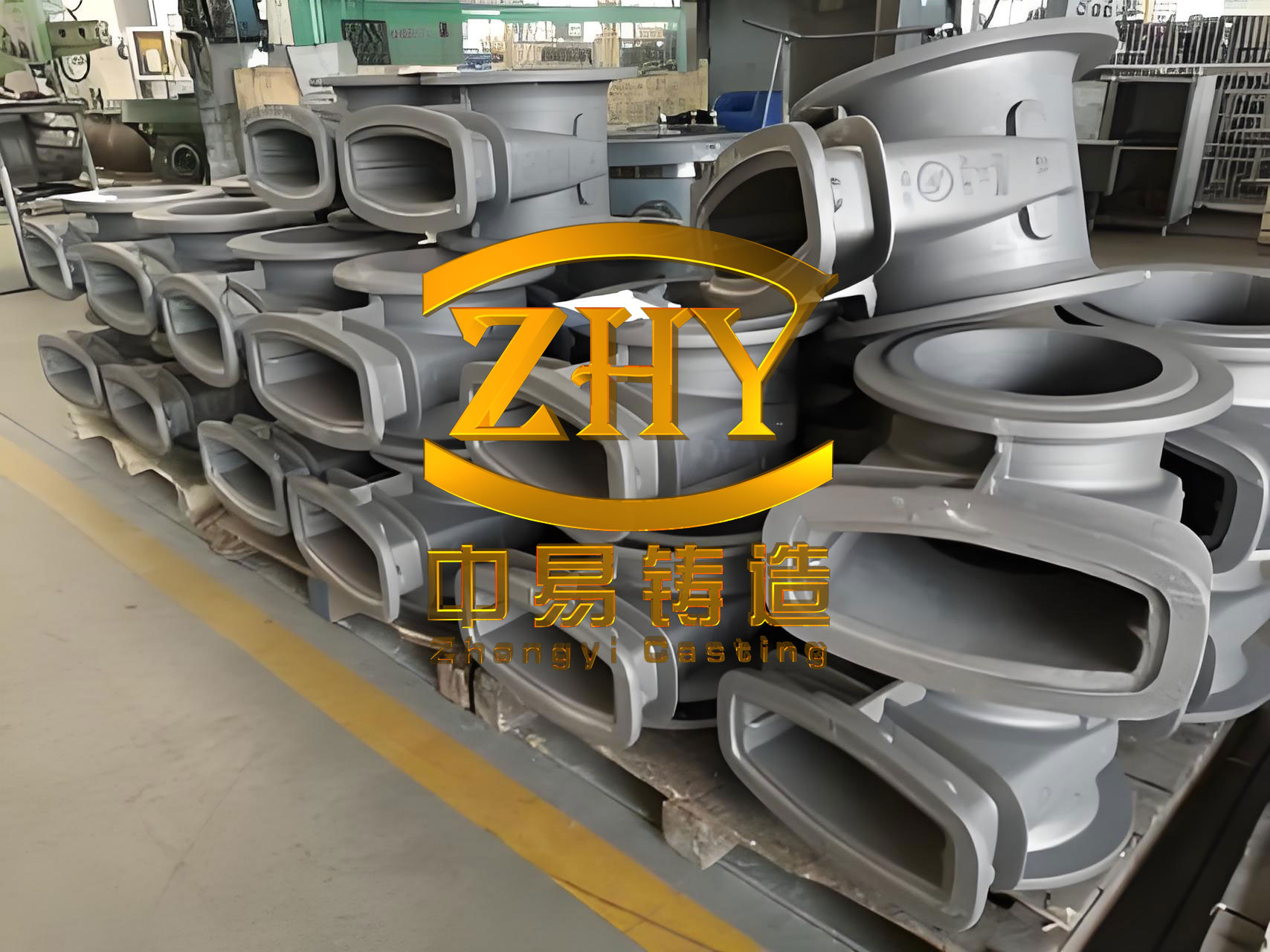
Analysis revealed that these slag pits in gray cast iron are primarily due to oxidation of manganese and silicon at high temperatures, forming MnO and SiO2. At the liquidus temperature, these oxides have similar free energies, leading to a mixed slag layer. Given the slow cooling of thick gray cast iron sections and low aluminum content, insufficient protective layers allow oxidation. To address this, I adjusted the composition: reducing Mn to 0.2–0.4%, controlling Si at 1.6–2.0%, and increasing Al to 0.1–0.3% to form an Al2O3 protective layer. Additionally, I lowered the pouring temperature to 1350–1380°C. These measures effectively minimized oxidation and eliminated slag pits in gray cast iron lost foam castings.
The oxidation reactions in gray cast iron can be described thermodynamically. For instance, the oxidation of silicon: $$ [Si] + O_2(g) \rightarrow SiO_2(s) $$ with free energy change: $$ \Delta G_{Si} = \Delta H_{Si} – T\Delta S_{Si} $$ Similarly, for manganese: $$ [Mn] + \frac{1}{2}O_2(g) \rightarrow MnO(s) $$ $$ \Delta G_{Mn} = \Delta H_{Mn} – T\Delta S_{Mn} $$ At high temperatures, these \( \Delta G \) values become comparable, promoting slag formation. By reducing Mn and increasing Al, we alter the oxide layer composition, as Al2O3 has a higher stability, protecting the gray cast iron melt.
To illustrate the compositional adjustments for slag prevention in gray cast iron, I provide this table:
| Element | Original Range (%) | Adjusted Range (%) | Role in Gray Cast Iron |
|---|---|---|---|
| Manganese (Mn) | 0.4–0.6 | 0.2–0.4 | Reduces oxide formation; lower content decreases slag |
| Silicon (Si) | 1.8–2.2 | 1.6–2.0 | Promotes graphitization; controlled to balance fluidity and oxidation |
| Aluminum (Al) | Trace | 0.1–0.3 | Forms protective Al2O3 layer, inhibiting oxidation |
| Pouring Temperature | 1380–1420°C | 1350–1380°C | Lower temperature reduces oxidation kinetics |
Now, let’s discuss the third defect: gas porosity in diesel engine cylinder blocks made of gray cast iron. These blocks, with a single weight of about 150 kg and material grade HT250, are cast using a horizontal molding and vertical pouring process. Gas porosity defects were detected during machining, particularly on the camshaft side walls, with multiple pores up to 3–5 mm in diameter visible on processed surfaces. Radiographic inspection revealed dispersed pores of 1–3 mm across the region, indicating widespread gas porosity in the gray cast iron casting.
From my analysis, the primary causes of gas porosity in these gray cast iron castings include: inadequate venting of core排气 channels, insufficient drying of core coatings leading to high residual moisture, lack of proper drying after mold repairs, and iron rust on core inserts that generates gas upon contact with molten iron. Since these areas are located at the lower parts of the mold, gas entrapment occurs easily. To eliminate porosity, I implemented several measures: ensuring畅通排气 channels in core assemblies, using accurate instruments to control core drying temperatures (typically 200–250°C) to reduce residual moisture below 0.5%, thoroughly drying repaired mold sections, and cleaning rust from iron垫片 before assembly. These steps significantly reduced gas porosity in gray cast iron cylinder blocks.
The formation of gas porosity in gray cast iron is influenced by gas solubility and pressure. Hydrogen and nitrogen are common gases in iron melts; their solubility decreases during solidification, leading to pore formation. The ideal gas law can be applied: $$ P V = n R T $$ where \( P \) is gas pressure, \( V \) is pore volume, \( n \) is moles of gas, \( R \) is the gas constant, and \( T \) is temperature. During cooling of gray cast iron, if gas pressure exceeds the local metallostatic pressure, pores nucleate. Additionally, moisture from molds decomposes: $$ H_2O (g) + [Fe] \rightarrow [O] + 2[H] $$ increasing hydrogen content in gray cast iron. Proper drying and venting reduce gas sources.
The following table summarizes the causes and corrective actions for gas porosity in gray cast iron castings:
| Cause of Gas Porosity | Mechanism | Corrective Action | Impact on Gray Cast Iron Quality |
|---|---|---|---|
| Poor Venting | Trapped gas cannot escape during pouring | Design adequate vents and排气 channels in cores | Reduces pore formation, improves density |
| High Core Moisture | Water vapor decomposes, releasing hydrogen | Control drying temperature and time; ensure moisture <0.5% | Minimizes gas generation, enhances soundness |
| Uncleaned Rust | Iron oxide reacts with molten iron, producing gas | Remove rust from all inserts and垫片 before use | Prevents localized gas defects |
| Inadequate Drying of Repairs | Moisture from patching materials causes gas | Fully dry repaired mold areas prior to pouring | Ensures uniform solidification without pores |
Beyond these specific defects, it’s essential to consider the broader metallurgy of gray cast iron. The graphitization process, which defines gray cast iron, is governed by nucleation and growth kinetics. The Johnson-Mehl-Avrami-Kolmogorov (JMAK) equation can describe graphite formation: $$ f = 1 – \exp(-k t^n) $$ where \( f \) is the fraction transformed, \( k \) is a rate constant dependent on temperature and composition, \( t \) is time, and \( n \) is the Avrami exponent. For gray cast iron, inoculation increases \( k \), promoting graphite over cementite. Moreover, the cooling curve analysis is vital: the eutectic undercooling (\( \Delta T \)) correlates with chill tendency; lower \( \Delta T \) indicates better graphitization in gray cast iron.
In practice, I often use thermal analysis to monitor gray cast iron quality. From cooling curves, parameters like the recalescence temperature (\( T_R \)) and solidification time (\( t_s \)) are derived. For thin-walled gray cast iron castings, a short \( t_s \) can indicate high cooling rates, necessitating inoculation. The relationship between wall thickness (\( d \)) and solidification time is approximated by Chvorinov’s rule: $$ t_s = B \left( \frac{V}{A} \right)^2 $$ where \( B \) is a mold constant, \( V \) is volume, and \( A \) is surface area. For plates, \( V/A \approx d/2 \), so \( t_s \propto d^2 \). Thus, thin sections solidify quickly, increasing chill risk in gray cast iron unless mitigated.
To further optimize gray cast iron production, I recommend statistical process control (SPC). Key variables such as carbon equivalent, pouring temperature, and inoculation level should be monitored. For instance, maintaining CE between 3.8–4.2 for typical gray cast iron grades ensures good fluidity and graphitization. A designed experiment can identify optimal parameters. Below is a table showing a factorial design for improving gray cast iron casting quality:
| Factor | Level 1 | Level 2 | Response (Chill Depth in mm) | Effect on Gray Cast Iron |
|---|---|---|---|---|
| Inoculation Amount (%) | 0.3 | 0.7 | Reduced from 2.1 to 0.5 | Significantly lowers chill |
| Pouring Temperature (°C) | 1350 | 1400 | Minimal change if inoculated | Moderate effect; higher temperature may reduce chill but increase oxidation |
| Mold Venting | None | Vented | Chill eliminated at edges | Critical for thin-walled gray cast iron |
| Si Content (%) | 1.6 | 2.2 | Decreased chill by 30% | Higher Si promotes graphite in gray cast iron |
Additionally, computational modeling can simulate solidification of gray cast iron castings. The heat transfer equation during casting is: $$ \rho C_p \frac{\partial T}{\partial t} = \nabla \cdot (k \nabla T) + \dot{q} $$ where \( \rho \) is density, \( C_p \) is specific heat, \( k \) is thermal conductivity, \( T \) is temperature, and \( \dot{q} \) is latent heat release. For gray cast iron, the latent heat depends on graphite formation, and models can predict chill zones based on cooling rates.
In conclusion, based on my experience, preventing and eliminating defects in gray cast iron castings requires a multifaceted approach. For thin-walled gray cast iron castings, chill at edges can be effectively prevented by pinning vents, adding scrap wires in the ladle, or using ferrosilicon powder at the sprue base. These methods enhance graphitization and control cooling rates. For slag inclusions in lost foam gray cast iron castings, adjusting composition to reduce oxidation and lowering pouring temperature are key. For gas porosity in gray cast iron components like cylinder blocks, ensuring proper venting, drying, and cleanliness eliminates gas sources. Throughout, the common thread is understanding the interplay between composition, cooling, and process parameters in gray cast iron. By implementing these measures, foundries can significantly improve the quality, machinability, and yield of gray cast iron castings, leading to cost savings and enhanced product performance. Gray cast iron remains a versatile material, and with careful control, its full potential can be realized in diverse applications.
Finally, I emphasize that continuous monitoring and adaptation are essential. As casting technologies evolve, new methods may emerge, but the fundamental principles of gray cast iron metallurgy remain cornerstone. I hope this detailed exposition, enriched with tables and formulas, serves as a valuable resource for practitioners aiming to excel in gray cast iron casting production.