
In my years of experience in foundry engineering, addressing shrinkage defects in cast iron parts remains a central and enduring challenge. Whether dealing with gray iron or ductile iron castings, the occurrence of shrinkage porosity and cavities can vary widely based on geometry, requiring nuanced approaches in process design. Even with carefully placed feeding risers, initial trials often reveal defects, necessitating iterative refinements. The core of riser design hinges on three elements: modulus, volume, and riser neck. The modulus, a representation of solidification time, is critical for timing; the volume dictates the available liquid metal for feeding; and the riser neck dimensions ensure the补缩通道 remains open. Here, I share practical insights and methodologies drawn from hands-on practice to effectively prevent and eliminate shrinkage issues in cast iron parts, aiming to foster交流 among practitioners.
The journey to sound cast iron parts begins with understanding riser neck defects. When the riser neck or ingate is removed, two distinct shrinkage patterns may emerge, each pointing to different root causes. The first type involves deep, smooth-walled holes that indicate insufficient feeding—either the riser body is too small and solidifies prematurely, or the riser neck freezes too early, blocking补缩. For such defects in cast iron parts, corrective measures include enlarging the riser body or increasing the riser neck modulus by thickening it or shortening its length. Conversely, the second type presents as dispersed, rough cavities, often resembling a “rotten neck.” This typically stems from a contact hot spot, where the riser neck is too large or too short, creating excessive thermal interference that delays local solidification. Here, reducing the riser neck size is key to mitigating the hot spot. It is crucial to distinguish between these cases, as opposite actions are required.
| Defect Type | Visual Description | Primary Cause | Corrective Actions |
|---|---|---|---|
| Type 1: Insufficient Feeding | Deep, smooth holes after neck removal | Riser volume too small or neck solidification too early | Increase riser body size; enlarge riser neck modulus or shorten length |
| Type 2: Contact Hot Spot | Dispersed, rough cavities | Riser neck too large or too short, causing thermal interference | Reduce riser neck size to minimize hot spot |
The concept of contact hot spot is vital: when a riser is placed at a geometric hot spot of a cast iron part, the combined thermal mass—including heated mold sand—exceeds the original hot spot circle, exacerbating shrinkage risks. Meanwhile, the flow effect in the riser neck prolongs its solidification time by 40% to 60% due to continuous hot metal flow, which can be modeled as: $$ t_{neck} = t_0 \times (1 + k) $$ where \( t_0 \) is the solidification time based on geometric modulus, and \( k \) is an enhancement factor ranging from 0.4 to 0.6. This effect helps maintain补缩通道畅通 longer, but must be balanced against hot spot formation.
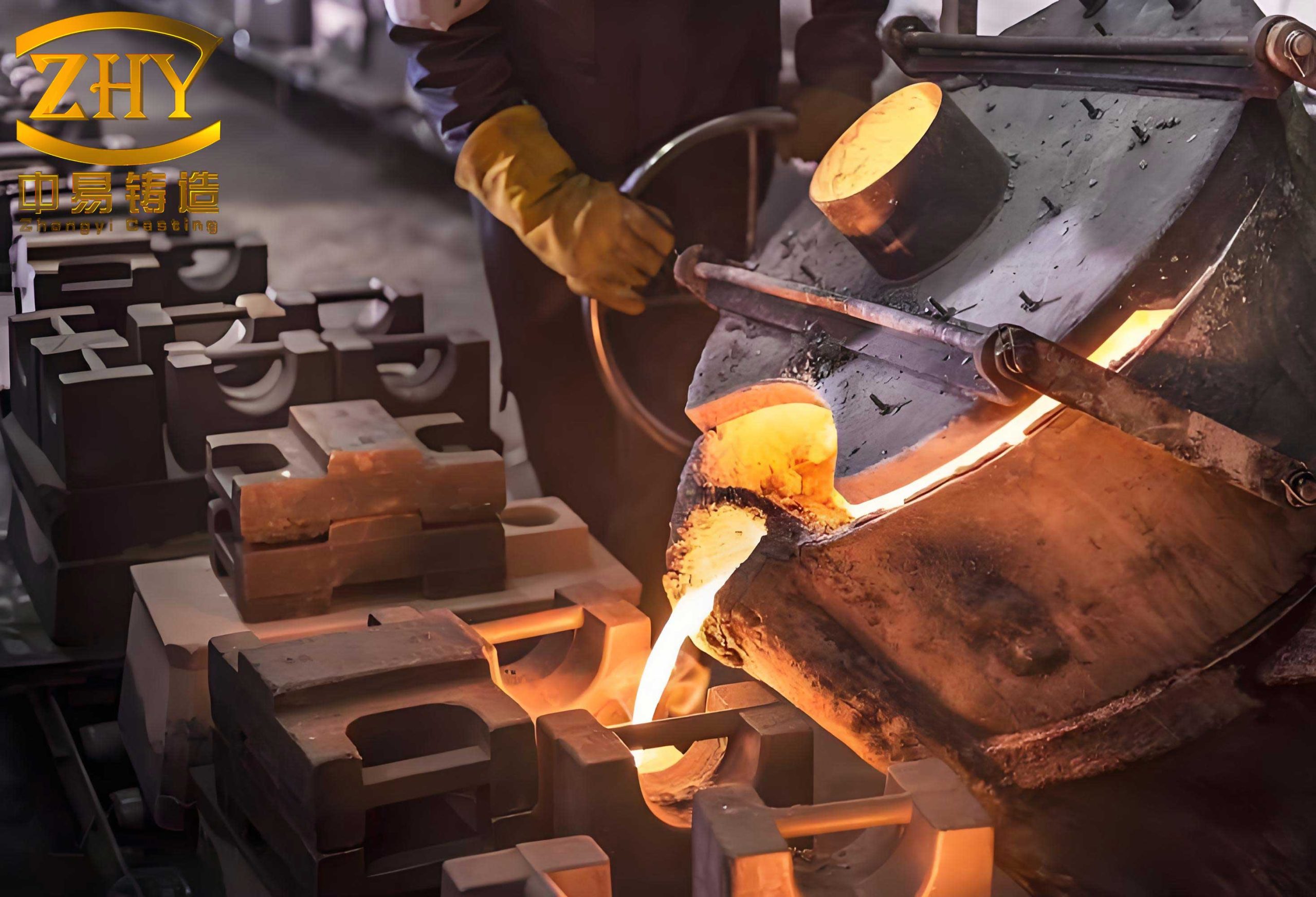
Moving to shrinkage at hot spots within cast iron parts, especially in ductile iron with its pasty solidification mode, the most effective approach is combining risers with chills. Often, risers are cold (filled separately from the gating system), limiting their feeding capacity; thus, chills accelerate local solidification, reducing the hot spot and aligning with riser feeding. The modulus principle guides this: for a riser to feed effectively, its modulus should exceed that of the hot spot. The modulus \( M \) is defined as: $$ M = \frac{V}{A} $$ where \( V \) is volume and \( A \) is cooling surface area. For a spherical hot spot of diameter \( D \), the approximate modulus is \( M = D/6 \). When using exothermic or insulating risers, which follow directional solidification, the effective modulus \( M_{eff} \) ensures the riser solidifies last, often allowing chill elimination. Manufacturers provide \( M_{eff} \) values, and selection criteria require: $$ M_{riser} > M_{hotspot} $$ This ensures adequate feeding for dense cast iron parts.
The use of top risers in cast iron parts requires caution, as they often lead to shrinkage at the neck due to the heavy feeding burden during liquid contraction. Since cast iron parts exhibit graphite expansion self-feeding, risers need not solidify last, unlike steel. For thick cast iron parts where top risers are unavoidable and defects occur, the cold neck riser technique is beneficial. This involves a larger riser neck paired with a chill at the neck—the large cross-section accommodates high initial feeding demand, while the chill minimizes contact hot spot and promotes early neck freezing to harness self-feeding. This balances external and internal feeding for robust cast iron parts.
Another common issue in cast iron parts is external shrinkage or surface sinking on sides or tops near risers, especially with middle parting lines. This arises from thermal interference heating the sand between riser and casting, causing delayed solidification and plastic deformation under negative pressure. Solutions include moving the riser away or placing chills at the sinking area to accelerate solidification. Similar phenomena at ingates or riser pads suggest concentrated metal flow, remedied by multiple ingates or reducing pad size. For cast iron parts, managing thermal干扰 is key to surface integrity.
Wheel-shaped cast iron parts present unique challenges. For thick-rimmed ductile iron wheels, axial shrinkage is common, often requiring chills alongside risers; exothermic top risers are preferred for long solidification times. When spokes create hot spots at rims, risers can be placed between two hot spots for efficiency, adhering to the principle of distancing risers from hot spots in cast iron parts. If the hub shows shrinkage, a riser on the core or an internal feeder may help. Gating should involve multiple radial ingates for uniform filling. These strategies enhance the quality of wheel cast iron parts.
For cylindrical cast iron parts with middle parting, conventional gating and risers on the parting plane may fail, especially at top flange hot spots. The climb-core pouring technique offers improvement: extending the runner up the core to introduce hot metal from the top, with a side riser for feeding. This boosts补缩 efficiency and yield. Additionally, mid-pour can cause inner surface roughness due to turbulent flow; switching to bottom pouring via extended runners ensures平稳充填, reducing slag and erosion. Such adjustments are crucial for sound cylindrical cast iron parts.
In vertical parting lines like DISA molding, riser placement for cast iron parts such as flywheels is best at the upper left or right at about 45°. Top risers risk neck defects, while central ones reduce yield. Gating should be mid-pour for balance—top pouring may cause sand erosion, and bottom pouring limits feeding. If bottom pouring is used for stability, connecting the riser to the sprue at an obtuse angle can provide hot metal, but care is needed to avoid premature filling. Optimizing these aspects improves production of cast iron parts on automated lines.
With iron mold coated sand processes, modifying molds is difficult, and riser setup is tricky. For isolated hot spots in cast iron parts, adjusting composition is effective. Fast cooling promotes fine graphite, increasing self-feeding via expansion; thus, carbon and silicon can be set higher. Since contraction is concentrated, the gating system’s post-filling feeding is strong. If defects appear suddenly, check charge materials and alloy additions. This chemical approach often resolves shrinkage in such cast iron parts.
Several general工艺 considerations impact cast iron parts. Small ductile iron castings cool quickly, requiring substantial external feeding; high yield should not compromise integrity—multiple small risers may be needed for complex geometries. Riserless casting for cast iron parts is risky; often, the gating system acts as a feeder, so its design must include feeding capacity. Intense inoculation can increase micro-porosity; for leak-tight or high-ductility cast iron parts, using strontium inoculants or higher hydrostatic pressure helps. Riser pads are essential to heat the neck, extending flow time—they should be in the drag, not omitted. If risers show no shrinkage but cast iron parts are defective, risers remain necessary due to batch variations; optimize sizes for best yield. Pouring speed matters: for thick cast iron parts, slower pouring leverages post-filling feeding to reduce shrinkage. Modulus-based riser design addresses time, but liquid feeding volume must be verified: $$ V_{riser} \geq \beta \cdot V_{casting} $$ where \( \beta \) is the shrinkage factor. Transitioning resin sand patterns to green sand may require larger risers for cast iron parts due to lower mold rigidity. Cold ribs or vents on top surfaces act as chills, preventing local shrinkage and aiding venting. These nuances underscore the complexity in producing defect-free cast iron parts.
| Concept | Formula | Description |
|---|---|---|
| Modulus | $$ M = \frac{V}{A} $$ | Determines solidification time; for feeding, \( M_{riser} > M_{casting} \). |
| Flow Effect Extension | $$ t_{neck} = t_0 (1 + k), \, k \in [0.4, 0.6] $$ | Prolongs riser neck solidification due to metal flow. |
| Shrinkage Volume | $$ V_{shrink} = \alpha \cdot V_{cast} $$ | \( \alpha \) is shrinkage rate (e.g., 4-6% for ductile iron). |
| Riser Volume Check | $$ V_{riser} \geq \alpha \cdot V_{cast} + V_{loss} $$ | Ensures sufficient liquid for feeding cast iron parts. |
In summary, preventing shrinkage in cast iron parts demands a holistic view of riser design, thermal management, and process adaptations. Through careful analysis of defect types—whether at riser necks, hot spots, or surfaces—and applying tailored solutions like chills, exothermic risers, or composition tweaks, we can achieve dense and reliable cast iron parts. The interplay of modulus, volume, and neck dimensions, coupled with实践经验, forms the bedrock of success. As technologies evolve, continuous learning and sharing of insights will further refine our approach to these perennial challenges in casting cast iron parts.