
In the pursuit of high-quality castings, the industry consistently focuses on advanced processes and methodologies. Among these, the lost foam casting process stands out for its ability to produce complex, near-net-shape components with excellent dimensional accuracy and surface finish. The core of this process involves replacing a foam pattern with molten metal within an unbonded sand mold, often under a vacuum. While this offers significant advantages, it also introduces unique challenges, particularly during the filling stage. The design of the gating system, therefore, transcends its role in traditional sand casting and becomes the critical control element for managing the complex interaction between the decomposing foam, the advancing metal front, and the sand mold’s stability. A well-designed gating system in the lost foam casting process is not merely a conduit for metal but a director of thermal, gaseous, and hydrodynamic phenomena.
It is essential to recognize that the foundation of any successful casting, including those produced via the lost foam casting process, begins long before the pattern is placed in the flask. The inherent quality of the base iron, or “parent metal,” is paramount. Factors influencing its nucleation potential—such as superheating temperature, holding time, carbon equivalent (CE), the Mn/S ratio, scrap steel charge percentage, carburization efficiency, and dissolved oxygen content—profoundly impact the final microstructure, mechanical properties, and casting soundness. Processes like scrap-melt carburizing and advanced pretreatment are among the most effective measures for enhancing this intrinsic nucleation capability. A high-quality melt provides the necessary fluidity and solidification characteristics to better withstand the thermal demands and potential chilling effects inherent in the lost foam casting process.
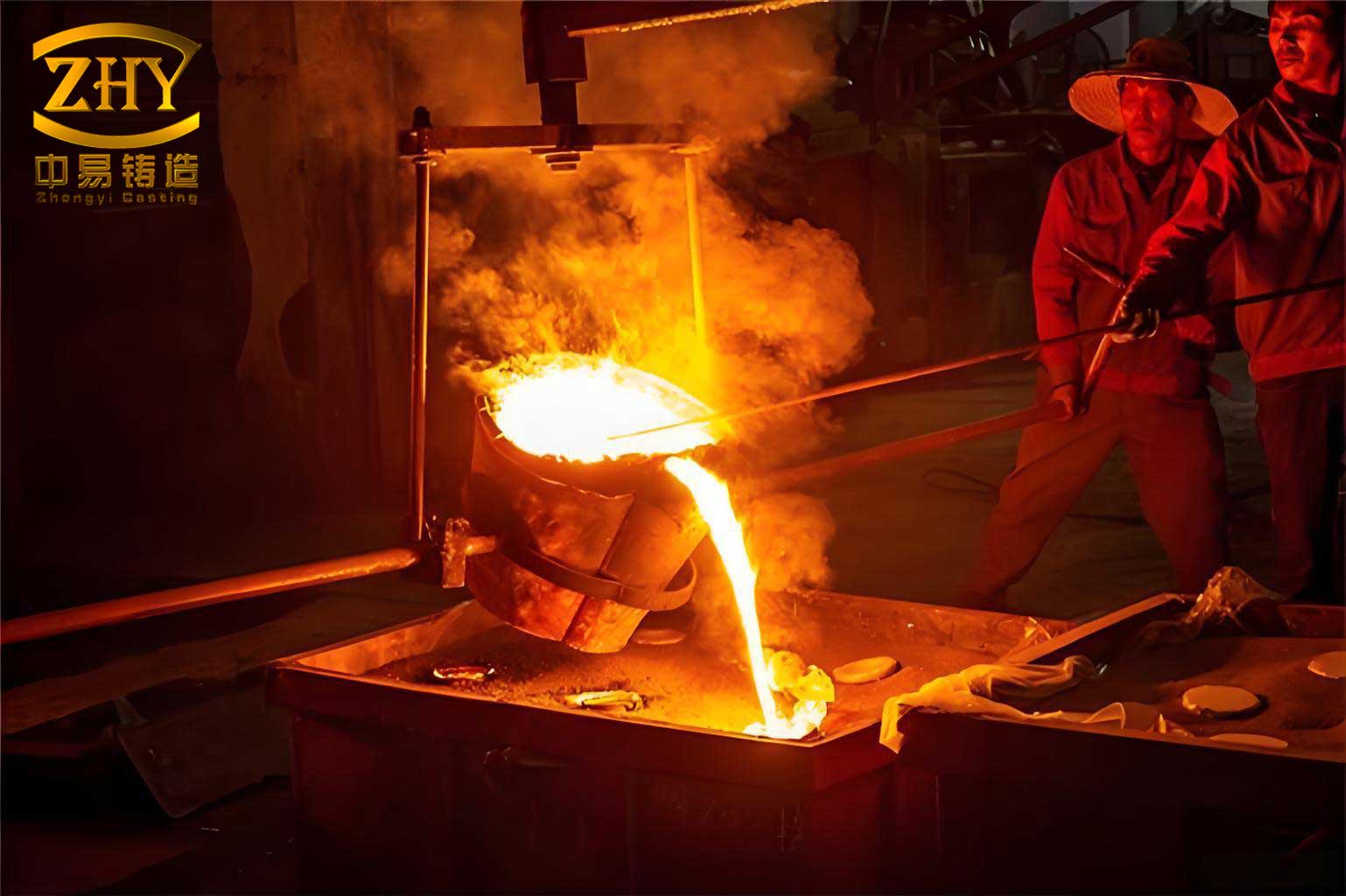
The lost foam casting process employs dry, unbonded sand compacted by vacuum pressure to maintain mold integrity against the thermal and static pressure of the molten metal. The gating system’s function is critically expanded in this environment. An improperly designed system can lead to a host of defects unique to or exacerbated by the process, such as carbonaceous inclusions (fold, lustrous carbon), gas porosity, cold shuts, and dimensional inaccuracies due to mold wall movement. The introduction of the vacuum field adds another significant variable, making the design principles for the lost foam casting process more complex and distinct from conventional foundry practice.
Fundamental Design Principles for the Lost Foam Casting Process
While traditional gating design aims to fulfill requirements like controlled filling, slag trapping, and directional solidification, the lost foam casting process imposes additional, non-negotiable constraints. For alloys poured above the thermal degradation temperature of the foam (typically >750°C for ferrous alloys), the following principles become vital:
- Rapid Priming of the Sprue: The system must enable the molten metal to fill the sprue almost instantaneously. This action establishes a metallostatic head and, more importantly, seals the system from atmospheric air ingress. Air entering through the sprue can lead to oxygen-starved combustion of the foam, generating excessive free carbon and resulting in carbon slag defects. A quick fill also helps stabilize the pressure differentials within the system.
- Management of Gaseous Decomposition Products: The gating design must facilitate the orderly evacuation of gases produced from the thermal degradation (pyrolysis) of the foam pattern. It should help maintain a stable and continuous “gas gap” or “advancing gas zone” ahead of the metal front.
- Balanced Fill Rate vs. Gasification Rate: The metal advance speed should be slightly less than or equal to the pattern’s gasification rate. Too slow a fill leads to excessive heat loss, causing cold shuts and misruns. Too fast a fill can trap liquid pyrolysis products (styrene) within the metal, leading to porosity and carbon defects. The optimal balance ensures the gas gap remains stable, allowing decomposition products to escape through the coating into the sand.
- Minimized Heat Loss and Optimized Thermal Gradient: The system should promote the shortest possible flow paths and rational filling directions to conserve superheat, maintain fluidity, and establish thermal gradients favorable for feeding and reducing internal stresses.
In practice, these principles often lead to a preference for pressurized or semi-pressurized gating systems in the lost foam casting process. A choked system at the sprue base or sprue-well connection helps achieve rapid sprue fill. However, care must be taken to avoid excessive turbulence. For systems with multiple ingates, a semi-pressurized design, with the choke upstream of the ingates, is often most effective.
Gating System Influence on Mold Wall Stability and Dimensional Accuracy
A critical, often overlooked aspect of the lost foam casting process is mold wall stability. The unbonded sand mold relies entirely on vacuum for strength. During filling and solidification, the static and metallostatic pressure of the metal can push against the mold walls, causing them to deflect or “migrate.” This leads to dimensional variation and wall thickness deviations in the final casting. The gating system design is a primary factor controlling this phenomenon.
The mechanism is driven by two main factors: the local metallostatic pressure and the duration for which that pressure is applied (dictated by the local solidification time). The gating style directly controls both by dictating the initial metal entry points and the resulting temperature distribution.
| Gating Style | Metal Entry Point | Thermal Profile | Pressure Duration at Base | Typical Wall Movement Profile |
|---|---|---|---|---|
| Bottom Gating | Lowest point of casting | Hot at bottom, cooler top | Very Long (base is hottest, solidifies last) | Maximum movement at base, decreasing upward. |
| Step Gating | Multiple levels (bottom & mid-height) | More uniform distribution of heat | Moderate/Short (heat is distributed, base cools faster) | Reduced overall movement. Movement at base is less than pure bottom gating. |
| Top Gating | Top of casting cavity | Hot at top, cooler bottom | Short (base fills last and is relatively cool) | Generally minimal movement at base, but risks turbulence. |
The relationship can be conceptually modeled. The local mold wall deflection ($\delta$) can be approximated as a function of the applied pressure ($P$) and the “effective pressure application time” ($t_{eff}$), which is linked to the local solidification time.
$$
\delta \propto P \cdot t_{eff}
$$
Where $P = \rho g h$, with $\rho$ as metal density, $g$ as gravity, and $h$ as the local metallostatic head height. $t_{eff}$ is complex but is minimized when the local solidification time is short (i.e., the area cools quickly). A bottom-gated system creates a large $h$ and a long $t_{eff}$ at the casting base, maximizing $\delta$. A step-gated system reduces the effective $h$ and $t_{eff}$ at any single point by distributing the heat source.
Numerical Simulation and Analysis of Filling Patterns
Modern simulation software is indispensable for visualizing and optimizing the filling sequence in the lost foam casting process. It helps analyze the state of the metal front, the collapse of the foam, and the stability of the gas gap.
Step Gating System Analysis
Simulations reveal that with a step gating system, metal initially enters from the upper ingates due to the initial back-pressure and flow resistance in the lower sections of the foam cluster. This metal then falls vertically under gravity, often creating an unstable front that can fold over and encapsulate foam. If this encapsulated foam does not fully degrade and vent before metal solidification, it results in internal gas or carbon inclusion defects. As filling progresses, the higher metallostatic head at the lower ingates eventually dominates, increasing their flow rate. The final fill is typically more balanced, but the initial transient phase is critical.
Bottom Gating System Analysis
In a bottom-gated system, metal advances from the ingate in a radial fashion, often with a slightly concave front. The foam at the center of the gas gap degrades first. The metal flow exhibits an “attached flow” or “wall-hugging” tendency because the gas pressure in the central gap is higher, and the vacuum draws gases more easily through the coating at the periphery. This creates a stable, well-defined gas gap. The filling direction is congruent with the upward movement of decomposition gases, which is generally favorable. However, the fill can be slower due to the consistent back-pressure along the entire flow path, and the thermal gradient is least favorable for feeding.
Top Gating System Analysis
Top gating introduces metal at the top of the cavity. The metal stream falls freely, with the core of the stream advancing faster than the periphery due to friction against the degrading foam walls. This central region of foam degrades first. The major advantage is an exceptionally wide and stable venting path for gases; the entire area below the falling stream is open for gases to escape upwards around the metal stream and through the coating. This minimizes back-pressure and allows for very rapid filling. The primary risks are severe turbulence, droplet formation (which can lead to cold shuts), and the most unfavorable thermal gradient for feeding, as the hottest metal is at the top of the casting.
| Criteria | Top Gating | Bottom Gating | Step Gating |
|---|---|---|---|
| Filling Stability | Poor (Turbulent) | Very Good (Stable, attached flow) | Moderate to Good (Initial transients) |
| Gas Venting Efficiency | Excellent | Good | Good |
| Thermal Gradient | Least Favorable (Hot top) | Favorable for Feeding (Hot bottom) | Moderately Favorable (Distributed) |
| Mold Wall Movement Risk | Low (at base) | High (at base) | Medium | Best Suited For | Simple shapes, thin-wall clusters, non-critical parts. | Cylindrical shapes, parts requiring excellent surface finish. | Complex geometries (housings, blocks) requiring a balance of properties. |
Advanced Considerations and Integrated Design Methodology
Beyond the basic style selection, successful implementation of the lost foam casting process requires attention to finer details of the gating system.
Ingate and Runner Design: For cylindrical castings, an internal “twin S-shaped” runner-ingate combo with a central sprue is highly effective in promoting balanced, rotational filling. Alternatively, an external step gating system can be used. For box-like or housing castings, a step gating system with a U-shaped or annular runner that feeds from multiple, balanced points provides high fill equilibrium and a stable gas gap. The use of hollow foam runners versus solid ones can also invert the initial filling sequence in step gates and must be accounted for in simulation and design.
The Vacuum Dynamic: The applied vacuum is not just a constant. The gating system must be designed in concert with the vacuum draw schedule. The goal is to maintain a slight positive pressure differential from the gas gap, through the coating, and into the sand, ensuring gas flow is always away from the metal front. The relationship can be simplified as needing:
$$
P_{gap} > P_{sand}
$$
where $P_{sand}$ is controlled by the vacuum line pressure. An abrupt or poorly timed vacuum can collapse the gas gap or draw liquid pyrolysis products into the coating.
Defect Mitigation through Gating: Specific gating strategies target specific defects common in the lost foam casting process:
- Carbon Inclusions/Cold Shuts: Primarily caused by slow filling and excessive heat loss. Top gating or highly pressurized systems that ensure very fast filling can mitigate this, albeit with other trade-offs. Preheating patterns can also help.
- Internal Porosity: Often results from trapped gaseous or liquid pyrolysis products. Systems that ensure a stable, manageable gas gap (like well-designed bottom or step gates) and sufficient vacuum draw are key.
- Dimensional Variation: Controlled by minimizing mold wall movement through gating style selection (favoring step over pure bottom gate) and optimizing pouring temperature to reduce pressure application time.
| Phase | Key Question | Design Objective |
|---|---|---|
| Conceptual | What is the primary casting geometry and quality requirement? | Select base gating style (Top, Bottom, Step) per Table 2. |
| Detailed Design | How to achieve rapid sprue prime? | Implement a choke (pressurized or semi-pressurized system). |
| How to balance fill and vent paths? | Design runner geometry for symmetrical feed; ensure coating permeability is adequate. | |
| How to manage thermal profile? | Position ingates to create a favorable temperature gradient for feeding and minimal wall movement. | |
| Validation | Does the fill sequence match predictions? | Use numerical simulation to visualize metal/foam front and gas gap stability. |
| Are pressure transients managed? | Coordinate gating design with vacuum schedule; ensure $P_{gap} > P_{sand}$ is maintained. |
Conclusion
The design of the gating system is the paramount technical control point in the lost foam casting process. It must harmonize the conflicting demands of rapid filling, orderly foam degradation, efficient gas evacuation, minimal heat loss, and mold stability. There is no universal solution; the optimal design is a compromise tailored to the specific casting geometry, alloy, and quality targets. The foundational step is selecting the appropriate gating style—top, bottom, or step—based on the desired thermal gradient, filling stability, and dimensional control. This must be followed by meticulous detailing of the sprue, runner, and ingates to control flow dynamics, often utilizing pressurized choke points. Finally, this physical design must be integrated with the process parameters, particularly the vacuum draw, to maintain the critical pressure differential that ensures a stable and non-defective filling event. Mastery of gating system design, supported by modern simulation tools and a deep understanding of the underlying physics, is essential for consistently producing high-integrity castings via the lost foam casting process.