
My recent involvement in developing the V-process for a critical woodworking machinery component, a complex large-plate structure, provided profound insights into the unique challenges and control strategies required for such gray iron casting applications. The shift from traditional green sand or resin sand methods to the vacuum-sealed molding process was driven by the pressing needs for improved surface finish, dimensional accuracy, reduced environmental impact, and lower operational costs. This narrative details the practical journey, problem-solving, and the synthesized technical takeaways from that development effort.
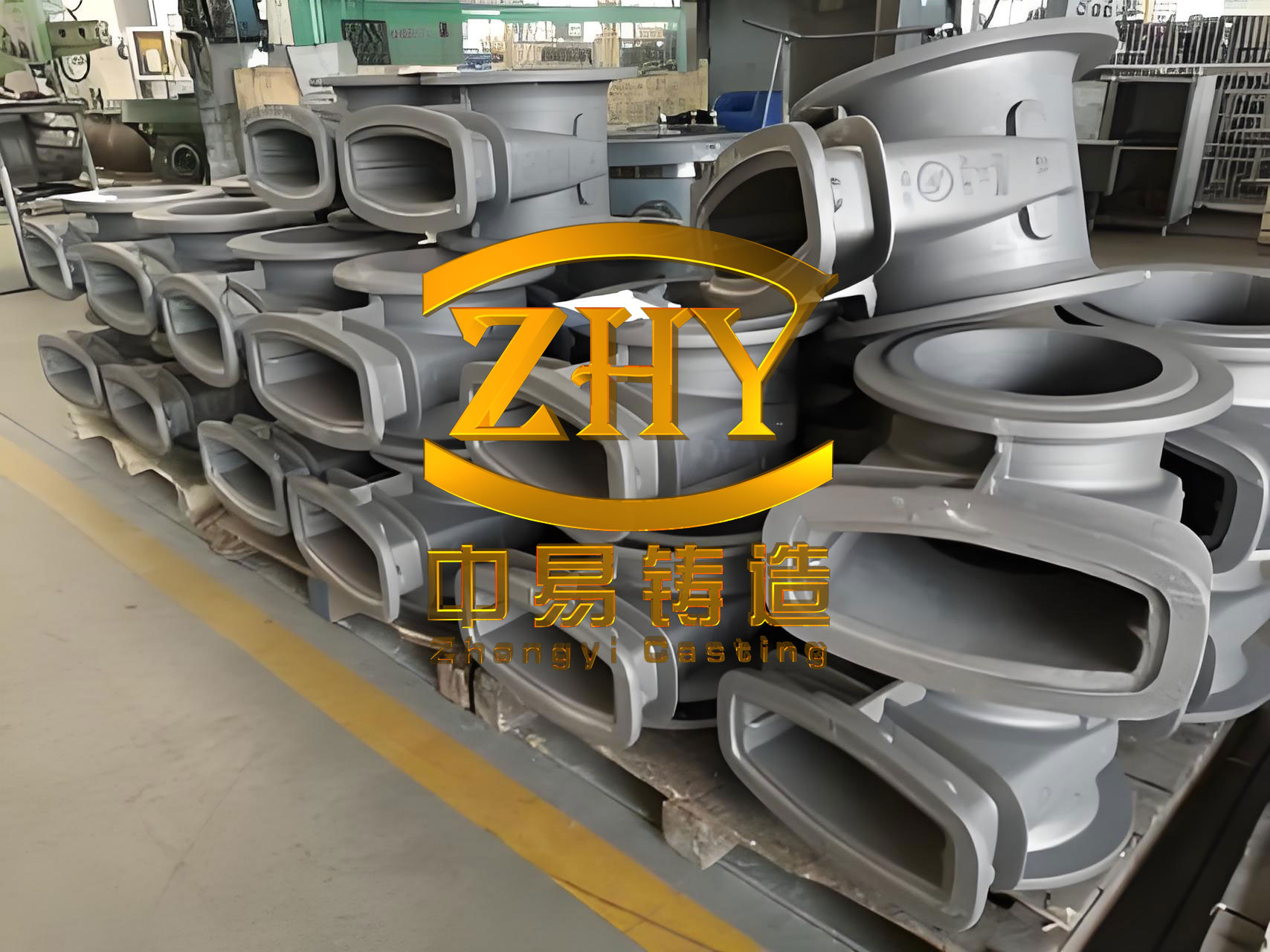
The component in question is a base for a double-head planer, emblematic of large-plane castings. Its characteristics define the core challenges: a substantial planar area (approximately 1800mm x 960mm) with a relatively thin wall thickness of 11mm, intricate networks of reinforcing ribs on one side, and stringent requirements for flatness, peripheral dimensional accuracy, and center-distance between mounting holes. The material specification is HT200 gray iron casting, which dictates its solidification behavior and shrinkage characteristics.
Initial Process Design and Immediate Challenges
The initial V-process design adopted a one-casting-per-mold strategy, with the large planar surface positioned at the drag side. The gating system was designed with a single sprue, a runner, and six ingates distributed along the ribs to promote uniform filling. Vent holes were placed at the highest points of the cope. The primary challenge emerged immediately at the first and most critical step: film draping.
The intricate web of intersecting ribs proved formidable for the EVA film. Despite repeated attempts and adjustments to heating, the film consistently bridged and tore at complex junctions. While manual patching with adhesive tape allowed us to proceed, it highlighted a severe limitation for production viability. Following coating application (initially brushed, leading to non-uniform layers), molding, and pouring, the first prototype was produced. Post-shakeout and shot blasting revealed two critical defects: localized mold collapse and extensive mechanical burn-on/bonding across the ribs and surfaces.
| Dimension | Target Casting (mm) | Mold Dimension (0.6% Shrinkage) (mm) | As-Cast Result (mm) | Actual Empirical Shrinkage |
|---|---|---|---|---|
| Length | 1802 | 1812 | 1792 | ~1.1% |
| Width | 962 | 966 | 955 | ~1.25% |
| Height | 90.5 | 90.5 | 89.6 | ~1.1% |
| Hole Center Distance | 802 | 805 | 798 | ~0.88% |
Dimensional analysis (Table 1) showed shrinkage values significantly higher than the 0.6% initially used for patternmaking, approaching 1.1-1.3% in the planar directions. Furthermore, the large plane exhibited severe warping, with a distortion bow of up to 10mm. However, a positive outcome was the surface roughness (Ra) of areas free from burn-on, measuring between 10-50 μm, far superior to conventional sand casting.
Root Cause Analysis and Systemic Adjustments
The failures were analyzed systematically:
- Film Drapery: The root cause was a combination of challenging geometry and film properties. Simply switching to a thinner, more ductile imported film was not a complete solution, as heat distribution on the heater frame caused inconsistent stretching. The fundamental issue was the part geometry itself.
- Mold Stability/Collapse: This was attributed to compromised film integrity from poor draping (causing vacuum leaks) and an insufficient/improperly distributed venting system for such a large, thin plane.
- Mechanical Burn-On: Directly caused by an incomplete, non-uniform, and weak refractory coating due to the unsuitable brushing method.
- Warping: A result of the casting’s structural geometry, non-uniform cooling, and the early loss of mold restraint after vacuum release.
The adjustments were multi-faceted and interdependent:
1. Part and Tooling Modification: In collaboration with the product designer, non-critical intersecting ribs were modified with larger fillet radii, and the height of some diagonal ribs was slightly reduced. This dramatically improved film conformability. Furthermore, a strategic reverse distortion of 7-8mm at the center, tapering to 3mm at the edges, was machined into the pattern to compensate for warpage.
2. Venting System Optimization: An additional vent was added in a distant, isolated section of the casting, ensuring uniform vacuum distribution and pressure differential stability across the entire mold cavity during pouring. The relationship between vent area ($A_v$) and sprue choke area ($A_s$) for such large planes needs careful consideration, often exceeding the typical 2:1 to 3:1 ratio:
$$ \frac{\sum A_v}{A_s} \ge 3 $$
This ensures regional mold stability.
3. Coating and Process Control: The coating application was switched to spraying, ensuring a complete, uniform layer over the complex rib structure, followed by proper drying to achieve adequate strength.
4. Pouring and Vacuum Protocol: The mold was tilted during pouring to reduce direct thermal impact on the film. Most crucially, the vacuum hold time after pouring was extended, and the sprue/riser area was covered with a secondary film to maintain mold strength during the critical solidification and cooling phase, countering graphite expansion and minimizing warpage.
Results and Comparative Analysis
The second trial incorporating these adjustments was successful. The gray iron casting was complete, free of collapse or significant burn-on. Dimensional accuracy was within acceptable limits, and the remaining warpage was reduced to 1-2mm, effectively compensated by the reverse distortion. The surface quality was excellent, with most peripheral surfaces meeting machining-free requirements.
| Parameter | Traditional Green Sand / Resin Sand | V-Process (Adjusted) |
|---|---|---|
| Draft Angle | Required (≥ 2.5°) | Minimal to None |
| Machining Allowance | Large (≥ 3mm per side) | Minimal (1-2mm on critical faces) |
| Surface Roughness (Ra) | > 40 μm | 10 – 50 μm |
| Weight Consistency | Poor (Variation > 8%) | Good (Variation < 3%) |
| Pattern/Mold Cost | Lower | Higher (reverse distortion, seals) |
| Environmental & Operational | High binder use, dust, labor-intensive | Dry sand, minimal binder, lower labor |
Synthesized Control Essentials for V-Process Large-Plate Gray Iron Castings
Based on this experience, the control essentials can be formalized into key domains:
1. Dimensional Fidelity: Shrinkage and Distortion
For complex, rib-reinforced large-plane gray iron casting in V-process, patternmaker’s shrinkage cannot be borrowed from conventional sand casting databases. The near-free contraction in unbonded sand after vacuum release leads to higher, anisotropic shrinkage. It must be determined empirically. A generalized observation can be expressed as linear shrinkage ($S$) being a function of geometric constraint ($G_c$) and vacuum hold time ($t_h$):
$$ S_{V\text{-}process} = f(G_c, t_h) \approx k \cdot S_{free} $$
where $k > 1$ compared to restricted sand casting, and $S_{free}$ is the alloy’s free contraction. For the subject HT200 casting, planar shrinkage approached 1.2%.
Warpage ($\delta$) is a primary concern. Control requires a combination of延长保压时间 (Prolonged vacuum hold), uniform temperature field from dispersed gating, and a pre-calculated reverse distortion ($\delta_{reverse}$) applied to the pattern. The latter can be estimated from initial trial data:
$$ \delta_{reverse} \approx \alpha \cdot \delta_{measured} $$
where $\alpha$ is an empirical factor (0.7-0.9) accounting for the effect of prolonged hold time.
2. Vacuum System Dynamics: The Critical Parameter
Vacuum pressure ($P_v$) is not a static setting but a dynamic variable through different stages:
- Molding Stage ($P_{v,m}$): Requires high, stable vacuum (e.g., -0.06 MPa or higher) to ensure mold hardness and precise contour reproduction.
- Pouring Stage ($P_{v,p}$): Must remain stable to prevent collapse. Stability is governed by vent area distribution and film integrity. The pressure differential ($\Delta P$) across the mold wall drives stability:
$$ \Delta P = P_{atm} – P_{v,p} $$
A sudden drop in $P_{v,p}$ reduces $\Delta P$, risking mold wall movement. - Hold/Solidification Stage ($P_{v,h}$): This is paramount for minimizing distortion. Premature release allows the still-hot gray iron casting to warp under its own weight and thermal stresses. The hold time ($t_h$) should extend well into the solidification and early cooling phase, often several minutes post-pouring.
3. Gating and Venting for Stability & Uniformity
The principle of uniform temperature distribution is vital to control thermal stresses and warpage. This is achieved through multiple, dispersed ingates. For large planes, the venting system must ensure uniform vacuum draw. The total vent area ($\sum A_v$) should be generously sized and strategically located to serve both as vents and structural supports for isolated sections of the mold cavity, preventing “island” formation and collapse.
4. Achieving Film Draping Integrity
This is a prerequisite for all other controls. Success hinges on:
- Design for Manufacturability (DFM): Collaborate at the product design stage to modify rib intersections (large fillets), adjust heights, or slightly alter rib layouts to facilitate film stretching without compromising part function.
- Tooling Design: Strategic placement of vacuum ports and seals on the pattern, especially in deep draws and complex corners, to guide film conformation.
- Film and Heating Process Control: Use films with appropriate high-temperature elongation and ensure uniform heating across the entire heater frame area to avoid localized weak, over-stretched zones.
The relationship can be seen as a system requirement: Film Integrity = f(Film Properties, Heating Uniformity, Part Geometry). Optimizing all variables is key.
5. Coating Management for Surface Finish
A high-quality, zircon-based refractory coating is non-negotiable for gray iron casting. It must be applied via spraying to guarantee a uniform, continuous layer over complex geometries, achieving a sufficient dry coating thickness (typically 0.3-0.8mm) and strength to prevent metal penetration and mechanical burn-on, thereby realizing the inherent surface finish advantage of the V-process.
| Control Domain | Key Parameter | Typical Target / Consideration |
|---|---|---|
| Pattern Design | Shrinkage Allowance | 1.1% – 1.3% (Planar), determined empirically |
| Pattern Design | Reverse Distortion | Application based on initial trial warpage data |
| Rib/Feature Design | Optimized for film draping (large fillets, adjusted heights) | |
| Molding | Film Draping | Complete coverage without tears; may require DFM changes |
| Coating | Application & Thickness | Sprayed, uniform, dry thickness 0.3-0.8mm |
| Vacuum Control | Molding Pressure ($P_{v,m}$) | > -0.06 MPa (stable) |
| Pouring Pressure ($P_{v,p}$) | Stable maintenance of $P_{v,m}$ | |
| Hold Time ($t_h$) | Extended post-pour (minutes) to reduce warpage | |
| Gating/Venting | Vent to Sprue Area Ratio | $\frac{\sum A_v}{A_s} \ge 3$ for large planes; uniform distribution |
| Pouring | Temperature & Tilt | Standard for iron; mold tilt to protect film |
In conclusion, the successful production of complex large-plate gray iron casting via the V-process demands a paradigm shift from conventional sand casting rules. It requires a deep understanding of the interaction between the unrestrained sand mold, the vacuum cycle, and the part’s inherent geometry. The core lies in proactively managing part design for drapability, empirically determining shrinkage and distortion compensation, rigorously controlling the vacuum cycle—especially the hold time—and engineering the venting system for holistic mold stability. When these elements are synergistically controlled, the V-process unlocks exceptional value for such components, yielding superior dimensional consistency, excellent surface quality, and significant environmental and operational benefits over traditional methods. This case underscores that the V-process is not merely a molding technique but a integrated production system whose full potential is realized only through meticulous attention to its unique set of interactive process variables.