
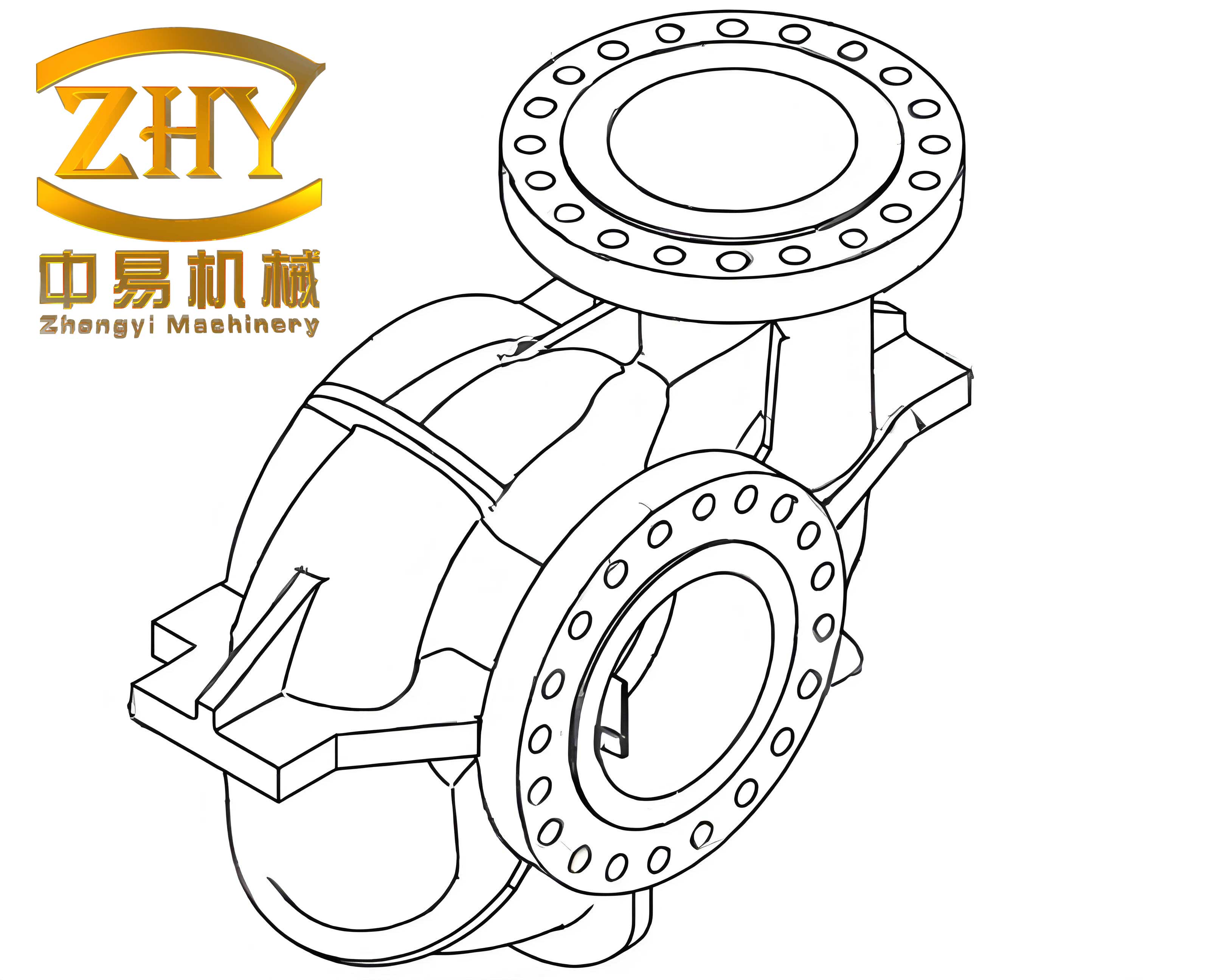
This article details the comprehensive journey of developing a robust investment casting process for a critical stainless steel component: the discharge housing for deep-well submersible pumps. The inherent complexity of the part, combined with stringent quality requirements, presented significant challenges in shell castings production. Through iterative design, simulation, and process refinement, a reliable methodology was established, ensuring the production of high-integrity shell castings that meet all functional and dimensional specifications.
The discharge housing is a central component in the pump assembly, responsible for directing fluid flow with high efficiency. Its demanding service conditions require exceptional dimensional accuracy, pressure integrity, and surface finish. The choice of the ceramic shell casting process was dictated by its unique ability to produce complex, thin-walled geometries with excellent surface quality, a prerequisite for the hydraulic performance of this part.
Part Analysis and Foundry Challenges
The geometry of the discharge housing defines the core challenges in its manufacture via shell castings. Key characteristics and corresponding difficulties are summarized below:
| Feature | Specification / Characteristic | Casting Challenge in Shell Production |
|---|---|---|
| Overall Dimensions | Height: 222 mm; Flange Diameter: 242 mm | Managing thermal gradients and feeding over a substantial volume within the ceramic shell. |
| Wall & Blade Thickness | Uniformly 5 mm | High risk of mistruns and cold shuts; difficulty in achieving directional solidification towards feeders in thin sections. |
| Internal Blades | 8 curved blades, forming a narrow, complex internal cavity. | Core definition and extraction; achieving a good surface finish (Ra 1.6-3.2 µm) on internal blade profiles is critical for hydraulic performance. |
| Flange Design | One plain flange, one “lacy” flange with 8 protruding bosses. | The lacy flange creates multiple isolated thermal hot spots, complicating feeding and increasing shrinkage risk. |
| Machined Areas | Both flanges and the central hub core. | These regions must be completely free of shrinkage porosity, demanding precise control of solidification. |
| Dimensional Tolerance | High coaxiality requirement with mating parts (impeller, shaft). | The ceramic shell must maintain dimensional stability under the thermal load of pouring to prevent distortion. |
The primary objective was to design a gating and feeding system that ensures sound shell castings, particularly in the designated machined areas, while simultaneously preventing defects like shell cracking during dewaxing and ensuring the internal surface finish.
Initial Process Design and Prototyping
The foundation of the process was a standard medium-temperature wax and colloidal silica binder system for building the ceramic shell. This system provides the necessary high-temperature strength and resistance to deformation, essential for producing precise shell castings. Two initial gating concepts were devised and tested.
Concept A: Horizontal Gating with Side Feeder. This layout positioned the part horizontally. A feeding ring was incorporated around the lacy flange to address its multiple hot spots, and a conical feeder was placed at the central hub. The principle was localized feeding from the side.
Concept B: Vertical Gating with Bottom Fill. This layout positioned the part upright. The same feeding ring and central hub feeder were used, but the main sprue was attached to the bottom of the lacy flange’s feeder, aiming for a more controlled, upward fill of the mold cavity.
The feeding ring is a crucial design element for shell castings with clustered hot spots. Its function can be conceptualized as creating a localized feeding reservoir. The effectiveness of a feeder in preventing shrinkage is governed by the requirement that it solidifies after the casting section it feeds. The modulus (Volume/Surface Area ratio) of the feeder must be greater than that of the hot spot. For ‘n’ discrete bosses on a flange, the feeding ring consolidates them into a continuous hot spot with a larger modulus, making it feedable by a single ingate. This can be simplified as ensuring:
$$M_{ring} > M_{boss}$$
where $M_{ring}$ is the modulus of the ring section and $M_{boss}$ is the modulus of an individual boss. The ring effectively acts as a runner distributing feed metal, governed by fluidity and thermal gradients within the shell casting.
Five prototype shell castings were produced: two using Concept A and three using Concept B. The shell-building process involved zircon flour for the primary coats followed by fused silica for backup coats, with careful drying between each layer.
Prototype Results, Failure Analysis, and Lessons Learned
The prototype campaign revealed several critical issues that informed the subsequent optimization.
| Gating Concept | Observed Defects | Root Cause Analysis |
|---|---|---|
| Concept A (Horizontal) | 1. Micro-cracks in shell at thin sections after dewaxing. 2. Shell fracture/leak at bottom during pouring. |
1. Dewaxing Pressure: Rapid wax melt in thin sections could not escape past thicker wax in feeders, causing shell fracture. Model: Internal pressure $P$ exceeds shell green strength $\sigma_s$. 2. Shell Integrity: Horizontal dipping led to non-uniform shell thickness. The weakest point failed under metallostatic pressure $P = \rho g h$. |
| Shrinkage porosity at ingate roots (lacy flange and central hub). | Thermal Saturation: Ingates were too short, causing them to act as direct extensions of the casting hot spots. They remained hottest, solidifying last and drawing feed metal away from the critical junctions, creating porosity. | |
| Concept B (Vertical) | Shrinkage porosity at ingate roots (lacy flange and central hub). | Similar thermal saturation issue. Additionally, the top feeder for the central hub was relatively cold due to bottom filling, reducing its feeding efficiency. The feeding distance was insufficient. |
The key takeaways were:
- Vertical Gating Superiority: Concept B proved fundamentally better for this part geometry. It provided more uniform shell build-up and aligned the core with the gravitational force, preventing core fracture.
- Ingate Design is Critical: The height and connection point of ingates must be designed to avoid creating a localized super-hot zone that becomes a shrinkage site.
- Dewaxing Must Be Managed: The shell is vulnerable during dewaxing. Pathways for melted wax to escape are necessary to prevent cracking, especially in assemblies with varying section thicknesses.
- Active Thermal Management is Needed: Passive feeding via top risers in a bottom-fill system may be inefficient. Actively managing the temperature gradient is required.
The fundamental heat transfer during solidification of these shell castings is described by Fourier’s law and the heat conduction equation. The goal is to create a directional temperature gradient $ abla T$ pointing toward the feeders.
$$ abla \cdot (k abla T) + \dot{q} = \rho C_p \frac{\partial T}{\partial t}$$
where $k$ is thermal conductivity, $\dot{q}$ is the latent heat release rate, $\rho$ is density, and $C_p$ is specific heat. The gating system must manipulate the boundary conditions to solve this equation favorably for the casting.
Process Optimization and Solidification Modeling
Based on the prototype analysis, Concept B was selected as the base and significantly optimized. The revised process is shown schematically below.
Key Modifications:
- Ingate Height Increase: The ingates for both the lacy flange feeder and the central hub feeder were lengthened (by ~20mm and ~15mm respectively). This moves the thermal connection point away from the casting, reducing the risk of the ingate root becoming the hottest spot.
- Dewaxing Vent Implementation: Wax vents (“dewaxing rods”) were attached to the highest points of the wax assembly and to areas like strengthening ribs. These create dedicated channels for wax escape during autoclave dewaxing, mitigating shell cracking risk.
- Two-Stage Pouring Sequence: The mold is filled from the bottom ingate (side feeder). Once the metal level reaches the base of the top feeder (central hub feeder), pouring is switched to directly fill this top feeder. This “re-pouring” practice significantly increases the temperature of the metal in the top feeder, enhancing its feeding efficiency for the critical central hub.
- Post-Pouring Insulation: Immediately after pouring, the exposed tops of all feeders are covered with insulating material (e.g., asbestos blankets). This dramatically reduces radiative and convective heat loss, slowing the solidification of the feeders and extending their feeding range.
Prior to physical trials, this optimized design was validated using commercial casting simulation software (CASTsoft CAD/CAE). The simulation modeled the filling and solidification physics, solving the Navier-Stokes equations for fluid flow coupled with the energy equation:
$$\rho \left( \frac{\partial \mathbf{v}}{\partial t} + \mathbf{v} \cdot abla \mathbf{v} \right) = – abla p + \mu abla^2 \mathbf{v} + \rho \mathbf{g}$$
$$\rho C_p \left( \frac{\partial T}{\partial t} + \mathbf{v} \cdot abla T \right) = abla \cdot (k abla T) + \dot{q}$$
The simulation parameters were set: shell preheat temperature = 1000°C, fill time = 12s (bottom fill). The results, as shown in a simulated shrinkage prediction plot, confirmed the design’s efficacy. The predicted porosity was isolated entirely within the volume of the side and top feeders, with the casting body itself predicted to be sound. This virtual validation provided high confidence before committing to tooling modifications and production trials.
Production Validation and the Ceramic Core Breakthrough
A small batch of 10 shell castings was produced using the optimized process. The dewaxing vents functioned perfectly, eliminating shell cracks. The two-stage pour and post-pour insulation resulted in castings free from shrinkage in the machined areas. However, a new challenge emerged during full-scale production of 100 pieces: occasional internal surface finning/roughness on the blade profiles and, in one case, a run-out (leak) from the internal cavity.
Root Cause: The internal cavity of the housing, formed by a soluble core (originally urea), was extremely challenging to coat and dry uniformly during the shell-building process. The intricate, narrow blade passages trapped slurry and sand, leading to potential weak spots in the shell’s interior surface and incomplete drying, which caused the finning and leak defects.
Final Innovation: Ceramic Core Integration. The definitive solution was to replace the soluble core with a pre-fired ceramic core. This transformed the shell-building process. The internal blade geometry was now defined by a strong, stable ceramic insert, eliminating the need to build the shell inside the deep, complex cavity. The core manufacturing process is outlined below:
| Step | Process | Key Parameters / Materials |
|---|---|---|
| 1. Mixture Preparation | Blend fused silica flour (320 mesh) with colloidal silica binder and organic additives. | Optimized viscosity and green strength for injection. |
| 2. Injection Molding | Inject mixture into core die to form precise blade geometry. | Control of pressure, temperature, and time. |
| 3. Drying | Controlled humidity and temperature drying to remove water. | Prevents warping and cracks. |
| 4. Firing | High-temperature sintering in a kiln. | ~980-1000°C for ~80 minutes. Develops high-temperature strength and stability. |
| 5. Dimensional Check | Inspect fired core against gauges. | Ensures accuracy for assembly into wax pattern. |
The core’s performance is critical. Its high-temperature creep resistance must withstand the metal static pressure and thermal stress during pouring. Its chemical stability must prevent reaction with the molten stainless steel. Finally, it must be readily removable after casting via chemical leaching or mechanical means. The core’s principal properties can be summarized by its high-temperature deflection under load, which must be minimal:
$$\delta \propto \frac{\sigma \cdot L^3}{E(T) \cdot I}$$
where $\delta$ is deflection, $\sigma$ is applied stress (from metal pressure), $L$ is unsupported length, $E(T)$ is the temperature-dependent modulus of elasticity of the core, and $I$ is the area moment of inertia. A high $E(T)$ at pouring temperature is essential.
A final validation batch of 20 shell castings was produced using the optimized gating system combined with the ceramic core. The results were conclusive: 100% casting yield, no internal finning defects, and the internal blade surface roughness consistently measured Ra 1.6-3.2 µm. The cores were easily removed post-casting, completing the process loop.
Conclusion and Process Summary
The successful production of the deep-well pump discharge housing demonstrates a systematic, engineering-led approach to solving complex shell castings challenges. The final, validated process integrates multiple synergistic solutions.
| Challenge Category | Specific Problem | Implemented Solution | Mechanism / Principle |
|---|---|---|---|
| Feeding & Solidification | Multiple hot spots on lacy flange | Feeding Ring | Consolidates hot spots into a single feedable section, increasing effective modulus $M_{effective}$. |
| Shrinkage at ingate roots & central hub | Lengthened Ingates + Two-Stage Pour + Post-Pour Insulation | Reduces thermal saturation at junction; creates a hot, active thermal gradient directed toward feeders; mathematically optimizes the solution to $\rho C_p \frac{\partial T}{\partial t} = abla \cdot (k abla T)$. | |
| Verification of soundness | Solidification Simulation (CAE) | Solves coupled fluid-thermal equations numerically to predict shrinkage locations and optimize feeder placement/sizing virtually. | |
| Shell Integrity | Shell cracking during dewaxing | Strategic Dewaxing Vents | Provides low-resistance pathways for melted wax ($\dot{m}_{wax}$), preventing pressure build-up ($P_{int}$) exceeding shell green strength ($\sigma_{shell, green}$). |
| Internal Quality | Poor surface finish and shell weakness in internal cavity | Ceramic Core Replacement | Eliminates internal shell-building; provides a precise, high-strength, stable surface ($Ra < 3.2 \mu m$) defined by the core’s fired geometry. Core strength $E_{core}(T_{pour})$ is paramount. |
| General quality control | Staged Prototyping & Root Cause Analysis | Structured iterative testing (horizontal vs. vertical gating, prototype vs. batch) with physical and analytical failure analysis to drive informed design changes. |
The evolution of this process underscores that producing advanced shell castings is not merely an art but a discipline requiring deep understanding of metallurgy, heat transfer, fluid dynamics, and materials science. The integration of predictive simulation with empirical process innovation and advanced core technology provides a powerful framework for manufacturing the next generation of complex, high-performance investment cast components.