
In the manufacturing of heavy-section machine tool tray casting parts, surface quality is paramount due to their critical role in numerical control machines, where they directly influence machining precision and dimensional stability. These casting parts are often exposed during operation, necessitating flawless surfaces free from defects. However, their substantial wall thickness, typically exceeding 100 mm, leads to slow solidification rates, making them prone to slag hole defects on the surface. These defects, initially small, can aggregate during solidification, forming clusters on the casting part’s surface, especially at corners and grooves. This issue is closely tied to gating system design, sand mold quality, and coating effectiveness. In this article, we delve into the root causes and present comprehensive improvements based on our experience with a specific machine tool tray casting part.
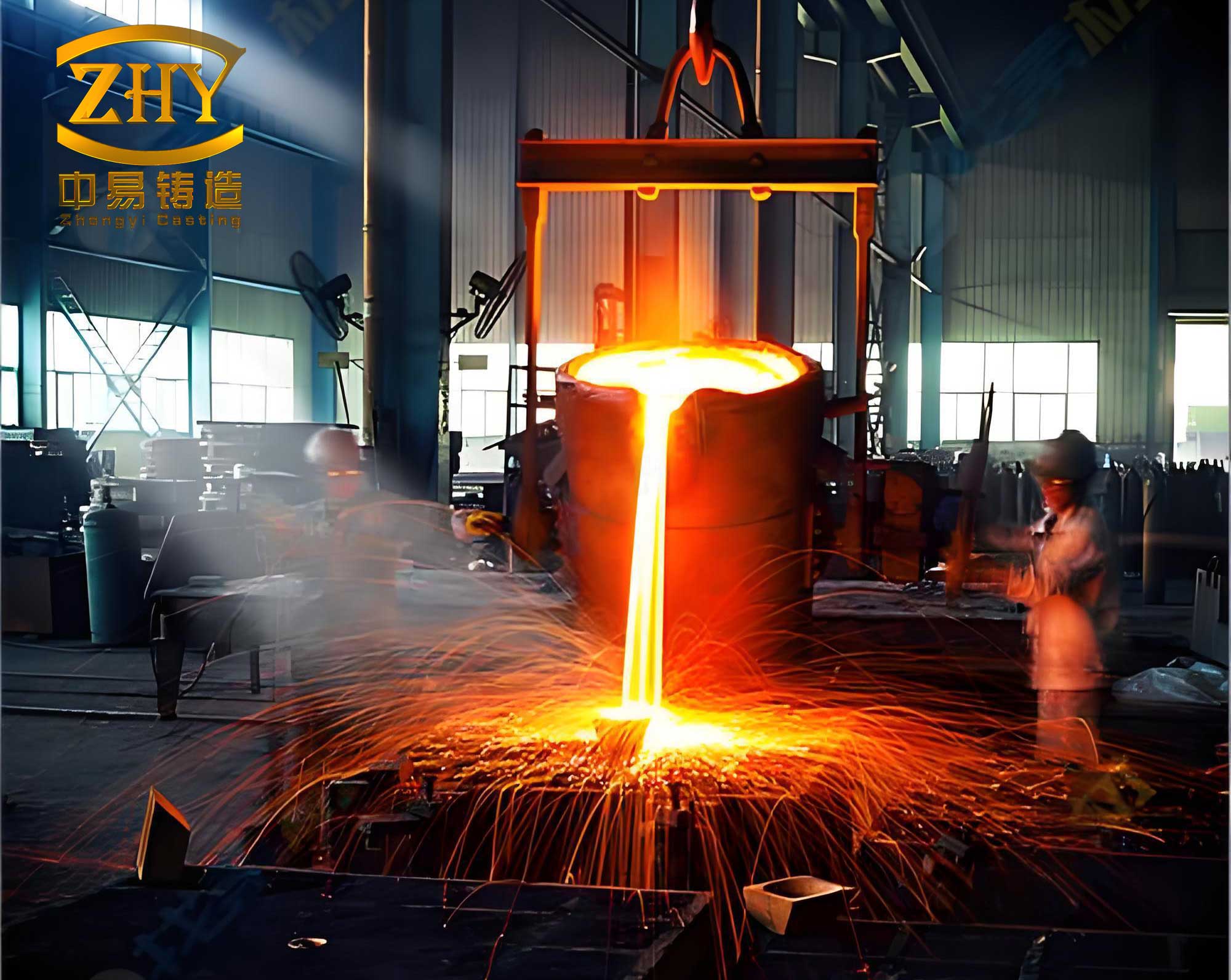
The casting part under discussion has an outer contour of approximately 800 mm × 800 mm × 200 mm and a weight of 700 kg, made from HT300 gray iron. Technical specifications require no casting defects on machined surfaces, including pores, sand inclusions, or slag holes. Despite rigorous processes, every casting part exhibited varying degrees of slag holes and inclusions on the upper surface, adversely affecting appearance and customer satisfaction. This persistent problem prompted a thorough analysis and optimization campaign.
To understand the defect formation, we first examined the initial casting process. The molding used furan no-bake resin sand with a one-cavity pattern. The gating system was semi-restricted, featuring a ceramic sprue with a diameter of 60 mm, a trapezoidal runner (top 40 mm, bottom 50 mm, height 50 mm), and six ingates each 60 mm wide and 7 mm thick. The cross-sectional ratio was ΣSingate : ΣSrunner : ΣSsprue = 1 : 1.8 : 1.2, with two 100 mm × 100 mm × 22 mm, 20 PPI filters placed vertically in the runner. This design aimed to facilitate flow but inadvertently contributed to turbulence.
Using AnyCasting simulation software, we analyzed the filling and solidification processes. The results revealed significant turbulence and air entrainment during mold filling, leading to severe oxidation of the molten iron. This oxidation generated oxide films that coalesced into secondary slag inclusions. As the metal rose, these inclusions accumulated on side walls and upper surfaces, forming slag holes or dispersed defects. The simulation outputs, including flow fields, temperature distributions, oxide slag predictions, and particle tracking, confirmed these issues. For instance, the velocity field showed erratic flow patterns, while temperature gradients indicated prolonged solidification times exacerbating slag aggregation.
The fluid dynamics involved can be described using the Navier-Stokes equations for incompressible flow, which govern the motion of molten metal during filling:
$$ \rho \left( \frac{\partial \mathbf{v}}{\partial t} + \mathbf{v} \cdot \nabla \mathbf{v} \right) = -\nabla p + \mu \nabla^2 \mathbf{v} + \mathbf{f} $$
where ρ is density, v is velocity, p is pressure, μ is dynamic viscosity, and f represents body forces. Turbulence models, such as the k-ε model, were applied to simulate chaotic flow:
$$ \frac{\partial (\rho k)}{\partial t} + \nabla \cdot (\rho k \mathbf{v}) = \nabla \cdot \left[ \left( \mu + \frac{\mu_t}{\sigma_k} \right) \nabla k \right] + P_k – \rho \epsilon $$
$$ \frac{\partial (\rho \epsilon)}{\partial t} + \nabla \cdot (\rho \epsilon \mathbf{v}) = \nabla \cdot \left[ \left( \mu + \frac{\mu_t}{\sigma_\epsilon} \right) \nabla \epsilon \right] + C_{1\epsilon} \frac{\epsilon}{k} P_k – C_{2\epsilon} \rho \frac{\epsilon^2}{k} $$
Here, k is turbulent kinetic energy, ε is dissipation rate, μt is turbulent viscosity, and Pk is production term. These simulations highlighted how the initial gating design promoted turbulence, increasing oxide formation.
To quantify defect sources, we analyzed the composition of slag samples from defective casting parts. Table 1 summarizes typical elements found, indicating high levels of Ba, Ca, and S, which originate from inoculants and sand additives.
| Element | Ba | Ca | S | Fe | Si | O |
|---|---|---|---|---|---|---|
| Average | 12.5 | 8.3 | 5.7 | 45.2 | 10.1 | 18.2 |
| Range | 10-15 | 7-10 | 4-7 | 40-50 | 8-12 | 15-22 |
This composition suggests that Ba and Ca from silicon-calcium-barium inoculant reacted with sulfur in the sand system to form oxides and sulfides. The sulfur content in reclaimed sand was measured at approximately 0.2%, which is relatively high for gray iron casting parts. The slow solidification of heavy-section casting parts allowed prolonged exposure to these reactive elements, facilitating slag formation.
Based on this analysis, we implemented a multi-faceted optimization strategy. First, we redesigned the gating system from semi-restricted to open-type to reduce flow velocity and pressure, ensuring smoother mold filling. The new system retained a ceramic sprue of ϕ60 mm but modified the runner to a trapezoidal shape with dimensions of top 35 mm, bottom 45 mm, height 45 mm, and ingates sized 100 mm wide and 10 mm thick, with six gates. The cross-sectional ratio became ΣSingate : ΣSrunner : ΣSsprue = 1 : 0.75 : 0.47. Filters were repositioned to the lower box for better slag interception. The governing equation for flow rate in an open gating system can be expressed as:
$$ Q = A \cdot v = \frac{\pi d^2}{4} \sqrt{2gh} $$
where Q is flow rate, A is cross-sectional area, v is velocity, d is sprue diameter, g is gravity, and h is metallostatic head. This change minimized turbulence, as verified by subsequent simulations showing laminar flow patterns and reduced oxide slag prediction.
Second, we addressed material-related factors. The inoculant was switched from silicon-calcium-barium to silicon-based types to limit Ba and Ca introduction. Additionally, we optimized the sand system by using low-acidity catalysts at 45% addition to lower sulfur content in reclaimed sand. The coating was upgraded to an anti-oxidation, anti-sulfur shielding type to prevent sulfur infiltration and reduce metal oxidation. The effectiveness of such coatings can be modeled using diffusion equations:
$$ \frac{\partial C}{\partial t} = D \nabla^2 C – kC $$
where C is sulfur concentration, D is diffusion coefficient, and k is reaction rate constant. This coating forms a barrier that impedes sulfur migration from sand to the casting part.
Third, we enhanced process controls. Pouring temperature was stabilized at 1380°C ± 10°C to balance fluidity and oxidation. Mold hardness was maintained above 85 on the B-scale to withstand metal pressure. Table 2 compares key parameters before and after optimization.
| Parameter | Initial Process | Optimized Process |
|---|---|---|
| Gating System Type | Semi-restricted | Open |
| Ingate Dimensions (mm) | 60 × 7 | 100 × 10 |
| Cross-sectional Ratio | 1 : 1.8 : 1.2 | 1 : 0.75 : 0.47 |
| Inoculant Type | Si-Ca-Ba | Si-Fe |
| Sand Sulfur Content (%) | 0.2 | 0.1 |
| Coating Type | Standard Iron | Anti-oxidation Shielding |
| Pouring Temperature (°C) | 1350-1400 | 1370-1390 |
| Simulated Turbulence Intensity | High | Low |
To validate these changes, we conducted production trials with multiple casting parts. Post-optimization simulations showed markedly improved filling behavior: flow fronts were uniform, with minimal air entrainment and oxide formation. Particle tracking indicated that slag particles were effectively trapped in the runner system, preventing them from reaching the casting part cavity. The solidification simulation also revealed more consistent temperature gradients, reducing thermal stresses that could exacerbate defects.
The experimental results were quantitatively assessed by inspecting casting parts after shot blasting. Defect rates were calculated based on surface area affected by slag holes. Table 3 presents data from a batch of 50 casting parts produced before and after optimization.
| Batch | Number of Casting Parts | Casting Parts with Slag Holes | Average Defect Area per Casting Part (cm²) | Defect Rate (%) |
|---|---|---|---|---|
| Pre-optimization | 50 | 48 | 15.6 | 96 |
| Post-optimization | 50 | 5 | 1.2 | 10 |
The defect rate dropped from 96% to 10%, with significant reduction in defect area. This improvement underscores the effectiveness of our measures. Moreover, customer feedback on the optimized casting parts confirmed enhanced surface quality, meeting stringent technical requirements.
Further analysis involved metallurgical examination of the optimized casting parts. Microstructure analysis revealed finer graphite flakes and reduced oxide inclusions, attributed to better inoculation and reduced oxidation. The hardness measurements averaged 220 HB, consistent with HT300 specifications. We also derived a quality index (QI) to quantify casting part integrity:
$$ QI = \frac{1}{1 + \alpha D + \beta S} $$
where D is defect density (number per unit area), S is slag inclusion volume fraction, and α, β are weighting factors. For pre-optimization casting parts, QI averaged 0.35, while post-optimization casting parts achieved 0.85, indicating superior quality.
In addition to process tweaks, we explored theoretical models for slag formation kinetics. The rate of slag accumulation on a casting part surface can be expressed as:
$$ \frac{dM}{dt} = k_s A (C – C_{eq}) $$
where M is slag mass, t is time, ks is rate constant, A is surface area, C is concentration of reactive elements, and Ceq is equilibrium concentration. By lowering C through material changes and reducing A exposure via improved gating, we minimized dM/dt.
Long-term production data over six months showed consistent results. The optimized process was applied to similar heavy-section casting parts, such as machine bed frames and columns, with comparable success. This scalability highlights the robustness of our approach. We also implemented statistical process control (SPC) charts to monitor key variables like pouring temperature and sand properties, ensuring sustained quality for every casting part.
Economic considerations were favorable: despite higher costs for advanced coatings and inoculants, the reduction in scrap rates and rework led to overall cost savings of 25% per casting part. This aligns with lean manufacturing principles, emphasizing defect prevention over correction.
In conclusion, the slag hole defects in heavy-section machine tool tray casting parts were systematically addressed through gating system optimization, material control, and coating upgrades. The open gating design promoted laminar flow, reducing turbulence and oxidation. Switching to silicon-based inoculant and low-sulfur sand minimized reactive element sources. Anti-oxidation shielding coatings provided additional protection. Simulation tools like AnyCasting were invaluable for predicting outcomes and guiding adjustments. These measures collectively enhanced the surface quality of casting parts, meeting customer specifications and improving production efficiency. Future work may focus on real-time monitoring systems for casting part quality and further refinements in alloy design for even better performance.
The journey from defect-prone to reliable casting parts underscores the importance of holistic process engineering. Each casting part, as a critical component, demands meticulous attention to every production stage. By integrating simulation, material science, and practical adjustments, we achieved a sustainable solution that benefits both manufacturers and end-users. This case study serves as a reference for other heavy-section casting part applications, demonstrating that with thorough analysis and targeted improvements, even persistent defects can be effectively mitigated.